

On this page
- The short answer, before anything else
- What actually decides who pays: what the tree hit, not who owned it
- The $3,000 standard-form rule: what a policy may pay to haul the tree away
- The tree itself is barely insured, and wind is why
- What removal actually costs, against those caps
- The one exception: when your neighbor's insurer pays
- Before it falls: what you may legally do about the tree next door
- Hiring the crew without creating a second problem
- Your first 48 hours: a checklist
- Frequently asked questions
- Where this comes from, and what moves
The short answer, before anything else
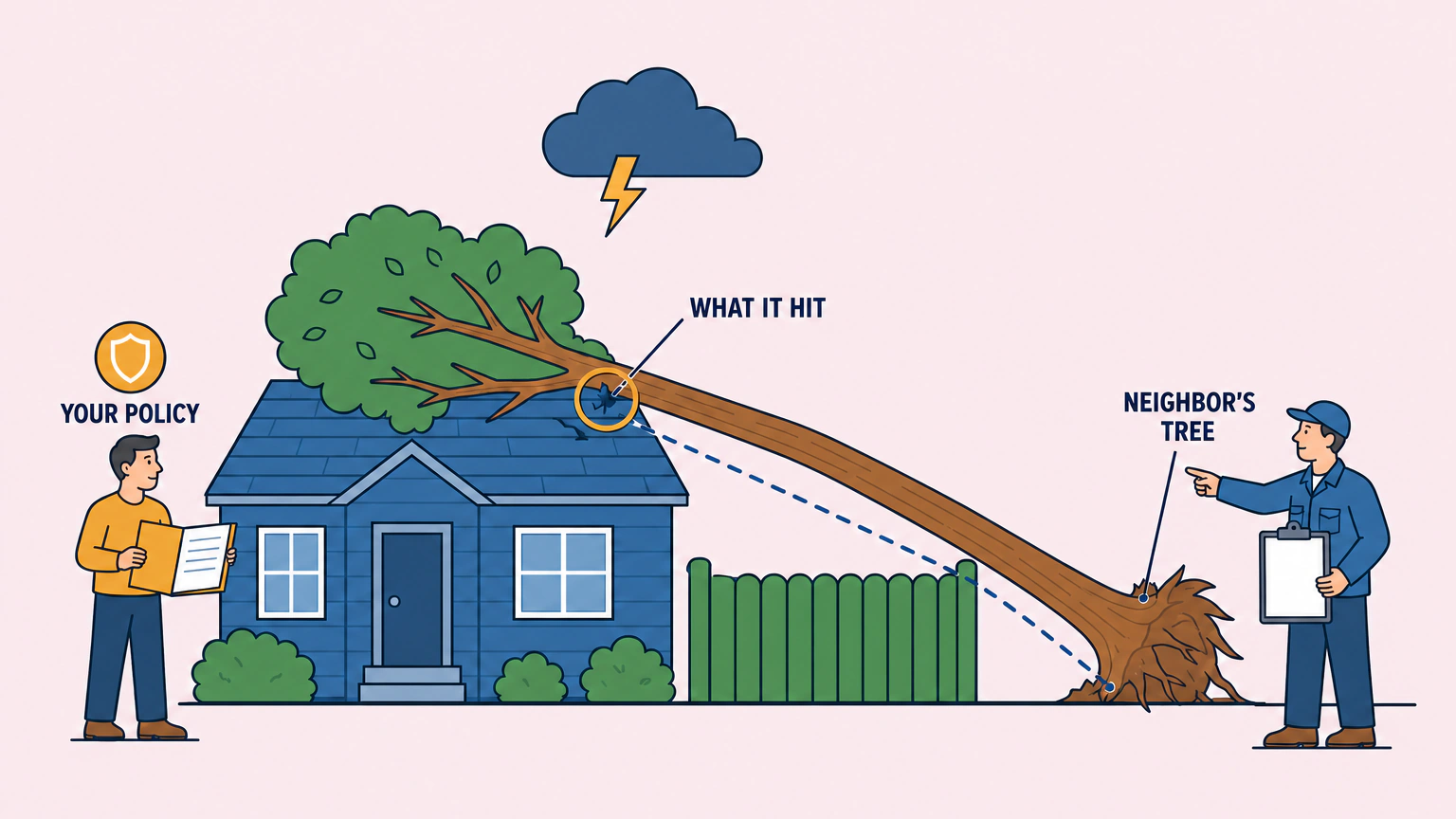
There's a tree on your roof and it grew in your neighbor's yard, so the first thing you want to know is whether this is their bill. Ordinarily it isn't. You file on your own homeowners policy, even though the trunk was rooted on the other side of the fence, because what the tree hit matters more than who owned it.
Under the March 2022 ISO Homeowners 3 form, hauling the tree away is covered when it damaged a covered structure or blocked a driveway or an accessibility route, and that allowance stops at $3,000 per loss and $1,500 per tree. Your carrier may have filed a different edition, with different limits or endorsements, so the policy with your name on it decides.
One exception exists, and it's narrow: documented negligence, meaning your neighbor knew or should have known the tree was hazardous and left it standing.
For the next hour, none of that matters. Photograph what you can see from somewhere safe, call your insurer, and authorize only the emergency work that stops the damage getting worse.
What actually decides who pays: what the tree hit, not who owned it
Your dwelling coverage looks at your address, not at the tree's. Coverages A and B insure your property against "direct physical loss," and that test never once asks who planted anything. So the property line, the thing you've been staring at since the crash woke you up, decides much less than you'd think. What the trunk landed on decides nearly everything.
| What the tree hit | Which coverage responds | Deductible applies? | Does whose tree it was matter? |
|---|---|---|---|
| Your house, or a structure attached to it | Coverage A, Dwelling (open peril) | Yes, once per loss | No, not for the structural damage |
| Detached garage, shed or fence | Coverage B, Other Structures, limited to 10% of your Coverage A limit | Yes | No |
| Nothing, it landed in the yard | Generally none. Removal is only reached if it blocks a driveway or an accessibility ramp | N/A if nothing is payable | No |
| Your car | Auto comprehensive, not homeowners | Yes, your auto deductible | No |
If it hit your house or anything attached to it
Coverage A pays for the dwelling and anything attached to it. The ISO HO-3 is an open-peril form, so direct physical loss is covered unless the policy names an exclusion or a limit. The insurer has to point at wording, not at a theory about the wind. Usually one deductible applies to the whole loss, not one per damaged item. Your declarations page and any endorsements can change that.
If it hit a detached garage, shed or fence
Now Coverage B answers, and it carries a ceiling most homeowners have never looked up. The standard form says Other Structures "will not be more than 10% of the limit of liability that applies to Coverage A." The consolation is in what it doesn't do. Using it doesn't reduce Coverage A, so a flattened shed takes nothing away from the house.
If it hit nothing but the lawn
This is the hard one, and the one that makes people furious. Nothing insured was damaged, so there's no structural claim, and the removal allowance mostly doesn't fire. Two exceptions survive, both narrow. The tree blocks a driveway so a road-registered vehicle can't get in or out. Or it blocks a ramp built to help a person with a disability. Otherwise you're paying to move your neighbor's tree off your own grass, which is exactly as annoying as it sounds.
If it hit your car
Wrong policy. A tree on the car is ordinarily an auto claim, answered by comprehensive coverage, and the deductible that applies is the auto one rather than the home one. If you carry liability-only auto coverage, your own policy pays nothing toward the damage to your car. Whether someone else can be made to pay is a separate question with a separate answer.
The $3,000 standard-form rule: what a policy may pay to haul the tree away
The clause that decides this is called Debris Removal, and it may be the least-read paragraph in a document almost nobody reads. In the standard Homeowners 3 form it comes in two halves with two different limits. The tree half is the one that sets what comes out of your pocket.
The two tests the loss has to pass
Two tests, and the loss has to pass both.
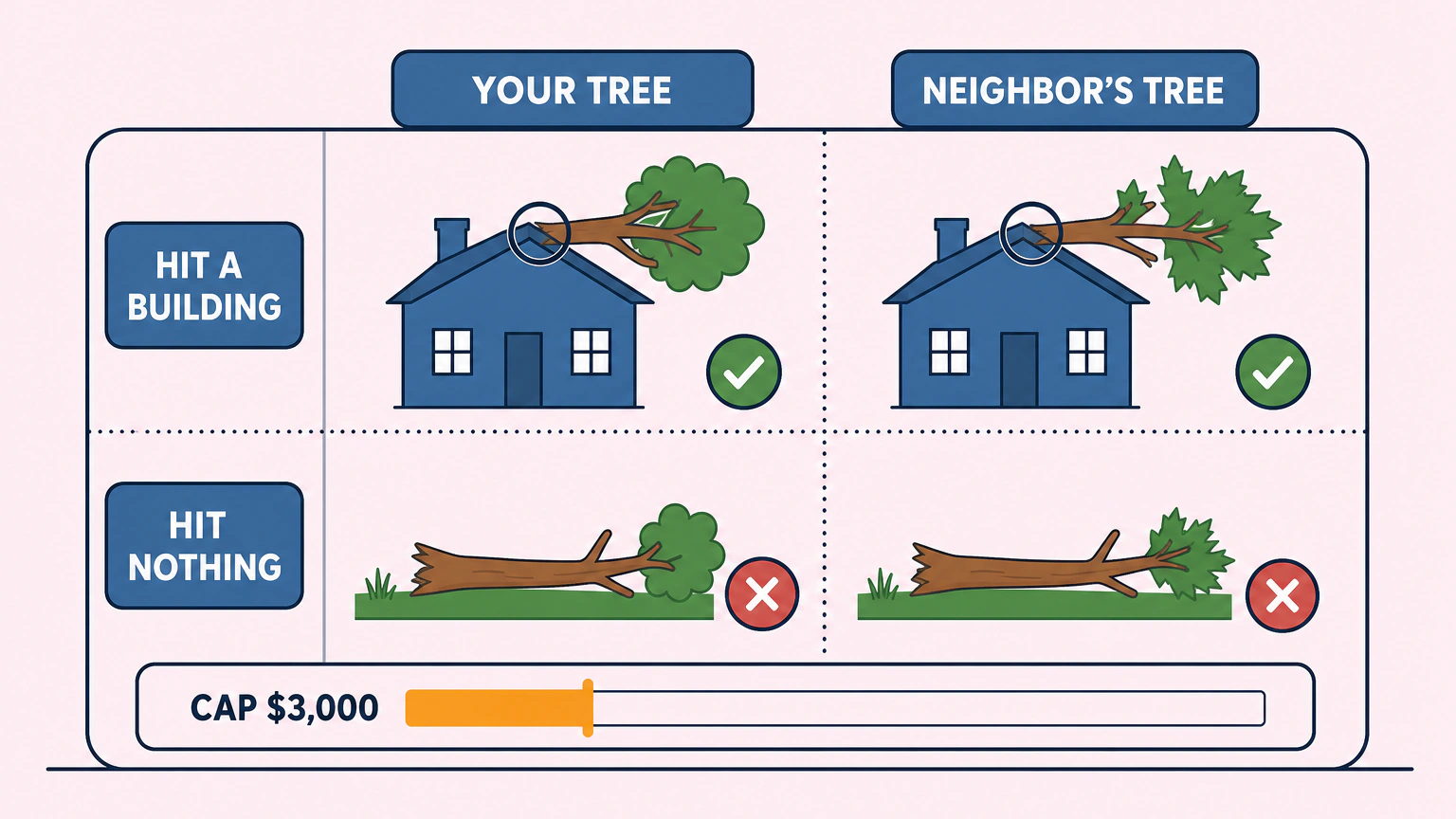
The first is what brought the tree down, and that one has a twist worth its own section, so hold it for a moment. The second is what the tree did when it landed. The March 2022 ISO form pays "reasonable expense, up to $3,000" only if the tree damaged a covered structure or, without damaging one, blocked a driveway so that a motor vehicle registered for public-road use cannot enter or leave, or blocked "a ramp or other fixture designed to assist a handicapped person to enter or leave the dwelling building."
A tree lying on the grass does none of those things.
The asymmetry: your tree versus your neighbor's tree
Put the two triggers side by side and the form stops making sense.
Your own tree qualifies only when "Windstorm or Hail or Weight of Ice, Snow or Sleet" felled it. Your neighbor's tree qualifies when any Peril Insured Against under Coverage C felled it, and that is a sixteen-item list running through fire, lightning, explosion, riot, aircraft, vehicles, smoke, vandalism, theft and falling objects.
Read that again, because it's worth a second pass. The tree you didn't plant, on the ground you don't own, is the better-covered case. That is the reverse of what almost everyone assumes.
The caps, and what they buy at today's prices
The current ISO form is blunt. The $3,000 "is the most we will pay in any one loss, regardless of the number of fallen trees," and no more than $1,500 of it goes to any single tree. Three trees down in one storm still share one $3,000 pool. The good news, such as it is: under that form this is additional insurance, sitting on top of the dwelling limit rather than eating into it.
The separate 5% that applies when the structural claim is big
The other half of the clause handles the debris of your own damaged property, and that cost sits inside the limit for whatever was damaged. When the repair plus the debris runs past that limit, "an additional 5% of that limit is available" for the debris. Different clause, different arithmetic, and nothing to do with the $3,000 fallen-tree allowance. On a $400,000 dwelling limit, 5% is $20,000.
The tree itself is barely insured, and wind is why
Everything so far pays for what the tree broke. The tree is its own coverage, with its own list of covered causes, and that list is much shorter than most homeowners expect.
The seven perils that cover a tree
Trees, shrubs, plants and lawns are covered for fire or lightning, explosion, riot or civil commotion, aircraft, vehicles not owned or operated by a resident, vandalism or malicious mischief, and theft. Read it once for what's on it. Read it again for what isn't.
Red flag: Windstorm is not on that list. Fire or lightning, explosion, riot or civil commotion, aircraft, vehicles not owned or operated by a resident, vandalism and theft are. So a healthy tree flattened by a straight-line wind is not a covered loss as a tree. It counts only as the cause of damage to something else.
5% of your dwelling limit, and $1,500 per plant
The March 2022 ISO form pays up to 5% of the dwelling limit for all your trees, shrubs, plants and lawns together, and no more than $1,500 for any one of them. On a $400,000 dwelling limit that's a $20,000 aggregate behind a $1,500 per-item ceiling. For a mature tree, that ceiling can sit far below what replacing it would cost. Disease and poor maintenance aren't among the listed causes either.
Where to find your own numbers in ninety seconds
Get your declarations page and find the Coverage A limit. Then open the policy itself to Additional Coverages and look for two names: Debris Removal, and Trees, Shrubs And Other Plants. Your own limits live under those two, and an endorsement can move them.
Pro tip: Take the Coverage A limit off your declarations page. Ten percent of it is roughly your detached-structure limit. Five percent of it is the ceiling on every tree, shrub and plant you own. Two numbers, ninety seconds, and you'll know your own policy better than most people who have already filed a claim.
What removal actually costs, against those caps
Homeowners insurance treats tree removal as a small add-on. The people who actually do the work treat it as a day with a crane in it. Those two views sit further apart than the caps let on.
What the market charges
Published 2026 national pricing puts most removals between $400 and $1,200, with $200 at the small, easy-to-reach end and $3,000 at the large or awkward one. Height drives the number more than anything else does.
| Removal job | Published market range | What the current ISO $1,500 per-tree cap covers |
|---|---|---|
| Small tree, under 30 feet | $200 to $500 | Usually the whole job |
| Medium tree, 30 to 60 feet | $500 to $1,500 | Up to $1,500 for that one tree; within the published range |
| Large tree, 60 to 80 feet | $850 to $2,000 | Up to $1,500 for that one tree |
| Extra-large, over 80 feet | $1,200 to $2,500+ | Up to $1,500 for that one tree |
Our own cost profiles come from quote requests on this platform rather than from a market survey. They put local tree services at a national average of $470, typically $194 to $816. For a certified arborist, the same cost profiles show $438, typically $184 to $693.
Anything over $1,500 clears the current ISO per-tree cap, and the published ranges show that happening on the large and complicated jobs.
Emergency, storm-surge and access pricing
Same-day or next-day removal commonly runs two to three times the standard rate, with crews billing somewhere around $100 to $400 an hour. Add a crane, a side yard too tight for a truck, or a tree resting on the power service, and it climbs again. After a regional storm, surge pricing and thin availability can push the early quotes unusually high. If your tree came down in a wider event, who to call first after storm damage sets the order.
The one exception: when your neighbor's insurer pays
There is a version of this where your neighbor's insurer writes the check. It's narrower than the phrase "their tree" makes it sound.
What negligence means in a tree claim
It is not "their tree, their problem." Liability generally needs three things to line up: the owner knew or should have known the tree was hazardous, had a fair chance to act, and did nothing. A visibly dead trunk helps. So does an arborist's report the owner already had, or a limb that already fell. A healthy tree in a hurricane helps not at all.
Which way it goes is a question of fact, settled by an adjuster first and by a court if it's contested, and nobody can call it from the outside.
The written notice that creates the record
This is the step that costs nothing and matters most. Written notice, delivered with proof, fixes what the owner was told and when. Keep the message, any arborist assessment and the delivery record in one place.
That record proves knowledge. It doesn't, on its own, prove negligence.
Protective step: Four things belong in the notice: what you saw, when you saw it, the arborist's written assessment if you have one, and a dated request that the owner have the tree inspected. Keep your copy and the delivery record together.
Subrogation, and getting your deductible back
If your insurer pays a covered claim and the facts support going after the other side, it can pursue your neighbor or your neighbor's insurer for the money. That's subrogation. A recovery may hand back some or all of your deductible, depending on how much comes in and what your state's rules say. It can take months. We'd treat a refund as a pleasant surprise rather than a line in the budget.
Before it falls: what you may legally do about the tree next door
The property line is a financial line. Cross it with a saw and the bill can multiply, in some states literally.
You can generally trim to the property line, and no further
Many places recognize a self-help rule: branches and roots that cross onto your side can be cut back to the line, at your expense. The limits vary by state and by town, and plenty of them stop well short of anything that would kill or seriously harm the tree. None of it gives you the right to step onto your neighbor's land to reach the wood. Read the local rule before the saw comes out, and hire someone who knows exactly where to stop.
Six states where crossing the line multiplies the bill
These remedies are not interchangeable, and a summary is never a substitute for the statute or for what the courts have made of it since.
| State | Statute | What it does | Relief if you had cause to believe it was your land |
|---|---|---|---|
| Iowa | Iowa Code § 658.4 | Treble damages for willfully injuring any timber, tree or shrub on another's land | None stated in the section |
| Minnesota | Minn. Stat. § 561.04 | Treble damages for cutting or injuring a tree on another's land | Single damages if the trespass was casual or involuntary, or the defendant had probable cause to believe the land was theirs |
| Missouri | Mo. Rev. Stat. § 537.340 | Treble the value of what was cut or destroyed, plus costs; the claimant "need not prove negligence or intent" | None stated in subsection 1 |
| New York | N.Y. RPAPL § 861 | Treble the stumpage value, or $250 per tree, or both, plus permanent and substantial damage to the land | Stumpage value or $250 per tree, or both, plus costs, if proved by clear and convincing evidence |
| Oregon | Ore. Rev. Stat. § 105.810 | Treble the damages claimed or assessed for willful injury or removal, with costs and attorney fees | Double damages under § 105.815 if the trespass was casual or involuntary, or you had probable cause to believe the land was yours |
| Washington | Wash. Rev. Code §§ 64.12.030 and 64.12.040 | Treble the amount of damages claimed or assessed for cutting, girdling or injuring a tree on another's land without lawful authority | Single damages if the trespass was casual or involuntary, or the defendant had probable cause to believe the land was theirs |
That's six states, not a map of the country. Others have their own statutory or common-law remedies.
How to find your own state's rule
Search your state's official code for "trespass" alongside "trees" or "timber," then check whatever guidance your state or your city publishes officially. Statutes, case law, local ordinances and valuation methods all differ, so before you take a saw to anything valuable, ask a lawyer licensed in your state. An arborist is the one to ask about the tree's condition and what it's worth.
Hiring the crew without creating a second problem
Getting the tree off the house is the simple part. Choosing who does it is where a bad week turns into an expensive one.
Certificate of insurance, and why workers' compensation is your problem too
Ask for proof of general liability, and for whatever workers' compensation coverage your state requires, then verify it with the insurer or agent named on the certificate rather than with the crew holding it. What's required, and what you're exposed to if somebody gets hurt in your yard, varies by state and by how the worker is classified. Your own insurer can tell you where you stand.
Assessment versus removal: two different hires
An arborist can assess the tree and write it up. A tree service takes it down. Often one company does both, so ask. The order matters when the tree's condition might decide a claim: as soon as it's safe, ask your insurer what needs documenting before the wood is hauled away. After that, the roof is a job for roofing contractors, and any water that got inside is a job for disaster recovery and restoration companies.
Verifying the credential
A decal on a truck door proves nothing. The International Society of Arboriculture runs a Find an Arborist tool from its "For the Public" pages that both locates arborists and verifies an individual credential. For companies, the Tree Care Industry Association keeps a member directory with an accredited-company filter, so you can confirm accreditation by state instead of taking a sticker's word for it. The crew that turned up uninvited the morning after the storm deserves the same scrutiny you'd give a roofer: how to tell a storm chaser from a real contractor applies to tree work without a word changed.
Your first 48 hours: a checklist
- Treat any downed line as live and call 911 or the utility before anyone goes near the tree.
- Do not enter an unsafe area to take photographs. From a safe location, document the scene before cleanup if possible; take wide shots and close views of accessible damage.
- Photograph the stump, root plate and trunk while they are still where they fell. If the tree was hollow, rotted or dead, that is visible now and gone after cleanup.
- Call your insurer and open the claim before you authorize any work beyond emergency protection.
- Make only reasonable temporary repairs, such as tarping a roof opening or boarding a window, and keep every receipt. A standard policy covers reasonable measures taken to protect covered property from further damage.
- Ask the adjuster two questions in writing: what your debris-removal allowance is, and whether your policy carries the trees, shrubs and other plants coverage.
- Get a written arborist assessment if the tree came from a neighbor's yard and looked unhealthy before it fell.
- Collect at least three written estimates for removal, and do not sign anything with a crew that arrived unsolicited.
Frequently asked questions
My neighbor's tree fell on my house, do I still have to pay my deductible?
Usually, yes. The claim goes on your own homeowners policy and your deductible comes off the payment like any other loss. If your carrier later recovers from the neighbor's side, some or all of that deductible can come back to you, depending on what it recovers and what your state's rules say. That takes months, and it isn't guaranteed.
Who is responsible for removing a fallen tree?
In practice, whoever owns the ground it landed on. Insurance chips in only through the debris-removal allowance, and only when that clause is triggered: the tree damaged a covered structure, or it blocked a driveway or an accessibility ramp. Grass alone doesn't do it.
Will insurance cover a tree that falls but doesn't hit anything?
Generally no, and this is the answer people hate. A tree lying on your lawn damaged nothing insured, so there's no structural claim and the removal allowance never fires. Two exceptions: it blocks a driveway so a road-registered vehicle can't get in or out, or it blocks a ramp designed to assist a person with a disability.
A tree fell on my car, is that homeowners or auto?
Auto, ordinarily, under comprehensive coverage, and you pay the auto deductible rather than the home one. A liability-only auto policy pays nothing toward the damage to your own car. Whether a third party can be made to pay is a separate question.
Can I cut my neighbor's branches that hang over my yard?
Many places let you trim back to the property line at your own expense. The limits vary by state and by locality, and some stop you well short of anything that would kill or seriously harm the tree. Cut past the line and you can be on the hook for enhanced damages. Check the local rule first, and hire someone who stops at the boundary.
My neighbor won't remove a dead tree. What can I do?
Put it in writing, with photographs and an arborist's written assessment if you can get one, and keep a delivery record. That record helps show what the owner knew before the tree came down. It doesn't establish negligence by itself, and it's still the most useful thing you can do for free.
Will my policy pay to take down a dangerous tree before it falls?
No. The standard ISO form doesn't cover preventive removal, so that work comes out of pocket, somewhere in the published 2026 national range of about $200 to $3,000 depending on size and complexity. Check your own policy anyway, and ask locally about assistance programs.
Where this comes from, and what moves
The policy wording here comes from the March 2022 ISO Homeowners 3, Special Form (HO 00 03 03 22), with an insurer's published form comparison read alongside it as a second opinion. Carriers file other editions and attach their own endorsements, so your own booklet is the one that decides. The statutes came from each state's own site, and the prices from published national pricing and our own cost profiles. Forms, statutes and prices all move, so treat these as the numbers to check rather than the numbers to bank on.
One honest caveat to close on. We're not your carrier and we're not your lawyer, and liability between neighbors turns on your state's law and the facts in your own yard, so take the specifics to your agent or an attorney where you live before you sign anything or cut anything.