


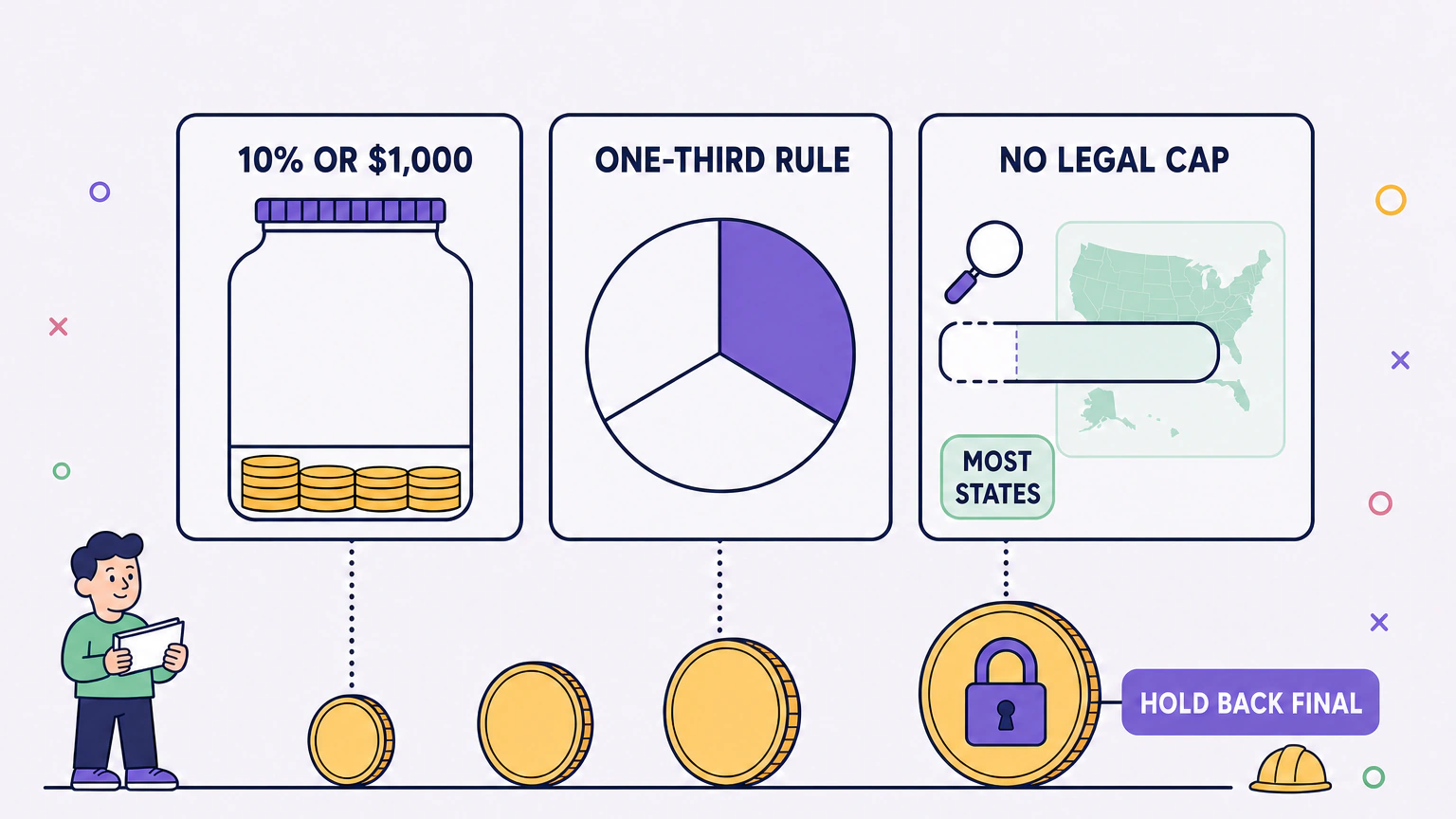
At least eight states impose a numeric cap on covered contracts. California and Nevada limit it to $1,000 or 10% of the contract price, whichever is less. Maryland, Massachusetts, Pennsylvania, Maine and Tennessee use roughly one-third, subject to price thresholds and, in Tennessee, county adoption. Ohio holds covered home-construction-service contracts over $25,000 to 10%, with exceptions. Three more states regulate deposits without setting a general percentage cap: New York makes covered pre-completion payments sit in escrow and bars covered roofing contractors from requiring a deposit, Florida starts a permit and start-work clock the moment you pay more than 10%, and Arizona requires the amount to be written into covered contracts over $1,000. Find your state first. Then structure everything after the deposit around milestones, not dates.
On this page
- The short answer: what's normal, and what's legal
- The states that limit contractor deposits by law
- What a deposit is actually supposed to pay for
- A payment schedule that protects you
- Red flags in a deposit request
- Before you write the check: a nine-point checklist
- If you already paid and the work never started
- How Industry Oversight checks a contractor before you hand over money
- Frequently asked questions
The short answer: what's normal, and what's legal
Two questions are doing battle in your head right now, and they have different answers. "Is this normal?" is a market question. "Is this allowed?" is a legal one, and it changes at the state line. A 33% deposit can exceed Ohio's cap on a covered contract over $25,000. On a $25,000 job in California, the same request is simply illegal.
Check your deposit before you pay
Enter your state and contract price. We'll show the most you should hand over before work starts.
10% OR $1,000
CA / NV COVERED
ONE-THIRD BASED
MD + THRESHOLD RULES
10% BASE
OH COVERED OVER $25,000
CHECK SCOPE + LOCAL LAW
The full price in the signed contract, before any finance charges.
Custom cabinets, made-to-order windows, engineered trusses. Leave at $0 if none. Your contract should list this on its own line.
Legal cap Maximum to pay before work starts: $1,000
California caps this at $1,000 or 10% of the contract price, whichever is less (Bus. & Prof. Code § 7159.5).
The cap does not apply where the contractor holds a performance-and-payment bond, a lien-and-completion bond, a bond equivalent, or a joint control approved by the registrar covering full performance and payment (Bus. & Prof. Code § 7159.5(a)(8)).
| Milestone | Share | Amount |
|---|---|---|
| At signing | 4% | $1,000 |
| Materials delivered to your property | 24% | $6,000 |
| Rough-in complete / midpoint | 29% | $7,200 |
| Substantial completion, punch list issued | 29% | $7,200 |
| Final payment, punch list closed and lien waivers received | 14% | $3,600 |
| Total | $25,000 | |
This schedule is our recommendation, not a legal requirement. The principle behind it — pay for work that is finished, and hold the last payment until the job is done — matches what California requires of every licensed contractor (Bus. & Prof. Code § 7159.5).
Rules shown for named jurisdictions were checked August 2026 against the sources cited in this article. Unlisted-state results are not a 51-jurisdiction survey. State and local law changes — confirm with the relevant licensing board before you pay. General information, not legal advice.
What most contractors ask for
Our band is 10% to 20% of the contract price, and where you land inside it comes down to two things: how big the job is, and whether anything has to be custom-made.
Bigger jobs can carry smaller percentage deposits, because the fixed cost of getting started is a smaller slice of a bigger contract. So a quote sitting at the top of the band isn't a warning sign on its own. If you're still weighing estimates, our guide on how to compare contractor bids covers the step before this one.
Why a big deposit is the contractor's risk problem, not yours
Construction money doesn't track the calendar. Demolition, rough-in and finish work carry different costs from one job to the next, so nobody can promise you that half the budget is spent by the halfway mark.
That's why a request for half your money on day one is worth arguing about. It shifts substantial nonperformance risk onto you, and you're the one person who can't manage it.
The states that limit contractor deposits by law
These rules govern home improvement contracts: repair, remodeling and alteration work on a home somebody already lives in. New construction and commercial work generally sit outside them, and several carry a price threshold below which nothing applies.
One caveat before you find your state: these rules change, and we're not your lawyer. Confirm your own situation with your state licensing board, your attorney general's consumer protection office, or an attorney before you pay.
| State | Limit before work starts | Statute | Exception or carve-out | Who enforces it |
|---|---|---|---|---|
| California | $1,000 or 10% of the price, whichever is less | Bus. & Prof. Code § 7159.5(a)(3) | A performance-and-payment bond, lien-and-completion bond, bond equivalent or joint control approved by the registrar; two active years is a blanket-bond application condition | Contractors State License Board |
| Nevada | $1,000 or 10% of the price, whichever is less | NRS 624.970(2)(g) | A $100,000 consumer-protection bond, or board relief under NRS 624.270(5) | State Contractors Board |
| Maryland | One-third, and nothing before both parties sign | Md. Bus. Reg. § 8-617 | None stated | Home Improvement Commission |
| Massachusetts | On agreements over $1,000: one-third, or the cost of special-order materials, whichever is greater | M.G.L. c. 142A, § 2 | Special-order cost, via the "greater of" test | Consumer Affairs and Business Regulation |
| Pennsylvania | One-third, plus special-order materials named in the contract; applies above $5,000 | 73 P.S. § 517.9(9)–(10) | Retailers posting a $100,000-per-store letter of credit | PA Attorney General |
| Tennessee | In counties that adopted Part 5, one-third at or before signing, and nothing before signing | T.C.A. §§ 62-6-510(11)–(12), 62-6-516(b) | A bond, or your written election to pay early; jobs of $3,000 or less excluded | Board for Licensing Contractors |
| Maine | One-third of the total contract price | 10 M.R.S. § 1487(5) | Contracts over $3,000; an opt-out counts only after the contractor states your rights (§ 1489) | Maine Attorney General |
| New York | No cap, but pre-completion payments must be escrowed | GBL § 771(1)(e); Lien Law § 71-a(4) | A bond or letter of credit within 10 business days instead. Roofing, gutter, downspout, siding: no deposit at all (§ 771-b(5)) | NY Attorney General |
| Florida | No cap, but paying over 10% starts a clock on the contractor | Fla. Stat. § 489.126(2) | Just cause, or your written agreement to longer | DBPR and local boards |
| Arizona | No cap; the deposit must be stated in any contract over $1,000 | A.R.S. § 32-1158(A)(7) | Recovery Fund repays up to $30,000 per residence, licensed contractors only | Registrar of Contractors |
| Ohio | On covered contracts over $25,000: 10% of the price | Ohio Rev. Code §§ 4722.01(C), 4722.04 | Up to 75% of a nonreturnable special-order item's cost; cost-plus contracts exempt | Ohio Attorney General |
The $1,000 states: California and Nevada
California is the strictest, and its wording leaves nowhere to stand. A down payment "shall not exceed one thousand dollars ($1,000) or 10 percent of the contract amount, whichever amount is less." No special-order exception exists, so on a $25,000 kitchen the ceiling is $1,000 whatever anyone decides to call the money. The same section also bars any payment that runs ahead of the value of the work performed, and breaking it is a misdemeanor.
Nevada borrowed the same formula for contracts signed on or after October 1, 2023, where the owner actually lives in the single-family home. Miss that rule and the contract is voidable by the owner. Voidable by you, that is. Not by them.
The one-third states: Maryland, Massachusetts, Pennsylvania, Maine, Tennessee
Same headline number, five different machines underneath it. The differences are where people get hurt.
Maryland is the blunt one. No deposit over one-third, and no money of any kind before both parties have signed.
Massachusetts runs a "greater of" test on agreements over $1,000. The deposit can't exceed one-third, or the actual cost of special-order material ordered before work begins, whichever is larger. And final payment can't be demanded until the work satisfies both parties.
Pennsylvania's home improvement law is the one that gets misreported most. It bites where the price is more than $5,000, and it caps the deposit at one-third, or one-third plus the special-order materials designated in the contract. It also bars any payment before signing.
Tennessee writes both rules as prohibited acts, but only where Part 5 applies: no payment before signing, and no more than one-third at or before signing. "Home improvement" there excludes contracts of $3,000 or less, and the Board's current list names nine counties that have adopted the home-improvement law.
Maine wants the contract in writing above $3,000 and caps the down payment at one-third. A violation there is prima facie evidence of an Unfair Trade Practices Act violation, which hands you the start of your own case.
States that regulate deposits without capping them: New York, Florida, Arizona
New York sets no percentage cap and does something arguably better for covered home-improvement contracts over $500. Every payment a contractor takes before substantial completion has to go into a New York escrow account within five business days, and while it sits there it's still your money. The contractor can skip escrow by handing you a bond, a contract of indemnity or an irrevocable letter of credit within ten business days instead. The contract has to say which route it's using.
New York also bans roofing deposits outright, in words worth quoting back: a roofing contractor "shall not require an owner to provide a deposit for the work and materials." The same rule reaches gutter, downspout and siding work. Materials get invoiced on delivery, the balance on completion, and Vetted roofing contractors in New York should know it without being told.
Florida attaches consequences to the 10% line instead of forbidding anything. Take more than 10% up front and a clock starts: permits applied for within 30 days, work begun within 90 days of the permits issuing, unless there's just cause or you agreed in writing to wait longer.
Arizona requires disclosure rather than restraint. Any residential contract over $1,000 has to state the advance deposit and every progress payment, each one tied to the stage that triggers it. Weaker than a cap. Still better than a handshake.
What most articles get wrong about this list
The list that gets copied from site to site says at least nine states cap deposits, and it names Arizona and Indiana. Arizona's statute requires the deposit to be disclosed, not limited. And the "10% or $1,000" formula pinned on Arizona is California's rule wearing somebody else's name tag.
Pennsylvania's threshold still shows up as $1,000 in older consumer material. The Attorney General's published Act 132 text says $5,000. Massachusetts gets called a flat one-third state when it's really a "greater of" state, which matters if you're buying custom cabinets, because you can legitimately owe more. When sources disagree, call your state licensing board. Then get the answer written into the contract.
What a deposit is actually supposed to pay for
A deposit isn't a trust exercise. Common legitimate uses are practical ones: permit fees, mobilization, material orders placed in advance. So ask what this particular number covers, and ask the contractor to document it.
Special-order materials are one good reason for a bigger number
Custom cabinets. Made-to-order windows. Imported tile, engineered trusses. Suppliers want money before they cut anything, and that's a real bill your contractor can't get out of paying.
The test is documentary. Your contractor names the supplier, shows you the quote, and puts the itemized cost on its own line in the contract. Massachusetts and Pennsylvania wrote that carve-out into statute. California didn't, which is why a California "material deposit" over $1,000 is still illegal no matter how genuinely custom the cabinets are. Most kitchen remodelers hand the cabinet quote over without being asked twice.
The label doesn't change the rule
"Mobilization fee." "Setup charge." "Scheduling deposit." Where a cap exists it catches whatever money changes hands before work starts, whatever the invoice decides to call it.
A contractor who splits an illegal deposit into a legal one plus a "scheduling fee" has just told you how they handle rules. Believe them.
A payment schedule that protects you
Payments follow completed work, never the calendar. Tie the schedule to dates and you're paying for time passing. Tie it to milestones and you're paying for progress. Only one of those finishes your kitchen.
| Milestone | What must be true before you pay | Share of price | Example on a $25,000 job |
|---|---|---|---|
| At signing | Contract signed by both parties, license verified, permit responsibility assigned | Your legal maximum, or 10% to 20% | $1,000 (California's cap) |
| Materials delivered | Materials physically on your property, not "ordered" | About 24% | $6,000 |
| Rough-in complete | Rough-in has passed inspection wherever a permit applies | About 29% | $7,200 |
| Substantial completion | The job is usable and the punch list is issued in writing | About 29% | $7,200 |
| Final payment | Punch list closed, permit signed off, lien waivers in hand | About 14%, never below 10% | $3,600 |
Those dollar figures are our editorial recommendation, not a legal requirement. They total $25,000 exactly and assume a California deposit. In a state with no cap, the first payment would run $2,500 to $5,000.
Tie every payment to a milestone you can see
Every progress payment should name something you can walk up to and put a hand on. Materials stacked in your garage. Rough-in signed off by the inspector. Drywall hung. A punch list issued and in your hand.
California requires exactly this of licensed contractors: the payment schedule has to be written in dollars and cents, and it has to reference the specific work and materials. New York asks the same thing in different words, requiring progress payments to bear a reasonable relationship to the work actually done.
Hold back the last 10-15% until the punch list is closed
Retainage is the money you don't hand over until the job is genuinely finished, usually the last 10% to 15% in consumer work.
That final payment is the only leverage that survives to the end of a job. The day it's gone, so is anyone's enthusiasm for fixing a door that sticks. Release it when the punch list is closed, the permit is signed off, and you're holding lien waivers from everyone who could file against your house.
Change orders reset the math
Every scope change goes in writing, with a revised price, before anybody picks up a tool. Pennsylvania treats a deviation from the plans without a dated, signed change order stating the price change as a prohibited act. Maine makes the change order state both the old price and the new one.
A change order is not an occasion for a fresh deposit. The one exception is genuinely new special-order material, and even then, expect the supplier quote you asked for the first time.
How to pay, and why it matters later
Use a credit card wherever the contractor takes one, because a card payment carries dispute rights a check simply doesn't. Avoid cash unless you get a dated receipt for it. Arizona requires the contractor to give you one for any cash paid.
Write the check to the business named in the contract, not to an unrelated individual. You want the payment record and the contracting party to be the same thing when somebody asks later.
Red flags in a deposit request
Stop and ask questions if:
- The deposit is 50% or more on a job over $10,000.
- Somebody wants money before anybody has signed. That's illegal in Maryland, Pennsylvania and in Tennessee where Part 5 applies.
- It's cash only, or the check is supposed to go to an individual rather than the business.
- The amount jumps after you say yes, or comes back as a "scheduling fee" to hold your slot.
- The contractor can't name the supplier or show you a quote for the special-order materials.
- The contract has no start date, no completion date and no payment schedule.
- You're being talked out of pulling or checking the permit.
- The pitch arrived unsolicited at your door after a storm.
- The license number doesn't check out with the state board, or there isn't one.
Unusual and illegal aren't the same thing, and it's worth knowing which one you're looking at. A 40% deposit in Ohio can violate the 10% cap on a covered contract over $25,000. The same request in Maryland is generally a prohibited act.
And you're allowed to say no. A deposit is a contract term like any other, and terms stay negotiable right up until the moment you sign. Treat the unsolicited knock after a storm with particular suspicion, because storm-chaser roofing scams almost always open with a large deposit demand.
Before you write the check: a nine-point checklist
- Verify the license number with your state board's lookup, and confirm the name on it matches the name on the contract.
- Confirm the insurance. Ask for liability and workers' compensation certificates sent straight from the insurer.
- Check your state's legal maximum against what is being asked.
- Make sure both parties have signed before money moves. In Maryland, Pennsylvania and in Tennessee where Part 5 applies, taking money first is illegal.
- Settle who pulls the permit, in writing. In Massachusetts, pulling it yourself generally costs you access to the Guaranty Fund, unless the contractor failed to give the required warning; our guide on who is supposed to pull the permit explains why.
- Read the payment schedule for milestones, not dates. If a row says "June 15," rewrite it as the condition that should be true by then.
- Check that special-order materials are itemized on their own line, with the supplier named and the quote attached.
- Confirm the final payment is at least 10% and is tied to a closed punch list, not to substantial completion.
- Pay by credit card or by check to the business, and get a dated receipt every time.
If you already paid and the work never started
If the money is already gone and nothing has happened, you still have a sequence to work through. The order matters more than you'd think.
Your three-day cancellation right, and the exception nobody mentions
The FTC's cooling-off rule lets you cancel certain sales made at your home, right up to midnight of the third business day after the transaction. It reaches sales of $25 or more at your residence, including the ones where you invited the salesperson in yourself, and the seller has to hand you two copies of a cancellation form when you sign.
Now the part almost nobody mentions. The rule does not cover a sale where you made the first move and asked the seller to come and repair or maintain your personal property. Don't stretch that exception over work on fixtures or on the house itself. And anything sold to you beyond the personal-property repair you actually requested is covered again.
New York goes further. A roofing customer can cancel once the insurer denies the claim, and every payment has to come back within ten days.
Complain to the licensing board, in writing
Get the right body, and put the complaint on paper. The Contractors State License Board in California. The Maryland Home Improvement Commission. The Pennsylvania Attorney General's Bureau of Consumer Protection, Massachusetts' Office of Consumer Affairs and Business Regulation, the Nevada State Contractors Board, the Arizona Registrar of Contractors.
In several states the deposit violation is a prohibited act all by itself, so the board can move without waiting for a court. Pennsylvania goes one better and adds a refund duty. Once you've sent a certified-mail request, failing to refund within ten days is itself a prohibited act, provided no substantial portion of the work is done and 45 days have passed since the start date in the contract.
Recovery and guaranty funds, and why they only exist for licensed contractors
Several states run a fund that may pay eligible homeowners when a contractor takes the money and disappears. What it takes to qualify differs from state to state, and the differences are not small.
Maryland's Guaranty Fund covers an actual loss caused by a licensed contractor, capped at $30,000 for one claimant and $250,000 across everyone claiming against that contractor. Arizona's Recovery Fund reimburses up to $30,000 per residence and $200,000 per contractor license, again licensed contractors only. Massachusetts wants a registered contractor, and it generally shuts out homeowners who pulled their own building permit, unless the contractor failed to give the required warning.
So an unlicensed or unregistered contractor isn't just riskier. Hiring one can put you outside your state's recovery program before anything has gone wrong.
Card disputes and small claims
If you paid by card, call the issuer now, not after another round of promises. Network rules often work on 120-day windows, but the date the clock starts and the outside limit both vary by dispute type, so waiting is the one thing you can't afford.
Keep everything. The signed contract, every receipt, the text messages, dated photos of the untouched site, your certified-mail demand letter. When what you've lost is a deposit rather than a whole project, small claims court is usually the right size of remedy.
How Industry Oversight checks a contractor before you hand over money
We run a license verification and a physical-location check on every listing before it appears. That's our own screening, not an independent audit, so confirm the license with your state board yourself before you sign anything.
And to be plain about the limits: Industry Oversight controls its own ratings and reviews, so they are not independent third-party reviews, and verifying a license is not a guarantee of a contractor's financial condition, solvency or workmanship. It's one check, done before you make the call. The site's satisfaction guarantee says Industry Oversight will work with the homeowner and contractor in good faith to address concerns. When you're ready, find a licensed general contractor near you, and check your own state's rule before you sign.
Frequently asked questions
How much should you pay a contractor up front?
Plan on 10% to 20% of the contract price, and go above it only for documented special-order materials. That's our conservative band, not a national standard. At least eight states cap covered contracts anyway: California and Nevada at $1,000 or 10%, Ohio at 10% on covered contracts over $25,000, and Maryland, Massachusetts, Pennsylvania, Maine and Tennessee on one-third-based rules with their own thresholds and exceptions.
Is it normal for a contractor to ask for 50% up front?
Usually not, and we'd push back on it. Fifty percent sits well above our 10% to 20% planning band on a residential job over $10,000, and depending on the contract, the threshold and the exceptions in play, it can blow straight through a statutory cap. Paying half on day one shifts substantial nonperformance risk onto you.
Which states cap how much a contractor can take as a deposit?
At least eight impose a numeric limit on covered contracts. California and Nevada cap it at $1,000 or 10%, whichever is less. Ohio caps covered contracts over $25,000 at 10%. Maryland, Massachusetts, Pennsylvania, Maine and Tennessee run one-third-based rules, each with its own scope and exceptions. New York, Florida and Arizona regulate covered deposits without setting a general percentage cap.
Can a contractor legally ask for a deposit before the contract is signed?
In three states, no. Maryland, Pennsylvania and Tennessee, where Part 5 applies, all prohibit demanding or receiving payment for covered home-improvement work before the contract is signed. The laws we read don't ban it nationwide. But money before signature leaves you without a signed contract to enforce, so we'd wait for both signatures anyway.
What is a normal payment schedule for a kitchen or bathroom remodel?
Five steps, each tied to a milestone instead of a date. Your state's legal maximum or 10% to 20% at signing. Roughly a quarter when the materials are actually delivered. Roughly 30% at rough-in inspection. Roughly 30% at substantial completion, with the punch list in writing. Then the last 10% to 15% once that punch list is closed.
When is a large materials deposit actually legitimate?
When the materials are genuinely made to order and the contractor has to pay the supplier before your job starts. Custom cabinets, made-to-order windows, engineered trusses. The test is documentary: name the supplier, show the quote, put the cost on its own contract line. Massachusetts and Pennsylvania wrote that carve-out into statute. California didn't.
Do I have three days to cancel a contract with a contractor?
Sometimes. The FTC's cooling-off rule gives you three business days to cancel a sale of $25 or more made at your home, including one where you invited the salesperson in. But it excludes a visit you requested to repair or maintain your personal property, and that exception shouldn't be stretched to cover home-repair calls generally.
What can I do if a contractor took my deposit and never showed up?
Send a written demand by certified mail with a deadline in it. Then file a complaint with the state licensing board, because in several states a deposit violation is actionable on its own. Dispute the charge with your card issuer while you still can. And if the contractor was licensed, check whether your state runs a recovery or guaranty fund.