


On this page
- The short answer, and where it comes from
- Which permits your specific job triggers
- Who is allowed to pull the permit where you live
- What a water heater permit actually costs
- Emergency replacements: the next-business-day rule
- What the inspector checks
- What happens if a water heater was replaced without a permit
- How to check your own jurisdiction in ten minutes
- Questions to ask before you sign the estimate
- Frequently asked questions
- Before you hire
The short answer, and where it comes from
You're standing in a wet garage, or holding an estimate with a permit fee you didn't expect. Same question either way.
Yes, usually. In the vast majority of US jurisdictions, replacing a water heater requires a permit and inspection, and that includes plenty of like-for-like swaps.
Most US jurisdictions work from the International Residential Code or the Uniform Plumbing Code, then amend it at home. R105.1 is blunt: anyone who intends to "erect, install, enlarge, alter, repair, remove, convert or replace any electrical, gas, mechanical or plumbing system" has to apply to the building official and get the permit first. Water heaters aren't on the short exemption list.
Local amendments can still create one, so the real questions are narrower. Does a permit apply to your job, who's allowed to file it, what does it cost, and how fast must you file after an emergency replacement?
That's a national rule of thumb, not a ruling on your address. Your authority having jurisdiction (AHJ) controls, and it may be a city, county, township or public health district.
We're describing how water heater permitting generally works, not making a call about your property. Your authority having jurisdiction has the last word, and its rules can differ from the model code.
What the code actually exempts
R105.2 lets a few plumbing jobs through without a permit, and the list is shorter than most people hope. Clearing stoppages. Repairing leaks in pipes, valves or fixtures. Removing and reinstalling a water closet where nothing is replaced or rearranged.
A water heater swap fails all three, because you disconnect the water supply plus either a gas line and vent or a high-amperage circuit.
The appliance itself is the reason.
A typical storage water heater burns fuel or uses a high-voltage circuit while holding tens of gallons of scalding water under pressure. Not a machine building officials feel casual about.
The genuine exceptions
Some jurisdictions do exempt particular replacement jobs. Those exceptions are local and job-specific, and only the office that wrote one can confirm it.
Unless yours confirms one covers your job, assume a permit is required. Los Angeles County Public Works answers in one line: "Yes a permit is required for a water heater installation, or replacement."
Which permits your specific job triggers
People say "replacing the water heater" about four different jobs, and each one pulls a different set of permits. Find yours before you read your estimate.
| Job type | Permits typically required | Extra code work commonly triggered | Typical install time |
|---|---|---|---|
| Like-for-like gas tank | Plumbing permit; gas/mechanical permit if the connector, shutoff or vent is altered | Expansion tank, pan, straps, T&P discharge piping | 2-3 hours |
| Like-for-like electric tank | Plumbing permit; electrical permit only if the circuit or wiring is altered | Expansion tank, pan, straps | 2-3 hours |
| Tank to tankless (gas) | Plumbing permit; gas/mechanical permit where gas or venting work triggers one | Gas-supply evaluation and possible upsize, appliance-listed venting, condensate drain on condensing models | Longer; varies with gas, venting and condensate work |
| Tank to heat pump water heater | Plumbing permit; electrical permit if a circuit is added or modified | Model-specific circuit and possible panel work, load calculations, spec sheet, manufacturer-required air volume or venting, condensate drain | Longer; varies with electrical and condensate work |
Permit names and combinations are set locally, so your building department holds the only answer that binds anyone.
Water Heater Permit Finder
Pick your situation. Permit rules are set locally, so treat this as a starting point and confirm with your building department.
Permits this job usually triggers
A plumbing permit. If the gas connector, shutoff or vent is altered rather than reused, a separate gas or mechanical permit may also apply.
Who is allowed to file
Your contractor files it. In many cities only a licensed professional may: New York City requires a Licensed Master Plumber to file the Limited Alteration Application, and Houston routes water heater permits through a master plumber who holds a Texas license and is registered with the City. Ask for the permit number once it issues.
Your building department has the final say. Confirm before anyone starts.
Gas and 240V work carries fire, carbon monoxide and electrocution risk. In many jurisdictions it must be performed by a licensed professional regardless of who holds the permit.
What the inspector will check
- T&P relief valve with full-size gravity-flow discharge piping, no trap or threaded end, and a termination height and location allowed by local code
- Thermal expansion control where a pressure-reducing valve, backflow preventer or check valve closes the system
- Drain pan where leakage could cause damage, with the locally required drain or replacement exception
- Seismic anchorage where state and local code require it; fastening details vary by adopted code
- Venting sized and materialed for the appliance installed, and adequate combustion air
- Approved gas connector and shutoff
Your next step
Search your city or county building department, confirm the fee and who may file, and get the permit fee itemized on your estimate before you sign.
Ask for the permit number and the passed-inspection record before you make final payment.
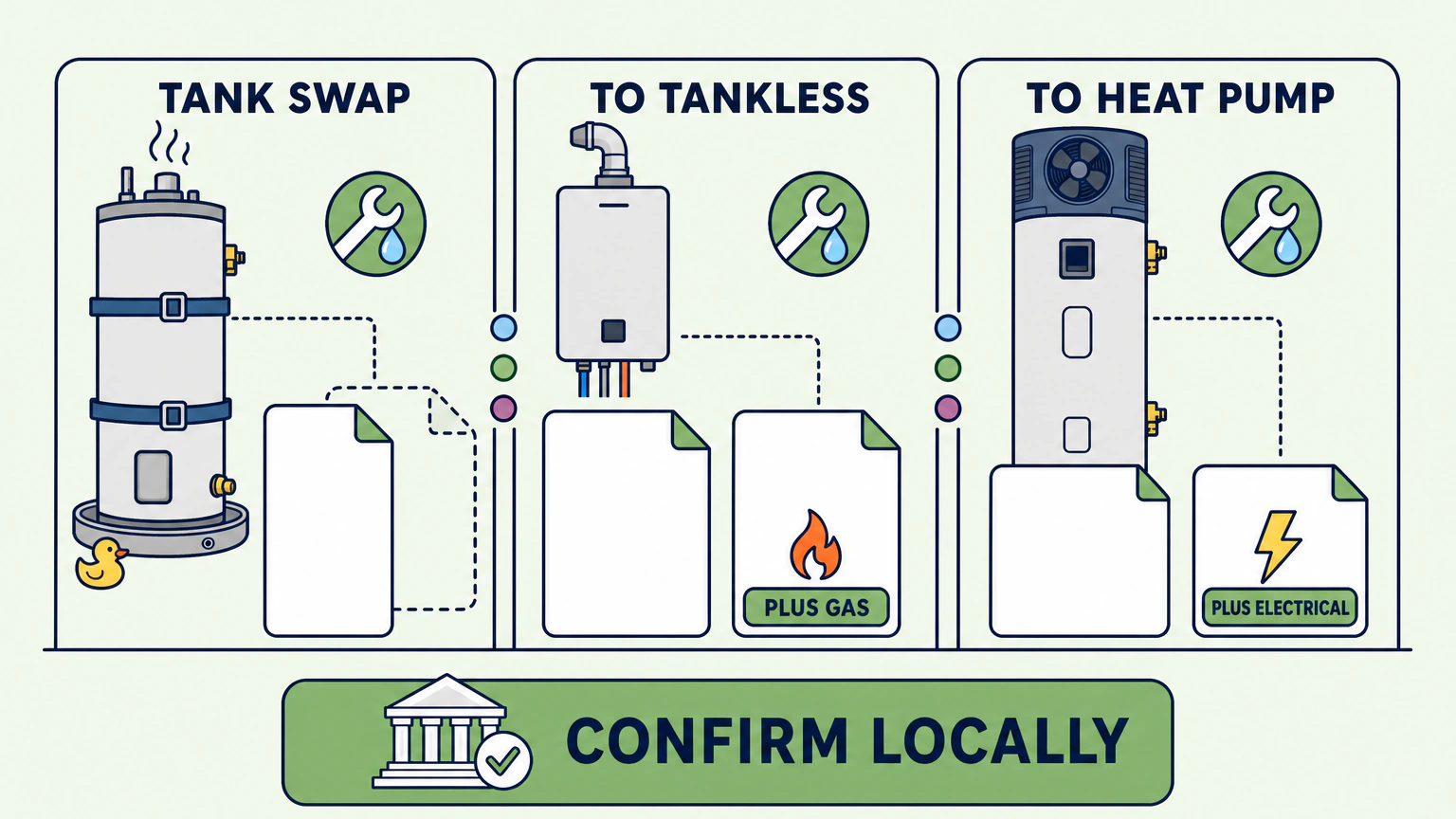
Which permits your job triggers
-
GAS TANK SWAP
Plumbing permit Gas or mechanical permit if altered -
ELECTRIC TANK SWAP
Plumbing permit Electrical permit if altered -
TO TANKLESS
Plumbing permit Gas or mechanical permit if triggered -
TO HEAT PUMP
Plumbing permit Electrical permit if circuit added or modified
CONFIRM LOCALLY
General guidance only, not legal advice. The authority having jurisdiction over your address controls. Verified August 2026.
Sources: International Residential Code R105.1, R105.2.1 and P2903.4; California Health and Safety Code section 19211; City of Houston Permitting Center; NYC Department of Buildings; Public Health – Seattle & King County; City of Morgan Hill, CA.
Like-for-like gas tank swap
One plumbing permit covers this in most jurisdictions. Touch the gas connector, the shutoff or the vent instead of reusing what's there, and a separate gas or mechanical permit attaches. Same fuel, same size, same location is usually the simplest permit case there is, though local exemptions can apply.
Like-for-like electric tank swap
One plumbing permit again. An electrical permit joins in only if the circuit, the disconnect or the wiring is altered rather than reconnected as-is. Electric swaps trigger the fewest code upgrades, because there's no venting and no combustion air to satisfy.
Tank to tankless
Here the scope jumps. The gas supply has to be evaluated, and it may have to be enlarged. The unit needs venting listed for that appliance. Condensing models need somewhere for the condensate to go. Any of that can pull a gas or mechanical permit in alongside the plumbing one.
It's also where we'd stop shopping on price.
Gas work carries fire, explosion and carbon monoxide risk, and local law may require a licensed professional.
Tank to heat pump water heater
This path often adds a second trade. Standard heat pump water heaters use 240V service, though ENERGY STAR also recognizes 120V/15A models, and the electrical permit turns on whether a circuit is added or modified. Budget for electrical contractors when the job needs circuit or panel work.
The paperwork grows too. Morgan Hill, California requires load calculations and the manufacturer's specification sheet, and waives the calculations where the main service panel is 200A or greater. Airflow follows the model's installation instructions: ENERGY STAR says manufacturers typically require 450 or 700 cubic feet of free air, or an approved venting configuration.
One money note, and it isn't good. The federal Section 25C credit, worth up to $2,000 on a qualifying heat pump water heater, applies only to property placed in service through December 31, 2025. For 2026, state and utility programs are what's left.
Who is allowed to pull the permit where you live
Being licensed to do the work and being eligible to file the permit are separate qualifications, set independently. A city can require a registered master plumber to file even for work a journeyman performs.
| Jurisdiction | May a homeowner file? | Who normally files | Source to verify |
|---|---|---|---|
| Houston, TX | Only under a separate Homeowner's Plumbing Permit: owner-occupied registered homestead, work performed personally | Master plumber holding a Texas license and registered with the City of Houston | houstonpermittingcenter.org |
| New York, NY | No | Licensed Master Plumber files a Limited Alteration Application | nyc.gov/buildings |
| Seattle and unincorporated King County, WA | Yes, a homeowner may buy a plumbing permit to do the work themselves | Public Health issues it; when a contractor does the work, the registered contractor applies | kingcounty.gov plumbing and gas piping |
| Unincorporated Los Angeles County, CA | Confirm with the department | Permit required for installation or replacement | pw.lacounty.gov |
| Morgan Hill, CA | Confirm with the city | Permit required for all replacements; heat pump installs need load calcs (waived at 200A+) and a spec sheet | morganhill.ca.gov |
| Some Indiana jurisdictions | Yes for an owner-occupied primary residence; no for a rental | Homeowner or licensed plumber | County or city building department |
Rules and fees are set locally, and they change. Confirm yours before you file.
Contractor-only jurisdictions
Houston stacks two requirements. Its permit description states the "permit must be obtained by a master plumber registered with the City of Houston": a Texas license, plus a city registration on top of it.
New York City is stricter. A swap gets filed as a Limited Alteration Application, and the only people who may submit one are Licensed Master Plumbers, Licensed Master Fire Suppression Piping Contractors and Licensed Oil Burner Installers.
Owner-builder and homestead permits
The permissive jurisdictions attach the same condition, and it's easy to miss.
You have to do the work.
Houston's Homeowner's Plumbing Permit is for an owner who owns the property, occupies it, has registered it as a homestead, and does the work personally. Public Health for Seattle and unincorporated King County runs the same logic. The permit authorizes the homeowner to do the plumbing, and when a contractor does it instead, that registered contractor applies.
Some Indiana jurisdictions allow owner-occupants to file for a primary residence but not a rental.
Read it as a transfer, because that's what it is. A homeowner permit puts code and inspection responsibility in your name, and it doesn't authorize an unlicensed person to perform work that requires a license.
Red flag: the contractor who asks you to pull it
Red flag: "You pull the permit, it's cheaper that way." The FTC puts "Scammers ask you to get any required building permits" on its list of home improvement scam tactics, and we treat that sentence as a door closing. It puts permit responsibility in your name, and it can be a sign that the contractor isn't licensed or registered to file in your city. Ask two questions: "Are you filing the permit, and will you give me the permit number once it issues?" and "What name is your license under, and in which state?" A plumber who files permits every week answers both without pausing. Then verify the license on your state board's own lookup before you sign.
If the homeowner is listed as the installer, the department looks to the homeowner to correct a failed inspection. Permit-shifting isn't a plumbing specialty, either: the same red flags show up after a storm.
What a water heater permit actually costs
Every jurisdiction sets its own fee schedule, which makes a national average close to useless as a budget. Published schedules are the numbers worth writing down.
| Where | Permit fee as found | Notes | Source and status |
|---|---|---|---|
| New York, NY | $130 | Limited Alteration Application fee for a 1-, 2- or 3-family home on jobs estimated up to $5,000 | NYC DOB published LAA fee and penalties chart |
| Houston, TX | Check the current schedule | Houston's page lists conflicting minimum-fee figures; the permit is filed by a city-registered master plumber, with no plan review at a single-family residence | Houston Permitting Center, water heater permit page |
| Houston, TX (homeowner route) | Check the current schedule | Houston's page publishes component and total figures that do not add up | Houston Permitting Center, homeowner permit page |
| Seattle and unincorporated King County, WA | Set by the Plumbing and Gas Program fee schedule | Permits required for replacement water heaters from July 1, 2026, in most cases over the counter | kingcounty.gov |
| National aggregate | $92 average, $75 median | Third-party survey of 36 cities in 22 states, compiled from published city fee schedules | PermitCalculator, directional only |
Fees are set locally and change on their own schedules. Look up your city's before you budget.
The permit fee versus the total job
Put the fee next to the job. Angi's 2026 data puts water heater replacement at an average of $1,346 within an $881 to $1,826 range. Fixr's 2026 figure is $1,400 within $900 to $3,000. A permit in the tens to low hundreds of dollars is roughly 2% to 10% of that.
The permit isn't where your money goes.
So when a contractor treats it as the thing wrecking your budget, they're telling you about their business, not about your budget.
Reading the permit line on your estimate
A transparent estimate shows the permit fee on its own line, not folded into labor. Permit handling may be included in the installation package, which is fine by us, as long as "included" still means an itemized number and a named filer.
If one quote covers the permit, the expansion tank and the pan while the other doesn't, you're not comparing two prices for the same job. You're comparing two different jobs. Our guide to how to compare contractor bids when no two estimates match does the unpicking.
Emergency replacements: the next-business-day rule
It's late, there's no hot water, and nobody's answering at the building department. The model code doesn't make you wait.
IRC R105.2.1 covers emergency equipment replacement and states that the permit application "shall be submitted within the next working business day to the building official."
Jurisdictions can amend that timing, so confirm the local rule before work starts if you can. If the replacement can't wait, get in writing when the application will be filed. A verbal "we'll take care of it" is not a filing.
What the inspector checks
This is the list that grows a "simple swap" quote on inspection day.
- Permit issued and posted or available on site
- T&P relief valve fitted, with full-size gravity-flow discharge piping, no trap or threaded end, and a termination height and location allowed by your code
- Thermal expansion control (expansion tank) where the system is closed by a PRV, backflow preventer or check valve
- Seismic anchorage where state and local code require it; fastening details vary by the adopted code
- Drain pan where leakage could cause damage, with the locally required drain or replacement exception
- Venting correctly sized and materialed for the appliance installed; combustion air adequate for a fuel-burning unit
- Approved gas connector and shutoff, or correctly sized circuit, disconnect and bonding for an electric unit
- Clearances to combustibles and, in garages, ignition-source elevation where locally required
- Unit level, secured, and accessible for service
T&P valve and discharge piping
The relief valve's discharge pipe carries most of the rules. IRC P2804.6.1 requires it to run full size, flow by gravity, carry no trap and no valve, and terminate not more than six inches above the floor with no threaded end.
Where it may discharge is where the codes split. The IRC permits the pan. UPC states such as Washington prohibit it, so an answer learned one state over can fail here.
Expansion tank on a closed system
IRC P2903.4 and IPC 607.3 require thermal expansion control where a check valve, pressure-reducing valve or backflow preventer closes the cold supply. Those devices let water in but not back out. That's all closed system means, and it matters because heating stored water raises pressure when it cannot expand backward.
Whether yours is closed depends on your actual supply arrangement, so ask what's on your line. These provisions address storage water heaters, and some UPC-based codes expressly exempt instantaneous on-demand units.
Seismic strapping in earthquake states
California doesn't leave this to judgment. Health and Safety Code section 19211 requires that "all new and replacement water heaters, and all existing residential water heaters, shall be braced, anchored, or strapped to resist falling or horizontal displacement due to earthquake motion", and it makes the seller certify compliance to the buyer in writing.
For tanks up to 52 gallons, California guidance calls for two straps, one in the upper third and one in the lower third, fastened into framing. Larger tanks can require more. Kits cost $10 to $30, so this is workmanship, not budget.
Drain pan and drain line
Model plumbing codes require a pan where leakage would cause damage. Local replacement exceptions can modify the drain requirement, so ask rather than assume. Where a pan drain is required, it's generally at least 3/4 inch and runs to an approved location.
Venting, combustion air and gas connectors
The flue you already have may not be listed or sized for the new unit. A condensing appliance needs compatible venting and a condensate path. Anything that burns fuel needs the combustion air the appliance and local code require. Any one of them can turn a simple swap into a longer job.
The code upgrades your old install never had, and who pays for them
Your old heater went in under an older code, so the expansion tank, the pan, the sediment trap or the venting that current code requires may simply not be there.
Here's the part that stings.
A manufacturer's warranty may cover the heater while excluding permit, installation and code-update costs. Check the written warranty, and have those items priced on the estimate rather than discovered on inspection day.
What happens if a water heater was replaced without a permit
Nothing happens at first. That's the trap. The consequences arrive on someone else's schedule, usually years later.
Fines and retroactive permits
Code enforcement can issue a citation, and some departments charge more than the standard fee retroactively. New York City publishes both numbers on one chart: $130 for the permit at this job size and, for a 1- or 2-family home, a $780 penalty for doing the work without it. Leave a penalty unpaid long enough and it can become a municipal lien.
Insurance
Coverage for water, fire or gas damage connected to faulty installation depends on the loss, the policy language and state law. That isn't a dodge. It's how claims get decided, which is why the person to ask is your own carrier, and why you should treat the answer as a risk rather than a guarantee.
Selling the house
Here's where it catches up with people.
A home inspector may flag visible defects, but ASHI's standard doesn't require inspectors to determine code compliance or permit status, and seller disclosure duties vary by state.
Once a buyer knows, they may request a retroactive permit, negotiate a credit, or reconsider the purchase. Doing it before listing costs a fee. Doing it in escrow costs leverage.
How to legalize it after the fact
Call the building department and ask about a retroactive or "after-the-fact" permit. It may charge a higher fee and require the installation to meet current code before inspection. Both are cheaper than explaining the tank to a buyer's agent.
How to check your own jurisdiction in ten minutes
Find the authority having jurisdiction
Start here: is your address inside city limits, or in unincorporated county? That answer picks the department, and a mailing address doesn't always tell you which side you're on.
Then search [city or county] building department water heater permit, and take the .gov result over any aggregator above it. The obvious body isn't always the right one. In Seattle and unincorporated King County, plumbing permits come from Public Health, whose notice states that permits are required for replacement water heaters starting July 1, 2026.
The four questions to ask when you reach them
- Is a permit required to replace a water heater at my address?
- Who may file it: a licensed contractor only, or may I file as an owner-occupant?
- What is the current fee, and is the inspection scheduled by me or by the filer?
- If this is an emergency replacement, by when must the application be submitted?
Write the answers down, with the date and the name of the person who gave them. It settles arguments later.
Verify the plumber before they file
A badge on a website is a picture of a license. Check the real one on the state board's own lookup. California's CSLB check and Washington L&I's contractor verification are both free.
Confirm the license is active, the business name on it matches your estimate, and the address behind it is real. Then compare against licensed plumbing contractors near you. We run license and physical-location checks on the providers we list, and how Industry Oversight verifies the pros it lists sets out how. Those checks and rankings are our own, not an independent third-party review.
Questions to ask before you sign the estimate
Eight questions that sort the plumber who handles permits routinely from the one who avoids them.
- Are you pulling the permit, or are you asking me to?
- What is the permit fee, and is it a separate line on this estimate?
- Which permits does this job need: plumbing only, plumbing plus gas, or plumbing plus electrical?
- What is your license number and the state that issued it, and what business name is it under?
- Which code upgrades does this install need that my old one does not have, and are they priced here?
- Who schedules the inspection, and who has to be home for it?
- If it fails inspection, who pays for the corrections and the re-inspection?
- Will you give me the permit number and the passed-inspection record before final payment?
Frequently asked questions
Do I need a permit if I replace my water heater with the exact same type and size?
Usually yes, though local exemptions do exist. IRC R105.1 makes replacement of a plumbing, gas or mechanical system permit work, and water heaters aren't on the code's exemption list. A like-for-like swap is often the simplest permit to obtain.
Can I pull the permit myself?
In some cities, yes. Homeowners in Seattle and unincorporated King County may buy a plumbing permit to do their own work, and some Indiana jurisdictions let owner-occupants file for a primary residence. New York City won't have it: you need a Licensed Master Plumber. Houston routes these permits through a city-registered master plumber unless you file a homeowner homestead permit and do the work yourself.
How much does a water heater permit cost?
Tens to low hundreds of dollars, set by your city. New York City's Limited Alteration Application fee is $130 for a 1- to 3-family home at this job size. PermitCalculator's tally of published city schedules puts the average near $92. Either way, you're looking at roughly 2% to 10% of a typical replacement.
What happens if I already replaced it without a permit?
Call your building department and ask about a retroactive permit. A higher fee may apply, and be prepared to bring the installation to current code before it passes. Leaving it alone is its own gamble: fines, insurance disputes, and a problem that surfaces when you're trying to sell.
My water heater failed last night. Does the permit have to come first?
Under the model code, no. IRC R105.2.1 allows an emergency equipment replacement to proceed with the permit application submitted the next working business day. Some jurisdictions amend that timing, so confirm locally and get the plumber's commitment on filing in writing before the truck pulls away.
Will my insurance deny a claim over an unpermitted water heater?
Nobody can answer that for your policy, and anyone who does is guessing. Coverage for water, fire or gas damage connected to faulty installation depends on the loss, policy language and state law. Ask your own carrier rather than assuming the answer either way.
Do tankless and heat pump water heaters need different permits?
Conversions often widen the permit set. Gas tankless conversions may add a gas or mechanical permit when the gas line or venting changes. Heat pump water heaters may add an electrical permit when a circuit is added or modified, and some cities also want electrical load calculations and the manufacturer's specification sheet.
Is there still a federal tax credit for a heat pump water heater in 2026?
No, and this one catches people. The Energy Efficient Home Improvement Credit under Section 25C, worth up to $2,000 on a qualifying heat pump water heater, applies to property placed in service through December 31, 2025 and is not available after that. State and utility rebate programs may still apply, so check yours directly.
Before you hire
Three things separate a job that's finished from a job that's merely done. Someone authorized to file the permit filed it. The inspection passed. And you're holding the permit number and the passed-inspection record before the final payment leaves your hands.
Start with licensed plumbing contractors near you, add electrical contractors if the conversion needs circuit or panel work, and price the job against the cost band on your own city's service page rather than a national average. Then call your building department: is a permit required at my address, and who's allowed to file it?