

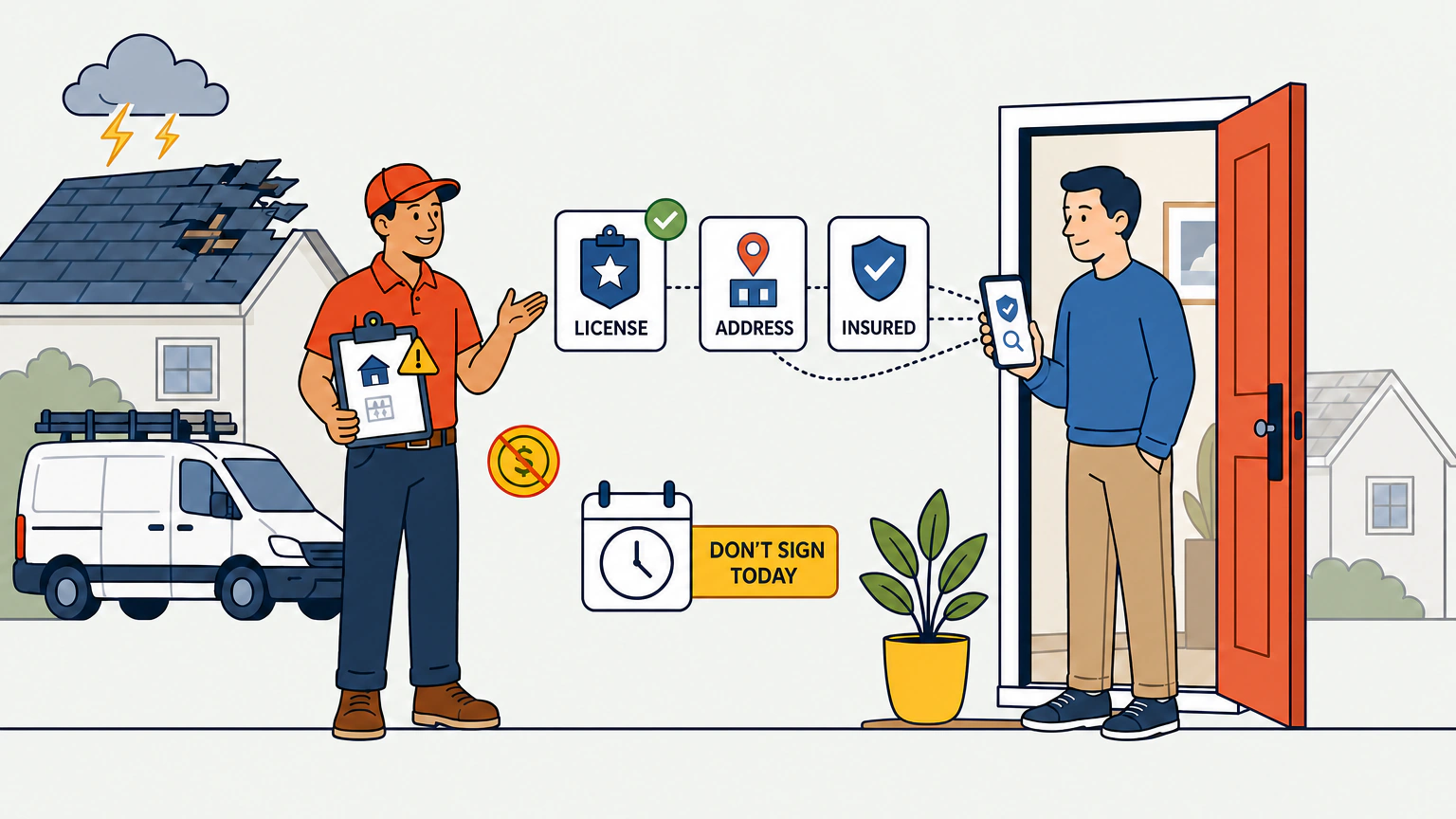
Start here. Don't sign anything the day a roofer turns up at your door. Two checks come first: look the company up in the applicable state or local licensing or registration records, and confirm it has a real local street address. And if anyone offers to pay, waive or "eat" your insurance deductible, walk away. That offer is illegal in several states, and it can put you on the wrong side of an insurance-fraud finding too.
The National Insurance Crime Bureau said reported instances of contractor fraud increased 38% from 2023 to 2025. The same bureau counted 23 major billion-dollar disasters in 2025, roughly $115 billion in damage. Storms make work for roofers, and for the people who only look like roofers. NOAA's Atlantic season peaks from mid-August to mid-October.
Walk away today if you hear any of these
- "We'll pay (or waive, or absorb) your deductible."
- "Sign today or the price goes up."
- "We'll handle the whole insurance claim for you."
- "We need the full amount up front, in cash."
On this page
- The 15-minute version: what to do before you sign anything
- What a "storm chaser" actually is (and why fast isn't the same as fraudulent)
- Red flags, sorted by how serious they are
- The deductible trap, and why it can make you the one in trouble
- How to verify a roofing contractor in about 15 minutes
- What normal payment terms look like
- The right order of operations after a storm
- If you've already signed, paid, or been burned
- Frequently asked questions
- Find a verified roofing contractor near you
The 15-minute version: what to do before you sign anything
- Photograph the damage from the ground before anyone climbs (why order matters).
- Open the insurance claim yourself, in your own name (the sequence).
- Check the applicable license or registration for the name on the contract, not the name on the truck (how).
- Confirm a physical street address and call the office line (how).
- Refuse any offer involving your deductible (why).
If someone is at your door right now
Three lines, and none of them have to be rude. "Can I have your legal business name and license number?" Write both down and take a card. "Thanks. I don't sign anything the same day." Then close the door.
What a "storm chaser" actually is (and why fast isn't the same as fraudulent)
A storm chaser is a contractor that solicits homeowners in damaged areas after severe weather, sometimes traveling from out of state. Storm chaser roofing companies are commonly reported to arrive within 24 to 72 hours of a hail or wind event, often before the adjuster does.
Speed isn't the problem, and some traveling crews do good work. The trouble comes later, because defects may surface after a traveling crew has left the area.
| What you can observe | Reason to verify | Stronger verification signal | How to check it |
|---|---|---|---|
| First contact | Unsolicited knock, 24 to 72 hours after the storm | You called, or a neighbor referred them | Ask who started it |
| Address | P.O. box, out-of-state plates, a hotel | A street address held for years | Search it on a map |
| License | "We don't need one here" | Number offered before you ask | State board lookup |
| Deductible | Offers to cover or rebate it | Expects you to pay it | Any such offer ends the conversation |
| Claim handling | Offers to negotiate with your insurer | Offers to attend the adjuster's visit | State law controls who may negotiate |
| Payment | Large sum up front, cash or app | Modest deposit, milestones, check | Compare with your state's cap |
| Warranty | Paper promise from a departing company | Labor warranty, local address | Ask who services it in year three |
Why the risk is real even in a quiet hurricane season
A quiet forecast is not the same as a quiet year for this. NOAA's updated 2026 Atlantic outlook is below normal: 7 to 13 named storms, 2 to 6 hurricanes, and a 75% chance of a below-normal season. Contractor fraud after a hurricane is only one slice of this, though. The NICB's warning discusses tornadoes, wildfires, floods and other disasters too, and none of those check the outlook first.
Red flags, sorted by how serious they are
Most advice on this hands you one flat list, which quietly treats "he knocked on my door" and "he offered to pay my deductible" as equally alarming. They aren't. Three tiers do the sorting: walk away, verify first, and normal practice.
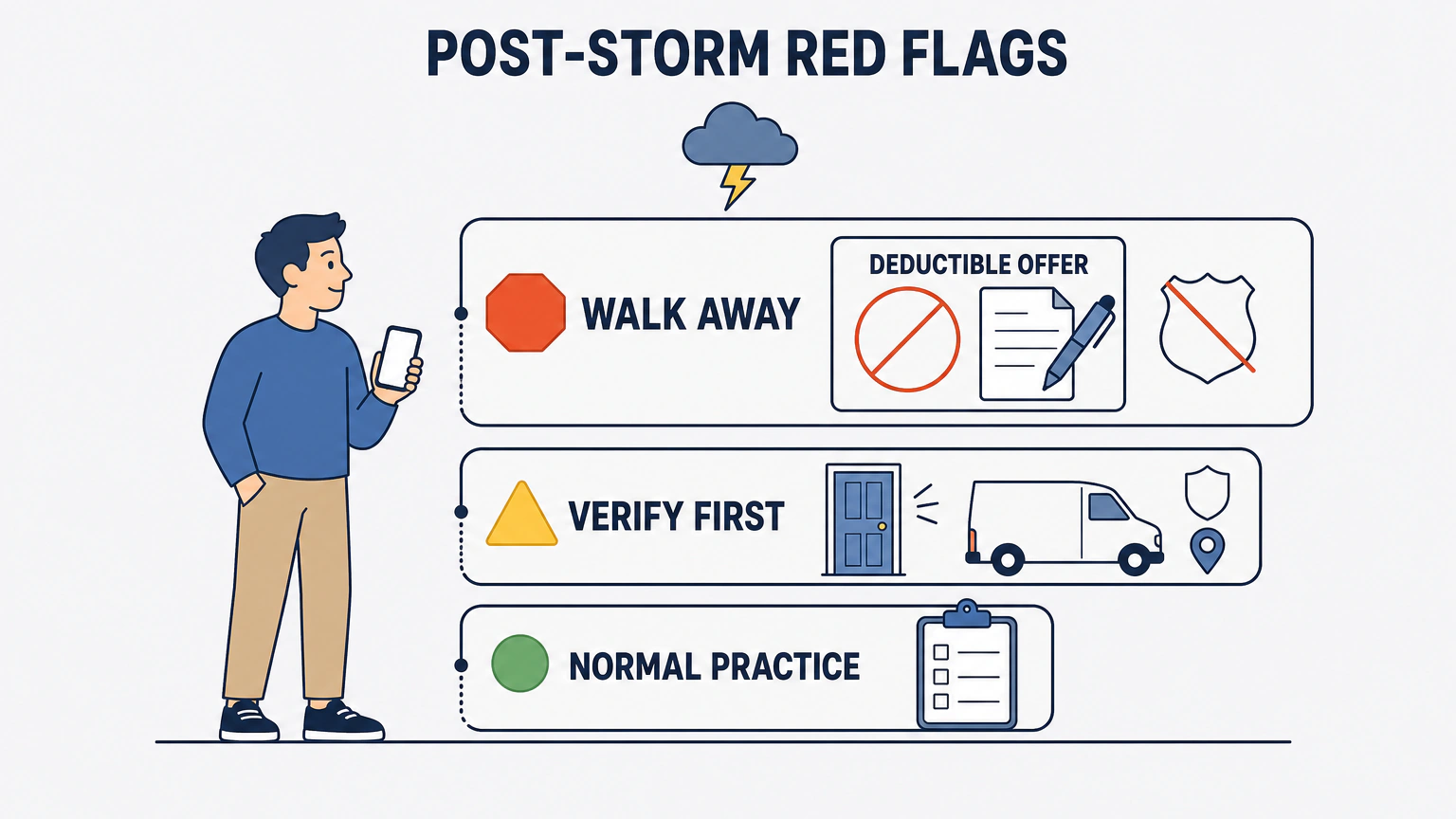
The explorer sorts 17 behaviors by stage and severity, so you can look up the one thing the contractor just said.
Red flag or normal? Check what the contractor just did
Pick where you are in the process, then how serious you need it to be. Nothing here is legal advice — laws vary by state and the official source controls.
Showing 17 of 17 behaviors
No behaviors match that combination. Reset the filters to see all 17.
At your door
-
Verify first Someone knocked within a day or two of the storm.
- Why this matters
- Crews that follow severe weather commonly arrive within 24 to 72 hours. Arriving fast is not proof of fraud on its own, and some traveling crews do competent work.
- What to do
- Take the legal business name and license number, then close the door and look them up yourself.
- Source
- FTC; widely reported industry practice
-
Walk away "Sign today or the discount goes away."
- Why this matters
- The FTC lists a discount that requires signing right away as a scam sign.
- What to do
- End the conversation and compare written estimates.
- Source
- FTC, How To Avoid Scams After Weather Emergencies and Natural Disasters
-
Walk away "We'll pay, waive or absorb your deductible."
- Why this matters
- Expressly illegal in Texas (Business and Commerce Code § 27.02(d), a Class B misdemeanor), Colorado (C.R.S. § 6-22-105), Minnesota (§ 325E.66), and Wisconsin (§ 100.65(2)); Florida treats an intentional waiver or rebate as insurance fraud. One way a waiver may be hidden is through a false or inflated estimate, and a homeowner who knowingly participates may carry exposure too.
- What to do
- Refuse, and report the offer to your state insurance department.
- Source
- Tex. Bus. & Com. Code § 27.02; C.R.S. § 6-22-105; Minn. Stat. § 325E.66; Wis. Stat. § 100.65(2); Florida DFS; Georgia AG Consumer Ed
-
Verify first "We don't need a license around here."
- Why this matters
- The FTC lists this claim as a scam sign. Licensing varies: Illinois and Florida license roofers directly, Oklahoma requires registration now and will require a residential roofing endorsement from 1 January 2028, and Texas has no state roofing license but municipalities may still require registration.
- What to do
- Check your state licensing board and then your city or county building department before anything else.
- Source
- FTC; IDFPR; Florida DBPR; Oklahoma CIB (HB 1628); SBA
-
Verify first Out-of-state plates, a P.O. box, or no local street address.
- Why this matters
- Not unlawful, but a reachable business address matters if you need warranty service later.
- What to do
- Ask for a physical street address, search it on a map, and ask how long they have been at it.
- Source
- FTC; NICB
During the inspection
-
Walk away They want to go up on the roof right now, alone.
- Why this matters
- Georgia's Attorney General consumer guidance warns that some unscrupulous roofers have used a "free inspection" to cause damage and justify repairs.
- What to do
- Do not let an uninvited contractor onto your roof.
- Source
- Georgia Attorney General Consumer Ed
-
Verify first They came down with damage you cannot see in your own photos.
- Why this matters
- It may be real — your ground-level photos may not capture every roof surface. But you need a baseline that predates their visit.
- What to do
- Photograph and video the roof from the ground, with zoom, before anyone climbs, and get a second opinion.
- Source
- NICB; FTC
-
Normal practice They offer to be present when your insurance adjuster inspects.
- Why this matters
- A contractor's presence is not itself claim negotiation, but state law controls what the contractor may discuss.
- What to do
- You may accept, but keep the claim in your own name and check state rules.
- Source
- Wis. Stat. § 100.65(8); C.R.S. § 6-22-105
-
Walk away "We'll handle the whole insurance claim for you."
- Why this matters
- State law controls who may negotiate a claim. Wisconsin already restricts contractor claim negotiation under § 100.65(8), and Georgia bars residential roofers from filing claims for customers unless they are or employ a licensed public adjuster.
- What to do
- Say no. If you want representation, hire a licensed public adjuster.
- Source
- Wis. Stat. § 100.65(8); Georgia AG Consumer Ed
In the contract
-
Walk away The contract has blank spaces.
- Why this matters
- NICB's guidance is explicit: never sign a contract with blank spaces. Anything can be written in afterwards.
- What to do
- Refuse to sign until every field is filled in and you have your own copy.
- Source
- NICB
-
Verify first No manufacturer, product line, color, or start and finish dates.
- Why this matters
- Without exact materials and dates, "like for like" does not identify the promised materials or schedule.
- What to do
- Require the manufacturer, product line, color, full scope, start and completion dates, payment milestones, and labor and material warranty terms in writing.
- Source
- NICB; FTC; BBB contract guidance
-
Verify first They ask you to sign an assignment of benefits.
- Why this matters
- An AOB transfers your right to be paid by the insurer to the contractor. It is not automatically a scam, but it moves control of the claim. Wisconsin's Act 230 adds required disclosures, itemized pricing, and a cancellation notice with a five-business-day postmark deadline, after which the contractor has up to ten business days to return deposits. Other states differ sharply.
- What to do
- Do not sign one at the door. Read it, check your state's rules, and ask your insurer first.
- Source
- 2025 Wis. Act 230
-
Walk away They ask you to pull the permit yourself.
- Why this matters
- The FTC lists this as a scam sign. Permit requirements and who applies for one are set locally.
- What to do
- Check with the local building department and put permit responsibility in writing.
- Source
- FTC, How To Avoid a Home Improvement Scam
At payment time
-
Walk away They want the full amount up front.
- Why this matters
- The FTC lists paying for everything up front as a scam sign.
- What to do
- Walk away.
- Source
- FTC
-
Verify first The deposit feels large.
- Why this matters
- Some states cap it. California generally limits a home-improvement down payment to the lesser of $1,000 or 10% of the contract price under Business and Professions Code § 7159.5, and the cap must appear in 12-point bold on covered contracts. The statute exempts contractors furnishing a qualifying bond or registrar-approved joint control. Where no cap exists, the deposit should still be modest and the balance tied to milestones.
- What to do
- Check your state's cap before you pay anything, and never pay for work not yet performed or materials not yet delivered.
- Source
- Cal. Bus. & Prof. Code § 7159.5; CSLB; FTC
-
Walk away They want cash, a wire, a gift card, a payment app or cryptocurrency.
- Why this matters
- The FTC singles out these methods because the money is nearly impossible to recover.
- What to do
- Pay by check or credit card, which leaves a record; credit cards also offer some dispute protections.
- Source
- FTC
-
Walk away They want the final payment before the work is finished.
- Why this matters
- The FTC's guidance is to never make the final payment until the work is done and you are satisfied. California generally bars collecting beyond completed work or delivered materials, subject to its qualifying-bond or joint-control exception.
- What to do
- Hold the final payment until the job is complete, inspected where required, and the site is clean.
- Source
- FTC; Cal. Bus. & Prof. Code § 7159.5
Last verified: August 9, 2026. State laws change — confirm with your state licensing board, state insurance department or attorney general before acting.
At your door
- An unsolicited knock: verify first. Arriving fast proves nothing either way.
- "Sign today or the discount goes away": walk away. The Federal Trade Commission lists same-day discount pressure as a scam sign.
- Any offer touching your deductible: walk away, every time.
- "We don't need a license around here": verify first. Licensing is set at the state or local level.
- Out-of-state plates, a P.O. box, or no local address: verify first.
During the "free inspection"
- Wanting to go up alone, right now: walk away. Some unscrupulous roofers have used a free inspection to cause damage and justify repairs.
- Damage that is not in your own photos: verify first, because your ground-level photos may not capture every roof surface.
- Offering to attend the adjuster's inspection: normal practice, but state law controls what the contractor may discuss.
- "We'll handle the whole claim for you": walk away.
In the contract
- Blank spaces: walk away. The NICB is blunt about this one, because anything can be written in afterward.
- No manufacturer, product line, color or dates: verify first. "Like for like" does not identify the promised materials or schedule without them.
- An assignment of benefits pushed at the door: verify first.
- Being asked to pull the permit yourself: walk away. The FTC lists it as a scam sign.
At payment time
- Full payment up front: walk away.
- A deposit that feels large: verify first, because your state may cap it.
- Cash, wire, gift card, payment app or crypto: walk away. The FTC warns that money sent this way is almost impossible to recover.
- Final payment before the work is finished: walk away.
The deductible trap, and why it can make you the one in trouble
It always arrives as a favor. The roofer will pay it, waive it, eat it for you. Your deductible is the part of the loss you are required to pay. One way a contractor may hide a waiver is through a false or inflated estimate to your insurer. Knowingly submitting false information can be insurance fraud, and the homeowner who went along with it may carry exposure too. That last part never comes up on the porch.
States where waiving your deductible is expressly illegal
Nine states, four questions each: whether roofers are licensed, whether the deductible offer is illegal, what the deposit rule is, and where to check. A state missing from the list is not a state where this is fine.
| State | Licenses roofers? | Deductible waiver | Deposit / payment rule | Where to verify |
|---|---|---|---|---|
| Texas | No; city registration may apply | Prohibited: Ins. Code § 707.002, and a contractor waiver is a Class B misdemeanor under Bus. & Com. Code § 27.02(d) | Insurance-funded contracts of $1,000+ need a 12-point bold notice | Texas Attorney General; city |
| Florida | Yes: certified (statewide) and registered (locally scoped) | An intentional waiver or rebate is insurance fraud | Verify with DBPR | DBPR license search |
| Colorado | No; city or county rules | Prohibited: C.R.S. § 6-22-105 | Rescind within 72 hours of written denial; deposits back in 10 days | Division of Insurance |
| Illinois | Yes: limited and unlimited licenses | Verify current rule | Verify current rule | IDFPR lookup |
| Oklahoma | Yes: registration, plus an endorsement required from 1 January 2028 (HB 1628) | Prohibited | Verify current rule | Construction Industries Board |
| Wisconsin | Dwelling contractor certification is required to pull one- and two-family dwelling permits | Already barred by § 100.65(2); contractor claim negotiation is also already restricted by § 100.65(8), and from 1 December 2026 Act 230 adds parallel rules | From 1 December 2026, a contract violating § 632.11 is void | DSPS; Commissioner of Insurance |
| Minnesota | Yes, statewide | Prohibited: Minn. Stat. § 325E.66; the license may be revoked | Insurance-paid repair deals need an itemized estimate | DLI lookup |
| California | Yes: C-39 classification | Verify current rule | Down payment generally capped at $1,000 or 10%, whichever is less, with an exception for a qualifying bond or registrar-approved joint control (Bus. & Prof. Code § 7159.5) | CSLB check |
| Georgia | No | May not pay your deductible or file claims for you (Georgia AG) | Verify locally | Georgia AG |
| Every other state | Varies; a pattern, not coverage | Absence here is not permission | Absence here is not a green light | Your board and attorney general |
We're not your lawyer, and this isn't insurance advice. Laws change and vary by state, county and city, and the official statute or regulator controls, so run anything here past your state licensing board, insurance department or attorney general before you act on it.
"We'll handle your insurance claim for you"
It sounds like a kindness. It decides who runs your claim. State law controls who may negotiate with your insurer on your behalf. Minnesota bars a contractor from interpreting policy terms or adjusting a claim without a public adjuster license. Wisconsin already restricts contractor claim negotiation, and Act 230 adds parallel insurance-law rules from 1 December 2026. Georgia's Attorney General says residential roofers may not file claims for customers unless they are, or employ, a licensed public adjuster.
Attending the adjuster's inspection is a different thing, and it may be permissible. Colorado draws that line exactly: a contractor may not act as a public adjuster, but may discuss the scope of repairs once there is a contract with you.
Assignment of benefits: read before you sign
An assignment of benefits, or AOB, transfers your right to be paid by the insurer directly to the contractor. It is not automatically a scam. It does hand over the money and, in practice, control of the claim, which is a lot to sign away standing in your own doorway.
If someone asks you to sign an assignment of benefits for your roof claim, the answer at the door is no, not today. Wisconsin is tightening this. From 1 December 2026, Act 230 lets an assignment name the contractor only as a copayee, requires itemized pricing, and sends deposits back within ten business days of cancellation. Other states differ sharply, so check yours first.
How to verify a roofing contractor in about 15 minutes
Tick these off on your phone while the truck is still in your driveway.
- Written down the legal business name and license number from the contract, not the truck
- Checked the applicable state or local licensing or registration record and confirmed it is active today
- Confirmed the license covers roofing and, where it applies, my county
- Checked disciplinary history, not just active status
- Confirmed a physical street address, and how long the business has been at it
- Called the office line during business hours and reached a person
- Received a certificate of insurance and confirmed it with the insurer named on it
- Searched the state attorney general's consumer division and the BBB for complaints
- Read the review distribution and the most recent reviews, not the star average
- Confirmed nobody has offered to pay, waive or rebate my deductible
Step 1: Find out whether your state licenses roofers at all
Whether there's a license to check at all depends on where you live. Some states license roofers directly: Illinois issues limited and unlimited roofing licenses, Florida runs certified and registered roofing contractors, and Oklahoma registers roofers and will require a Residential Roofing Endorsement from 1 January 2028. Some cover roofing only inside a general-contractor or home-improvement license. Some, Texas among them, have none at all, and the rule sits with the city or county.
So start at your state licensing board, then call your local building department. As the Small Business Administration puts it, license requirements vary by activity and by state, county and city.
Step 2: Check the license against the legal business name, today
Search the entity named on the contract, not the name painted on the truck. Trucks carry brand names. The license applies to the named contractor.
Then check three things: that the status reads active today, that the scope covers roofing, and that any jurisdictional limit fits your address. That last one catches people out. A Florida registered roofer may contract only in the jurisdiction or jurisdictions for which the registration was issued, so a valid registration can still be the wrong one for your address.
Step 3: Confirm a real, local, physical address
Ask for a street address, not a P.O. box, and ask how long they've been at it. Call during business hours and see whether a person picks up. What you're testing is whether the business will be reachable if you need warranty service later.
Pro tip: Paste the address into a maps search before you call. A warehouse, a mailbox store or a residential lot three states away isn't disqualifying on its own, but it is the question to ask out loud, because it tells you where you could send a warranty claim later.
Step 4: Get the certificate of insurance and verify it with the insurer
Ask for a certificate showing general liability and, where employees are involved, workers' compensation. General liability may cover the contractor's liability for property damage. Workers' compensation generally covers employees' work-related medical costs and lost wages. A certificate shows the coverage that was stated on it, so call the carrier named there and verify.
Step 5: Check complaints and read the review pattern, not the average
Search the licensing board's discipline records, your state attorney general's consumer division, and BBB complaint history. Then read the shape of the reviews instead of the headline number. Twenty reviews in one week after four silent years is a pattern. So is a wall of five stars with no detail.
Our directory of vetted roofing contractors near you runs those same two checks, license status and a verified physical location, on every listing. We'd rather be plain about what that is: Industry Oversight produces and controls its own ratings, businesses cannot pay to be included or featured, and these are our own checks rather than an independent audit or a government verification.
What normal payment terms look like
Everyone asks what the roof will cost. The question that protects you is when the money moves, and by what method.
Deposits: what's reasonable and what's capped
Some states cap the deposit outright. California generally limits a home-improvement down payment to $1,000 or 10% of the contract price, whichever is less, though the statute exempts contractors furnishing a qualifying bond or registrar-approved joint control. Break the cap and it's a misdemeanor carrying a $100 to $5,000 fine. Break it somewhere covered by a state or federal disaster declaration and the court must impose the maximum. That last part is not an accident. Everywhere else, keep the deposit modest and tie the balance to milestones.
| Payment stage | What's normal | What's a red flag | Why |
|---|---|---|---|
| Deposit | A modest percentage, or your state's cap | A large sum before materials arrive | It is all a departing crew needs |
| Progress payments | Tied to completed milestones | Payments running ahead of the work | California generally bars collecting beyond completed work or delivered materials, subject to its qualifying-bond or joint-control exception |
| Change orders | Written and priced before the work | Verbal "we found more damage" charges | Undocumented extras are harder to dispute |
| Final payment | After completion and cleanup | Requested before the job is finished | Never pay the last installment until satisfied |
| Payment method | Check or credit card | Cash, wire, gift card, app, crypto | Those methods can be almost impossible to recover |
| Insurance proceeds | Paid to you, then paid by you | Signing your insurance check over | The FTC advises against it |
Payment methods that leave you a way back
The FTC's list of methods to refuse is short: wire transfer, gift card, payment app, cryptocurrency and cash. Once that money moves it is almost impossible to recover. Pay by check or credit card instead, because both leave a record and credit cards also offer some dispute protections. Keep every invoice.
What has to be in writing before any money moves
Before any money moves, the contract has to name the exact manufacturer, product line and color. It has to carry the full scope of work, start and completion dates, and a payment schedule tied to milestones. It has to state labor and material warranty terms separately, and say who pulls the permit. Never sign one with blank spaces. Keep your own signed copy.
The right order of operations after a storm
The order matters as much as the hurry. The sequence can affect how well you document and protect a claim.
- Document. Photos and video from the ground, before anyone climbs.
- Report. Call your insurer and get a claim number in your own name.
- Inspect. Bring in a contractor you chose, not one who chose you.
- Compare. Written estimates covering the same scope, no signatures yet. Our guide to how to compare contractor bids when no two estimates match shows you how to normalize them.
- Contract and pay. After the adjuster's report, in stages, never in cash.
Storm chasers usually arrive between steps 1 and 3, inside 24 to 72 hours. Doing step 2 yourself closes that gap.
One honest exception: emergency mitigation can't wait. Tarping a roof and pulling water out are mitigation, not repair. Your policy may require reasonable steps to prevent further damage. Do it, document it, and keep the receipts.
If the damage is an emergency
Safety comes before all of it. For downed power lines, a gas odor or visible structural collapse, call 911 or your utility, and keep everyone off the roof.
For water already inside, bring in disaster recovery and water-damage specialists promptly. For a tree on the structure, contact emergency tree removal promptly. If it is across a service line, make that safety call first. Both trades attract door-knocking too.
If you've already signed, paid, or been burned
Preserve everything before you do anything else. The contract, every text and voicemail, your photos, all receipts and canceled checks, the salesperson's name, the plate on the truck.
Then escalate in order. Complain to the contractor in writing, by certified mail with a return receipt. Contact your state licensing board, then your state attorney general's consumer protection division. Notify your insurer's fraud unit. Report to the NICB and to the FTC at ReportFraud.ftc.gov, the route for reporting a roofing contractor scam.
Move on the cancellation window today. The FTC's Cooling-Off Rule gives three business days to cancel certain qualifying sales made in your home, but exceptions apply, and some states add their own, such as Colorado's 72-hour rescission right after written notice of a denial. FEMA endorses no contractor and charges no application fee, so any claim of a federal endorsement is a misrepresentation. If the provider came from our directory, how our satisfaction guarantee works explains your route.
Frequently asked questions
Is it illegal for a roofer to pay or waive my insurance deductible?
In several states, expressly yes. Texas, Colorado, Minnesota and Wisconsin prohibit it by statute, and Florida treats an intentional waiver or rebate as insurance fraud. Everywhere else, check your own state's law before you act. A waiver may be hidden through a false or inflated invoice, and a homeowner who knowingly participates may carry exposure too.
Should I let a door-to-door roofer inspect my roof after a storm?
Not unsupervised, and not the same day. Photograph and video the roof from the ground yourself first, so your baseline predates any visit. Some unscrupulous roofers have used a free inspection to cause damage and justify repairs. If you do want an inspection, pick the company yourself and be present for it.
How do I check whether a roofing contractor is licensed?
Start at your state licensing board, then call your city or county building department. Some states license roofers directly, Illinois and Florida among them. Some cover roofing only through a general-contractor or home-improvement license. Some, Texas included, have no state roofing license at all, which leaves the question with your local building department.
How much should I pay a roofing contractor up front?
As little as your state allows. California generally caps a home-improvement down payment at $1,000 or 10% of the contract price, whichever is less, unless the contractor furnishes a qualifying bond or joint control approved by the registrar. Where no cap exists, keep the deposit modest and tie the balance to milestones. Full payment up front is always a walk-away.
Can a roofing contractor negotiate my insurance claim for me?
Not unless state law authorizes that role. State law controls who may negotiate a claim with your insurer, and several states restrict contractors from doing so unless they hold the required public-adjuster license. Attending the adjuster's inspection is a different thing, and it may be acceptable depending on state law. For representation, hire a licensed public adjuster or attorney.
Do I have to call my insurance company before I hire anyone?
Contact your insurer and open the claim yourself first. The exception is genuine emergency mitigation, such as tarping a roof or extracting water, since your policy may require reasonable steps to prevent further damage. Do what stops the damage, document what you did, and keep every receipt.
What should I do if I already paid a storm chaser?
Preserve the contract, the texts, the photos and the receipts before anything else. Complain to the contractor in writing by certified mail, then escalate to your state licensing board, your state attorney general, your insurer's fraud unit, the NICB and ReportFraud.ftc.gov. Check your cancellation window today, because it is short.
Are all out-of-town roofers after a storm scams?
No. A fast response or an out-of-state company is not proof of fraud. What matters is whether the license, the address, the contract and the payment terms hold up under a short check, and who honors the warranty once the crews move on.
Find a verified roofing contractor near you
Start with two checks: verify any applicable license or registration, and confirm a real local street address.
When you're ready for estimates, our directory of vetted roofing contractors near you is a place to start, and how to compare contractor bids when no two estimates match covers what to do with three of them in hand. We'll say it once more, because it matters: Industry Oversight produces and controls its own ratings, businesses cannot pay to be included or featured, and our license and physical-location checks are our own, not an independent third-party audit or a government verification. If a listed provider goes wrong, how our satisfaction guarantee works sets out the route.