

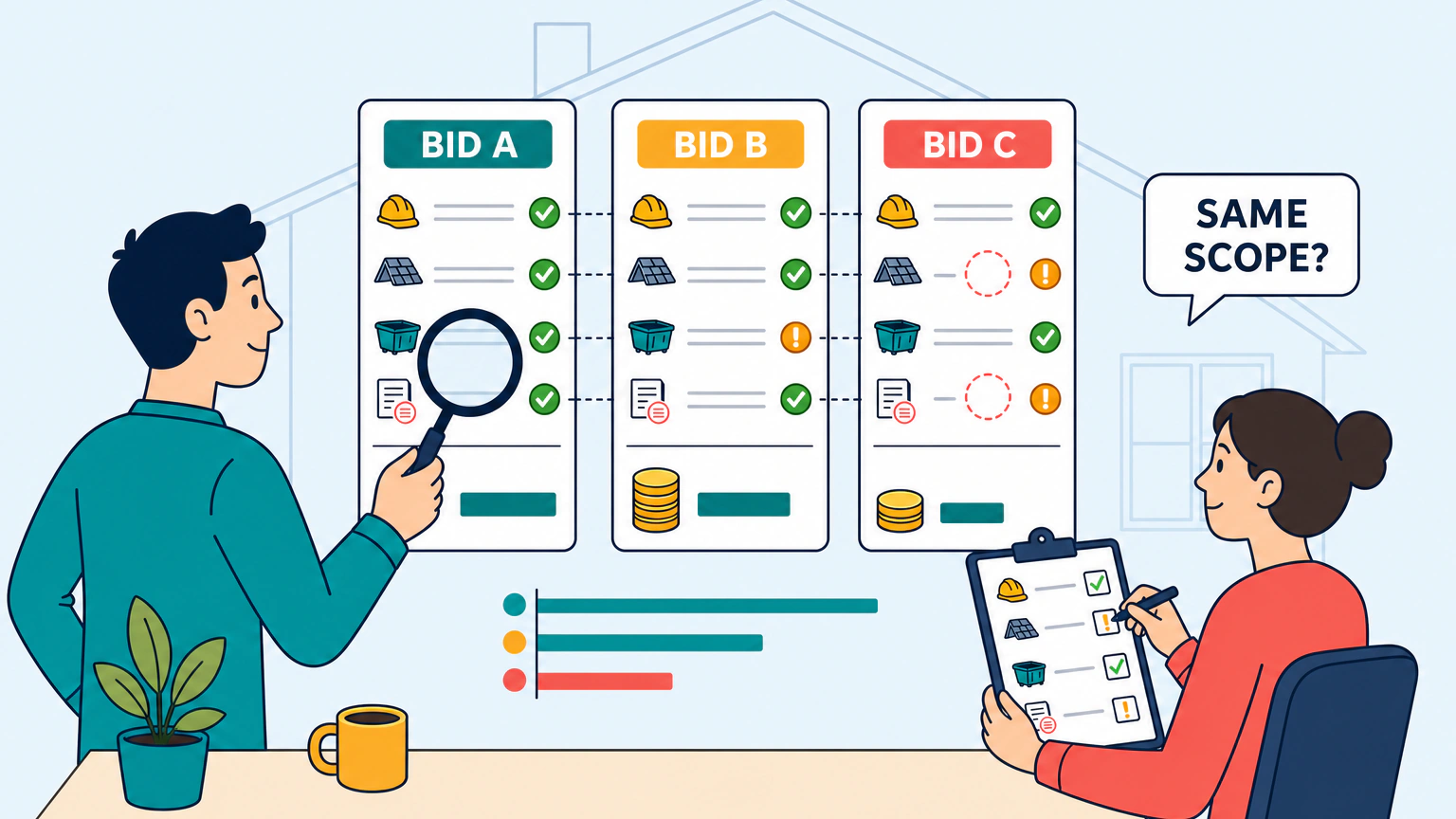
Three bids for the same kitchen come back at $34,000, $41,500 and $52,000. Nothing on those three pages tells you whether the $18,000 spread is quality, greed, or work that one of them quietly left out.
On this page
- Why three bids for the same job never match
- Before you compare: get every bid onto the same scope
- The five-step bid leveling method
- Worked example: three roof replacement bids
- Reality-check the total against local market data
- The payment terms are part of the offer
- Red flags that should end the conversation
- Before you sign: verify the bid you picked
- Frequently asked questions
- Choosing between the same job three times
Why three bids for the same job never match
A spread is not evidence of a rip-off. It's three businesses reading the same job three ways, and the useful question is what each of them actually put a price on.
The four things contractors price differently
Four variables move a bid before anyone lifts a shingle.
- Labor rate and crew size. Six days with four people and eleven days with two are the same job at nowhere near the same price.
- Material grade and brand. Swap synthetic underlayment for felt and hundreds of dollars move while the line title stays exactly the same.
- Subcontracting. Work bought from a sub carries the sub's margin, and it may carry a general-contractor markup on top of that.
- Overhead and markup. A shop, trucks, insurance and a project manager all cost money, and a smaller firm may not spend it the same way.
Scheduling sits on top of those four. A contractor's workload can influence the price, and by itself it tells you nothing about quality.
What a big spread actually tells you
Read a wide spread as a prompt to check scope, not as proof about price. When one bid lands far under another, check whether it contains the same work. And if what you really came here for is how to tell if a contractor is overcharging, here is the honest answer: totals that describe different jobs can't tell you.
The Federal Trade Commission puts it plainly. "Don't automatically choose the lowest bidder. And ask for an explanation if there's a big difference among the estimates." It names no number of bids, only "get multiple estimates." Three is the industry convention, repeated by Sweeten and BuildZoom. It isn't a rule.
Before you compare: get every bid onto the same scope
You can't level three bids written against three different mental pictures of the job. So the work starts before the bids do, with one page you hand to everybody.
The 12 line items every written bid should show
A bid you can compare is a bid that's itemized. California's Contractors State License Board sets the bar with a single example: a contract should read "install oak kitchen cabinets, manufactured by Company XYZ, model 01381A, as per the plan," not just "install kitchen cabinets." One of those you can check against a delivery. The other you can't.
- Legal business name, street address, phone, and license or registration number
- A written description of the work, broken out by area and trade
- Named materials: brand, model, grade, color, quantity, never category names
- Demolition and tear-off, priced on its own line
- Debris removal, dumpster and disposal fees
- Permit fees, and who pulls the permit
- Labor, shown separately from materials
- Subcontracted work, named by trade
- Every allowance, with a dollar figure and what it buys
- Explicit exclusions: what the bid does not include
- Estimated start and substantial completion dates
- Payment schedule (deposit, progress milestones, final payment trigger), warranty for both labor and manufacturer, and the change-order procedure
Item 6 settles who is responsible for pulling permits before that turns into an argument. And a bidder who asks you to pull them yourself is doing something the FTC lists as a scam signal.
How to issue one scope sheet to all three contractors
Write one page before you invite anybody to bid. Rooms and surfaces. Materials you have already chosen, by brand and model. The ones you haven't chosen, with the allowance you want carried for each. Work you're doing yourself. Anything about access that a crew would otherwise discover on the first morning. Send that page to every bidder, and ask each of them to price it line by line, in your order.
Pro tip: A contractor who won't itemize against your scope sheet has told you something for free. And the ones who do it well have shown you how they communicate before the job starts.
The five-step bid leveling method
The trade calls this bid leveling, and what you end up with is a bid leveling sheet: one grid on which every bid covers identical scope. It's a structured way to compare contractor bids, and how long it takes depends on how complicated the bids are.
Step 1: Put every line item from every bid in one column
Start with the most detailed bid and list every line it names. Then work through the others and add anything they name that the first one missed. You want the union, not the intersection. If any one contractor priced it, put it on the sheet and ask the others whether they included it or excluded it.
Step 2: Flag what is missing, not what is expensive
Now go across each row and mark the bids that say nothing at all about it. Silence is the finding. A bid that's $2,000 cheaper because it leaves out required disposal is incomplete, and you may pay for that line later anyway. Check permits, tear-off, disposal and cleanup every single time.
Step 3: Price the gaps and add them back
Two methods work here, and neither one invents a figure. The better one is to email the contractor who left the item out, ask what they'd charge for it, and get the answer in writing so it becomes part of the bid. If they won't answer, we'd take the highest figure any of the other bids shows. It's deliberately conservative, and the silence earned it.
Step 4: Equalize the allowances
An allowance is a placeholder dollar figure a contractor carries for something you haven't selected yet: tile, cabinets, fixtures. A bid carrying a $3,000 tile allowance looks $6,000 cheaper than one carrying $9,000. Then you go and choose the tile you actually want, and the difference can return as a change order later. Reset every bid to identical allowance figures before you total anything. On a kitchen, price a real selection with kitchen remodelers first.
Step 5: Re-total and re-rank
Add each adjustment to its subtotal and total the bids again. The order can change, so re-rank after every adjustment. One caveat before you get attached to a winner: leveling compares scope, not competence. Verifying the business behind the number comes later.
Filled in with the three roofing bids from the next section, that grid looks like this.
| Line item | Bid A | Bid B | Bid C | Missing from | Gap cost to add |
|---|---|---|---|---|---|
| Tear-off and disposal | $1,150 | $1,420 | $1,600 | none | none |
| Dumpster | missing | $525 | $600 | A | $600 to A |
| Underlayment | $380 felt | $690 synthetic | $1,150 synthetic | none | none |
| Flashing | $240 reused | $610 new | $880 new | none | none |
| Decking replacement (contingency) | missing | $600 (4 sheets) | $900 (6 sheets) | A | $900 to A, $300 to B |
| Ventilation | missing | $395 | $720 | A | $720 to A |
| Permit fee | "owner to obtain" | $285 | $285 | A | $340 to A |
| Labor | $5,630 | $5,000 | $6,400 | none | none |
| Warranty (years, written) | 1 year, verbal | 5 years, written | 10 years, written | A | not priced |
| Cleanup | missing | $325 | $365 | A | $365 to A |
| Subtotal | $7,400 | $9,850 | $12,900 | ||
| Adjustments added | $2,925 | $300 | $0 | ||
| Leveled total | $10,325 | $10,150 | $12,900 | ||
| Rank before leveling | 1st | 2nd | 3rd | ||
| Rank after leveling | 2nd | 1st | 3rd |
That is the Bid Leveling Worksheet, and rebuilding it in your own contractor bid comparison spreadsheet takes one column per bidder.
Worked example: three roof replacement bids
Three roofers walked the same asphalt roof and came back at $7,400, $9,850 and $12,900. HomeAdvisor, a competitor that publishes its own cost dataset, puts roof replacement at a $9,607 national average inside a typical range of $5,902 to $13,374. All three sit inside that band, so the band alone does not explain the spread. A range that wide holds a complete job and an incomplete one just as comfortably.
Step 1 built the union. Bid A named six lines, Bid C named ten. Step 2 found the blanks, and every one of them was on the cheapest bid: no dumpster, no decking contingency, no ventilation, no cleanup, and a permit line that read "owner to obtain."
Step 3 priced them. Bid A's roofer emailed back that he would pull and pay for the permit for $340. On the rest he went quiet, so those gaps carry the highest figure the other bids showed: $600 for the dumpster, $900 for decking, $720 for ventilation, $365 for cleanup. Step 4 equalized the one allowance at six sheets of decking rather than four, so Bid B picks up $300.
Step 5 re-totals. Bid A moves to $10,325 and Bid B to $10,150. The cheapest bid on the day it arrived is now the second cheapest, and the $2,450 that looked like a discount was $2,925 of unpriced work. Same roof, same three roofers, different answer.
The sheet can't decide everything for you. Bid A quoted felt where the others quoted synthetic, and it reuses the existing flashing. Those are grade choices worth a question rather than omissions. The warranty is the line to press on, because a one-year verbal warranty is not the written warranty you need. For your own local band, start with roofing contractors near you.
Reality-check the total against local market data
Leveling tells you which bid is cheapest relative to the others. It can't tell you whether all three are high. For that you need a number from outside the bidding entirely.
Bid Spread Check
Enter your lowest and highest bid. We'll show you how far apart they are and where both numbers sit against the published range for that kind of work.
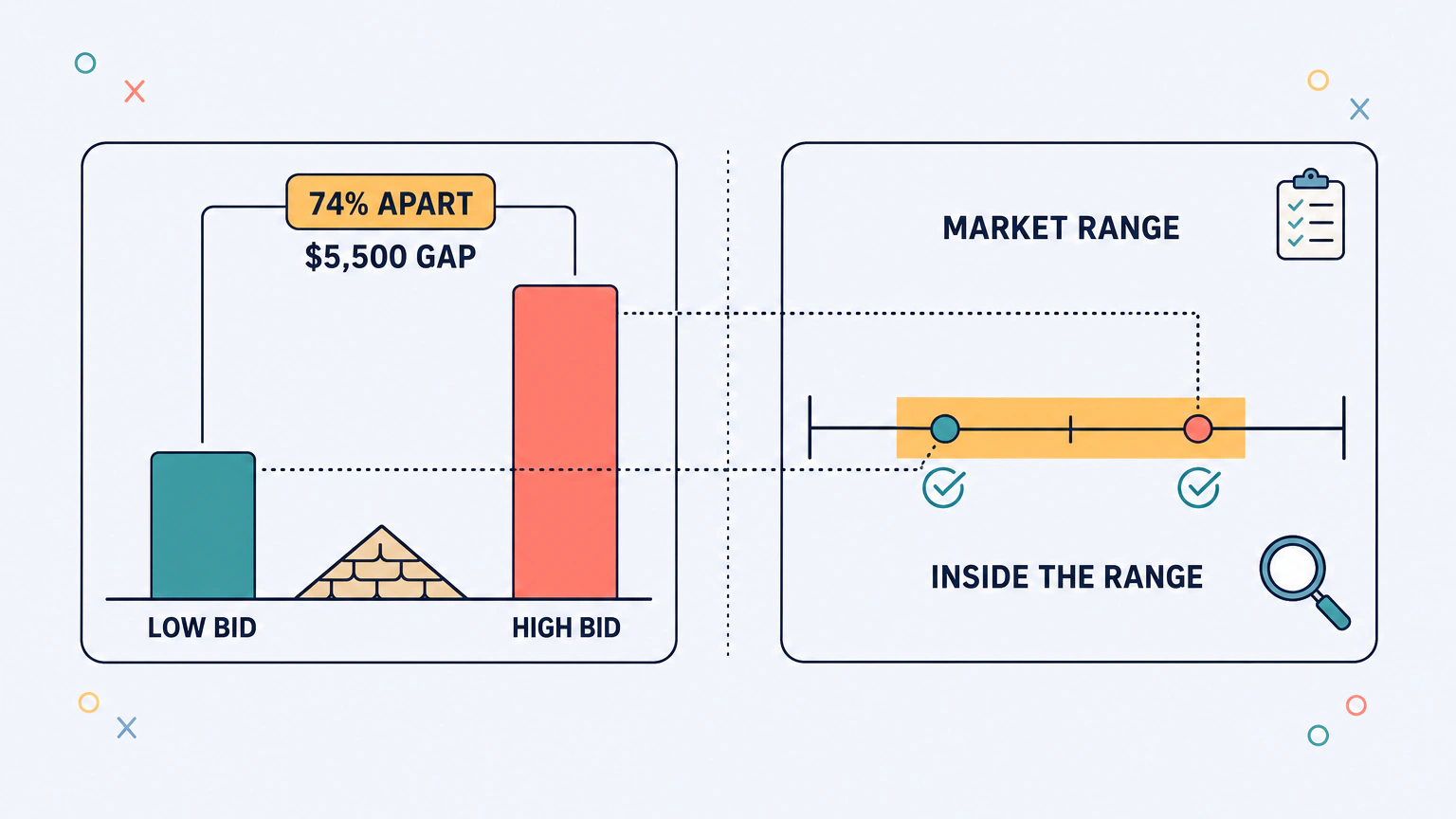
Two roofing bids of $7,400 and $12,900 are 74% apart — a gap of $5,500. Both sit inside the published typical range for a roof replacement, $5,902 to $13,374, against a $9,607 national average (HomeAdvisor, a competitor's published national dataset, updated June 17, 2026).
The FTC's advice is to 'ask for an explanation if there's a big difference among the estimates.' The size of the gap alone does not show that one contractor is overcharging; compare the scopes line by line.
We only show a range where there is a published one to show.
The smallest total you were quoted.
The largest total you were quoted.
What your numbers say
Your bids are 74% apart — a gap of $5,500.
Your two bids match to the dollar
Enter both bids to see how far apart they are.
We swapped these for you.
The FTC's advice is to 'ask for an explanation if there's a big difference among the estimates.' The size of the gap alone does not show that one contractor is overcharging; compare the scopes line by line.
Both of your bids fall inside the published typical range for a roof replacement, $5,902 to $13,374, against a $9,607 national average (HomeAdvisor, a competitor's published national dataset, updated June 17, 2026). When both bids sit inside the market range, the band alone does not explain the gap; compare the scopes line by line.
Level the two bids line by line before you compare the totals — the five steps above, then the worksheet.
Been asked for a deposit? What a contractor can legally take before work starts depends on your state — see how much to pay a contractor up front.
Where these figures come from
- Roof replacement, $5,902 to $13,374 typical, $9,607 national average. HomeAdvisor roof replacement cost page, updated June 17, 2026. This is a competitor's published national dataset, not ours. Checked August 9, 2026.
- General contracting / multi-trade, $3,294 to $52,258 average price range. Drawn from 656 cost profiles on industryoversight.com/general-contractors/. This band is our own site-controlled first-party data. Checked August 9, 2026.
- Kitchen remodel, bathroom remodel, HVAC replacement and Something else. No verified reference band exists for this block, so none is shown and none is estimated.
- How the percentage is calculated. The gap is divided by the lower bid, so the lower bid is always the denominator.
Figures checked August 9, 2026. Cost bands are reference ranges, not quotes, and actual costs are location-dependent. General information, not legal advice.
Where Industry Oversight's cost profiles fit
Our own page for vetted general contractors in your area shows an average price range of $3,294 to $52,258, against a $25,200 national average.
Now the limits, because a figure published without its method is a marketing claim. That is our own data, gathered by us, and not independent third-party data. We take no referral fees and businesses cannot pay for placement, which removes one motive without changing the fact that we are marking our own homework. The provider list is localized while the cost module labels its average national, and a band that wide is a starting point rather than a verdict. Open the page for your own category and metro, and read it fresh.
When a bid outside the range is still the right bid
A bid above the band is a question to ask, not a disqualification. Bids run legitimately high for steep or multi-story access, structural damage found on the walk-through, historic-district requirements, code-triggered upgrades that arrive with the permit, and scope the others skipped. Ask which of those applies, and ask for the answer in writing on the bid. A below-band bid deserves the first scope check, though the range alone can't show you why it is low.
The payment terms are part of the offer
Two bids with identical totals are not the same offer. One wants 40% before the truck arrives and holds nothing back at the end. The other stages payments against completed work. At the same number, the second one is cheaper, because your money stays yours longer.
Put the payment schedule next to the totals
Add three rows to your sheet. The deposit each bidder asks for. How many progress payments there are, and what triggers each one. How much is held back until the punch list is closed. A bid with no retainage has removed one source of leverage when the last 5% drags.
What about the deposit? A contractor who wants a large payment before a tool has been lifted is telling you something, and in some states a demand that size may also be against the law. Deposit caps are set state by state, and which rule applies depends on where the work is happening and what the contract is worth. Put whatever each bidder asks for on your comparison sheet, then check the rule where you live before you sign. See how much to pay a contractor up front for the state-by-state limits, the special-order-materials exceptions, and a payment schedule you can copy into the contract.
Progress payments, and never paying ahead of the work
Tie every payment to a completed, inspectable milestone instead of a calendar date. "Dried in and passed rough inspection" is a trigger. "July 15" is not. And treat "materials ordered" as a different sentence from "materials delivered to my property." The FTC's guidance is short enough to memorize: don't pay the full amount for the project up front, and never make the final payment until the work is done and you are satisfied.
Your right to cancel
For a qualifying sale covered by the FTC Cooling-Off Rule, the seller must give written notice of your right to cancel within three business days. Read "qualifying" carefully. The rule covers certain sales made at your home or a seller's temporary location and has exceptions, so it does not attach to every home-improvement contract. For a California contract with the three-day right, the contractors board says cancellation must be in writing and mailed before midnight of the third day. A phone call is not a cancellation.
We're not your lawyer, and cancellation and deposit rules are written state by state. Check the rule where the work is happening, and on a contract big enough to hurt, have someone read it who does this for a living.
Red flags that should end the conversation
The FTC publishes most of these warning signs. The last two are contract defects it flags in the same guidance.
Stop the conversation if:
- They knocked on your door because they were "in the area."
- They say they have materials "left over from a previous job."
- They're pressuring you for an immediate decision. Urgency is the tool. The signature is the target.
- They want the full amount up front, or will only accept cash. Both reduce your leverage before work starts.
- They're asking you to get the required building permits.
- They're suggesting you borrow money from a lender they know. The FTC documents this as a loan scam against your home.
- The contract they handed you has blank spaces in it. Anything can be written in after you sign.
- Their license or registration number is not on the estimate. The FTC lists it among the items a contract should include.
Before you sign: verify the bid you picked
Leveling picked a bid. Three checks confirm the business behind it, and each one proves something narrow.
Run the license number on the estimate through your state board's own lookup rather than the copy the contractor handed you. That proves the number is live and belongs to this business. It doesn't prove trade competency, and requirements vary by state, county and city.
Ask for a certificate of insurance, then validate it with the insurer named on it. A forwarded certificate proves a document exists. It doesn't prove the policy is in force.
Then check identity and complaint history: physical address, years in business, what past customers report. Years in business is not proof of experience with your job. How Industry Oversight vets the pros it lists sets out the standard we hold ourselves to.
Frequently asked questions
Why do contractor estimates vary so much?
Because they may not be pricing exactly the same job. Labor rates, crew size, material grade, subcontracting and overhead all move the number, and two bids can carry different sets of line items entirely. Level the scope first. Whatever difference survives that is the real one, and it's the only difference worth arguing about.
Is a contractor's bid the same thing as an estimate or a quote?
Not reliably. The labels aren't used consistently: an estimate may be a projection, while a quote or bid may be offered as a firmer price. What matters more than the word on the page is whether the number is written, itemized and tied to a defined scope. Ask which one you are being handed.
How many contractor estimates should I get?
Three, by convention. Marketplaces such as Sweeten and BuildZoom repeat that number, but it is a norm rather than a rule, and the FTC says only to get multiple estimates without ever naming a figure. On a $60,000 project, a fourth bid costs you an afternoon and can pay for itself.
Should I pick the lowest estimate?
Possibly, after leveling and vetting. The FTC's wording is "don't automatically choose the lowest bidder," which is not the same as never. If a low bid still holds the same scope once the missing lines are added back and the allowances are equalized, and its license and insurance check out, it isn't a low bid. It's a low price.
What should be included in a contractor's estimate?
The FTC says a written estimate should include a description of the work to be done, materials, completion date and the price. Treat that as the floor rather than the target. Our 12-item checklist is the version you can actually compare bid to bid, and contract requirements vary by state on top of it.
How much can a contractor ask for upfront?
It depends on where the work is happening. Some states cap the deposit by law, so a demand that is routine in one place may be illegal in another. Whatever the figure, put it on your comparison sheet, because a bid that wants more money earlier is a more expensive offer at the same total. See how much to pay a contractor up front for the limit where you live.
What are construction allowances, and why do they make a bid look cheaper?
An allowance is a placeholder dollar figure a contractor carries for a selection you haven't made yet, such as tile, cabinets or fixtures. Set it low and the bid looks cheap today, while a change order can arrive later, once your real choice turns out to cost more. Equalize allowances before comparing totals, or you are comparing guesses.
Can I cancel a contract with a contractor after signing?
Sometimes, but not automatically. For a qualifying sale covered by the FTC Cooling-Off Rule, the seller must give written notice of your right to cancel within three business days. The rule covers certain sales made at home or at a seller's temporary location and has exceptions. For a California contract with the three-day right, the contractors board says cancellation must be mailed before midnight of the third day, and state law may add other rights.
Choosing between the same job three times
Take the bids on your desk and build the union of every line item. Price the missing ones back into the bids that skipped them. Equalize the allowances, re-total, re-rank, and look at what is left. If your project is not roofing or a kitchen, browse all 66 service categories and open the page for your trade to check whether it publishes a usable cost module. The goal was never to find the cheapest contractor. It was to make sure that when you choose, you are choosing between the same job three times.