


It can become your problem if you directed the injury-producing work, created or failed to address a dangerous condition, or were legally the worker's employer. The rules and exceptions vary by state, and workers' compensation does not erase a separate claim against a negligent third party.
On this page
- The short answer, and the policies that may respond
- Why workers' compensation coverage matters
- What actually puts the bill on you
- What your own homeowners policy does, and where it stops
- Read the certificate before you read the estimate
- Where to check coverage in your state, for free
- If somebody does get hurt at your house
- Frequently asked questions
The short answer, and the policies that may respond
Several policies may matter when somebody is hurt at your house. They do not line up in one fixed queue.
Workers' compensation ordinarily pays benefits to a covered employee injured on the job and protects the employer from most employee lawsuits. A contractor's general liability policy covers some claims for injury or damage the business causes to third parties; it is not a substitute for workers' compensation or employers' liability. Your homeowners liability and medical payments coverage may respond to a claim against you, subject to your policy's terms and exclusions.
Your exposure depends on more than which policies exist. State law, employment status, control of the work, the cause of the injury and each policy's terms all matter.
| Who got hurt | Which policy answers first | What that usually means for you |
|---|---|---|
| An employee of a company you hired | That company's workers' compensation ordinarily pays employee benefits | The worker may still bring a separate claim against you if state law allows it and alleges you caused the injury |
| A one-person contractor with no workers' compensation | No workers' compensation benefit is automatic | Any claim against you turns on legal liability and your policy's terms and exclusions |
| A subcontractor's worker on a job run by your general contractor | The subcontractor's or general contractor's workers' compensation may apply, depending on state law and the project arrangements | Ask the general contractor to confirm coverage for every worker |
| Someone you hired, pay and direct yourself | Depends on your state's household employment rules | You may be their employer, with the duties that follow |
So the next question is what can create a claim against you even when workers' compensation exists.
Why workers' compensation coverage matters
A lettered truck or ten years of good reviews tells you nothing about whether a crew carries workers' compensation.
What workers' compensation actually does
Workers' comp is the no-fault bargain sitting under most jobs in the country. The Texas Department of Insurance describes it in a sentence: a policy "provides lost wages and medical benefits to employees injured on the job," and, except where gross negligence causes a death, "coverage limits liability if an employee sues your business for damages."
A covered worker can receive benefits without proving the employer was at fault, and the employer is shielded from most employee lawsuits. That protection does not automatically bar a claim against a third party, including a homeowner.
That distinction matters: workers' compensation protects the employer, while a claim against you is judged separately.
The one-person crew is the gap
A sole proprietor with no employees may not be required by state law to carry workers' compensation for himself.
State rules differ sharply. Texas lets private employers stay out of the system in most cases. Florida requires coverage from the first employee in construction, while qualifying corporate officers and LLC members may file an exemption for themselves. California now requires most active licensed contractors to keep workers' compensation paperwork on file, even if they report having no employees.
That makes coverage worth checking before you hire tree services or anyone else working at height.
What actually puts the bill on you
Liability usually turns on control, dangerous property conditions and whether the law treats you as the worker's employer. You can reduce each risk before the work starts.
When you start directing the work
New York writes control directly into statute, which makes it a useful illustration. Labor Law section 240 puts ladder and scaffold duties on "all contractors and owners and their agents, except owners of one and two-family dwellings who contract for but do not direct or control the work." Section 241 carries the same exemption.
The exemption is written for homeowners who do not direct or control the work. New York courts construe those words strictly and look for supervision of the method and manner of the work.
Where the line falls in a real case is a fact question, and we won't pretend there's a bright rule. Handing up a bottle of water isn't directing the work. Merely supplying a ladder is not necessarily enough either; New York courts look for significant participation in how the work is performed. That matters on jobs you can't see: hire roofing contractors and the important work happens above your head, which is where the urge to shout instructions gets strongest.
When you knew about the hazard and said nothing
Premises-liability rules differ by state. A dangerous condition you created or knew about can matter, especially when it was not obvious to the worker.
The rotted tread on the deck stairs. The hidden irrigation line under the lawn. The breaker panel with the wrong labels.
Write the list down, hand it over before anyone starts, and keep a copy.
When you are the employer, not the customer
This is the one nobody sees coming. Hire a person directly, pay them yourself, set what gets done and when, and some states stop calling you a customer.
California's Labor Code section 3351(d) counts anyone employed by the owner or occupant of a residential dwelling, doing work incidental to owning, maintaining or using the place, as an employee. Section 3352(a)(8) pulls them back out if, in the 90 calendar days before the injury, the employment "was, or was contracted to be, for less than 52 hours" or "for wages of not more than one hundred dollars ($100)." If either limit is met, this definition excludes the person. Crossing both limits removes that particular exclusion, but other classification rules can still matter.
Section 2750.5 goes further, with a rebuttable presumption that a worker performing services requiring a contractor's license is an employee rather than an independent contractor. The state licensing board spells out the consequence for owner-builders: if your workers are hurt, or your subcontractors aren't licensed or carry no insurance and they're hurt, "you could be asked to pay for injuries and rehabilitation through your homeowner's insurance policy or face lawsuits."
New York draws its line at hours. Yard work and occasional chores around a one-family, owner-occupied home need no coverage. It's required if the chores are regularly scheduled, if a minor handles power-driven machinery including a power lawnmower, or if a domestic worker puts in forty or more hours a week for the same household.
Those household-employment rules concern people you hire directly, not a company's employees.
What your own homeowners policy does, and where it stops
Most people quietly assume their homeowners policy is a general-purpose net under everything that happens on the property. It isn't. The NAIC's consumer guidance is precise about the scope: homeowners insurance covers your home and your belongings "as well as your personal legal responsibility (or liability) for injuries to others or their property while they're on your property." It names four standard coverages: property damage, additional living expenses, personal liability and medical payments.
Read the operative words again. Your personal legal responsibility. The policy answers for covered claims against you. A worker's compensation claim and a separate claim against you are different matters.
The Insurance Information Institute is blunt about one edge. If you were required by law to buy workers' compensation and didn't, "your homeowners or other applicable policies will not pay for any fines, court awards or any other penalties against you."
Red flag: four answers that should slow you down. - "Don't worry, you're covered under your homeowners policy." Your policy may cover your liability; it does not replace their business insurance. - "I'm bonded." A bond is not a substitute for liability or workers' compensation insurance. - "I'll email you the certificate myself." Ask for the agent's details instead. - "My guys are all subcontractors, so I don't need comp." That's exactly the arrangement California's Labor Code declines to take at face value.
Medical payments is small, fast and does not need a lawsuit
Medical payments to others can pay a visitor's covered medical expenses without anyone establishing legal liability. Whether it applies to a worker or contractor depends on the policy's terms and exclusions.
It is also capped at the amount on your declarations page. The NAIC notes that additional liability and medical payments coverage may be available "for a nominal premium," so ask your insurer what a higher limit would cost.
California puts workers' comp in homeowners policies for household employees
California has a specific rule for household employees. Insurance Code section 11590 says no policy providing comprehensive personal liability insurance may be issued or renewed in the state without coverage for workers' compensation liability to a person defined as an employee by Labor Code section 3351(d). If the policy doesn't contain that provision, it doesn't matter. The section says such a policy "shall be construed as if such provisions were embodied therein."
Two limits ride with it. Section 11591 removes the requirement where the work relates to the insured's own trade or business, and 11590 itself steps aside where other existing, valid and collectible workers' comp already covers the injury. This is a California rule, so a policy written in another state may work nothing like it.
Read the certificate before you read the estimate
Ask for proof of insurance and you'll be handed one sheet of paper, usually an ACORD certificate of liability insurance. The Insurance Information Institute's advice to anyone hiring a firm is exactly that: "Ask the firm for a copy of its certificates of insurance, which provides documentation that the firm provides workers compensation for its employees."
Start at the top, because the header is startling and true. "THIS CERTIFICATE IS ISSUED AS A MATTER OF INFORMATION ONLY AND CONFERS NO RIGHTS UPON THE CERTIFICATE HOLDER." The form tells you in capital letters that it's a snapshot, not a promise. Read it anyway. The right seven things on that page are most of what you need.
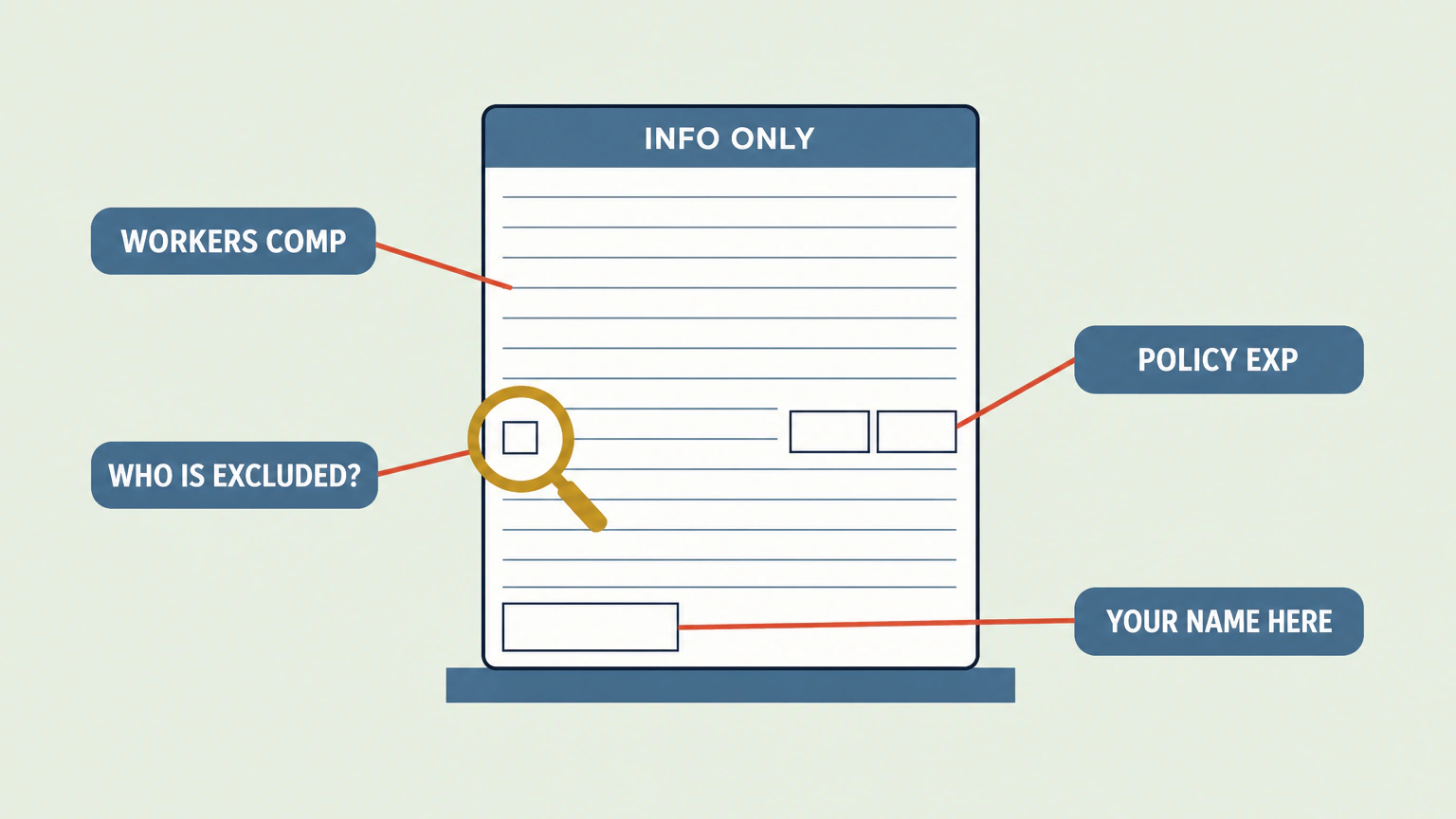
- The name of the insured. Check it against the business name on your estimate. If the names differ, ask the agent which entity is insured and how it is related to the person who quoted you.
- The "WORKERS COMPENSATION AND EMPLOYERS' LIABILITY" row. Look for a policy number in it. An empty row means no workers' comp on this certificate, whatever the conversation in your driveway suggested.
- The box reading "ANY PROPRIETOR/PARTNER/EXECUTIVE OFFICER/MEMBER EXCLUDED?" A "Y" means at least one person in one of those listed roles is excluded from that policy. If an excluded person is going up the ladder, ask the agent what coverage protects that person.
- The "POLICY EXP" date. Hold it against the dates your job will actually run, including any possible delay.
- The general liability limits, and the warning above them. The form says "LIMITS SHOWN MAY HAVE BEEN REDUCED BY PAID CLAIMS," so treat the printed number as a ceiling, not a balance.
- The certificate holder box. That's where your name goes, and on its own it gives you nothing. The fine print says that if the certificate holder is an additional insured, "the policy(ies) must be endorsed."
- The producer. That's the agency that issued the form. The form also lists the insurers and their NAIC numbers, which you can check through your state insurance department.
A certificate tells you about coverage, not about whether the man holding it is who he says he is. If he turned up three days after a hailstorm, how to tell a storm chaser from a real contractor is the other half of this check.
Ask the agent, not the contractor
A certificate that arrives from the agency named in the producer box is worth more than a PDF forwarded by the contractor, and the reason is regulatory rather than cynical.
A certificate cannot expand what the policy says. Texas put the principle into statute: Insurance Code section 1811.155 states that a person "may have a legal right to notice of cancellation, nonrenewal, or material change" only if that person is named within the policy or an endorsement to it, and the policy, the endorsement or state law requires the notice. Being typed into the certificate holder box satisfies neither condition.
So look up the producer independently before you call. Confirm the policies are in force today, then ask the question almost nobody asks: does the workers' compensation policy cover the specific people who'll be at my house?
Where to check coverage in your state, for free
Workers' compensation is state law, and state rules differ sharply. California requires current coverage paperwork for most active contractor licenses. Texas lets private employers stay out of the system in most cases. All five states below provide a public route to check coverage or license records, though the tools differ.
| State | What the state requires | Free public lookup | What you will see |
|---|---|---|---|
| California | To issue, reinstate, reactivate, renew or maintain an active license, a contractor must have a current workers' compensation certificate or self-insurance certification on file. A qualifying joint venture with no employees can file a statement instead (Bus. & Prof. Code § 7125, operative January 1, 2026) | CSLB "Check a License" | License status and complaint disclosure; Section 7125 requires the workers' compensation paperwork to be on file with the board |
| Washington | Contractors must be registered and bonded, and an employer with employees must keep its workers' comp account paid to date | L&I "Verify a Contractor, Tradesperson or Business" | Registration, bond, whether the workers' comp account is active and paid to date, safety citations, lawsuits against the bond, and a printable Certificate of Workers' Comp Coverage |
| Florida | Construction employers need coverage from the first employee, including owners who are corporate officers or LLC members. Non-construction employers from the fourth. Officers and members may file an exemption, and on issuance that person "is not an employee and may not recover workers' compensation benefits" | Division of Workers' Compensation Proof of Coverage database, plus the Exemption Search | The policy on file, or an exemption filed in that person's name |
| New York | Coverage required for employees, with separate household rules for casual labor and domestic workers. Owners of one and two-family dwellings who contract for but do not direct or control the work sit outside Labor Law §§ 240 and 241 | Workers' Compensation Board, "Does Employer Have Coverage?" | Policy and coverage information filed by insurers from January 1, 2002 to date |
| Texas | Private employers may choose not to carry workers' compensation in most cases. Employers without it are non-subscribers and must report that to the state | TDI "Workers' compensation insurance coverage verification" | Links to subscriber, self-insurer and non-subscriber records; TDI provides an email route when status is unknown |
These five are the ones we read against each state's own source. The other 45 run their own rules, and here's how to find yours.
If your state is not in the table
Search for your state's workers' compensation division or industrial commission, then look for a proof of coverage search, an employer coverage search or a certificate lookup. Those are the three names the same tool travels under.
If your state licenses contractors, check the license record first. Some states attach coverage status to the license record, as Washington does; others publish it separately.
Where nothing public exists, call the agent. That is a good way to ask what was in force on the date you call, but the policy and endorsements still control.
If somebody does get hurt at your house
Skip the rest and start here.
- Call 911 for a serious injury or a suspected head, neck or back injury.
- If you suspect a head, neck or back injury, don't move the person unless staying put is more dangerous than moving.
- Photograph the scene and the equipment before anything is tidied up. The ladder where it fell, the ground, the tools, the weather.
- Write down what happened and who was there while it's fresh. Names, times, what was said.
- Notify your own insurer promptly, even if you're certain this isn't your problem.
- Ask the contractor for their carrier's name and the claim number once it's open. Give both to your insurer.
Pro tip: we'd hold off on promising to pay anybody's medical bills directly, however decent it feels in the moment. Report it to your insurer first. Homeowners policies can require permission before you make voluntary payments, except for first aid at the time of the injury.
We're not your lawyer or your insurance agent, and a serious injury is the moment to call both.
Frequently asked questions
Does homeowners insurance cover a contractor who gets hurt at my house?
Sometimes. Your policy can cover your legal responsibility for injuries on the property, and medical payments may pay covered expenses without anyone proving fault. But both are subject to terms and exclusions. A workers' compensation claim and a separate claim against you can exist at the same time.
Can a contractor sue me if he falls off my roof?
He can file. Workers' compensation does not automatically prevent a separate claim against a homeowner who allegedly caused the injury. Whether that claim succeeds depends on state law and the facts, including who controlled the work and whether a dangerous property condition contributed to the fall.
How do I check whether a contractor really has workers' compensation?
Start with the state: Washington, Florida, New York and Texas publish coverage-verification routes. California requires current workers' compensation paperwork for most active contractor licenses, so verify the license status there. Then look up the agency in the producer box independently and ask it to confirm the policy is current. Don't rely on a PDF the contractor emails you.
Do I need workers' compensation for someone who does yard work for me?
In New York, not for occasional chores around a one-family, owner-occupied home. Coverage is required if the jobs are regularly scheduled, or if a minor handles power-driven machinery including a power lawnmower. California runs a different test: if the work came to under 52 hours, or wages of not more than $100, in the 90 days before an injury, the person falls outside the definition. Other states set their own lines.
The certificate says the owner is excluded. What does that mean?
It means at least one proprietor, partner, executive officer or member is excluded from that policy. The box itself does not tell you why, and it does not prove the particular person on your roof has other coverage. Ask the agent to identify who is excluded and what, if anything, covers that person.
What if the contractor works alone and says he doesn't need coverage?
He may be right about the legal requirement, because workers' compensation generally covers employees and a crew of one has none. That still leaves a gap. If he is hurt, whether your homeowners policy responds depends on your legal liability and its terms and exclusions. Ask his agent what coverage, if any, protects him personally.
Before the next person works on your house, run both checks. Pull the state record, then look up the producer independently and ask whether the policy is current and covers the people who will actually be there. Then hire.
If you're starting from an empty list, vetted general contractors near you is the place to begin, and how Industry Oversight vets the pros it lists sets out the standard they clear first. The insurance check belongs in the same conversation as the money, so settle how much to pay a contractor up front while you're there.