

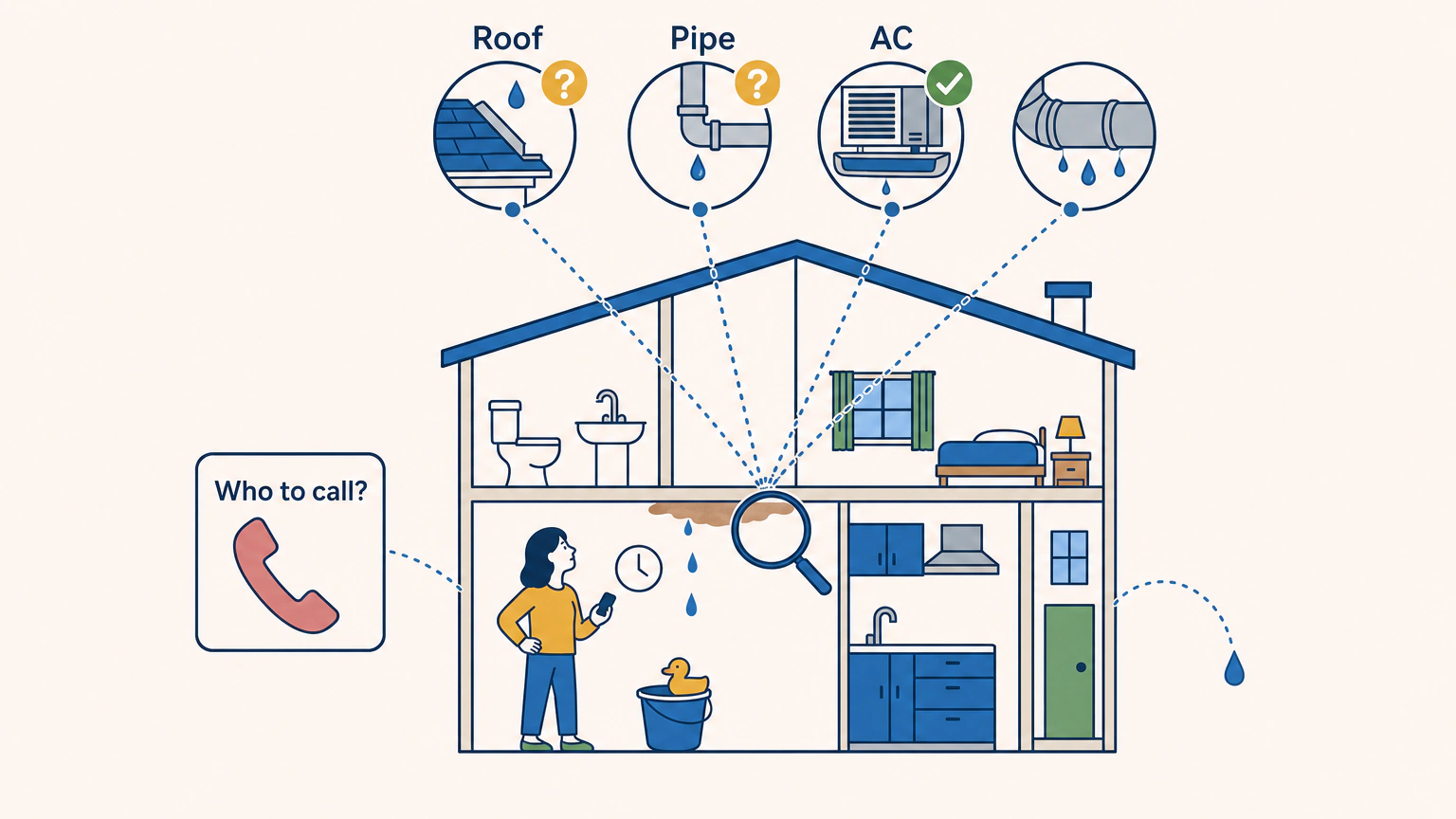
Stop here if any of this is true right now: the ceiling is sagging or bulging, water is at or near a light fixture, ceiling fan or smoke alarm, or it's actively pouring. Clear the room. Cut power to that circuit at the panel only if you can reach it without entering water; otherwise call an electrician. Treat it as an emergency rather than a diagnosis.
Industry Oversight lists all four trades and sells none, so we rank the suspects instead of picking one. If a named storm brought the stain, start with the order of calls after a storm.
On this page
- First, is this an emergency or do you have time to think?
- The four suspects behind almost every ceiling stain
- Three tests that narrow it down in about twenty minutes
- What the stain itself tells you
- Who to call, and what the first visit actually costs
- The 48-hour clock, and how to tell a real remediation call from a sales pitch
- Insurance: what a ceiling leak claim turns on
- Fixing the ceiling comes last
- Frequently asked questions
First, is this an emergency or do you have time to think?
Three signs that mean act now, not later
Any one of these means stop diagnosing and start moving. The ceiling is sagging, bulging or drooping. Water is near a light fixture, fan or alarm. It drips faster than a bucket can catch it.
Safety: Water and electricity together are lethal, and nothing written from a distance replaces somebody standing under your ceiling. If it's sagging, leave the room and call a professional.
The first ten minutes
Move furniture and electronics clear, put a container under the drip, and shut off the main if plumbing is a suspect. Photograph and video everything before you clean up, because drying and cleanup can remove visible evidence. If it's 10 p.m. and you're weighing tonight against tomorrow morning, what an after-hours call actually costs has the math.
Should you poke a hole in a bulging ceiling?
No. Published consumer guidance conflicts, and we won't split the difference on this one. If the ceiling is bulging, leave the room and call a professional before puncturing it.
The four suspects behind almost every ceiling stain
The roof — and why the stain is almost never under the hole
Water gets in at flashing, a vent boot, a valley or a missing shingle, then runs along the decking to a low point, so the stain may appear several feet from the entry point. Call roofing contractors in your area, unless it's a stain that tracks the chimney, which can point to a failing crown or liner.
A supply or drain line on the floor above
Go stand in the room directly over the stain. If a bathroom, kitchen or laundry sits above it, look there first: a failed toilet wax ring, a shower pan leak, a pinhole in a supply line. A drain leak stains in bursts, when someone uses the fixture. A supply line drips day and night.
Your air conditioner — the condensate drain and pan
In summer this moves up the list. A residential AC can pull gallons of water a day out of the air. When the condensate line clogs or the pan rusts through, the overflow can land on the ceiling below the air handler. A condensate overflow switch may shut the system off when the pan or drain backs up. Call HVAC contractors.
Pro tip: the float switch that prevents this. A condensate overflow switch can shut the system off before a backed-up pan spills. Not every air handler has one. Ask an HVAC technician whether yours does, and to install or test it during a maintenance visit.
Condensation, ice dams and "ghosting" — the stain that isn't a leak
Under-insulated ducts and vent boots sweat in a humid attic, and an exhaust fan vented into the attic dumps its moisture into the insulation. In cold climates, ice dams push meltwater back under the shingles and stain a top-floor ceiling with no hole in the roof. Ghosting isn't water: soot and dust along cold framing lines, in evenly spaced stripes rather than a ring.
| Likely source | Where the stain shows up | When it gets worse | Evidence that confirms it | Who to call | What the first visit typically costs |
|---|---|---|---|---|---|
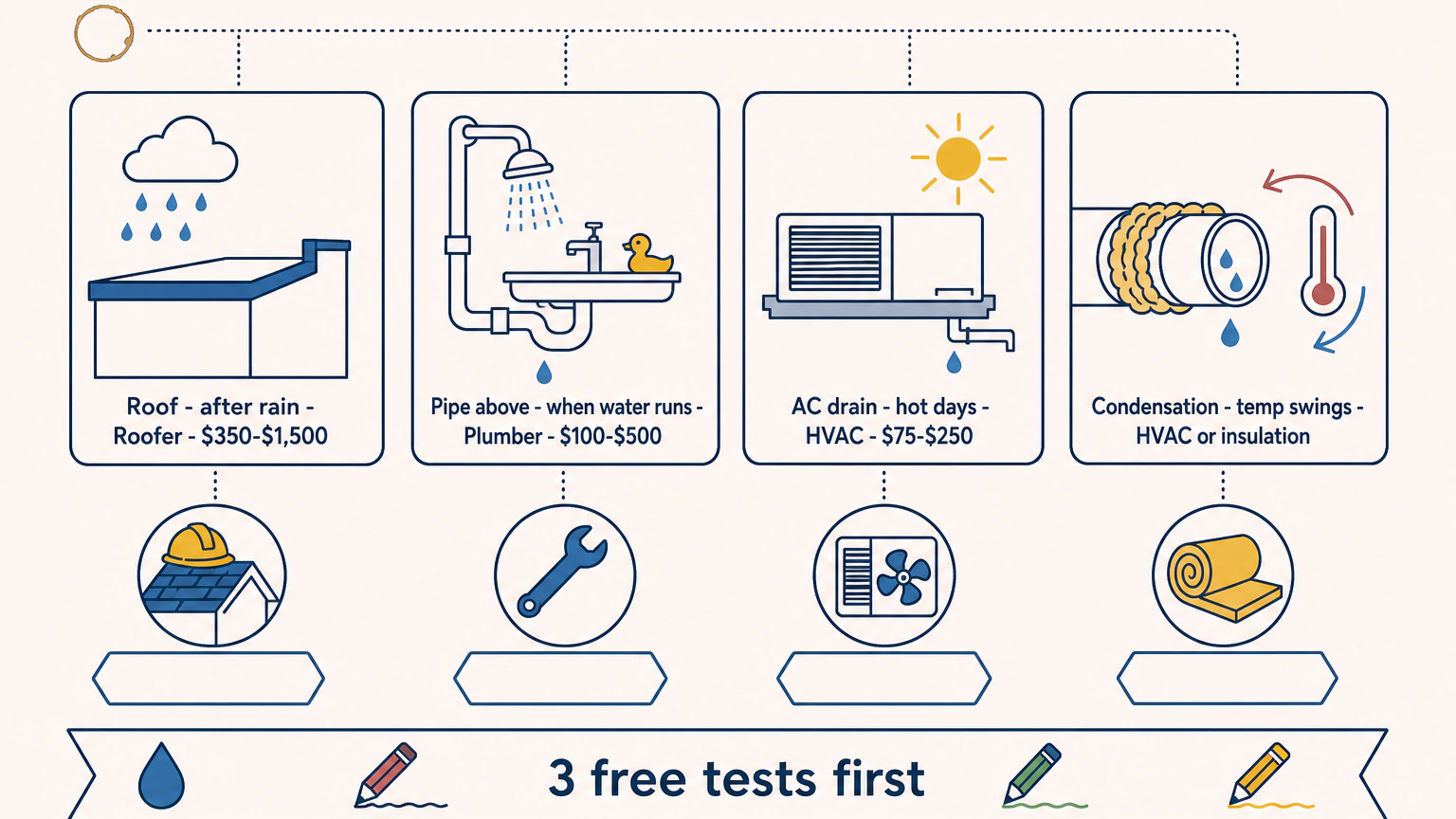
| Roof | Top floor; chimneys, skylights, walls | Rain, snowmelt, ice dams | Damp insulation, stained sheathing | Roofer | $350-$1,500, avg $800 (Fixr, 2026) |
| Pipe above | Below a bathroom, kitchen or laundry | Fixture use; continuous on a supply line | Musty smell, high water bill, creeping meter | Plumber | $100-$500 (Angi, 2026); $241-$292 (Homewyse, May 2026) |
| AC condensate | Near a vent or the air handler | Hot, humid weather; heavy cooling run time | Water in the pan, gurgling, shutdowns | HVAC | Clearing $75-$250 (HomeGuide, 2026) |
| Condensation, ice dam, ghosting | Duct runs, vent boots, exterior walls | Temperature and humidity swings | Sweating ducts, exhaust fan in the attic | HVAC, insulation, roofer | Within a service visit |
Three tests that narrow it down in about twenty minutes
Test 1 — the weather-and-water log
Mark the edge in pencil and date it. For a few days, note whether it rained, whether anyone showered or ran laundry, and how hard the AC worked. Growth after rain points at the roof, growth after fixture use at plumbing, and growth on hot, humid days at condensate.
Test 2 — the shut-off test
Turn off the main water supply and wait at least 15 minutes. When you slowly turn it back on, a rush of water may indicate a leak. With every indoor and outdoor water fixture off, a changed meter reading also indicates a possible plumbing leak. Neither test identifies the leak's location.
Test 3 — the look from above
If the attic is safely accessible, take a flashlight in, never go onto the roof, and step only on joists or truss chords. If insulation or joists are wet, stop and call a professional. You're looking for damp insulation in a wide patch, stained sheathing, daylight through the deck, water in an air handler pan, and an exhaust duct off its fitting. Where the space above is a finished floor, check it for soft spots and the caulk around the tub and toilet.
Before you call anyone: twenty minutes of evidence
- Photograph the stain straight on with a coin for scale.
- Pencil the current edge and date it.
- Note what sits directly above: room, fixture, equipment.
- Touch it: damp and cool, or dry and hard?
- Press near the edge: firm, or soft and spongy?
- Write down the last seven days of weather.
- Run the shut-off test, then turn the water back on slowly.
- Read the water meter with every fixture off, then again in fifteen minutes.
- If the attic is safely accessible, look from the hatch; do not enter if insulation or joists are wet.
- If an air handler sits above, check its pan.
- Photograph what you find, dry areas included.
- Note when the stain first appeared; your insurer will ask.
What the stain itself tells you
Old damage or active leak?
Put your hand on it. Damp and cool, dark, spreading, no rings, drywall firm: that reads as active. Dry, yellow-brown, hard-edged and ringed reads as older, each ring roughly one soak-and-dry cycle. Squishy means saturated, whatever the color. Nobody dates water damage precisely, though, and a dry stain does not prove the source stopped.
What is leaking onto your ceiling?
Answer three questions about what you can see. We'll match the four usual suspects to your clues and tell you who fixes each one.
Top-floor ceiling, worse after rain, dry stain with rings - here is what that points to. Top of the list: Your roof - matches both clues.
Danger - stop and clear the room
Clear the room. Cut power to that circuit at the panel only if you can reach it without entering water; otherwise call an electrician. Do not stand under the ceiling or press on it. Call for emergency help before you diagnose anything.
No pattern means timing alone cannot identify the source. With every indoor and outdoor fixture off, record the water-meter reading, wait at least 15 minutes without using water, and read it again. A change indicates a possible plumbing leak but does not identify this stain's source.
-
Matches both clues Your roof
WhyWater gets in at flashing, a vent boot, a valley or a missing shingle, then runs along the decking before it drips, often several feet from where it entered.
When it gets worseDuring and after rain, snowmelt, ice dams.
Confirm it yourselfMark the edge of the stain in pencil, write today's date beside it, and check it after the next rain.
Who to callA roofing contractor.
What it costsRoof leak repair $350-$1,500, national average $800 (Fixr, 2026); minor vent-boot and shingle fixes from about $100.
-
Matches one clue Condensation or an ice dam
WhySweating ducts, an exhaust fan venting into the attic, or winter meltwater backing up under the shingles can all stain a top-floor ceiling without a hole in the roof.
When it gets worseTemperature and humidity swings rather than rain; ice dams in deep winter.
Confirm it yourselfIf the attic is safely accessible, inspect from the hatch with a flashlight; do not enter if insulation or joists are wet, and call a professional instead.
Who to callAn HVAC or insulation contractor; a roofer if you get ice dams every winter.
What it costs
-
No direct match A pipe above
WhyThere is no bathroom, kitchen or laundry above this ceiling, and the stain tracks the weather rather than water use.
When it gets worseWith fixture use, or continuously if it is a pressurized supply line.
Confirm it yourselfWith every indoor and outdoor fixture off, record the water-meter reading, wait at least 15 minutes without using water, and read it again. A change indicates a possible plumbing leak but does not identify this stain's source.
Check for a plumbing leakWith every indoor and outdoor fixture off, record the water-meter reading, wait at least 15 minutes without using water, and read it again. A change indicates a possible plumbing leak but does not identify this stain's source.
Who to callA plumbing contractor.
What it costsLeak detection $100-$500 (Angi, 2026); $241-$292 typical to find a plumbing leak (Homewyse, May 2026).
-
No direct match The AC condensate drain
WhyThe stain is not near a vent or the air handler, and it grows with rain rather than with cooling season.
When it gets worseHot, humid weather; heavy cooling run time.
Confirm it yourselfLook at the air handler: standing water in the pan, gurgling at the unit, or a system that keeps shutting itself off. A condensate overflow switch may shut the system off when the pan or drain backs up.
Who to callAn HVAC contractor.
What it costsCondensate drain-line clearing runs $75-$250 (HomeGuide, 2026). Ask an HVAC technician whether your system has a condensate overflow switch and what installation would cost.
This stain looks like an older event. That does not mean it stopped - it means it soaked and dried at least once. Mark it, date it, and watch it through the next rain.
If anything is wet, dry it within 24-48 hours. The EPA says that in most cases mold will not grow if wet materials are dried inside that window - it is a guideline, not a guarantee.
Price ranges are from the publishers named on each line. Cost profiles and vetted-provider counts are Industry Oversight's own data, not an independent audit. General information only - not a substitute for an on-site professional assessment.
Why the stain came back after you painted it
Because paint is not a diagnosis. Fix the source first, let the cavity dry, then prime before the topcoat. A stain can bleed back through fresh paint even after the leak is fixed if it was not sealed with a stain-blocking primer.
Who to call, and what the first visit actually costs
The cost of finding out
| Path | Diagnostic visit | Typical repair range | Source and year | Industry Oversight category cost profile |
|---|---|---|---|---|
| Plumbing leak | $100-$500; $241-$292 per leak | Varies by fixture and access | Angi 2026; Homewyse May 2026 | $178-$465 typical, $318 avg, 629 profiles |
| Roof leak | In the repair quote | $350-$1,500, avg $800 | Fixr 2026 | $5,297-$10,348 typical, 944 profiles (whole trade) |
| AC condensate | In the service call | Clearing $75-$250 | HomeGuide 2026 | $3,865-$7,463 typical, 832 profiles (whole trade) |
| Restoration and drying | Moisture readings at assessment | Scope-driven | Industry Oversight, 2026-08-03 | $1,428-$6,120 typical, $2,550 avg, 570 profiles |
| Mold inspection | The inspection is the purchase | Sampling quoted separately | Industry Oversight, 2026-08-03 | $295-$1,031 typical, $662 avg, 890 profiles |
| Ceiling drywall repair | Quoted with the patch | One-sheet patch is below the band | Industry Oversight, 2026-08-03 | $996-$2,618 typical, $1,780 avg, 708 profiles |
Those Industry Oversight profiles are our own platform data, not an independent audit, and the roofing and HVAC bands cover whole trades weighted toward replacement rather than leak repair.
Why paying for the diagnosis is the cheapest decision on this page
A leak caught early may require only a vent-boot repair or a cleared drain line. Left alone, the same leak can damage decking, insulation and drywall and require remediation. The Insurance Information Institute puts the average water damage and freezing claim at $13,954, and in 2022 that category alone was better than a quarter of all homeowners claims.
The ninety-second check before anyone comes out
Confirm five things first: an active license for that trade where your state requires one, a physical street address rather than a call-center number, years in business, a dated review count, and IICRC certification for restoration. Our own licensing and address checks are ours, not an independent audit: that's how Industry Oversight vets the companies it lists.
The 48-hour clock, and how to tell a real remediation call from a sales pitch
What the EPA actually says
The EPA is careful here: "In most cases, mold will not grow if wet or damp items are dried within 24-48 hours." A guideline, not a guarantee. Some water-damaged porous materials may have to be discarded, and the EPA names ceiling tile, insulation and drywall among them. If the cavity is wet, that's when water damage restoration companies bring drying equipment. And if anyone in the house has asthma, allergies or a weakened immune system, that's a question for a doctor, not a checklist.
Categories 1, 2 and 3 — the words that decide how much of your ceiling comes out
Demolition scope follows the water category, which comes from ANSI/IICRC S500, the water restoration standard, now in its fifth edition (2021). The standard is a paid publication, so take these as the working definitions rather than the exact clause text. Category 1 is sanitary: a broken supply line, rainwater, melting snow. Category 2 is significantly contaminated: washing machine or dishwasher discharge, a toilet overflow with urine. Category 3 is grossly contaminated: sewage and floodwater. Categories are not fixed: Category 1 water can deteriorate to Category 2 or 3 as conditions change or contaminants are introduced. So ask which one the technician assigned, and why, before agreeing to any demolition. A good one has the answer ready.
Red flags in a restoration pitch
Red flag: one of these should slow the conversation down. Several should end it at the door.
- Arrives uninvited after a storm, or calls before you called anyone.
- Wants an assignment of benefits signed before you have read it or called your insurer.
- Quotes a demolition scope before taking a moisture reading, or hides the readings.
- Says the whole ceiling must come out without naming the water category.
- Demands a large cash deposit, or any deposit before work is scheduled.
- Cannot produce a license number, a physical address or IICRC certification.
- Offers to "handle the insurance company for you" in exchange for control of the claim.
The FTC sees the same pattern: pressure to decide immediately, payment up front or in cash, claims that no license is needed, and requests to sign your insurance check over.
Insurance: what a ceiling leak claim turns on
Sudden and accidental versus gradual
A burst supply line is a common example of a sudden loss that may be covered. A slow leak that stained the same spot for months is usually excluded as gradual damage. Washington State's Office of the Insurance Commissioner says burst pipes and failed appliances are usually covered when reported promptly, while gradual seepage and delayed repairs may not be. Rain entering through storm damage may be covered, but water flowing across the ground is flooding, which standard homeowners insurance typically excludes.
Document before you clean up, and keep the receipts
Photograph and video before you move or dry anything. Then take reasonable steps to stop the damage, and keep the receipts. Most policies carry both a duty to mitigate and a reporting deadline, in the section headed Duties After Loss.
When filing may not be worth it
Run the arithmetic first. If the likely repair sits near or below your deductible, a claim can cost more over time, because even a small paid claim follows you into your renewal. We'd think hard before filing on a cleared drain line. Your policy and your state's law decide what is covered, and if a claim gets handled unfairly, your state department of insurance is the neutral route.
Fixing the ceiling comes last
Drywall, texture and paint only make sense once the source is repaired and the cavity is dry, confirmed with a meter. Patch it early and you pay for the same ceiling twice. A small patch is handyman work. A full sheet or matched texture belongs to drywall and plaster contractors, where our own listing data puts the typical job between $996 and $2,618. Roof and restoration bids never match each other, so compare the repair quotes line by line before you sign, and for plumbing start with licensed plumbing contractors near you.
Frequently asked questions
Who do I call first for a water leak in the ceiling — a plumber or a roofer?
Use timing as a clue, not a diagnosis. Growing during or after rain, with only attic and roof above? Call a roofer. Growing when someone showers or does laundry? Call a plumber. No pattern? Check the meter with every fixture off. A changed reading indicates a possible plumbing leak, but it won't identify the ceiling stain's source.
Can there be a water stain on the ceiling with no leak?
Yes. Sweating ducts, an uninsulated vent boot, an exhaust fan venting into the attic, or an overflowing condensate pan all stain a ceiling with no hole in the roof. Evenly spaced stripes along the framing are ghosting: soot and dust, not water.
Is a water stain on the ceiling dangerous?
A dry, ringed stain that feels firm is usually not an emergency. A sagging or spongy ceiling is: wet drywall loses strength and can collapse. Water near a light fixture is urgent for a different reason, and the EPA's mold clock runs 24 to 48 hours.
How can I tell if a ceiling water stain is old or new?
Damp, cool, dark, spreading and without rings usually means active. Dry, yellow-brown, hard-edged and ringed means older, each ring roughly one soak-and-dry cycle. Nobody dates water damage precisely, and a dry stain does not prove the source stopped. Mark the edge, date it, and let the next week tell you.
Can a ceiling actually collapse from a water leak?
Yes. Wet drywall loses strength quickly, and a bulge means water has pooled above a sheet that is already failing. Clear the room and keep people and pets out. Cut power to that circuit only if you can reach the panel without entering water; otherwise call an electrician. Don't press on it.
Does homeowners insurance cover a ceiling leak?
Usually only when the damage was sudden and accidental: a burst supply line, a failed appliance hose. A slow leak that stained one spot for months is normally denied as maintenance. Washington State's regulator is blunt: damage you let get worse is not covered.
How much does it cost to find out where a ceiling leak is coming from?
Plumbing leak detection runs $100 to $500 on Angi's 2026 figures, and Homewyse puts the typical single leak at $241 to $292. Roofers fold the diagnosis into the repair quote. Clearing an AC condensate line runs $75 to $250, per HomeGuide. Cheap, next to the ceiling.
Should I puncture a bulging ceiling to let the water out?
No. Published consumer guidance conflicts, so take the version that doesn't end with a sheet of ceiling in your arms: leave the room and call a professional before puncturing a bulging ceiling.