

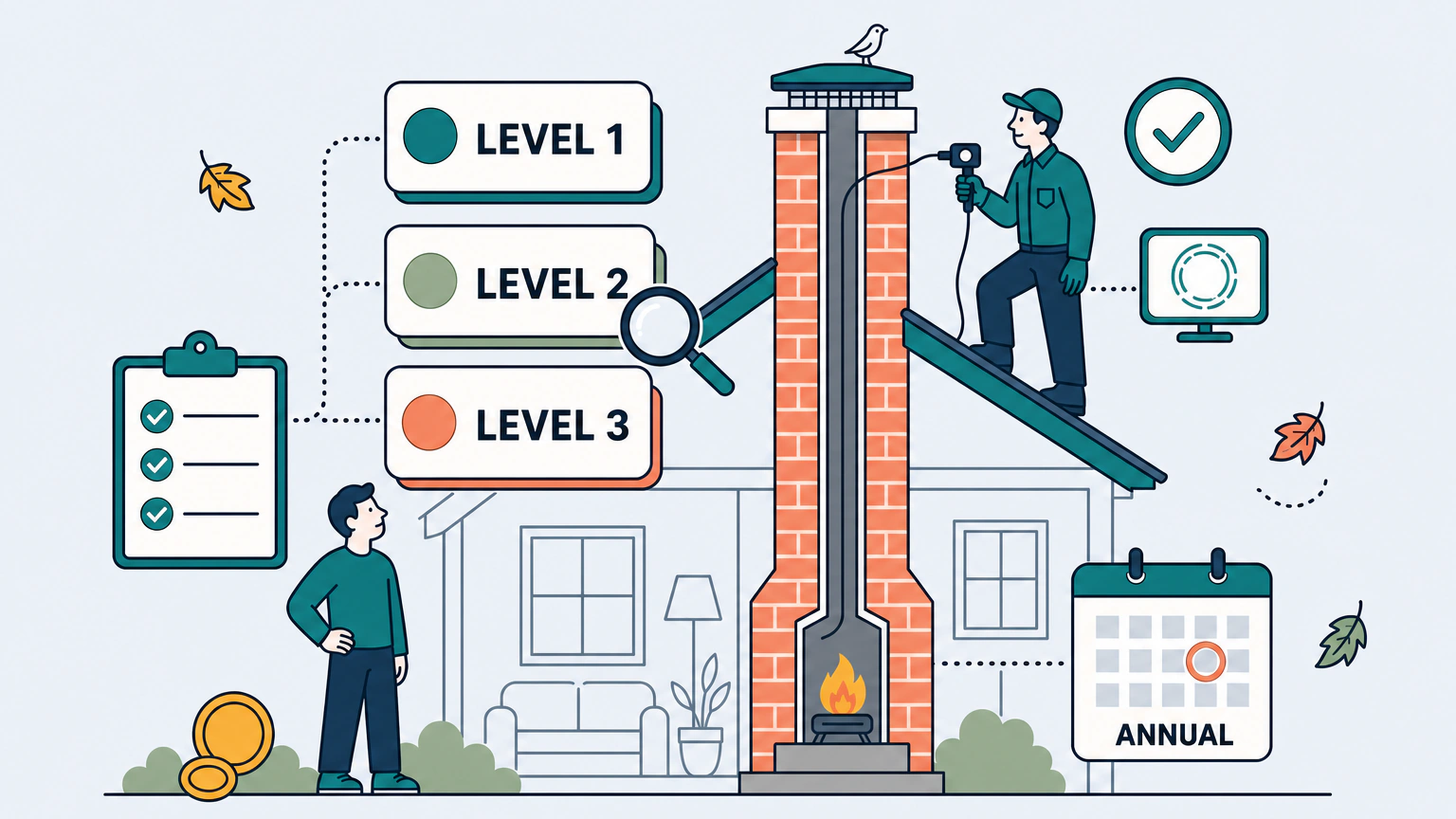
If nothing about your fireplace or chimney has changed since last winter, you need a Level 1: the routine annual check, usually $100 to $250 including a basic chimney sweep cleaning. You need a Level 2, which adds a video scan of the flue and runs $250 to $600, only when something changed or something happened: you are buying or selling the home, you swapped the appliance or the fuel, the flue is about to be relined, or a fire, storm or earthquake was likely to have damaged the chimney.
On this page
- A sweep and an inspection are not the same purchase
- The three levels, in plain English
- Which level does your situation call for?
- How often, and does it still apply if you barely use the fireplace?
- What it costs in 2026
- Why any of this matters, in numbers
- How to hire the person who does the inspection
- The pressure tactics to walk away from
- Book it in August, not in October
- Frequently asked questions
A sweep and an inspection are not the same purchase
Cleaning is maintenance. Inspection is assessment. Two purchases, and the ad rarely says which one you're getting. The Chimney Safety Institute of America (CSIA), which certifies sweeps, wants the inspection yearly and the sweeping as needed.
That gap is where the money leaks. A "$99 chimney sweep special" might buy a Level 1 and a written report. Or twenty minutes with a brush and nothing on paper.
So ask one question when you book: does this price include a Level 1 inspection, and will I get a written report? HomeGuide says most inspections include cleaning, and prices a Level 1 with basic cleaning at $100 to $250 (2026).
The three levels, in plain English
Nobody in the trade invented these tiers. They come from NFPA 211, the Standard for Chimneys, Fireplaces, Vents, and Solid Fuel-Burning Appliances, now in its 2027 edition. Certified sweeps are tested on it, and NFPA publishes it online with free read-only access.
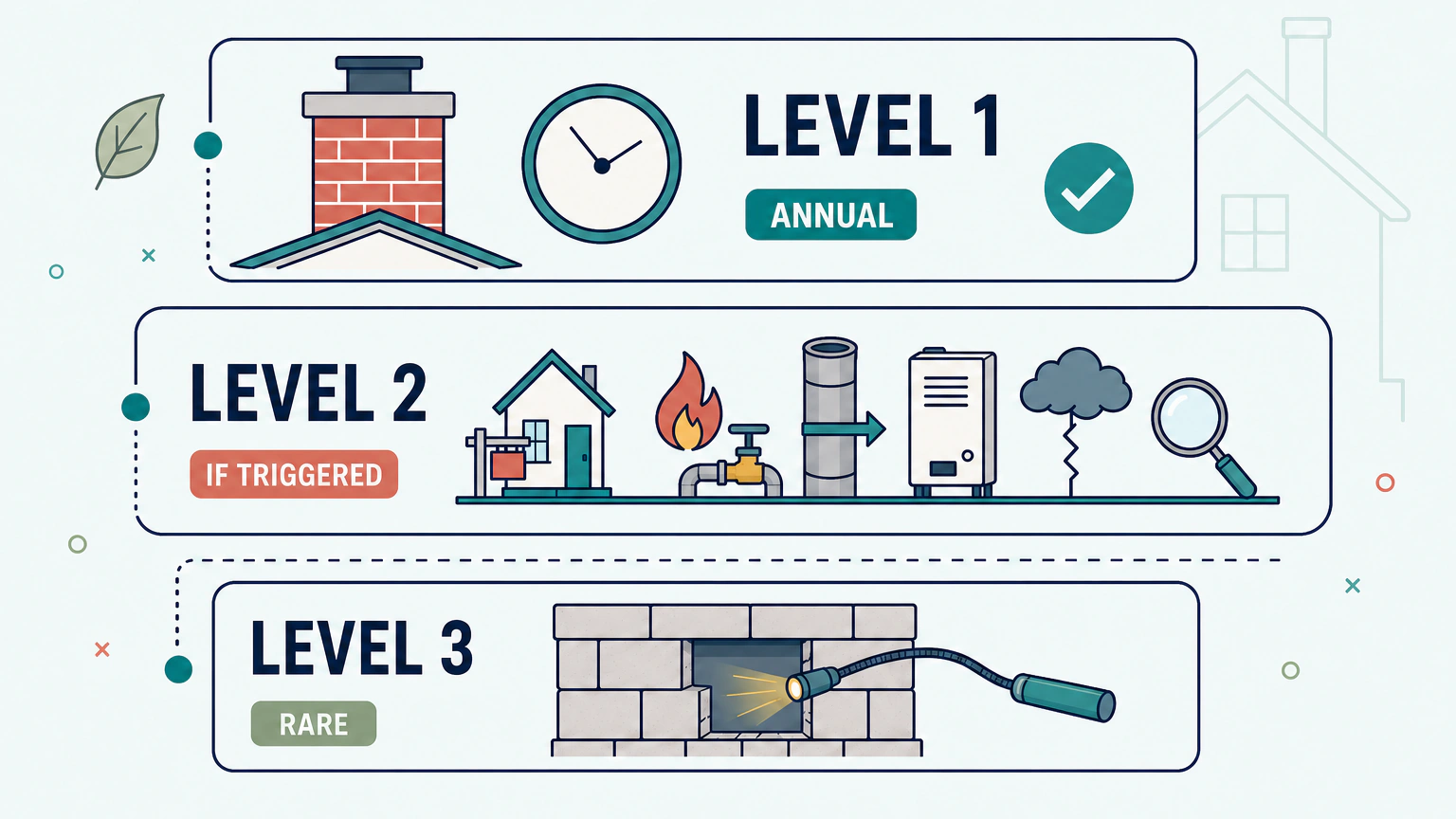
Level 1: the routine annual check
The technician checks the readily accessible parts of the chimney, appliance and connection for sound structure, a clear flue and correct clearances. Figure 30 to 60 minutes. On an unchanged system that's the whole job, and anyone proposing more should name the trigger.
Level 2: the one triggered by change or by an event
Everything in the routine check, plus the accessible spaces nobody thinks about, plus a camera down the flue to see the internal surfaces and joints. Nothing gets demolished. No panels come off with special tools. Expect 60 to 90 minutes.
Level 3: the invasive one, and it is rare
Reserved for concealed investigation after an incident known to have caused damage, or for a hidden hazard that a Level 1 or Level 2 turned up but cannot evaluate without opening concealed areas. Opening those areas means removing attached parts of the chimney or building. Demolition with a clipboard.
| Level | What the standard covers | Tools used | Typical time | Typical 2026 cost | When it applies |
|---|---|---|---|---|---|
| Level 1 | Readily accessible chimney, appliance and connection: soundness, no obstruction or deposits, basic clearances | Flashlight and hand tools, no panels removed | 30 to 60 min | $100 to $250 including basic cleaning (HomeGuide) | Annual check on an unchanged system |
| Level 2 | Level 1 plus accessible attics, crawl spaces and basements, and clearances to combustibles there | Adds a video scan of flue surfaces and joints; opens accessible panels; roof access | 60 to 90 min | $250 to $600 (HomeGuide, 2 flues); $260 to $460 (Angi); to $1,000 for tall or multi-flue (Angi) | Sale, fuel or appliance change, prior to relining, or after an operating malfunction or external event likely to have caused damage |
| Level 3 | Concealed portions of the chimney structure and flue | Removal of permanently attached chimney or building material | Varies, often multi-visit | $900 to $5,000 including minor repairs (HomeGuide, 3 flues) | After an incident known to have caused damage, or when a Level 1 or 2 finds a hidden hazard it cannot evaluate |
Level definitions from NFPA 211 as published by CSIA and the trade. Costs are 2026 ranges from the publishers named. Durations are trade figures, not requirements.
Which level does your situation call for?
An unchanged system in normal use is a Level 1. A change, or an event likely to have caused damage, moves you to a Level 2. The trigger list:
- Sale or transfer of the property.
- A change of fuel type.
- Prior to relining or replacing the flue lining.
- Adding or replacing an appliance of dissimilar type, input rating or efficiency.
- A malfunction, or an event likely to have caused damage: a building or chimney fire, an earthquake, a storm.
If none of that describes your year, the standard isn't asking you to buy the camera scan. Neither are we.
If you are buying or selling
The sale trigger comes from the standard, not from federal law. Whether it binds you depends on local code adoption, your lender or insurer, and your contract. Trade pages calling it "required by law" overstate the case, and they're usually selling the scan.
We'd buy it anyway, because a standard home inspection skips the flue scan, and the seller who finds the problem first controls the negotiation.
If you just replaced or added an appliance
A new furnace, water heater, insert or stove vented into the existing chimney is a dissimilar-appliance change. A flue sized for the old appliance can be wrong for the new one, and sizing drives draft, condensation and deposits. So settle replacing the appliance that vents into it first, then book the inspection.
If there was a chimney fire, a storm or an earthquake
A chimney fire can crack or separate flue material and leave nothing visible from the firebox. The short one that put itself out still counts.
Storm damage never arrives on its own, so after a storm, work out the order of calls.
These filters need JavaScript. The complete level rule and the price ranges for all three levels are listed below.
You need a Level 1 inspection.
This is the routine annual check on an unchanged system. The technician examines readily accessible parts of the chimney, the appliance and the connection, confirming the structure is sound and the flue is clear of obstructions and combustible deposits. Typically 30 to 60 minutes.
This trigger comes from NFPA 211, a national standard, not from federal law. How binding it is where you live depends on local code adoption, your lender or insurer, and your contract.
- Level 1 including basic cleaning: $100–$250 (HomeGuide, 2026)
- Standard sweep including Level 1: $150–$375 (HomeGuide, 2026)
Wood smoke can form creosote in the chimney. Ask what deposit level was found and whether sweeping is included.
Your appliance choice changes this note, not the inspection level.
The whole rule, not just your branch
- Level 1 — the routine annual check when nothing below applies. Including a basic cleaning: $100–$250 (HomeGuide, 2026). Standard sweep including Level 1: $150–$375 (HomeGuide, 2026). Typically 30 to 60 minutes.
- Level 2 — the answer whenever any of the five Level 2 triggers below applies. $250–$600 for up to two flues (HomeGuide, 2026). $260–$460 (Angi, 2026). Up to $1,000 for tall or multi-flue chimneys (Angi, 2026). Typically 60 to 90 minutes.
-
Default, nothing changed and no event
Level 1 Your situation
No trigger applies, so the standard calls for the routine annual check.
-
Sale or transfer of the property
Level 2 Your situation
The standard treats a change of owner as the point where the chimney's condition has to be established.
-
Change of fuel type
Level 2 Your situation
A different fuel puts different demands on the flue, so it is looked at again.
-
Prior to relining or replacement of the flue lining
Level 2 Your situation
The inspection comes first, so the new lining goes into a chimney whose condition is known.
-
Addition or replacement of an appliance of dissimilar type, input rating or efficiency
Level 2 Your situation
What the chimney is venting has changed, even though the chimney has not.
-
Operating malfunction, or an external event likely to have caused damage — building fire, chimney fire, seismic event, weather event
Level 2 Your situation
Something has happened that could have damaged the chimney out of sight.
How often, and does it still apply if you barely use the fireplace?
Once a year. NFPA 211's language, as CSIA publishes it: chimneys, fireplaces and vents "shall be inspected at least once a year for soundness, freedom from deposits, and correct clearances." That covers the flue serving any appliance, gas included.
A rarely used chimney isn't automatically a safe one. Low-use flues fail through animal nests and debris, through water from a cracked crown or failed flashing, and through liner deterioration. None of that cares how many fires you lit.
Sweeping is a separate question, and it follows the creosote, not the calendar. Inspect yearly. Sweep when the inspection says the deposit warrants it.
What it costs in 2026
Two publishers price this work, they don't agree, and we won't average them. Every figure keeps its publisher and its year.
The national bands, side by side
HomeGuide and Angi both publish 2026 level-by-level figures, and they agree on the shape. The camera scan roughly doubles the price of the routine visit. The invasive one is a different category, closer to a small repair job than an appointment.
What moves your price
How many flues, and most bands cover one or two. Chimney height and roof access. Whether a sweep is bundled in. What everything costs where you live.
Bundling a sweep with an inspection or repair can reduce the total cost, so ask for the combined price.
The stale-figure problem
Connecticut's Department of Consumer Protection still tells homeowners that "for $90 to $150, a professional chimney sweep should thoroughly clean your fireplace and chimney and check for defects." Current 2026 national guides put standard chimney-sweep ranges higher, and the state's figure carries no date.
An official-looking number can outlive the market it described. Check your quote against current dated ranges from more than one publisher.
| Service | Published range | Source (year) |
|---|---|---|
| Standard residential chimney sweep including a Level 1 inspection | $150 to $375, national average $275 | HomeGuide (2026) |
| Level 1 inspection including a basic chimney sweep cleaning | $100 to $250 | HomeGuide (2026) |
| Level 2 inspection | $250 to $600, up to two flues | HomeGuide (2026) |
| Level 2 inspection | $260 to $460 | Angi (2026) |
| Level 3 inspection including minor repairs | $900 to $5,000, up to three flues | HomeGuide (2026) |
| Chimney relining | $1,500 to $4,000 typical; $2,000 to $7,000 for cast-in-place or clay liners | HomeGuide (2026), checked 2026-08-05 |
| "Thorough cleaning and inspection" | $90 to $150 | Connecticut Dept. of Consumer Protection, undated page checked 2026-08-05; shown as an out-of-date official figure |
Publisher ranges, not quotes. We publish no cost profile for this category, so we have no price band of our own.
Why any of this matters, in numbers
NFPA's Home Fires Involving Heating Equipment analysis, covering 2014 to 2018, pins the largest single share of home heating fires, 25%, on failure to clean, and notes that creosote ignition is a frequent cause of chimney fires. The same analysis puts 48% of home heating fires in December, January and February. Newer editions supersede those figures.
CDC counts more than 400 U.S. deaths a year from unintentional carbon monoxide poisoning not linked to fires, and a blocked or breached flue is one road there.
Read those as reasons to keep the appointment, not reasons to panic.
If a carbon monoxide alarm sounds, or anyone in the house has a headache, nausea or dizziness that clears up outdoors, get everyone outside and call 911 or the gas utility from there. We can tell you which inspection to buy. Only a person at your chimney can tell you it's safe.
How to hire the person who does the inspection
The standard settles which level. Working out whether the person at your door is any good takes five more minutes.
CSIA certifies people, not companies
Under CSIA's trademark policy, a multi-employee company may use the CSIA certification mark only when at least one currently certified person is on site performing or supervising the work. Check that person through CSIA's Find a Certified Pro locator on csia.org.
Verify the person, not just the company
- Get the name of the technician assigned to your house, then check that person with CSIA.
- Ask whether the company is a National Chimney Sweep Guild member, as a second signal.
- Confirm a physical business address, not a phone number and a "service area."
- Confirm insurance by calling the insurer named on the certificate, not by email.
- Check your state's contractor registry before authorizing repair work.
- Read the review pattern, not the star average: recency, volume, repeated themes.
Chimney repair is often regulated even where sweeping is not
Licensing rules for chimney sweeping vary by state and locality. Repair is the part that more often carries a registration requirement: Connecticut states that "persons who perform chimney repair must be registered as a home improvement contractor in Connecticut." Your own state office settles it for your address.
A shortlist of vetted chimney sweeps near you is a fair place to start. The cards show license badges, a physical address, years in business and review counts. Those are our own checks on our own listings rather than an independent audit, and no business can pay to be listed. Read how Industry Oversight vets the companies it lists, then go verify the license yourself.
Demand the report
No report, no argument. Nothing to get a second opinion on, nothing to hand a buyer, nothing to show an insurer.
What a complete inspection report should contain
- The level performed, named as Level 1, 2 or 3.
- The date, the technician's name, and their certification number if they hold one.
- Photographs of every claimed defect, with enough context to place it on your chimney. For a Level 2, video stills.
- A plain-language description of each finding, sorted into needs repair now, monitor, no action.
- The creosote deposit level found, and whether the flue was swept.
- Any recommended repair priced as a separate written estimate, not folded into the invoice.
The pressure tactics to walk away from
Red flag: the chimney sales script
- Anyone at your door uninvited. Connecticut is blunt: "NEVER hire a chimney sweep who shows up at your door uninvited."
- An unsolicited phone offer at a suspiciously low price, used to get a technician into the house.
- Damage photos that could be of any chimney. Ask which part of yours it is.
- Fear language about carbon monoxide or a house fire, attached to a same-day close.
- Pressure to decide immediately. Connecticut again: "If you are being pushed to make an immediate decision, then make the decision to look for someone else."
- A deposit demanded for repairs or materials before any written contract exists.
- A "24/7 emergency chimney service" with no verifiable address.
If a technician tells you the chimney is unsafe and needs thousands of dollars of work, ask for the report and photographs, decline same-day authorization, and get a second inspection from a company that isn't quoting the repair. A sweep confident in the finding won't mind waiting.
Know the size of the decision. Relining runs $1,500 to $4,000 typically, and $2,000 to $7,000 for cast-in-place or clay liners (HomeGuide, 2026). With more than one quote, compare the repair quotes line by line first. Report suspected fraud to your state attorney general or consumer protection office and to reportfraud.ftc.gov.
Book it in August, not in October
Pro tip: Book in summer, before peak fall demand. If the visit turns up masonry or waterproofing work, temperature and moisture can limit application and curing, so an earlier finding leaves more time for repairs before winter. Photograph your firebox and chimney exterior now, so you have a before-image if a technician later says something changed.
Connecticut points homeowners at "late spring or early summer when heating season is over." Late summer works too, ahead of the fall rush.
The repairs an inspection turns up belong to other trades. Crown repair, tuckpointing, stack rebuilding and relining are masonry repair. Water near the chimney is often failed flashing around the chimney, a roofing job.
Frequently asked questions
What are the three levels of chimney inspection?
Level 1 is the routine annual check of readily accessible areas. Level 2 adds accessible attics, crawl spaces and basements plus a video scan of the flue interior, and something has to trigger it: a change, or an event likely to have caused damage. Level 3 opens concealed parts after an incident known to have caused damage, or when a Level 1 or 2 finds a hidden hazard.
How often should a chimney be inspected?
Once a year, and it isn't the sweep saying so. NFPA 211 calls for chimneys, fireplaces and vents to be inspected at least once a year for soundness, freedom from deposits and correct clearances, and CSIA agrees. Wood, pellets or gas, however rarely you light a fire.
Is a chimney sweep the same thing as an inspection?
No, and the ads blur them. Cleaning is maintenance. Inspection is assessment. HomeGuide says most inspections include cleaning, and prices a Level 1 with basic cleaning at $100 to $250 (2026). Ask which one your quote covers.
Do I need a Level 2 chimney inspection to sell my house?
The standard says yes. NFPA 211 lists sale or transfer of a property as a trigger. Whether it binds you depends on local code adoption, your lender or insurer, and your contract, which is why trade pages calling it "required by law" overstate the case. We'd buy it regardless. A general home inspection skips the flue.
How much does a Level 2 chimney inspection cost?
Published 2026 national ranges are $250 to $600 for up to two flues (HomeGuide) and $260 to $460 (Angi), with tall or multi-flue chimneys toward $1,000 (Angi). Those are publisher ranges, not quotes. Bundling chimney sweeping with inspections or repairs can reduce overall maintenance costs.
Do I need an inspection if I never use my fireplace?
Yes, every year. Low-use chimneys fail through animal nests and debris blocking the flue, water intrusion through a cracked crown or failed flashing, and liner deterioration. None of that depends on how many fires you light.
Does a gas fireplace need a chimney inspection?
Yes. Gas produces little or no creosote, so the flue rarely needs sweeping, but the annual inspection still applies. Blockage, liner damage and improper venting are carbon monoxide risks on any fuel, and CDC reports more than 400 U.S. deaths a year from non-fire carbon monoxide poisoning.
How do I check that a chimney sweep is actually certified?
Ask for the name of the certified person who will perform or supervise the work at your house, then look that individual up through CSIA's Find a Certified Pro locator on csia.org. Under CSIA's trademark policy, a multi-employee company may use the certification mark only when at least one currently certified person is on site. The sticker on the van isn't the check. The name is.
Nothing changed since last winter means a Level 1. A sale, a fuel or appliance change, planned relining, or an event likely to have caused damage means a Level 2. Level 3 opens concealed areas after an incident known to have caused damage, or when a Level 1 or 2 finds a hidden hazard.
So make the call this week. Get the technician's name before the truck arrives, check the credential, and insist on a written report with photographs. For a shortlist, pull vetted chimney sweeps near you.