

On this page
What a contractor recovery fund is, and where the money comes from
If a licensing board says its complaint process can discipline the contractor but cannot repay you, ask a separate question: does the state run a recovery or guaranty fund?
Some states hold a pot of money for this exact moment. Before you start doing the math on how much you should have paid up front, ask the board whether it runs one and what it calls it.
Where the money comes from, and why it matters
The money comes from several places, including license fees, contractor assessments, permit surcharges and contractor penalties. Minnesota charges every licensee $320 to $520 at renewal, scaled to what the business grosses. Virginia's DPOR says its fund is "supported entirely by assessments paid by licensed contractors, not by any tax revenues." North Carolina does it at the permit counter, where an inspector collects $10 for each home a general contractor will build or alter and sends $9 to the state board.
The funding source does not settle eligibility by itself. Still, most of these programs generally cover losses tied to a contractor who held the license or registration the state requires.
These funds also reach past remodeling. Minnesota and North Carolina both cover new single-family construction, so a stalled build by one of the home builders you hired counts too.
What the fund will not pay for
Several states exclude costs beyond the direct loss. Maryland's statute rules out attorney fees, court costs, interest, punitive damages, personal injury and knock-on losses in one breath. Washington's law excludes fees, costs and punitive damages too, and North Carolina's board says much the same.
Virginia is the broad exception, because its statute lets a claim include court costs and attorney fees. Arizona and Nevada have narrower exceptions for contested recovery decisions appealed to court. Maryland adds an exclusion of a different kind: no default judgments. Win because the contractor never showed up in court, and you can be left holding a piece of paper the fund won't read.
What you get back is your direct out-of-pocket loss. Not what the whole mess cost you.
Four questions that decide whether a fund will pay
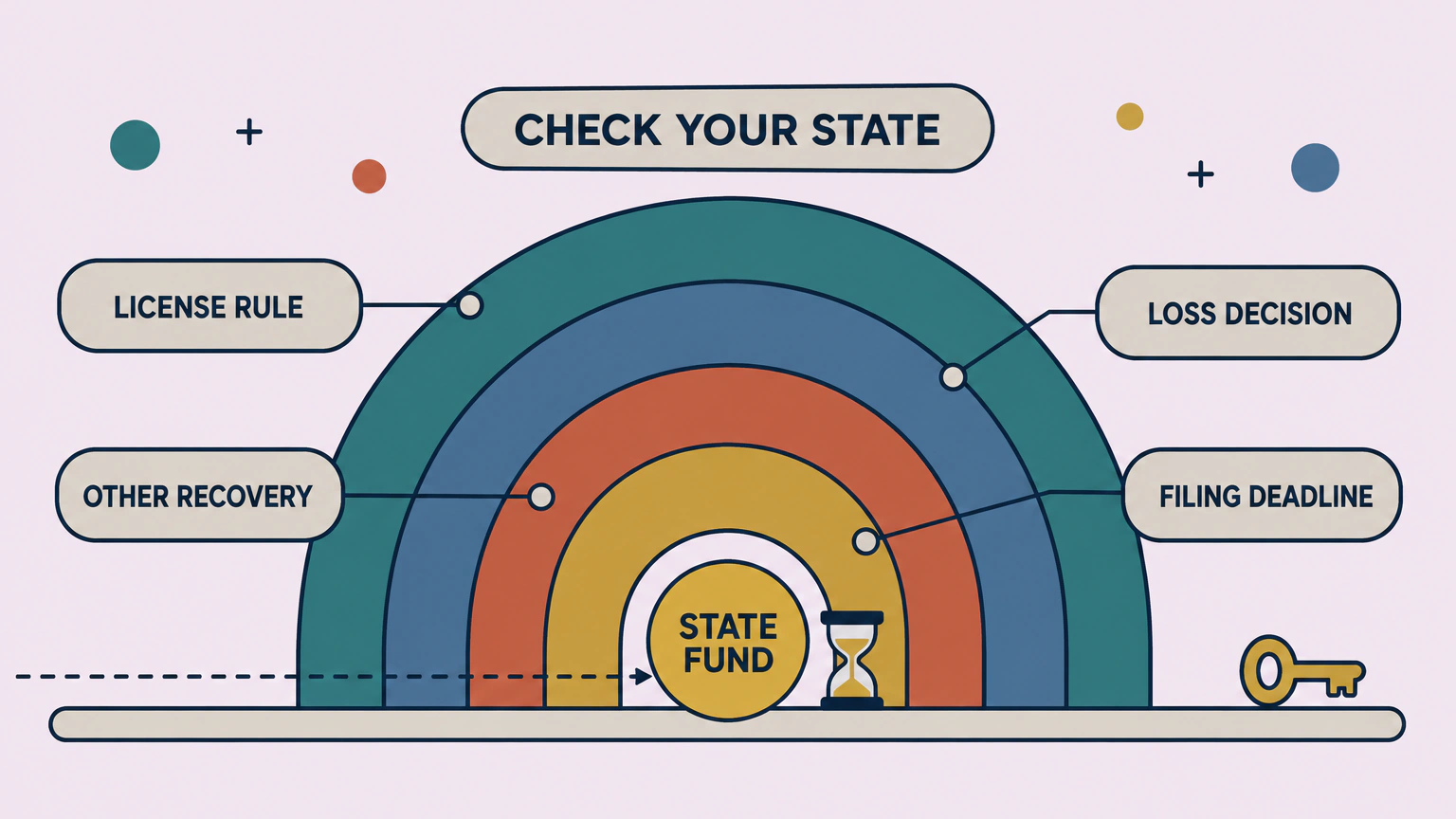
The rules keep returning to four questions: what license status the state requires, who must confirm the loss, what other recovery you must try and which clock applies. The answers vary by state. Missing a required step can end your claim.
What license rule does your state use?
Licensed when, exactly? The answer changes by state, and it can decide the claim. Arizona is the generous version: the contractor has to have held a proper license on the day you signed, the day of your first payment, or the day work started, and any one of the three will do.
Florida is the strict version. Its statute bars a claim where the contractor "did not hold a valid and current license at the time of the construction contract." Nevada shuts the door if the license was suspended or revoked when you signed. North Carolina is the outlier, and a useful one. Its fund also reaches a contractor who wasn't licensed at all but faked it, either by using someone else's license certificate or by posing as a licensed builder to pull the permit.
Some jobs never needed a licensed contractor at all: here's what a handyman can legally do without a license. This is also the one question you can settle before you sign. We check licenses and physical locations before a business goes on our lists, and those are our own checks and our own ratings rather than an outside review. That's how we vet the businesses we list.
Who must confirm the loss?
Most of these funds want a court judgment against the contractor that hasn't been paid. Minnesota asks for a final judgment on grounds like fraud, dishonest practice, taking your money for other purposes or plain failure to perform. In Virginia the judgment has to be unpaid and to rest on improper or dishonest conduct. Washington and North Carolina both need one that remains unsatisfied.
Florida widens the door. It takes an arbitration award or a restitution order from its licensing board in place of a judgment. Maryland's Home Improvement Commission can find the loss itself, so a Maryland homeowner doesn't have to sue anybody. Nevada also lets a homeowner ask its Contractors Board to find actual damages without first obtaining a court judgment.
Five of these eight funds require a court judgment. Florida, Maryland and Nevada also offer routes through arbitration or a board finding.
What must you chase before the fund?
Several are funds of last resort, and their laws make you chase other recovery first. Washington and Arizona both require that you have "proceeded against any existing bond" covering the contractor. Florida wants the limits of any bond, surety, warranty or insurance policy used up first. Virginia sends a claimant holding a judgment against a bonded contractor to the bond, and North Carolina writes it into what counts as a loss: one that no bond, surety agreement or insurance contract covers.
The bond claim doesn't go to the licensing board. It goes to the surety company named on the contractor's license record, a private insurer that wants your paperwork in its own format. Whatever the bond pays then comes off what the fund pays. Virginia caps a single claim at $30,000 including any bond money, so a $10,000 bond payout leaves $20,000 of headroom.
Which event starts the clock?
Washington gives you ninety days from the end of the civil action. Florida and North Carolina each give a year from the end of the case. Virginia allows twelve months after the judgment becomes final, Minnesota two years and Maryland three years from when you discovered, or should have discovered, the loss. Nevada gives you four years after the qualified work is completed to file a Board complaint, or two years after a judgment if you use the judgment route.
The trap is where the counting starts. Most of these clocks begin at the end of a lawsuit you haven't filed yet, so the deadline stays invisible until it's close. Arizona runs the other way and catches people for it. Its two years count from the act itself or from occupancy, and it's the lawsuit that has to be filed inside that window rather than the claim. Miss it there and no judgment is coming, so no claim is either.
We can tell you how these funds work. We can't tell you whether yours will pay, and if the number is big enough to hurt, an hour with a lawyer before you file is money well spent.
What the nine states we checked actually pay
We read the statute or the agency's own page for each of these nine states. Treat this as nine states answered rather than the whole country. Among states with fixed per-claim caps, published limits run from $25,000 to $100,000. North Carolina instead caps an award at 10% of the fund balance when the Board approves it. Filing windows run from ninety days to four years, depending on the route and starting event.
| State | Fund and authority | What it pays | What you need first | Deadline |
|---|---|---|---|---|
| Arizona | Residential Contractors' Recovery Fund, Registrar of Contractors | $30,000 per claimant, $200,000 per license | Court judgment, bond chased first | Sue within two years of the act or of occupancy |
| Florida | Homeowners' Construction Recovery Fund, DBPR and the CILB | $100,000 Division I or $30,000 Division II on contracts signed from July 1, 2024 | Judgment, arbitration award or board restitution order, with bond and insurance exhausted | One year from the end of the case |
| Maryland | Home Improvement Guaranty Fund, MHIC | $30,000 per claimant, $250,000 per contractor | A Commission or court finding. No lawsuit needed, and no default judgments | Three years from when you found the loss |
| Minnesota | Contractor Recovery Fund, Department of Labor and Industry | $100,000 per owner, $550,000 per licensee | Final judgment plus diligent collection efforts | Two years from the judgment becoming final |
| Nevada | Residential Recovery Fund, State Contractors Board | $40,000 per claim, and per contractor the lesser of $750,000 or 20% of the account | A Board finding of actual damages, or an unsatisfied court judgment. Closed to you if you pulled the permit | Four years after completed work for a Board complaint, or two years after a judgment |
| North Carolina | Homeowners Recovery Fund, Licensing Board for General Contractors | Up to actual loss, capped at 10% of the fund balance when approved. The Board sets each award | Unsatisfied judgment, every other route exhausted | One year from the end of all civil proceedings |
| Virginia | Contractor Transaction Recovery Fund, DPOR | $30,000 per claim including bond money, $100,000 per contractor per biennium | Unpaid judgment for improper or dishonest conduct, bond first | Twelve months after the judgment is final |
| Washington | Homeowner Recovery Program, Labor and Industries | $25,000 per contractor per parcel, or the unpaid judgment | Judgment entered after July 1, 2026 on your primary residence, bond first | Ninety days from the end of the court case |
| California | No CSLB contractor recovery fund. The license bond is one route | $25,000 bond, which may have to cover multiple claims | A claim to the surety named on the license record | Set by the bond, so pull the record early |
| Other states | Ask your own state contractor board | Varies | Check the state's own eligibility rule | Ask which event starts the filing clock |
The cap is a ceiling, not a payout
Three things sit between your state's published cap and a check.
The first is the aggregate. Once claims against one contractor reach $200,000 in Arizona, $250,000 in Maryland or $550,000 in Minnesota, that contractor's pot is finished, and Arizona and Virginia then split what's left among the claimants pro rata. If the same operator burned nine other households in your county, you're all drinking from one glass.
The second is arrival order. Washington pays applications in the order they land and waitlists the ones that arrive after the money runs out.
The third is discretion, stated openly. Washington's law says payments "are discretionary" and that nobody is entitled to one. North Carolina's statute hands its board full discretion over the order, amount and manner of payment, then adds that all payments are "a matter of privilege and not of right." Read the cap as the best case, not as the offer.
Three places where the usual rules bend
Maryland offers a route without a lawsuit. Its Commission can find your loss itself, which takes the lawsuit out of the front of the process.
Florida's restitution route is the quiet one. An arbitration award, or a final board order telling the contractor to pay you back, does the same work as a judgment.
Nevada is strict about permits and intended use. Pull the building permit yourself, or build as an owner builder, and you're out before anyone looks at the merits. The same goes if you intended to rent, lease or sell the residence within a year after the qualified work was completed. Read what happens when work was done without a permit before you decide the paperwork was the safe move.
Washington opened a fund on July 1, 2026, and the window is ninety days
Washington's Homeowner Recovery Program is new, and eligible homeowners can apply now. Two conditions will catch people. The judgment has to have been entered after July 1, 2026, so an older unpaid judgment against the same contractor won't qualify. And the home has to be one you own and live in as your primary residence, in a building of four units or fewer, with condominiums shut out.
The money is capped at $25,000 per contractor per parcel, or whatever is left unpaid on the judgment, whichever is smaller. Labor and Industries can only pay out a share of the prior year's closing balance each year, and everyone past that line waits in the order they applied. Ninety days isn't much time to build a file, so start while the case is still winding up.
When your state has no fund, check the contractor's bond
We checked nine states and there are plenty more we didn't. If yours isn't in that list, ask your licensing board whether a fund exists and what it's called. If the answer is no, ask which routes your state provides, including a board complaint, a bond claim or court.
A bond claim is one possible route to money.
How a bond claim works, and what it is worth
Think of a contractor's license bond as a pool rather than a policy. It isn't sized to your loss. It's a fixed sum that may have to cover more than one claim. On a $25,000 bond and a $60,000 loss, the arithmetic is unkind.
Start with your state board's license lookup. If the record names a surety company, file the bond claim with that company rather than the board. Ask what paperwork it needs and how long you have, then send it.
California, where CSLB points you to the bond and courts
California's Contractors State License Board does not run a contractor recovery fund. Its consumer pages direct homeowners to the complaint process, arbitration, courts and the contractor's bond instead.
CSLB has three other things to offer. It can investigate and issue a citation carrying a civil penalty of up to $30,000, plus an order to fix the work, and that penalty money goes to the state rather than to you. It runs arbitration, required for disputes of $25,000 or less and voluntary between $25,000 and $50,000. And it points you at small claims court and at the contractor's license bond, which rose to $25,000 on January 1, 2023.
In California, CSLB can discipline the contractor, but its complaint process is not a recovery fund.
What to do this week, in order
Every step here is cheap and most of them expire. The order matters because the license record is the one piece of evidence that can change under you.
- Pull the contractor's license record today and screenshot it. The date that matters may be when you signed, paid or work began, depending on the state.
- Write down every dollar you paid and how you paid it, then find the canceled checks, card statements and transfer receipts.
- Send one dated written demand to the contractor's last known address, by a method that proves delivery, and keep the copy.
- Call the surety company named on the license record and ask how to open a bond claim and what its window is.
- File a complaint with your state licensing board, then ask that board directly whether the state runs a recovery fund.
- Ask the fund which decision it requires. If it requires a judgment, ask a court clerk or a small claims self help desk about the court's filing limit.
- Diary the deadline the day you learn it, counting from the date the fund uses rather than the day you were hurt.
Red flag: four things that cost people their claim.
- The complaint desk tells you it cannot get your money back. That answer may describe the complaint process rather than a separate fund or bond. Ask about both by name.
- Someone offers to file your fund claim for a cut before you have checked the fund's official application and instructions.
- You are holding off on filing until the contractor answers. The deadline may run from the contractor's act, completed work, discovery or the end of a case. None waits for a promise.
- The contractor was not properly licensed or registered when your state requires it. All but North Carolina generally tie eligibility to a licensed or registered contractor, so read your own state's rule before you give up.
Then there's the house itself, still half finished. The FTC takes reports of home improvement scams at ReportFraud.ftc.gov while you sort the rest out. When you're ready to hire again, start with general contractors in your area, and if a storm brought the first one to your door, learn how to tell a storm chaser from a real contractor before you talk to any of the roofing contractors knocking this season.
Common questions about contractor recovery funds
What is a contractor recovery fund?
It's a pot of money a state holds to pay homeowners whose contractor caused a loss they couldn't collect. The programs we checked draw from sources such as license fees, contractor assessments, permit charges and contractor penalties. A state agency or licensing board decides who qualifies and how much they get.
Does every state have a contractor recovery fund?
No. Of the nine states we checked, eight run a fund. California's CSLB doesn't run a residential recovery fund. The names differ enough to hide them. Minnesota calls it a Contractor Recovery Fund, Maryland a Home Improvement Guaranty Fund, Washington a Homeowner Recovery Program. If your state isn't among those, call your licensing board and ask by name before you give up.
Do I need a court judgment before I can claim from a recovery fund?
Often, but not always. Arizona, Minnesota, North Carolina, Virginia and Washington require an unpaid court judgment. Florida also accepts an arbitration award or board restitution order. Maryland's Commission can find the loss itself, and Nevada lets you file a Board complaint without first getting a judgment.
How long do I have to file a recovery fund claim?
Between ninety days and four years, depending on the route and starting event. Washington gives ninety days. Florida and North Carolina give a year, Virginia twelve months and Minnesota two years. Maryland gives three years from when you discovered or should have discovered the loss. Nevada gives four years after completed work, or two years after a judgment if you use that route.
Can I claim if my contractor was not licensed?
In most of these states, no. Florida bars a claim where the contractor didn't hold a valid and current license when you signed, and Nevada shuts you out if the license was suspended or revoked then. North Carolina is the exception: its fund also reaches someone who wasn't licensed and faked it to win your business.
Do I need a lawyer to file a claim?
No lawyer is required just to submit a fund claim, but five of these states make you get a judgment first. Most of these funds won't pay your legal fees anyway. North Carolina's board doesn't consider attorney fees, and Washington's law excludes them. Virginia is the broad exception, since its statute lets a claim include court costs and fees. Arizona and Nevada have narrower exceptions for contested recovery decisions appealed to court. On a large loss, get advice regardless.