

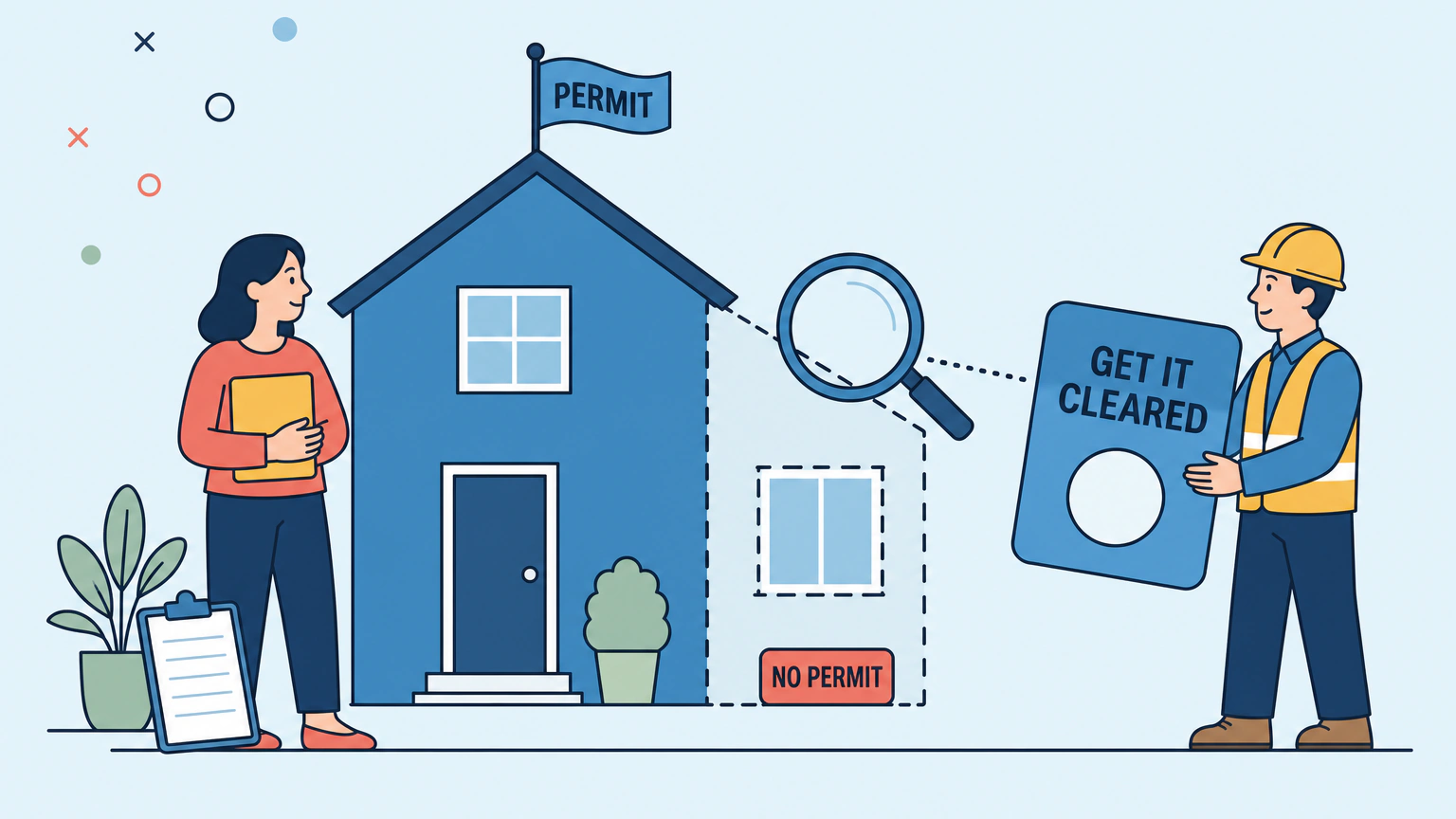
It isn't. Unpermitted work does not automatically make your house unsellable, and the Fannie Mae appraisal provision does not itself bar a mortgage on a home with an addition built without a permit. Fannie's Selling Guide asks the appraiser for one thing: comment on the quality and appearance of the work, and on its impact, if any, on market value. You may have three practical options, depending on local law and the facts of the property. Legalize it after the fact and pay whatever penalty your jurisdiction assesses, and the seven jurisdictions we read all calculate that differently. Take the work back out. Or, where state and local law and your transaction allow, disclose it and price it into the sale. Choosing well turns on a number nobody has quoted you yet, and it isn't the penalty.
On this page
- What counts as unpermitted work, and why it belongs to you now
- Why old unpermitted work may not be grandfathered
- Your three exits, and how to choose
- What legalizing actually costs
- The money questions everyone gets wrong: mortgage, appraisal and insurance
- Selling, buying or fixing it, and who to call
- Frequently asked questions
What counts as unpermitted work, and why it belongs to you now
Unpermitted work is construction, alteration or equipment replacement that needed a permit from the local building department when it was done and never got one. It doesn't matter that the work looks professional, or that it has stood for twenty years. The question is whether your authority having jurisdiction, which may be a city, a county, or in some states a state agency, required a permit for that job at that time.
Who has to fix it is local too, and in the two places we read closely the answer is the owner. Prince William County, Virginia, tells buyers plainly that purchasing a property where building code violations exist makes them legally responsible for correcting the violations and meeting current code standards. Sonoma County, California, addresses its legalization and removal policy to the property owner, not to whoever swung the hammer.
The jobs that most often turn out to be unpermitted
Finished basements, converted garages, enclosed porches and patios, added bathrooms, decks, electrical circuits moved or added, water heaters and HVAC units swapped out. That's the roster. Each one is a job a homeowner or a contractor might wrongly treat as small enough to skip.
If you're still planning the work rather than finding out about it years later, whether the job needed a permit in the first place has a concrete answer for each trade.
The three ways it usually surfaces
Usually it's a sale. A buyer's inspector writes up a room the county record has never heard of, or an appraiser measures square footage that doesn't match the file. Bringing in a home inspector before you list moves that discovery onto your calendar instead of your buyer's.
Second route: a permit application of your own. Apply for anything new and the department pulls your property's permit history while you stand there.
Third: a complaint or a claim. A neighbor reports work in progress, or damage brings an adjuster into a space with no inspection record.
Why old unpermitted work may not be grandfathered
Time doesn't launder this. In some jurisdictions, work being legalized counts as new work, so it has to satisfy the code in force the day the permit issues rather than the code that applied when somebody built it. Permit Sonoma says it in one sentence: "Unpermitted work being legalized shall meet all policies and current codes." Prince William County is blunter, telling owners the building code makes no reference to grandfathering of unpermitted work.
Where that's the rule, a basement finished to the code of the late 1990s can need today's egress opening, smoke and carbon monoxide alarms, insulation and electrical protection before an inspector will pass it. The years of quiet ownership buy you nothing. Prince William County says paying property taxes doesn't cure the violation, and that a zoning approval doesn't extend to building code use or compliance.
Your three exits, and how to choose
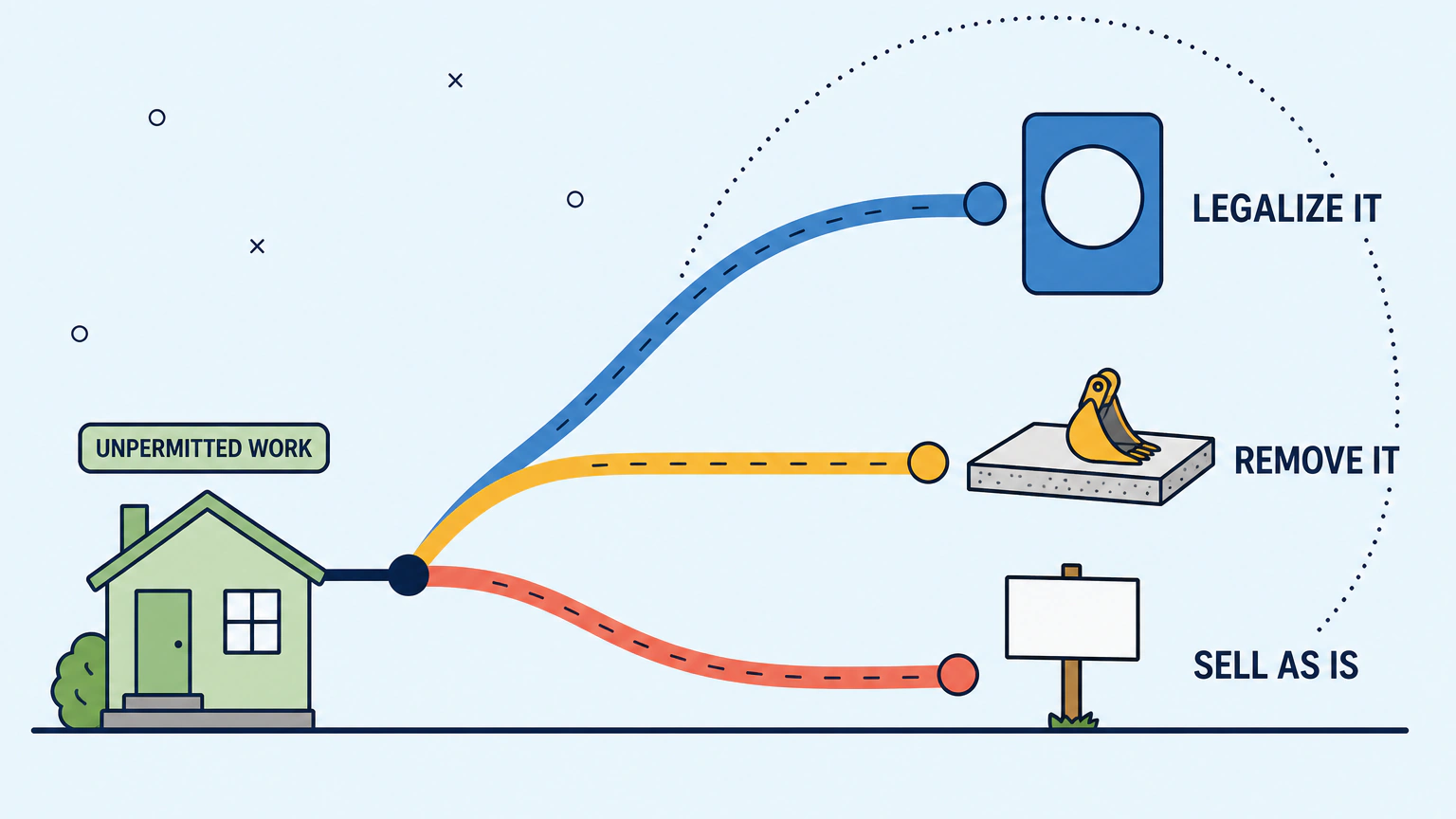
Three routes out: legalize it, remove it, or, where the law and the transaction allow, disclose it and sell as is. Which one is yours turns on what legalizing would cost, what the space is worth to a buyer, and how much time you have before a closing or a compliance deadline.
| Route | What you actually do | What it costs | When it is the right call | What it does not fix |
|---|---|---|---|---|
| Legalize it | Apply describing the existing work, add drawings if required, open concealed areas, correct, pass a final inspection | The penalty fee, plus a larger and less predictable compliance bill | The space adds real value and the construction is sound | Not a disclosure duty on a sale that already happened |
| Remove it | Take the work out under its own permit, restore the structure, pass a final inspection | Demolition, restoration, and the removal permit | Unheated additions, decks, anything whose upgrade cost beats the value it adds | Not the money the work originally cost you |
| Disclose it and sell as is | Tell buyers what you know, in writing, on your state's form, and price accordingly | Buyer leverage on price, a smaller buyer pool, more lender and insurer questions | Legalizing costs more than the space is worth, or a deadline rules it out | Not any code obligation that remains with the property under local law |
Exit one, legalize it with an after the fact permit
The path can include five steps. You file an application describing work that already exists. You may be told to produce as built drawings from a licensed design professional. An inspection opens the concealed areas so the framing, wiring and plumbing can be seen. Whatever that turns up gets corrected. Then a final approval.
Expect to clear other departments before the permit issues. Sonoma County wants all of its departmental approvals in hand first, and Prince William County lists zoning, environmental, health for well and septic, land development, fire marshal and plan review, which is a lot of counters for one converted garage.
Use your jurisdiction's own word when you call: retroactive permit, after the fact permit, as built permit. Where concealed electrical work is involved, bring in a licensed electrical contractor early. Inspectors may require finished surfaces to come off so concealed work can be seen.
Exit two, remove it
Nobody wants this one. It is sometimes the cheapest honest answer.
You may not have to take out everything. Sonoma County describes what owners typically do: remove the minimum needed to close the violation, then keep and legalize the rest. A whole structure comes out under its own demolition permit. An addition comes out under a building permit, with its own final inspection. Removal wins more often than people expect on unheated additions, decks, and anything whose code upgrade cost runs past the value it adds. We'd price it before assuming legalizing is the answer.
Exit three, disclose it and sell as is
Selling with the work disclosed may be possible, but state and local law and the terms of the transaction control that. The cost shows up as leverage. Offers come in lower, the buyer pool narrows, and lenders and insurers start asking questions.
What selling doesn't necessarily do is extinguish a code obligation that local law attaches to the property. An as is clause is a contract term between you and that one buyer. It doesn't override a disclosure duty your state imposes by statute. An as is sale does not buy you silence.
What legalizing actually costs
Legalizing can involve two separate categories of cost. One is your jurisdiction's charge for having started without a permit. The other is the cost of proving the work complies and bringing it into compliance with the applicable code. The first is usually published. The second has to be walked, opened and quoted.
Bill one, your city's penalty fee, and the four shapes it takes
There is no national number, and the reason is odd: the charge isn't even the same shape from one city to the next. Los Angeles charges a flat multiple with a floor under it. Seattle's multiple climbs with the value of the work. Phoenix charges by the day, counting from the moment the work began. Portland charges whatever the investigation costs the city.
| Jurisdiction | What the charge is called | How it is calculated | Permit types this was verified on | Source and date |
|---|---|---|---|---|
| Seattle, WA | Special investigation fee | Tiered on the value of the work: 1x the base fee to $5,000, 3x to $50,000, 5x to $100,000, 10x to $500,000, 50x to $5,000,000, then 100% of the permit fee. Where the permit fee is not valuation based, 2x. Not refundable | SDCI permits under SMC 22.900B.020 | Seattle SDCI 2026 Fee Subtitle, Table B-2, page 12 |
| Los Angeles, CA | Investigation fee | Double the amount charged for the application for inspection, license or permit fee, never less than $400, in addition to all other required fees | Permits under LAMC Chapter IX, Articles 1 to 8 | LAMC Section 98.0402(a), amended by Ord. No. 185,587, effective July 16, 2018 |
| Phoenix, AZ | Investigation fee, plus a Section 114 permit fee | $250 or the permit fee, whichever is greater, not to exceed $2,500, for every day or part of a day from the time the unpermitted work began until a permit is obtained. The permit fee itself is then 2 times the Table A fee, except residential demolition | Building safety permits | Phoenix Planning and Development fee schedule, Appendix A.2, page 43 |
| Portland, OR | Investigation fee | No multiple. The average or actual extra cost the city incurs confirming the work conforms to code, collected whether or not a permit issues | Mechanical permits under PCC Title 27 | Portland City Code 27.03.030.D |
| Miami-Dade County, FL | Double fee | Double the permit fee for doing work without a permit. Minimum mechanical permit fee $227.90 | Mechanical permits, unincorporated Miami-Dade | Miami-Dade mechanical permit fee sheet |
| Nashville and Davidson County, TN | Tripled permit fees | Where electrical work requiring a permit is commenced before the permit is issued, the permit fees are tripled, in addition to any other penalty | Electrical permits | Metro Codes building permit fee schedule, 2025, Section 16.20.250.B |
| Sonoma County, CA | Penalty fees | Imposed if applicable; the amount is not published. Its operative rules: work being legalized must meet current codes, and work that cannot be legalized must be removed under a permit | Building and demolition permits | Permit Sonoma Policy 9-4-19, version 11/08/2023 |
Each of those came out of the jurisdiction's own fee schedule, municipal code or published policy. Several are trade specific rather than citywide, which is the point of the permit type column. Portland's rule sits in its mechanical code. Nashville's tripling applies to electrical permits. Miami-Dade's double fee comes off a mechanical fee sheet. So don't assume your city works like any of them. Other jurisdictions may carry a general provision in an adopted building code that lets the building official charge an extra fee for work commenced before a permit was issued, without fixing the amount.
To find yours, search your building department's website for "fee schedule", then search that document for investigation, penalty, or without a permit. If nothing turns up, call and ask for the work without permit fee by name, in writing.
Several of these provisions say plainly that paying an investigation fee doesn't relieve anyone of code compliance or of other penalties. Seattle's says so expressly. The fee buys an application, not forgiveness.
Bill two, the compliance cost, which can be larger
This one can have five moving parts: as built drawings, opening the finished surfaces, the corrections, repairing what you opened, and the repeat inspections.
Your jurisdiction may want drawings of what exists, prepared by a licensed professional, which is where an architect or design professional enters the job. It may want concealed work exposed for inspection. Whatever gets found has to be corrected the way the authority requires, and then the finishes go back on.
Which is why the total is hard to price before anything has been opened. A firm quote at that stage may cover only the part everybody can see.
How to get a real number before you commit
Work in this order. Call the building department first. Ask for the full permit history on your address, then ask what their fee for work already done is called and how it's calculated, in writing. Only then bring in a licensed general contractor to walk the space and quote the opening, the corrections and the repair as separate lines.
Before you make either call, build your own file.
- Pull the county assessor's record and note the year built, square footage and room count on file.
- Ask the building department for the full permit history, by street address and by parcel number.
- Compare that permitted square footage and room count against what is physically there today.
- List every difference, with the approximate year you believe the work was done.
- Photograph each area, including any framing, panel or plumbing already exposed.
- Look for a certificate of occupancy or final inspection card for each addition or conversion.
- Get the fee for work already done, and how it is calculated, in writing.
- Put it all in one folder before you list the property or call a contractor.
The money questions everyone gets wrong: mortgage, appraisal and insurance
Three things get said about unpermitted work with nothing behind them. That a mortgage is now impossible. That the space is worth nothing. That your insurer will deny the claim. So we read the documents.
What Fannie Mae actually requires
Fannie Mae's Selling Guide gives this exactly one sentence. If the appraiser identifies an addition that does not have the required permit, the appraiser must comment on the quality and appearance of the work and its impact, if any, on the market value of the property.
That is a commentary requirement, not a prohibition. Nobody is banning the loan. In practice, a poorly built addition gets described in a report your lender reads. Lenders may apply stricter rules of their own, so ask your loan officer about investor overlays and get that answer in writing too.
How it lands in the appraisal
The practical effect turns up in the measuring. For single-family dwellings, Fannie Mae generally requires appraisers to follow ANSI Z765-2021, subject to a different state-law or regulatory standard. Under ANSI, a level with any portion below grade is reported separately from above-grade square footage. Finish doesn't change that. Neither does the permit.
Above grade, Fannie Mae requires the appraiser to comment on an addition built without the required permit: its quality and appearance, and its impact, if any, on market value.
What your homeowners policy does and does not pay
Your policy is a contract. It pays what its own terms say it pays, and the gap that bites after a loss is code upgrade cost. Rebuilding to today's code can cost far more than putting back what was there, and that difference is generally sold as an add on. The Texas Department of Insurance lists "extra construction or repair costs to meet local building codes" among the common endorsements a homeowner can buy.
Read your declarations page for ordinance or law coverage. Then ask your agent, in writing, what your policy would and would not pay for a loss in a space with no permit record. Ask while it's still a question rather than a claim.
Selling, buying or fixing it, and who to call
What you do next depends on which of these you are. A seller with a closing date. A buyer holding an inspection report and a decision. An owner whose contractor left the paperwork undone.
Disclosure is your state's rule, not a national one
Three obligations get mashed together here, and they don't carry the same force. Statutory disclosure is what your state's law requires you to tell a buyer, usually on a form the state prints. Contractual obligations are whatever you and the buyer write into the contract, as is language included. Market practice is what buyers and agents ask for out of custom, and custom is not law.
The forms genuinely differ. Texas is one that names unpermitted work outright: item 9 of the statutory seller's disclosure notice at Section 5.008 of the Texas Property Code asks whether the seller is aware of room additions, structural modifications, or other alterations or repairs made without necessary permits or not in compliance with building codes in effect at that time.
None of which is permission to be vague. A broader duty to disclose known material facts can apply whatever the printed form asks. Read your state's form, ask your agent or a real estate attorney what it covers, and never answer a disclosure question with anything but the truth.
If your contractor never pulled the permit
Start with paper. Contract, invoices, texts and emails into one folder, then find any clause saying who was responsible for permits.
Now put it in writing. Ask the contractor to confirm who carried that responsibility, and ask them to file and pay for the after the fact permit. If you still owe money on the job, that balance is your leverage, which is why a payment schedule that protects you matters more than any clause in the contract.
If that goes nowhere, possible complaint routes include your state or local contractor licensing authority and your state attorney general or consumer protection office. Keep the point in view, though. You want the work cleared, not revenge.
Red flag: the permit tactic the FTC names. The Federal Trade Commission keeps its own list of signs that a home improvement contractor may not be reputable.
- Knocks on your door looking for business because they are "in the area"
- Says they have materials left over from a previous job
- Pressures you for an immediate decision
- Asks you to pay for everything up front, or only accepts cash
- Asks you to get any required building permits
- Suggests you borrow money from a lender they know
Read that fifth one twice. It's a reason to ask who pulls each required permit before you sign, and to get the answer written into the contract. If the work followed weather damage, the same red flags show up after a storm.
Who to hire to clear it, and what to ask them
You may end up hiring three people: a general contractor to scope and run the job, an architect or design professional if as built drawings are required, and the trade contractor for whichever discipline is at issue, most often electrical.
Three questions separate the pro who will close this out from the one who will learn on your job. Have you taken an after the fact permit through this exact building department before? Will you file the permit yourself, in your own name? Will you quote the opening and the repair separately from the corrections?
Then confirm the license number with the authority that issued it, yourself, before you sign. You can also read how Industry Oversight verifies the pros it lists, including license status and physical location. Those are our own checks rather than an independent third party audit, and they don't replace that call.
Frequently asked questions
What counts as unpermitted work?
Work that needed a permit from your local building department when it was done and never got one. That covers structural changes, additions, garage and porch conversions, and most electrical, plumbing and mechanical work. What matters is what your jurisdiction required at the time, not how good the work looks or how long ago somebody did it.
Can you sell a house with unpermitted work?
Possibly, though state and local law and the terms of the transaction decide that. Buyers may price the risk into their offer, lenders and insurers may ask questions, and your state's disclosure rules apply either way. Selling doesn't necessarily close a code case, and it may not extinguish an obligation that local law attaches to the property.
Does homeowners insurance cover unpermitted work?
That depends on your policy's terms and the facts of the claim. The piece people miss is code upgrade cost, the extra expense of rebuilding to current code after a covered loss, which may require an endorsement. The Texas Department of Insurance lists it among common endorsements, so read your declarations page for ordinance or law coverage.
Does unpermitted work affect an appraisal or a mortgage?
It can affect the appraisal, and lenders may impose additional requirements. Fannie Mae's Selling Guide requires the appraiser to comment on the quality and appearance of an addition built without the required permit, and on its impact, if any, on market value. That's a comment, not a veto. Individual lenders may be stricter, so ask yours.
Does title insurance cover unpermitted work?
That depends on the policy. Texas Form T-1R, effective November 1, 2024, generally excludes loss caused by enforcement or violation of laws, building and zoning ordinances included. But the exclusion doesn't reach notices of violations or enforcement in the public records at the policy date, and Schedule B may still carry an exception. Forms vary by state, so ask your title company which one you have.
What happens if I buy a house and find unpermitted work after closing?
Depending on local law, it may become yours to resolve, even though a previous owner did the work. Prince William County, Virginia, states the principle plainly: a buyer who purchases a property where building code violations exist becomes legally responsible for correcting them, and for meeting current code standards. Whether you have a claim against the seller is a question for a real estate attorney.
What should I do if my contractor never pulled the permit?
Get the contract, the invoices and every message into one folder. Then ask in writing who was responsible for the permit, and ask the contractor to file and pay for the after the fact permit. If that fails, possible complaint routes include the state or local licensing authority and your state attorney general or consumer protection office.
Permit rules and fee amounts are set locally and they change on their own schedules, so confirm any number with your own building department before you plan around it. Our verification policy explains how we check what we publish. We're not your lawyer or your insurance agent, and when a sale or a dispute is riding on this, one of those is worth an hour before you sign.