

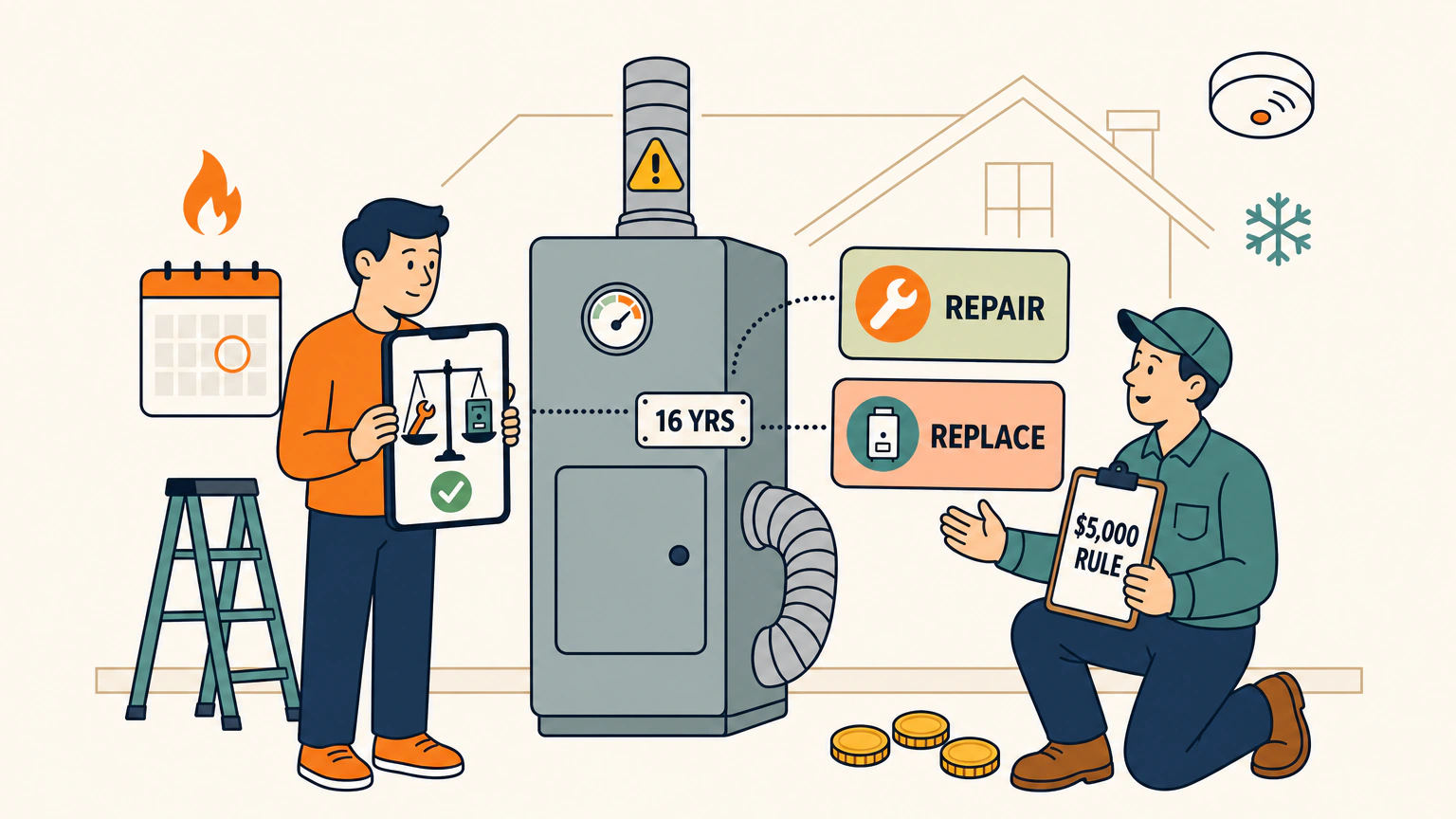
Two questions arrive at once, usually from the same person: is this worth fixing, and is it safe? Start with the money.
On this page
- The short answer, and the two tests that give it to you
- Find your furnace's real age before you run any math
- What furnace repairs actually cost in 2026
- What a replacement actually costs in 2026
- Five signals that override the math
- "You have a cracked heat exchanger." What to do in the next 30 minutes
- How to get a second opinion without losing a week
- The 2026 money picture, and what changed this year
- Timing, because the cheapest month to replace a furnace is not January
- If you are replacing: the six things that must be in the quote
- Frequently asked questions
The short answer, and the two tests that give it to you
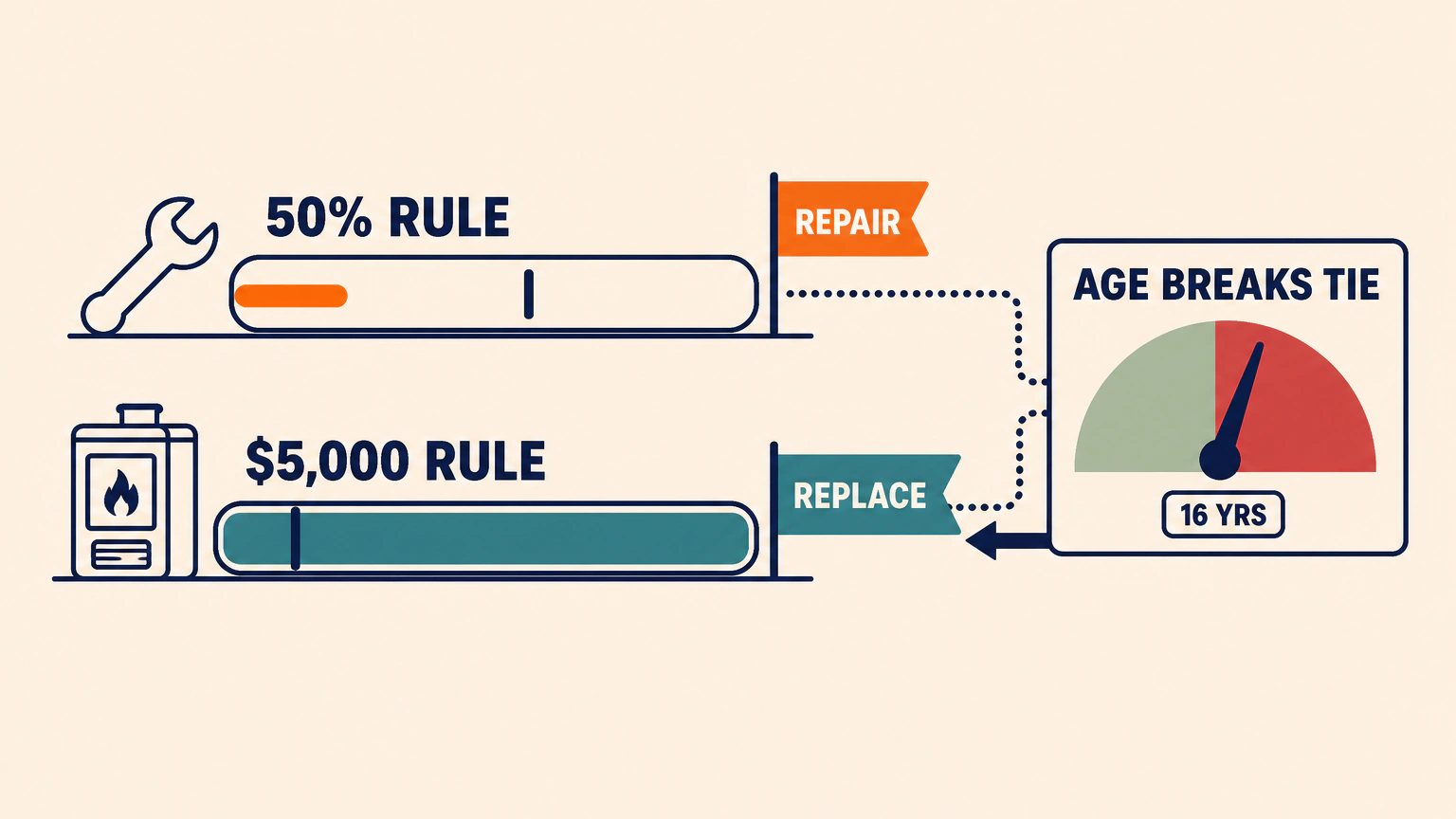
Two rules of thumb circulate in the trade, and on the same furnace they can disagree. Run both anyway. Then look at what they leave out.
Test 1, the 50% rule
Carrier's guidance points to replacement when two things are true together: the furnace is over 15 years old, and the repair approaches half the cost of a new system. Take a 16-year-old furnace with a $1,200 repair, set against the $4,814 average HomeAdvisor publishes. That repair is 25% of a new system, well below the threshold, and Carrier's rule doesn't treat that alone as the decision.
Test 2, the $5,000 rule
Multiply the furnace's age by the repair quote. Anything over $5,000 points to replacement. CBS News, June 2026 calls it a guide rather than a guarantee, which is the right way to hold it. Same furnace, same quote: 16 times $1,200 is $19,200. Replace.
When the two tests disagree, age breaks the tie
One furnace, one quote, two answers. The 50% rule weighs your repair against the price of a new system. The $5,000 rule multiplies it by the furnace's age. Neither claims age alone decides which of them wins.
Neither is a standard. Neither is a code. When they split, the call falls to what no rule of thumb can see: how the unit has behaved, what it costs to run, and what a second technician says.
Run both rules on your own furnace
CARRIER CONDITION 25%
$1,200 is 25% of $4,814, short of the halfway mark, and the furnace is 16 years old. Carrier's combined replacement condition is not met.
$5,000 RULE $19,200
16 years x $1,200 = $19,200, past the $5,000 mark. Above $5,000: points to replacement.
NO COMBINED VERDICT The two rules do not provide a combined verdict. Weigh condition, repair history, efficiency and a second quote.
16 YRS sits inside the typical 15-20 YRS range for gas furnaces.
Not sure? The nameplate has the model and serial numbers. Date-code formats vary by brand and model; use the manufacturer's lookup or call with both numbers.
HomeGuide lists control boards at $300 to $650, draft inducers at $400 to $1,100, blower motors at $500 to $2,300, and heat exchangers at $1,000 to $3,000.
Prefilled with the national average of $4,814 from HomeAdvisor. Typical range $2,823 to $6,897. Replace it with your own quote if you have one.
Our own listing data: $5,630 national average, $3,865 to $7,463 fair range, from 832 cost profiles, checked August 9, 2026. Covers all HVAC work, not furnace replacement alone.
It's printed on the nameplate. 80% is the current federal minimum for non-weatherized gas furnaces manufactured before December 18, 2028.
The two rules do not provide a combined verdict. Weigh condition, repair history, efficiency and a second quote.
Carrier's combined condition
$1,200 is 25% of $4,814; the furnace is 16 years old. Carrier's combined replacement condition is not met.
Carrier's guidance couples a furnace over 15 years old with a repair approaching half of replacement value. Not a standard.
The $5,000 rule
16 years x $1,200 = $19,200. Above $5,000: points to replacement.
A contractor rule of thumb reported by CBS News, June 2026. A guide rather than a guarantee.
Age
16 years old. Gas furnaces typically last 15 to 20 years. Inside the typical 15-to-20-year range for gas furnaces.
Repeat repairs
Two or more repairs in a heating season can signal that replacement deserves consideration; this does not decide the question independently.
Efficiency
Moving from 80% AFUE to 95% AFUE cuts fuel use for the same heat by about 15.8%. Multiply that by your own annual heating bill to see it in dollars. DOE's 95% minimum applies to non-weatherized and mobile-home gas furnaces manufactured on or after December 18, 2028.
assumed 80% AFUE, the current federal minimum for non-weatherized gas furnaces manufactured before December 18, 2028
This tool does math on prices. It cannot tell you whether your furnace is safe to run. If a carbon monoxide alarm has sounded, or anyone in the home has a headache, nausea or dizziness that improves outdoors, leave the building and call 911 or your gas utility.
Find your furnace's real age before you run any math
Both tests need the furnace's age, and most people have to go find it rather than recall it. Guess three years wrong and the $5,000-rule product can move by thousands.
How to read the nameplate and the serial number
Open the cabinet's front door and look for a metal or foil label, there or on a side panel. That's the nameplate. It carries the model and serial numbers, the BTU input and the AFUE rating, which is the share of fuel the unit turns into heat.
The serial can reveal the age, but the date code is brand- and model-specific. If the label is unreadable, try the manufacturer, your building department's permit record, or the seller's disclosure.
What "15 to 20 years" actually means by fuel type
Gas furnaces typically last 15 to 20 years. Electric furnaces run 20 to 30, oil furnaces 15 to 25. Read those as bands, not expiration dates. Climate and maintenance move a unit inside its band, which is why age is context rather than the verdict.
Pro tip: Photograph the nameplate today, while the basement is still a pleasant place to stand. Model number, serial number and AFUE rating are what service calls and quotes ask for, and the photo checks a diagnosis against the real unit.
What furnace repairs actually cost in 2026
The cheap fixes nobody should replace a furnace over
Before anything else, three simple checks. Replace a dirty filter, which can cause shutdowns that look exactly like a dead furnace. Change the thermostat batteries. Reset the breaker.
If it's a part, it's usually a cheap one. Ignitors, flame sensors, thermostats, limit switches and run capacitors fail, get swapped, and none by itself generally justifies a new system.
The three repairs that change the decision
Three failures can become decision points, not line items. A cracked heat exchanger is a combustion-safety failure, and on an older unit it may favor replacement. A blower motor can be one of the priciest moving parts in the cabinet. A control board is the unit's brain.
Whatever the part, watch the airflow. Starve a furnace of air and it overheats, and the overheating damages expensive things downstream.
| Repair | Typical installed cost | How often it fails | Does it change the repair-or-replace call? |
|---|---|---|---|
| Ignitor | $100–$250 | Among the parts that typically fail first | No, fix it |
| Flame sensor cleaning or replacement | Under $400 | Common | No, fix it |
| Thermostat | $190–$480 | Common | No, fix it |
| Limit switch | $100–$375 | n/a | No, fix it |
| Gas valve | $200–$800 | n/a | Potential decision point on an older unit |
| Control board | $300–$650 | n/a | Potential decision point on an older unit |
| Draft inducer motor | $400–$1,100 | n/a | Potential decision point on an older unit |
| Blower motor | $500–$2,300 | n/a | Potential decision point |
| Heat exchanger | $1,000–$3,000 | Late-life | Usually; warranty and overall condition matter |
| Labor rate | $75–$150/hour | n/a | Ask for it before the visit |
Those are HomeGuide ranges for 2026. Carrier puts the average repair bill near $300, with a spread from $65 to $1,500.
What a replacement actually costs in 2026
The published national bands, side by side
Three cost publishers put the national average within about $15 of $4,800, which sounds like consensus until you read their ranges. Those run from $2,823 to $6,897 at one end and past $11,000 for high-efficiency systems at the other. The average is not your number.
What actually drives your number
Four things set it. BTU capacity, from a load calculation on your house rather than whatever size the old unit was. The AFUE tier. The fuel type. And the install work the changeout drags in behind it.
That last one is where quotes surprise people. Move from an 80% AFUE furnace to a condensing one and the metal flue usually comes out, PVC goes in, and the water the new unit makes needs a drain. If the fault turns out to be the chimney, the venting or the wiring, browse all 66 service categories and hire the trade that owns it.
Ductwork, and the quote that is not comparable
Two furnace quotes are often not the same purchase. One prices a straight changeout. The other adds sealing, resizing or a new return, and the totals diverge for reasons unrelated to the furnace. Read the scope before the total, then compare the quotes line by line.
| Source | Average | Typical range | What it covers |
|---|---|---|---|
| HomeAdvisor | $4,814 | $2,823–$6,897 | Furnace install, national |
| Fixr | $4,800 | $2,800–$7,500 | Furnace replacement, national |
| This Old House | $4,799 | $1,600–$10,000 | New furnace, national |
| HomeGuide | n/a | $3,500–$7,500 standard efficiency; up to $11,500 high-efficiency | New furnace, national |
| Carrier | n/a | $3,800–$12,000 gas; $6,750–$10,000+ oil; $2,000+ electric | 80,000 BTU, 1,600–2,000 sq ft |
| Industry Oversight cost profiles | $5,630 | $3,865–$7,463 fair range; $1,805–$10,815 full spread; $150/hr average | All HVAC work, 832 cost profiles, checked August 9, 2026 |
That last row is our own listing data, not an independent survey, and it covers all HVAC work rather than furnace replacement alone. Treat it as a sanity band, not a price.
Five signals that override the math
The math assumes the only problem is the one on the invoice.
- Two or more repair visits in a heating season. Add up what you've already spent. That pattern can signal that replacement deserves consideration.
- Heating bills up materially with no change in fuel prices, use or weather. Compare comparable months, then have the cause diagnosed.
- Rooms that will not hold an even temperature after servicing. Ask whether the fault sits in the furnace or the ducts, because a new furnace does not fix the ducts.
- Short cycling, or several tries to light. Get it diagnosed rather than watched. Both have several possible causes.
- Visible rust, soot streaks, or a CO alarm that sounded while the furnace ran. Stop using it. Get it inspected before anyone discusses price.
The first four wait on a diagnosis. The fifth is a safety problem, and it waits for nothing.
"You have a cracked heat exchanger." What to do in the next 30 minutes
Red flag: the Pennsylvania Attorney General and the FTC warn about the same handful of moves. Any one should slow you down.
- The inspection was free or nearly free, and now there's a large repair or replacement quote.
- The urgency is an imminent house fire or carbon monoxide leak.
- They came to you. You didn't call them.
- They want you to agree to installation today.
- They want cash, or a large payment, before anything is in writing.
- They won't show you a photo or video of the defect.
Sign a contract in your own home and you may have a window to cancel it. Pennsylvania's advisory says three business days, but your state sets its own. Report it to your attorney general and to the FTC at reportfraud.ftc.gov. The same tactics show up after storms.
Why this is the most abused diagnosis in the trade
First, the part nobody disputes: cracked heat exchangers are real, and carbon monoxide kills people every heating season. Nothing here argues for waving it away.
It is also easy to abuse. The failure is dangerous. It's expensive. And a homeowner has almost no way to verify it. The Pennsylvania Attorney General has warned about contractors who offer free or cheap inspections, then "create a sense of urgency with warnings of a pending house fire or carbon monoxide leak."
The proof to ask for before you authorize anything
- "Can you show me a photo or video of the crack, with something in frame showing where it is?" A shot of unidentifiable metal is not evidence.
- "Did you run a combustion analyzer? What CO reading did you get, in ppm, and where?" A company qualified for this call carries one.
- Ask for the diagnosis in writing, with the part number and the unit's model and serial.
- "If you are red-tagging this furnace, who is notified, and can I have that in writing?"
- Say no to same-day installation, and to paying before a written contract exists.
- Photograph the nameplate and the paperwork yourself before they leave.
When it is a genuine emergency
If a CO alarm sounds while the furnace is running, leave. If anyone has a headache, nausea, dizziness or breathlessness that improves outdoors, leave. Call 911 or the gas utility from outside, and don't go back in.
The Consumer Product Safety Commission counts more than 200 U.S. deaths a year from unintentional non-fire carbon monoxide poisoning tied to consumer products. Its advice is short. A CO alarm outside each sleeping area. A yearly inspection of every fuel-burning system, flue and vent. And no homeowner servicing these appliances.
We can hand you the questions and the numbers. We can't tell you a furnace is safe, and no page can. That takes a licensed professional standing in front of it.
How to get a second opinion without losing a week
A second diagnostic fee can be cheap insurance on a four-figure decision. We'd pay it.
What to say when you call the second company
Don't hand over the first diagnosis or the price. Describe symptoms only: what the furnace does, what it sounds like, when it started.
Then ask for three things. A written diagnostic report with documentation. The service-call fee. And whether that fee comes off the repair. An independent home inspector is another route, though the ASHI standard covers readily accessible heating equipment without requiring a heat-exchanger inspection.
What to verify about both companies before either comes back
Both of them, including the one you're about to trust.
- Check license status with the state or local licensing authority, not a number printed on a truck.
- Confirm liability insurance with the insurer named on the certificate, not an emailed PDF.
- Confirm a real physical address, not a phone number or PO box.
- Check years in business.
- Read the review pattern, not the average: recency, volume, repeated complaint themes.
- Search complaint history with your state consumer protection office.
Our listing of vetted HVAC contractors near you shows license status, location, years in business and review counts. Those are our own checks on our own listings, which is exactly as independent as it sounds. Read how Industry Oversight vets the contractors it lists, then treat it as a starting point.
The 2026 money picture, and what changed this year
The federal tax credit for furnaces ended December 31, 2025
If a salesperson brings up the tax credit, they're behind on the news. No federal tax credit applies to a furnace installed in 2026. The Section 25C credit was worth up to $600 on a qualifying furnace or boiler until the One Big Beautiful Bill Act terminated it, and the IRS is blunt about the cutoff: the credit "will not be allowed for any property placed in service after December 31, 2025."
What matters is the day the equipment was installed, not the day you bought it. A qualifying 2025 install may still be claimed on a 2025 return using Form 5695.
Where money is still available
State rebates and utility incentives are separate from the federal credit and may still be available. The IRA-funded HOMES and Home Electrification and Appliance Rebates programs run state by state. Call your state energy office and your utility before work starts, because eligibility and pre-approval requirements vary.
The 2028 efficiency rule is not a reason to buy today
You'll hear this one framed as a deadline. It isn't. DOE's final rule sets a 95% AFUE minimum for non-weatherized and mobile-home gas furnaces, compliance date December 18, 2028. It governs what gets manufactured from that date. It requires nobody to replace anything, and it doesn't expire the furnace in your basement.
Its legal footing is unsettled, too. The D.C. Circuit upheld the standard in November 2025. The Supreme Court vacated that on June 8, 2026 and sent the case back, and DOE is weighing a February 2026 petition to push the date to 2030. December 2028 still stands. A salesperson using it as a replacement deadline is applying pressure, not quoting a fact.
Timing, because the cheapest month to replace a furnace is not January
Late spring through early fall is often the lower-cost window: more time to compare quotes, better odds an installer can come when you call.
If your furnace is 15 or older and limped through last winter, decide before the first cold night rather than during it. A pre-season inspection can reveal problems before winter demand peaks, while you still have the leverage of not needing heat tonight.
If you are replacing: the six things that must be in the quote
A quote missing any of these is just a number.
- The model and AFUE rating of the exact unit, its BTU capacity, and the load calculation behind it.
- Line-item labor, separate from equipment.
- Venting: whether the flue is reused, replaced with PVC or relined, and what that costs.
- Condensate drain work, if a condensing unit goes in.
- Permit and inspection: who pulls it, and whether the fee is in the price.
- Warranty terms, with the manufacturer's parts warranty and the contractor's labor warranty separated, with durations.
Get two or three written quotes for any replacement that isn't an emergency, each covering all six. If the permit line is vague, check who is supposed to pull the permit, then compare the quotes line by line.
Frequently asked questions
Is it worth repairing a 20-year-old furnace?
Often not, but the furnace and the repair decide that, not the birthday. At 20 years a gas furnace sits at the top of its typical 15-to-20-year service-life range. A minor fix that buys another season can still be the right call.
What is the 50% rule for furnace repair?
If the repair quote reaches half the cost of a new system and the furnace is past mid-life, replacement is generally the better value. Carrier publishes it. It is a contractor rule of thumb, not a standard and not a code, and it belongs alongside the $5,000 rule rather than instead of it.
How much does it cost to replace a furnace in 2026?
Published national averages cluster around $4,800. Typical ranges run roughly $2,800 to $7,500, with a full spread from about $1,600 to over $11,000 for high-efficiency systems. Your own number turns on BTU sizing, AFUE tier, fuel type, venting and ducts. Our cost profiles average $5,630 across all HVAC work.
How long does a furnace last?
Gas furnaces typically last 15 to 20 years. Electric furnaces often reach 20 to 30, and oil furnaces typically last 15 to 25. Maintenance, install quality and climate move those bands, so read them as a range rather than an expiry date.
How do I find out how old my furnace is?
Read the nameplate, usually inside the front door or on a side panel. The serial number can encode the manufacture date, but the format varies by brand and model. If it's unreadable, call the manufacturer with the model and serial, or check your building department's permit record.
Is there still a federal tax credit for a new furnace in 2026?
No. The Section 25C credit applies to qualifying property placed in service on or before December 31, 2025, so a furnace installed in 2026 does not qualify. A qualifying 2025 install may still be claimed on a 2025 return with IRS Form 5695. Anyone still selling on that credit is selling nothing.
Can I keep using my furnace if a technician says the heat exchanger is cracked?
Treat it as serious. A cracked heat exchanger can put carbon monoxide into the air you breathe. Ask for photographic proof and a combustion analyzer reading before you authorize thousands of dollars of work. If a CO alarm has sounded, or anyone has symptoms that clear outdoors, leave and call 911.
What time of year is cheapest to replace a furnace?
Late spring through early fall is often less expensive. Off-season you may avoid emergency premiums, find installers with open calendars, and have time to collect two or three written quotes and compare them. Replacing during a January cold snap can cost more, and it hands the decision to whoever can get there first.
Run both rules, and when they disagree don't let either one decide for you. Weigh the condition, the repair history, what the thing costs to run, and what a second technician says. Cost math never decides whether a furnace is safe: a sounding CO alarm, or symptoms that clear outdoors, means leave and call 911 or the gas utility.
When you're ready to price the job, our page of vetted HVAC contractors near you carries a local cost band and license-checked contractors. Start with two names, not one.