


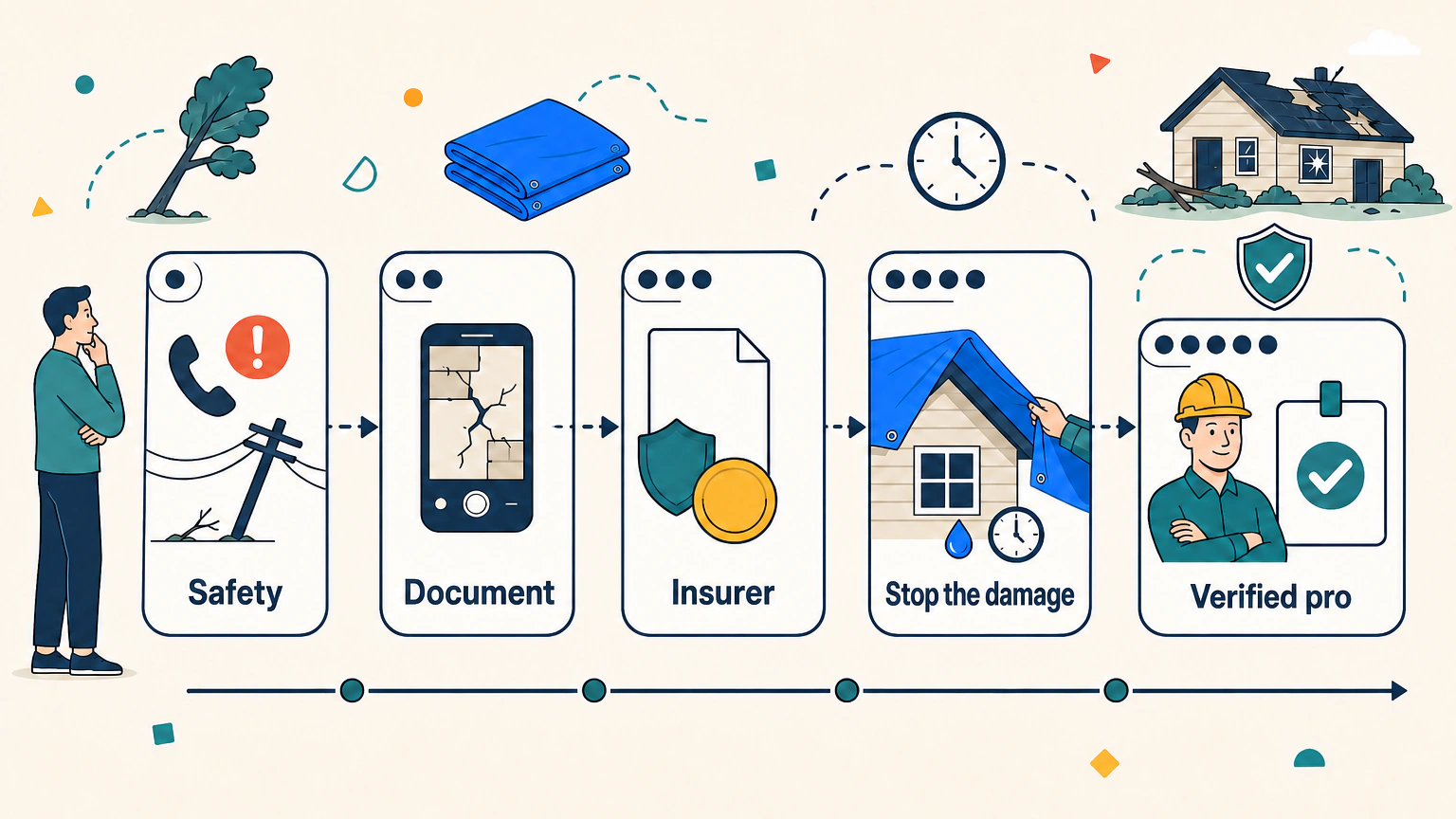
Call in this order: 911 or your utility if anyone is in danger or a power line is down; document the damage as soon as it is safe; notify your insurance company promptly if you decide to file; call a mitigation crew to tarp, board up, or extract water as soon as it is safe; then hire a licensed contractor for permanent repair after verifying their license and physical address. Don't hold off on an emergency measure that's stopping active damage just because the insurer hasn't called back. A downed line, a gas smell, or a visibly sagging roof comes before every other call.
Knowing who to call after storm damage comes down to your policy's post-loss duties: the notice you owe your insurer, and your duty to take reasonable steps to stop the damage spreading.
We don't sell leads to the contractors we list, so we can also tell you when not to call anyone.
Safety first: if there's any question about live electricity, gas, or whether the structure is sound, get out and call 911 or your utility. Nothing on a screen replaces emergency services.
On this page
- The short answer — the storm damage call order
- Phase 1 — Make the property safe before you call anyone about repairs
- Phase 2 — Document the damage before you clean up anything
- Phase 3 — Call your insurer, and read your Duties After Loss page
- Phase 4 — Stop the damage from spreading
- Phase 5 — Hire the right trades, in the right order
- Special cases that reorder the list
- Your storm paper trail: what to keep, and for how long
- When to escalate: adjuster disputes, public adjusters, and your state DOI
- Frequently asked questions
- Find a verified pro near you
The short answer — the storm damage call order
- Immediately: 911 or your utility. Downed line, gas odor, fire, injury, unstable structure.
- As soon as it is safe: photograph and video everything, before you move debris.
- Promptly: call your insurer if you decide to report the loss; reporting periods vary by state and policy.
- As soon as it is safe: call a mitigation crew for tarping and board-up; start water extraction and drying within 24 to 48 hours.
- Next: call a licensed contractor for the permanent repair, verified first.
Your own damage can reorder phases 4 and 5. A tree on the structure puts a tree crew ahead of the roofer, and water inside puts extraction first. The tool builds the order for your house.
Your storm damage call order
Answer three questions. We'll put the calls in the right order for what you're looking at.
Roof damage, no immediate hazard, planning to file a claim - here is your call order.
- 1
Photograph and video everything - before you move anything.
Now.
Do this before any removal, cleanup, or repair.
Source: NAIC, Navigating the Claims Process: Recover and Rebuild.
- 2
Call your insurer to report the loss.
Promptly.
Reporting periods vary by state and policy. If you decide to file, notify your insurer promptly.
Your deductible and whether the policy settles at ACV or RCV decide the payout.
Sources: NAIC, What You Need to Know When Filing a Homeowners Claim; NC DOI, Loss Prevention and Aftermath.
- 3
Get an emergency tarp or board-up.
As soon as it is safe.
Reasonable temporary-repair costs are typically reimbursed when the loss is covered. Keep every receipt and photograph the work.
Find disaster recovery companies
Sources: NC DOI; Virginia SCC.
- 4
Check whether Operation Blue Roof has an active mission in your area.
Within the mission's sign-up window.
Free temporary roof covering from USACE and FEMA when a mission is active. Standard shingles or similar nailable roofs qualify; metal roofs are considered case by case. blueroof.gov or 888-ROOF-BLU.
A mission must be assigned to USACE after an affected-state request. Primary residences and qualifying occupied rentals may qualify when no more than 50% of the roof framing is damaged and the framing can support installation. Mobile homes are considered case by case; flat, clay, slate and asbestos-tile roofs are excluded. blueroof.gov or 888-ROOF-BLU (888-766-3258).
Sources: USACE Operation Blue Roof; FEMA.
- 5
Call a licensed roofing contractor for inspection and estimate.
After documentation and temporary stabilization.
A free inspection is fine. Signing a contract or an assignment of benefits to get one is not.
- 6
Verify the contractor before they start.
Before any work begins.
- Look the license up on the state or county board and confirm status, name match and trade class.
- Confirm a real physical address, not a PO box, a mail drop or an out-of-state hotel.
- Ask for a certificate of insurance emailed by their insurer, not by them.
General information, not insurance advice. Your policy and your state's rules control. Program details for Operation Blue Roof change with each disaster declaration - check blueroof.gov.
Phase 1 — Make the property safe before you call anyone about repairs
None of the money questions matter if someone is electrocuted or a weakened structure comes down.
Downed power lines, gas smells, and sagging structure: 911 and your utility
Assume every line on the ground is live. The Electrical Safety Foundation International warns a downed line can energize the ground up to 35 feet away, further in wet conditions, so keep everyone back that far. Never try to move one, not with a broom handle, not with anything.
Call 911, then your utility; only the utility can make a downed service line safe. Licensed electricians take over after that. Smell gas? Leave, and call from outside.
When to leave the house, and when it's safe to stay
Get out and stay out if you see any of these: a roof or wall that visibly sags, water at or near the electrical panel, a gas odor, standing water in a room with outlets, a ceiling bowing under trapped water. Any one of these takes a professional to clear.
What not to touch until someone qualified says so
Standing water. The breaker panel. Anything that went under. And nobody climbs a wet roof, ever.
A furnace, water heater or HVAC condenser that sat in water needs professional evaluation before anyone switches it on. Some must be replaced, some may be reconditioned. Pulling the disconnect on flooded equipment is utility or electrician work, not yours.
Phase 2 — Document the damage before you clean up anything
Every instinct says clean up. The NAIC tells homeowners to document all losses before removing any debris or belongings.
The 15-minute photo and video routine
One walk-around video first, narrating as you go, then the stills.
- Walk-around video saying the date and address
- A wide shot of each side of the house
- A close-up of every damage point you see
- The roofline on your phone's zoom, not a ladder
- Gutters, downspouts, screens, siding, yard debris
- Each ceiling and wall stain, hand in frame for scale
- Water lines on walls and furniture legs
- The attic, only if it is dry and sound
- Damaged contents one by one, with serial numbers
- The panel and submerged mechanicals, from a distance
- A screenshot of the National Weather Service storm report
- Pre-loss photos already on your phone
Write the loss list while it's fresh
Four things per item: what it is, roughly how old, roughly what it's worth, and where it was. Write it tonight.
The best evidence you own is already in your pocket. A birthday photo from last year shows the ceiling before the storm.
Do not throw anything out yet
Keep damaged property wherever you can safely store it, so the adjuster can see it. Sort as you go: wet-but-savable in one place, destroyed in another. Put the destroyed pile somewhere covered rather than the curb, and photograph it.
Phase 3 — Call your insurer, and read your Duties After Loss page
You want a deadline. There isn't a national one, and anyone handing you a flat number is guessing. The amount of time to report a claim varies by state and by policy, so check your own policy and notify your insurer promptly if you decide to file.
What to have ready when you call
Have it in front of you before you dial: policy number, the date and time of the storm, a one-paragraph description, whether the house is habitable, and what emergency measures you've taken.
Then ask three things and write the answers down. What is my deductible for this peril? Is my roof settled at replacement cost or actual cash value? Which emergency expenses do you reimburse?
Should you call a roofer before your insurer?
Contractors have a real argument for going first. A free inspection sizes the damage, and if the repair lands under your deductible, a claim would pay nothing and may still remain on your loss history.
So take the inspection. Policies require prompt notice, so don't let it delay a claim you've decided to file, and don't sign a contract or an assignment of benefits to get one. An inspection is information; a signature is a commitment.
Deductibles, ACV vs. RCV, and whether the claim is worth filing
Three things set what actually lands in your account.
The first is the deductible for that peril, which for wind and hail may be a percentage of your dwelling coverage rather than a flat amount. The second is the settlement basis: replacement cost (RCV) pays the covered replacement cost, actual cash value (ACV) subtracts depreciation. The third is the roof's age, which drives that depreciation under ACV and may affect scheduled roof coverage.
| Scenario | Roof age | Settlement basis | Deductible | Approximate payout |
|---|---|---|---|---|
| Roof replacement | Any age | Replacement cost | $4,000 | $6,000 |
| Roof replacement | 5 years | Actual cash value | $4,000 | About $4,500 |
| Roof replacement | 10 years | Actual cash value | $4,000 | About $3,000 |
| Roof replacement | 20 years | Actual cash value | $4,000 | $0 |
Texas Department of Insurance numbers: a $200,000 dwelling, a 2% deductible, a $10,000 roof. One regulator's illustration, not a national rule. And the $4,000 is 2% of the dwelling limit, not of the repair cost. Check your declarations page.
If your estimate lands at or below your deductible, filing may not be worth it. The NAIC says the same: check your deductible before reporting minor damage.
Phase 4 — Stop the damage from spreading
Waiting politely for permission can cost you money. North Carolina's insurance regulator advises making reasonable emergency repairs to prevent further damage, and failing to prevent avoidable damage may jeopardize coverage for it.
Tarping, board-up, and water extraction: what's typically reimbursed
Tarping covers an open roof. Board-up closes broken windows. Extraction pulls standing water out before it wicks into the drywall.
Reasonable temporary-repair costs are typically reimbursed when the loss is covered, so keep every receipt and photograph the work before and after. Call verified disaster recovery companies, not whoever's parked on your street.
Two traps. The open-ended "emergency services" authorization signed at 11 p.m. is a blank check with your name on it. And a temporary-repair invoice can get big enough to deplete money you need for the permanent repair, so ask your adjuster how temporary-repair costs apply to your policy limits first.
Free help after a declared disaster: Operation Blue Roof
Before you pay for a tarp: Operation Blue Roof is a FEMA mission run by the US Army Corps of Engineers, and it installs a fiber-reinforced temporary roof covering free. It runs when FEMA assigns the mission to USACE at an affected state's request, and covers primary residences and qualifying occupied rentals with no more than 50% of the roof framing damaged. Standard shingle roofs or similar nailable material qualify. Metal roofs and mobile homes are case by case, while flat, clay, slate and asbestos-tile roofs are excluded, and major debris has to come off the roof first.
Every mission sets its own locations and window, so check current availability and sign-up details at blueroof.gov or 888-ROOF-BLU (888-766-3258). In a declared area, federal individual assistance starts at DisasterAssistance.gov.
Red flag: if you hear any of these, stop. "No license is needed for this work." "The discount applies only if you sign today." "Sign over your insurance check." "Full payment up front." "Pay by wire transfer, gift card, payment app, cryptocurrency or cash." "We're from the Corps, or FEMA, or your utility, and there's a fee." "We'll cover your deductible," which can just mean the cost reappears further down the estimate. The first five are the Federal Trade Commission's own list.
The 24-48 hour clock on water
The EPA gives you the one real deadline here: wet or damp materials dried within 24 to 48 hours will in most cases not grow mold. Drying is urgent.
If mold is already visible, sampling is usually unnecessary. If you suspect hidden mold after drying, consider an experienced mold inspection company. And don't close up a wall cavity because the surface feels dry.
Phase 5 — Hire the right trades, in the right order
Hazard removal, then structure, then envelope, then interior finishes. Skip a rung and you pay twice: rebuilding drywall over a wet cavity is an expensive mistake in storm repair.
Which trade owns which damage
| What you're seeing | Who to call | How fast | Directory category |
|---|---|---|---|
| Downed line, arcing, burning smell | 911, then utility | Now | Emergency |
| Water coming through the roof | Tarp crew, then roofer | As soon as it is safe | Disaster recovery, roofing |
| Tree on the structure | Emergency tree service | As soon as it is safe | Tree services |
| Standing water, wet carpet | Mitigation and drying | Start within 24 to 48 hours | Disaster recovery |
| Musty smell, spreading stains | Experienced mold professional | Promptly | Mold inspection |
| Wet panel, dead appliances | Licensed electrician | Before re-energizing | Electrical contractors |
| Sewer backup, submerged water heater | Plumber and electrician as appropriate | Promptly and before re-energizing | Plumbing, electrical contractors |
| Missing shingles, dented gutters | Roofer, to inspect | After documentation and temporary stabilization | Roofing |
| Debris and destroyed contents | Junk removal | After the adjuster | Junk removal, hauling |
| Multi-trade rebuild | General contractor | After scope is agreed | General contractors |
Vet a storm contractor in ten minutes, on your phone
- Get the legal business name and license number in writing.
- Look it up on the state or county board; confirm status, name match and trade class.
- Map the address; confirm it is not a PO box, mail drop or out-of-state hotel.
- Ask for a certificate of insurance emailed by their insurer, not by them.
- Read the oldest and newest reviews, not the average, for one complaint repeating.
- Search your state attorney general and the licensing board for complaints.
- Confirm in writing that they pull the permit in their own name.
Industry Oversight checks license status and physical location for the businesses it lists, and none can pay for inclusion or placement. We run this directory and generate those checks ourselves, so they're our checks, not an independent audit. Run the seven steps anyway.
Storm chasers and the pressure-to-sign playbook
Crews arrive from out of state after a big storm and work door to door while everyone is still rattled. Run each one against the seven warning signs, starting with "no license needed," "sign today or lose the discount," and "sign over the check."
The tell is not the out-of-state plate, because legitimate contractors follow storms too. The tell is the pressure. Read how to tell a storm chaser from a real contractor.
Never sign over your insurance check
An assignment of benefits hands your claim rights to the contractor, who then settles the scope with your insurer instead of you. We think it's the worst paper you can sign in the week after a storm.
The FTC's alternative is a certificate of completion through your bank, which pays the contractor by stage as you approve the work. Pay by credit card, tie payments to milestones, never pay cash, and get more than one estimate on the same scope: how to compare contractor bids shows what to line up.
Special cases that reorder the list
A tree fell on your house — or your neighbor's tree did
Call 911 or the utility if lines are involved, then your own insurer, then emergency tree services, then the roofer.
Whose tree it was rarely decides anything. Coverage usually follows the damaged property, not the property line, unless negligence can be proved, such as an owner who ignored a clearly rotting tree.
Debris removal is commonly covered when the tree damages a covered structure, and may cover a blocked driveway or accessibility ramp. Limits around $500 per tree and $1,000 per incident are common examples, not universal caps. A tree that hits nothing and blocks no covered access is usually your cost; a crushed car is a comprehensive auto claim.
Flood water versus storm water
Rising surface water isn't typically covered by a standard homeowners policy and needs separate flood coverage. Wind-driven rain through a storm-created opening usually is.
NFIP coverage generally takes effect 30 days after purchase, with four listed exceptions, so don't wait until flooding is imminent. The source of the water also helps determine which policy applies and which adjuster handles the loss.
Power surge and lightning damage to appliances and HVAC
Power surges can damage or degrade electronic equipment. Inventory everything that was plugged in: the garage door opener, the well pump, anything with a control board.
Test the air conditioner only once the property and equipment have been cleared as safe. We'd want a written diagnostic from licensed electricians or an HVAC tech, not a verbal "it's probably the board."
When the storm repair needs a permit
Permit rules are local. Emergency stabilization such as tarping and board-up may be exempt, while structural repair, re-roofing, electrical service replacement and water heater replacement may require permits.
Call your local building department and ask, and check whether the replacement needs a permit before a submerged water heater gets swapped out. A contractor who waves off permits without checking the local rule has told you something useful.
Your storm paper trail: what to keep, and for how long
One folder, digital or physical.
Photos and video with timestamps. The loss inventory. Every estimate and invoice. Receipts for tarps, hotel nights, meals and storage. The name and date of every adjuster call. Every letter and email, including the ones that annoyed you. Keep the lot until the claim is closed and the repair's warranty has run out.
When to escalate: adjuster disputes, public adjusters, and your state DOI
If the estimate looks low, or the claim comes back denied, ask for the adjuster's line-item estimate in writing. Then have an independent contractor price that same scope, line by line. That comparison gives you a documented basis for a dispute.
Check whether your policy has an appraisal clause too, a process for settling disputes over the amount of a loss.
A public adjuster works for you rather than the insurer, and charges a fee that may be stated as a percentage or a dollar amount. Your state department of insurance can explain licensing, fee limits and complaint options. United Policyholders, a nonprofit consumer organization, publishes plain-language ACV and replacement-cost guides.
Frequently asked questions
Should I call my insurance company or a roofer first after a storm?
Safety and documentation come first. Once the immediate hazards are handled and the damage is documented, notify your insurer promptly if you decide to file, and let a free contractor inspection run alongside. Just don't sign a contract or an assignment of benefits to get one.
How long do I have to file a storm damage claim?
There is no single national deadline. The amount of time to report a claim varies by state and by policy, so check your own policy and notify your insurer as soon as it is safe if you decide to file.
Will filing a storm damage claim raise my rates?
It can. A filed claim may remain on your loss history even if it closes without paying you anything, which is the part nobody expects. A claim near or below your deductible may not be worth filing. Ask your agent how a claim for this peril is treated in your state.
Can I make repairs before the adjuster arrives?
The emergency ones, yes. Reasonable measures that prevent further damage, such as tarping, board-up and water extraction, are typically reimbursed when the loss is covered. Hold off on extensive permanent repairs until the insurer has inspected or authorized you to proceed. Photograph everything before and after, keep the receipts, and hang on to damaged materials where you safely can.
Who do I call if a tree falls on my house?
Utility or 911 first, if power lines are anywhere in it. Then your own insurer rather than your neighbor's, even when the tree grew in their yard. Then an emergency tree service to get the tree off the structure, then a roofer or general contractor for the repair.
Does homeowners insurance pay to tarp my roof?
Usually: reasonable emergency measures are typically reimbursed when the loss is covered. Keep every receipt and photograph the work before and after. Before you authorize a large mitigation scope, ask your adjuster how temporary-repair costs apply to your policy limits.
Is Operation Blue Roof free, and do I qualify?
Free, yes, when a mission is active in your area. It covers primary residences and qualifying occupied rentals with no more than 50% of the roof framing damaged, with framing able to support the temporary cover. Standard shingles or similar nailable roofs qualify. Metal roofs and mobile homes are case by case; flat, clay, slate and asbestos-tile roofs are excluded. Check current availability at blueroof.gov or 888-ROOF-BLU (888-766-3258).
Find a verified pro near you
Start with the water. Water through the roof or standing inside goes to verified disaster recovery companies first, then licensed roofing contractors for the permanent repair. A tree on the structure goes to emergency tree services. A wet panel or dead appliances go to licensed electricians. A musty smell after everything has dried goes to mold inspection companies.
Pick the one that matches what's happening in your house right now, and run the ten-minute check on whoever answers.