

On this page
- The short answer if you are getting a quote right now
- What ended, and the exact date each one stopped
- The timing test that decides whether you can still claim 2025 work
- What still pays for the same work in 2026
- When a quote still promises you a tax credit
- What this work costs now that the credit is gone
- Frequently asked questions
The short answer if you are getting a quote right now
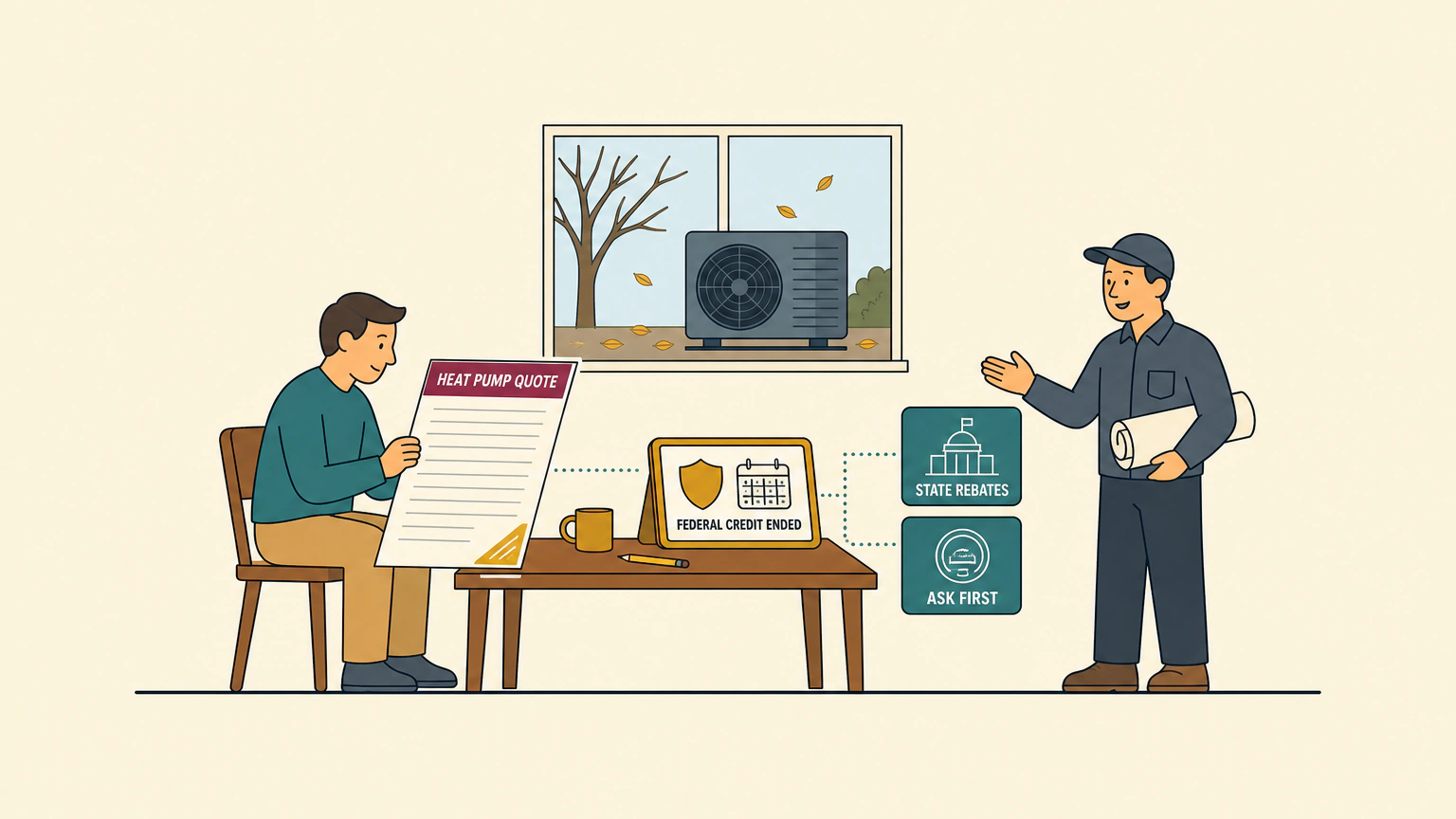
There is no federal tax credit for a heat pump, furnace, air conditioner, insulation, window, door or solar system placed in service in 2026: 26 U.S.C. 25C(i) shuts the Energy Efficient Home Improvement Credit off for any property placed in service after December 31, 2025, and 26 U.S.C. 25D(h) shuts the Residential Clean Energy Credit off for any expenditure made after that date. If qualifying work was completed in 2025, you may still be able to claim it on your 2025 return, and separate state and utility rebate programs may still be available, but any 2026 quote that prices in a 30 percent federal credit is quoting a credit that no longer exists.
Both home energy tax credits ended under the same law. Public Law 119-21, signed July 4, 2025, moved several energy deadlines forward by years: section 70505 rewrote the end of 25C, section 70506 the end of 25D. No new federal tax credit has replaced them.
No federal credit applies to a job finished in 2026
Two code sections controlled the two credits, and both are closed. Section 25C covered the efficiency work most homeowners buy: heat pumps, furnaces, air conditioners, insulation, windows and doors. Section 25D covered solar, batteries and geothermal.
Watch the wording when you look them up. IRS summary pages say the 25C credit is allowed for property placed in service "before December 31, 2025," while the statute at 25C(i) says the section does not apply to property placed in service after December 31, 2025. The statute is the rule that counts. A system finished on December 31, 2025 is inside the window. One finished on January 1, 2026 isn't.
The one job that still qualifies: work completed in 2025
If qualifying equipment was placed in service during 2025, you may still be able to claim the credit. Any credit belongs on your 2025 return, claimed on IRS Form 5695, Residential Energy Credits, not on a 2026 return.
If you already filed for 2025 without it, you can fix that. The IRS FAQ on these credits says you can amend a return that left the credit off. A refund claim generally has to be filed within three years of the original return or two years of paying the tax, whichever is later.
If your project straddled the new year, keep reading. The date that decides your claim is probably not the one you think.
What ended, and the exact date each one stopped
This wasn't a phase-down. Before Public Law 119-21, both credits ran into the 2030s and 25D had a scheduled step from 30 percent down to 26 and then 22. Congress struck those steps and set one hard stop instead, which is why advice published in 2024 and 2025 is now wrong rather than merely dated.
Section 25C, the credit that covered heat pumps, furnaces, insulation, windows and doors
While it existed, 25C paid 30 percent of qualified costs, capped at $1,200 a year for most items. Inside that cap sat sub-caps: $600 for all exterior windows and skylights, $250 per exterior door and $500 for all doors, $150 for a home energy audit, and $600 per item for a central air conditioner, a gas, propane or oil furnace, boiler or water heater, or a qualifying electrical panel upgrade. Heat pumps, heat pump water heaters and biomass stoves and boilers had a separate $2,000 annual cap.
It was nonrefundable, and unused amounts couldn't be carried into a later year. It applied to existing homes, and in most cases the home had to be your main home; landlords and other owners who did not live in the home could not claim it. Subsection 25C(i) ends it. If you're taking bids from window installers this fall, that $600 window line is gone.
Section 25D, the credit that covered solar, batteries and geothermal
Section 25D paid 30 percent with no annual or lifetime dollar limit, apart from a cap of $500 per half kilowatt on fuel cell property. It was nonrefundable too, but unlike 25C it carries forward: the 2025 Form 5695 instructions say the form is used to carry an unused portion of the residential clean energy credit into 2026.
Subsection 25D(h) ends it for expenditures made after December 31, 2025. That word, expenditures, is a different legal test from 25C's. For anyone hiring solar installers near the new year, it's the word that decides everything.
The three later deadlines that have already passed
Three related provisions ran a few months longer, and they're all behind us. The home EV charger credit under section 30C stopped for property placed in service after June 30, 2026. The builder credit under section 45L stopped for a qualifying new home acquired after that date. The commercial buildings deduction under section 179D stopped for property whose construction begins after it. For a homeowner in August 2026, nothing on the IRS list of expiring energy provisions is still open.
| Credit or deduction | What it covered for a homeowner | Last date it applies | The test that decides |
|---|---|---|---|
| Energy Efficient Home Improvement Credit (26 U.S.C. 25C) | Heat pumps, heat pump water heaters, central AC, furnaces and boilers, insulation and air sealing, windows, doors, home energy audits, some panel upgrades | Property placed in service on or before December 31, 2025 | Date placed in service |
| Residential Clean Energy Credit (26 U.S.C. 25D) | Solar electric, solar water heating, geothermal, wind, fuel cells, battery storage | Expenditures made on or before December 31, 2025 | Date original installation is completed; for construction or reconstruction, when the taxpayer's original use begins |
| Alternative Fuel Vehicle Refueling Property Credit (30C) | A qualifying home EV charger and its installation in an eligible census tract | Property placed in service on or before June 30, 2026 | Date placed in service |
| New Energy Efficient Home Credit (45L) | Claimed by the builder of a qualifying new home, not by the buyer | Home acquired on or before June 30, 2026 | Date the home is acquired |
The timing test that decides whether you can still claim 2025 work
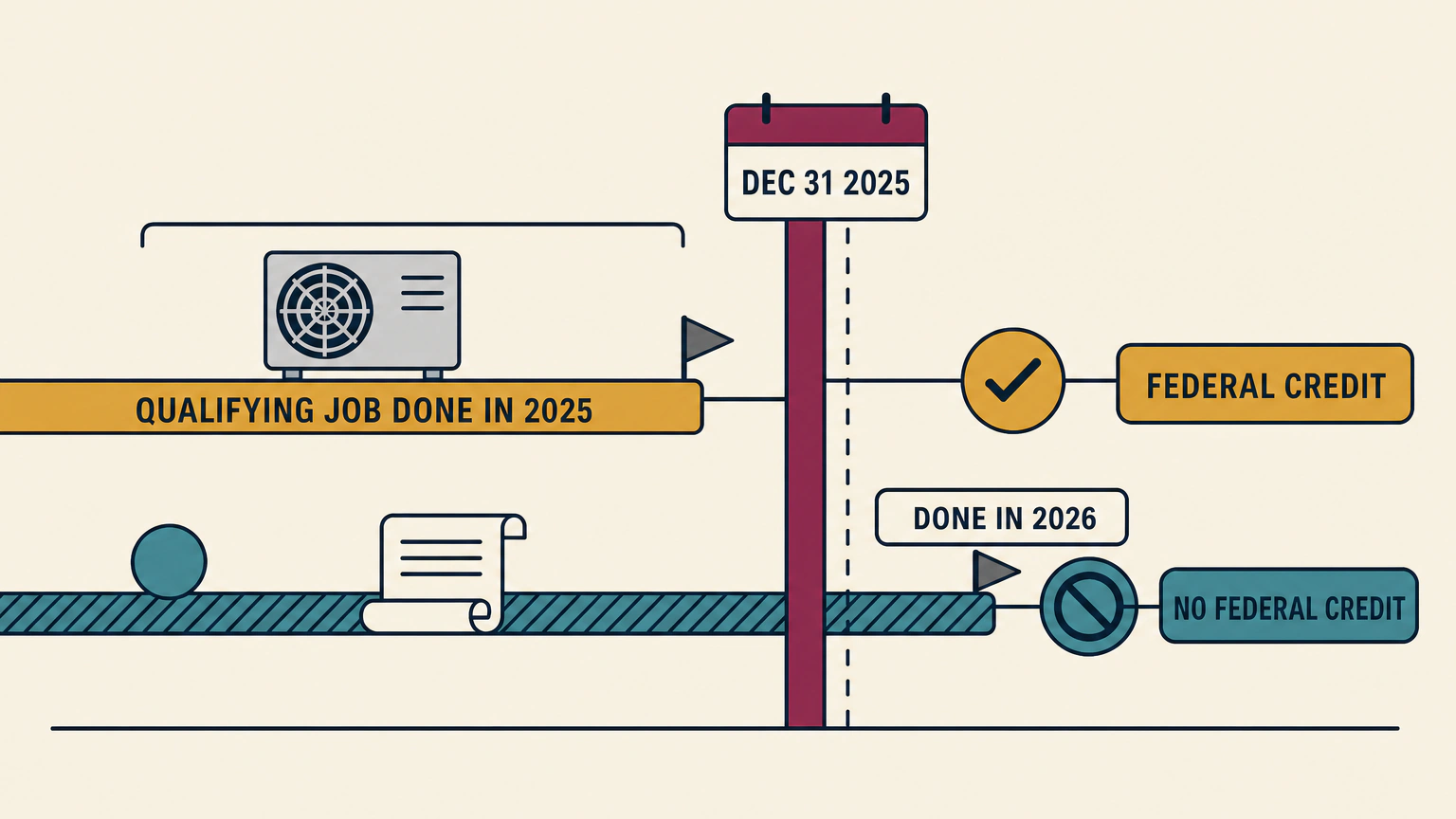
One date decides whether a project that straddled the new year is worth anything at tax time. It isn't the date you paid.
Why paying in 2025 does not save a 2026 installation
Section 25D(e)(8)(A) treats an expenditure as made when the original installation of the item is completed, not when you paid. The IRS answered the deposit question directly in Fact Sheet FS-2025-05, question 7: if installation is completed after December 31, 2025, the expenditure is treated as made after that date, and the credit is gone. Paying in December buys nothing if the crew arrives in February.
Section 25C runs on a similar clock. Its test is the date the property is placed in service, and the IRS tells you to claim the credit for the tax year the property was installed, not merely purchased.
Keep records of the project's timeline: the installer's completion certificate, the final inspection or commissioning record, and for solar the utility's permission to operate letter.
The manufacturer identification number your 2025 claim needs
Section 25C(h) allows no credit for specified property placed in service after December 31, 2024 unless the item was produced by a qualified manufacturer and you report the qualified product identification number on the return. The 2025 Form 5695 instructions make that concrete: for specified property placed in service in 2025 you enter the four-character qualified manufacturer identification number, the QMID, for each item.
Insulation and air sealing materials are the exception, and the IRS says they are the only qualifying property exempt from the manufacturer and number requirements. Windows and doors aren't.
If qualifying equipment went in during 2025 and you never received that number, ask the installer or the manufacturer now, before the return is filed.
| Your situation | The date that counts | Federal credit? | Where it is claimed |
|---|---|---|---|
| Heat pump installed and running in November 2025 | Placed in service, November 2025 | Potentially, if otherwise eligible and subject to the 2025 caps | 2025 return, Form 5695 |
| Deposit paid December 2025, system installed February 2026 | Installation completed, February 2026 | No | Nowhere |
| Contract signed and work done in 2026 | Any 2026 date | No | Nowhere |
If your panels went on the roof in December 2025 but the utility granted permission to operate in January 2026, we can't tell you which date controls. No IRS document we could find says whether the original installation counts as completed at the install or at the switch-on. Take the completion certificate, the final inspection and the permission to operate letter to a tax professional.
What still pays for the same work in 2026
The federal tax credits are gone. The separate DOE rebates are administered through states, territories and Tribes and remain available in select states.
State Home Energy Rebates, and what they can be worth
The Department of Energy's Home Energy Rebates program has two halves. HOMES, the Home Owner Managing Energy Savings rebate, is worth up to $8,000 for a whole-home upgrade that models at least 20 percent energy savings, and it's open to households at every income level. HEEHR, the High-Efficiency Electric Home Rebate, is worth up to $14,000 for efficient electric equipment and envelope work, delivered at the point of sale either at a retailer or through your contractor. Grantees may raise the amounts for households under 80 percent of area median income.
States, territories and Tribes run their own versions with their own rules. DOE says the rebates are now available in select states and publishes no consolidated status list, so no national page can tell you where yours stands. HEEHR is designed to emphasize insulation and air sealing before heating and cooling upgrades, work that may involve insulation contractors.
Utility, manufacturer and state tax incentives, and how to verify one before you sign
Utility rebates are another possible source of money. Check the utility's own site for eligibility, equipment requirements and claim deadlines. Manufacturer promotions may run through the installing dealer. Some states run their own tax credits as well.
The verification rule is the same for all three: confirm on the payer's own website or by phone with the payer, never on the contractor's flyer, and get the amount, the deadline and the conditions into the written contract. One note if you're still filing a 2025 return: the IRS treats a utility subsidy as a reduction of your qualified expenses, so a rebate can shrink the credit you claim.
How to reach your own state energy office in one step
DOE directs you to your State or Territory Energy Office for current program status and eligibility information. NASEO, the National Association of State Energy Officials, publishes a clickable index of all 50 states, the District of Columbia and the territories at naseo.org/members-states.
Open your state, then ask two questions: is HOMES or HEEHR accepting applications here, and is the rebate claimed by me or by my contractor?
When a quote still promises you a tax credit
Some of these promises may be stale web copy rather than fraud. A page written in 2024 and never touched since will still say the government pays 30 percent, and the salesperson quoting it may believe it. We checked one home energy contractor's own incentives page: headed "2026 Home Energy Tax Credits," it still states in the present tense that homeowners can claim a 30 percent credit, up to $2,000, for installing a heat pump. Your job isn't to judge the motive. It's to price the job on money that exists.
Four questions to ask before you sign
Ask these four out loud, and write down the answers.
- "Which incentive is this, exactly: a federal credit, a state rebate, a utility rebate or a manufacturer promotion?" A named payer can be checked in five minutes; "the government pays 30 percent" cannot be checked at all.
- "Who claims it, me or you?" A point of sale rebate comes off the invoice, so you see a lower price on the day, while a tax credit is claimed by you, later, on your own return.
- "Show me the payer's own page or program document." A screenshot of the contractor's own incentives page is not verification.
- "Will you put the amount, the deadline and the conditions in the written contract, and price the job without it as well?" A quote that survives having the incentive stripped out is a quote you can compare against another bid.
Red flag: signs a quote is priced on money that is not there. A line item on a 2026 installation labeled as a federal tax credit: ask for a revised quote without it. A discount that only holds if you sign before a "credit deadline": there is no federal deadline left to beat, and the FTC lists pressure for an immediate decision as a sign of a home improvement scam. A promise to "handle the paperwork" for your federal credit: the credit is claimed on your tax return with Form 5695, and only for 2025 work. An incentive quoted out loud but missing from the contract: the FTC's advice is to get promises made in conversation into the written agreement. A link to the installer's own tax credit page rather than the payer's: ask for the utility, state or manufacturer page.
What to do if a bid was priced around a credit that no longer exists
Ask for a revised written quote with the incentive line removed, then compare the bids properly on out-of-pocket price alone. Ask to have any promised incentive written into the contract rather than relying on the sales pitch.
If a business won't correct a written claim about a federal credit, report it to the FTC at reportfraud.ftc.gov and to your state attorney general's consumer protection office. We name no business, and we won't tell you whether a particular claim breaks the law. That one is for a lawyer or the regulator.
What this work costs now that the credit is gone
What homeowners are paying, from Industry Oversight cost profiles
With the federal credit out of the arithmetic, the number that matters is the whole price. These are our own aggregated cost profiles rather than a market statistic, and your area may sit above or below the national figures.
| Work | National average | Typical price range | Cost profiles |
|---|---|---|---|
| Heating and air conditioning | $5,630 | $3,865 to $7,463 | 832 |
| Insulation | $1,657 | $1,040 to $2,392 | 809 |
| Windows | $5,574 | $3,064 to $8,769 | 676 |
| Solar | $24,245 | $16,904 to $31,718 | 931 |
Two decisions sit either side of these numbers. Before you price a replacement, settle whether to repair or replace the furnace at all. Once replacement is decided, take at least three quotes from HVAC contractors near you and compare them on out-of-pocket price.
Frequently asked questions
Is the 25C tax credit still available in 2026?
No. Section 25C(i) says the section does not apply to any property placed in service after December 31, 2025, and the 2025 Form 5695 instructions say the same. If your equipment went in during 2026, there's no federal credit for it, whatever a quote says.
When did the heat pump tax credit end?
The $2,000 heat pump credit ended with section 25C, which stops at property placed in service after December 31, 2025. Public Law 119-21, signed July 4, 2025, moved that date forward from 2032. No new federal tax credit has replaced it for homeowners.
I paid for solar in 2025 but it was switched on in 2026. Can I still claim it?
What matters is when the original installation was completed, not when you paid. Section 25D(e)(8)(A) sets that test, and IRS FS-2025-05 confirms that paying in 2025 for a 2026 installation earns nothing. No IRS source says whether utility switch-on is part of completion, so take your paperwork to a tax professional.
Can I claim a 2025 installation on my 2026 tax return?
No. The IRS says you must claim the credit for the tax year the property was installed, so 2025 work goes on your 2025 return on Form 5695. If you already filed without it, the IRS FAQ says you can generally amend within three years. An unused 25D amount can still carry forward.
What is the qualified product identification number, and what if my installer never gave me one?
For property placed in service in 2025, it is the four-character QMID the IRS assigns to the qualified manufacturer. Section 25C(h) generally requires a qualified product identification number for specified property placed in service after December 31, 2024, and Revenue Procedure 2024-31 allows taxpayers to use the QMID in place of that number for property placed in service during 2025. Ask the installer or the manufacturer for the QMID.
Do state or utility rebates still exist in 2026?
Yes. The federal credits and the rebate programs are separate money. The Department of Energy's Home Energy Rebates are run by states and territories, and DOE says they are available in select states. Utility rebates follow their own program rules and may also be available.
A contractor's website still advertises a 30 percent credit. What should I do?
It may be stale copy, but verify it. Ask for the incentive in writing with the payer named, and ask for the job priced without it. If a written claim about a federal credit is not corrected, report it at reportfraud.ftc.gov and to your state attorney general.
Sources and limits. The rules above were read in these primary sources: the statutory text of 26 U.S.C. 25C and 25D, IRS Fact Sheet FS-2025-05 of August 21, 2025, the IRS pages for both credits, and the Department of Energy's Home Energy Rebates program page. FS-2025-05 carries the IRS's standard caveat: it is not published in the Internal Revenue Bulletin, so the IRS will not use it to resolve a case, though good-faith reliance protects you from accuracy-related penalties. We're not your accountant, and this is general information about a federal rule rather than tax advice. Business use of your home, a second home, a rental or a credit carried forward from an earlier year all change the answer, so take your own situation to a tax professional or the IRS before you file.