

More than one U.S. household in five relies on a septic system or a small shared one, by EPA's count. If yours is one of them, you may never have seen inside the tank or know how many lids it has. That's normal. The job is cheap right up until the year you skip it.
On this page
What a septic tank pump out costs
Hold any quote for a 1,000 gallon tank against $300 to $700. Just know where that range comes from. We looked for septic pumpers who publish their own rates and couldn't find one we'd stand behind. So every septic pumping cost here is somebody's aggregate of other people's invoices, and that includes the figures we publish ourselves.
Ours tell a stranger story. Our septic pump out and cleaning companies category averages $1,530 across 882 cost profiles, with a typical range of $589 to $2,550. Those pages price to a location, so treat that as one snapshot, not a national line. It still runs two to five times what either cost guide puts on a routine pump out. We think the category covers bigger jobs than the scheduled visit. If you're quoted $1,500 for a routine pump out, ask which job they're pricing.
Price by tank size
The first thing that moves the price is the size of the tank, and plenty of owners don't know theirs. EPA says your local health or environmental department usually permits septic systems, and it can send you a copy of the permit and the "as-built" drawing. If the papers are gone, both cost guides pair a three-bedroom house with a 1,000 gallon tank and a four-bedroom house with 1,250 gallons. HomeAdvisor says most homeowners have tanks between 1,000 and 1,500 gallons.
HomeGuide labels its figures 2026 data, and HomeAdvisor's page is still titled for 2025. At the common sizes, they barely disagree.
| Tank size | What HomeGuide puts on a pump out | What HomeAdvisor puts on a pump out |
|---|---|---|
| 750 gallons | $225 to $525 | $250 to $550 |
| 1,000 gallons | $300 to $700 | $325 to $700 |
| 1,250 gallons | $375 to $875 | $375 to $900 |
| 1,500 gallons | $450 to $1,050 | $450 to $1,100 |
What the treatment plant charges before the truck reaches you
Once your tank is empty, the hauler still has to unload the truck, and the treatment plant charges for the load. The three plants we checked publish a per-gallon rate. King County weighs each load and bills the equivalent per-pound charge. Unlike almost everything else in this trade, those rates are public. That makes disposal the one piece of septic tank emptying cost you can look up yourself.
| Where the load goes | Rate per gallon | Disposal on a 1,000 gallon load |
|---|---|---|
| Concord, New Hampshire (all NH communities) | $0.065 | $65.00 |
| Athens-Clarke County, Georgia (collected in county) | $0.15 | $150.00 |
| King County, Washington (South Treatment Plant) | $0.1745 | $174.50 |
| Athens-Clarke County, Georgia (from five neighboring counties, delivered by an ACC-based business) | $0.35 | $350.00 |
These are what three treatment plants charge the hauler in 2026, not what the hauler charges you. Athens-Clarke's published rates rise to $0.17 and $0.38 in 2027.
Between Concord and a load hauled into Athens from a neighboring county, the gap is $285 on the same 1,000 gallons. That's real money on a job priced at $300 to $700, and it's spent before anyone lifts a shovel. Athens alone charges more than twice as much depending on which county the load came from.
To find your own number, search your city or county wastewater utility's site for septage rates. All three plants we checked post theirs publicly.
The extras that move the number
The cost to pump a septic tank can land above those ranges for honest reasons. HomeGuide's questions for a pumper map them well. Does the estimate include finding the lids or digging to reach them? Is disposal included? Is there an extra fee for a system that hasn't been maintained? What's the per-gallon rate? HomeGuide puts typical pumping at $0.30 to $0.70 a gallon.
Those can all be fair charges. Buried lids take digging, and nobody digs for free, which is why Penn State Extension suggests risers, extensions that bring the lids up to the soil surface. A long-neglected tank may need jet cleaning to wash packed sludge off the walls and floor, a septic tank cleaning cost HomeGuide puts at $200 to $300 extra. It's worth asking whether a long hose run or a weekend slot changes the price.
Then read the quote line by line. Check the pump out against your tank size. If disposal is listed on its own, ask what the line covers and how it was calculated. If it's missing, ask, because a quote without it can look cheaper than it is. Get three quotes and compare the quotes properly.
Additives and repair pitches made on the same visit aren't extras. They're a separate conversation, and usually a shorter one.
How often your tank actually needs pumping
Why the answer is a range and not a number
EPA says household tanks are typically pumped every three to five years. It names four things that set the pace: household size, total wastewater, the volume of solids and the size of the tank. A garbage disposal matters too, since EPA says a home with one needs its tank pumped more often.
Penn State Extension puts the interval at every two to three years after allowing for time adults spend at work and children spend at school.
Both cost guides chart frequency by bedrooms. Bedrooms don't flush, though. People do. And the agencies don't agree on the trigger either.
Worth knowing: EPA says pump when the scum layer sits within six inches of the bottom of the outlet tee, when the sludge layer comes within twelve inches of the outlet, or when sludge and scum together fill more than 25 percent of the liquid depth. Its own frequent-questions page instead gives a rule of thumb of two-thirds of the tank volume. Penn State Extension puts the industry line at 30 percent and tells homeowners to pump at a third. Three thresholds, two agencies, one honest conclusion: nobody can tell you from a distance.
When you are selling, and when the house is about to fill up
Two moments can override the schedule. If you're selling, a septic inspection may decide the timing. EPA notes that many states require one when a property changes hands, and part of an inspection is deciding whether the tank needs pumping. If yours does, it needs attention before the transfer.
The other moment is about rest. The drainfield is the buried bed of soil that soaks up your tank's liquid, and Penn State's research found it benefits from stretches with no wastewater. So Penn State advises pumping the day before the family leaves for summer vacation. The point isn't summer. It's the empty house. The mirror case is a house about to fill with holiday guests. More people make more wastewater, so if your tank is near its trigger, we'd book it before they arrive.
How to tell it is time instead of guessing
The three measurements a pro takes inside the tank
The liquid in your tank leaves through a T-shaped outlet, and EPA says that tee is there to keep sludge and scum from leaving with it. Two measurements track how close those layers have crept to the outlet. The third tracks how much of the liquid depth they fill.
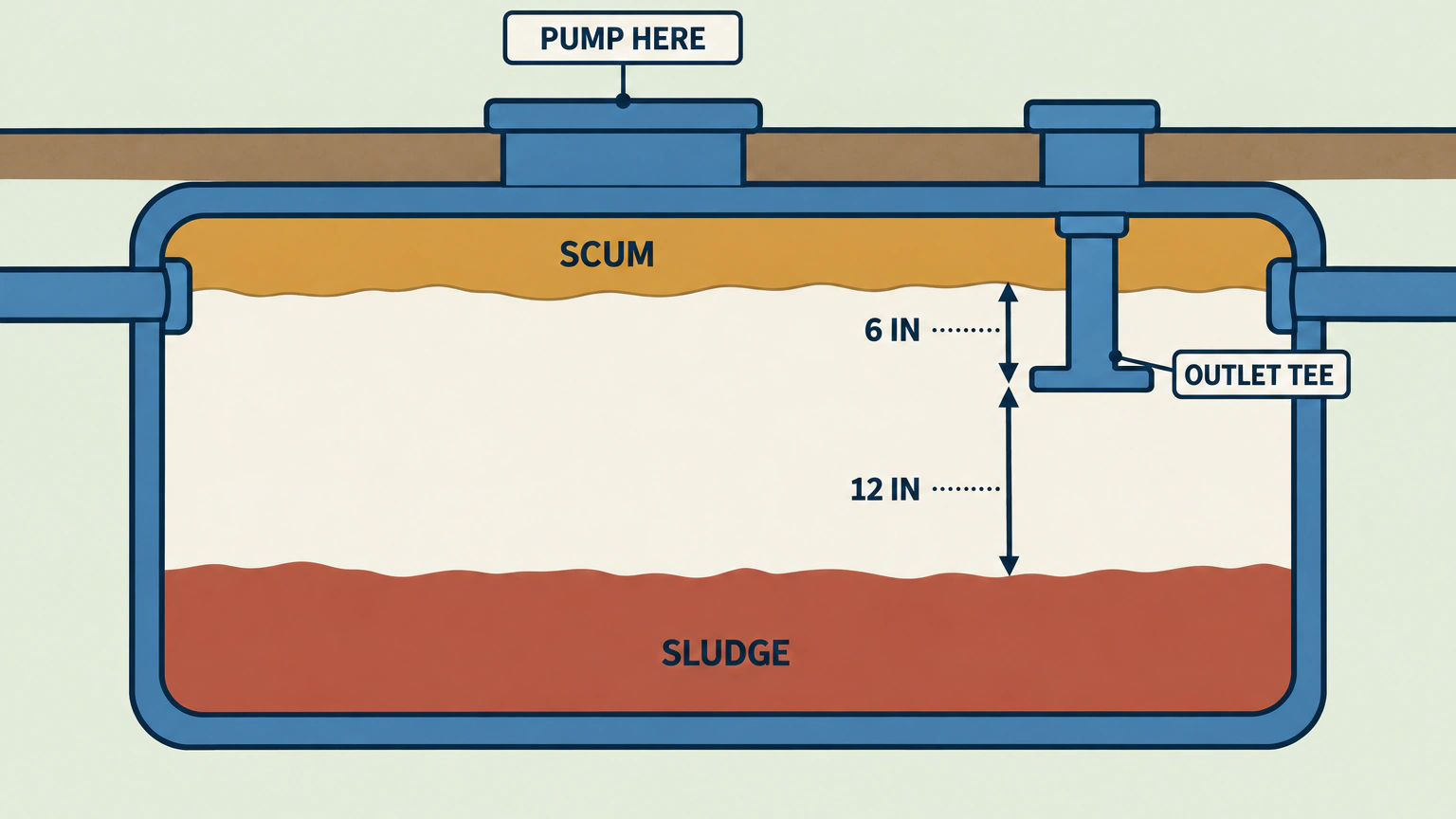
In yard terms, EPA's triggers are gaps. Pump when the bottom of the scum sits within six inches of the bottom of the outlet. Pump when the top of the sludge comes within 12 inches of the outlet. Pump when the two layers together fill more than a quarter of the liquid depth. Past those points, solids can start slipping out toward the drainfield. A service provider will examine both layers on a visit, and EPA tells you to write the levels down, so you can see how fast your household fills the tank.
The check you can do yourself with a long pole
Penn State Extension gives homeowners a simple test. Once a year, open the access port over the first chamber, lower a long pole to the bottom and pull it out. Sludge darkens the pole, so the dark band shows how deep it runs. If it's more than a third of the tank's depth, book the pump out. Penn State adds that most homeowners are better off just pumping every two or three years. The pole is for anyone who'd rather measure than guess.
Never enter a septic tank for any reason, and don't lean over an open lid. In Penn State's words, "These tanks contain gasses that can kill you."
The signs that mean stop waiting
Some tanks announce themselves. EPA's warning signs:
- sewage backing up into toilets, drains or sinks
- tubs, showers and sinks all draining very slowly
- gurgling in the plumbing
- standing water or damp spots over the tank or drainfield
- a sewage smell around the tank or drainfield
- bright green, spongy grass over either one, even in dry weather
Sewage coming up into the house is the one case where we'd pay what an after hours call costs rather than wait for morning. Slow drains and gurgling mean calling a septic pro soon. The outdoor signs need a pro who'll look at the field, not just the tank. Penn State says pumping the tank won't clear a clogging layer that has built up in the soil.
What to watch on the day the truck comes
You booked it and you're paying for it, so the visit itself is what you're buying. Penn State's advice is simple: "It is a good idea to be on hand to ensure that it is done properly."
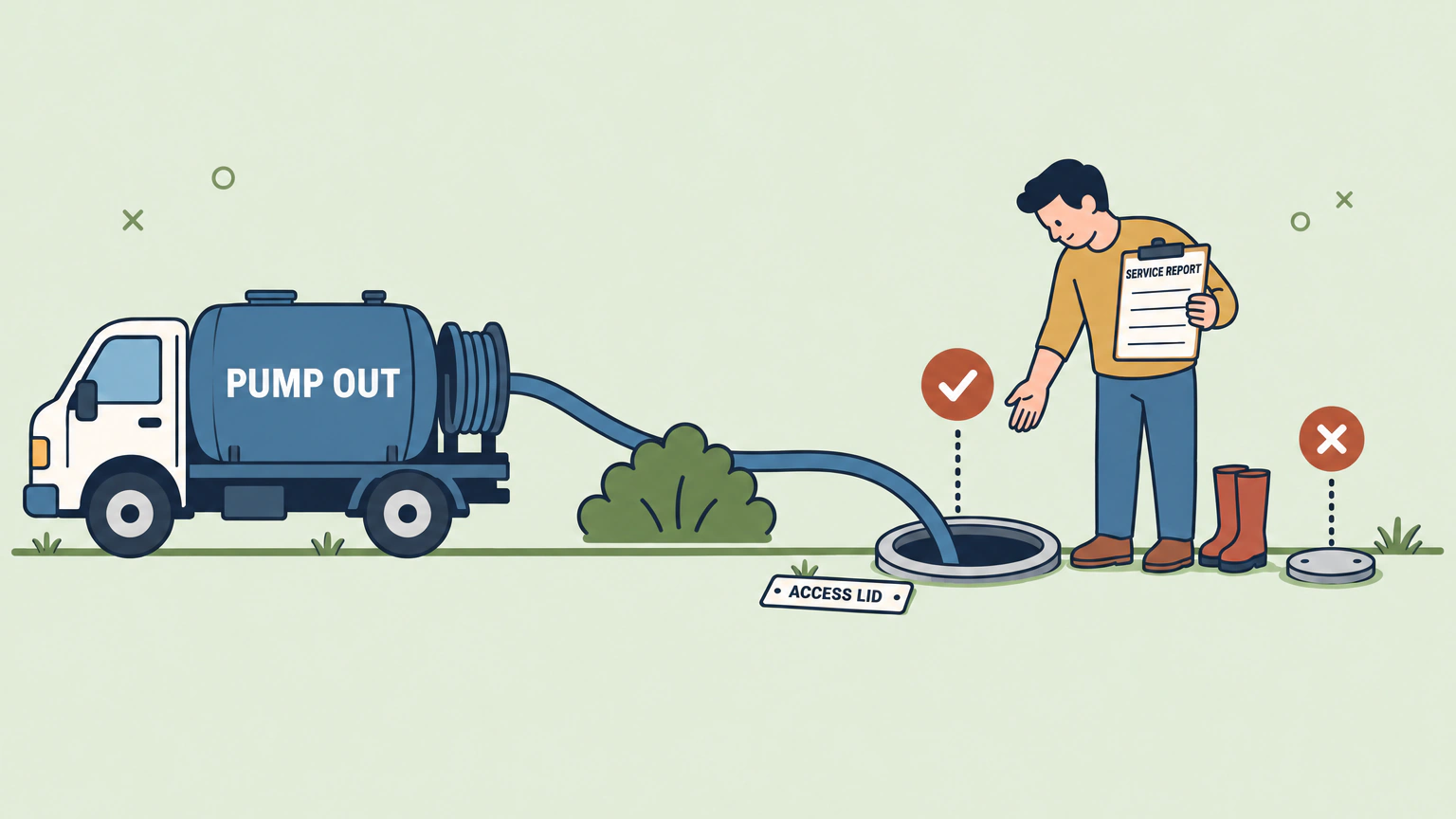
Which hole the hose goes into
Picture the top of the tank. Over its body sits a large central access cover, sometimes called the manhole. Over the inlet and outlet sit much smaller inspection ports, each directly above a baffle. Those small ports are for checking the fittings, not for the hose.
Penn State Extension is blunt about why: "Pumping a tank through the baffle inspection ports can damage the baffles and yield incomplete removal of sludge and scum." That's two problems for the price of one visit. A damaged outlet baffle may stop holding solids back from the drainfield. And the sludge left behind is already using up room before your next interval starts.
Don't get hung up on the count. Penn State mentions two central ports because Pennsylvania now requires two-chamber tanks on new and upgraded systems, and until recently most tanks were single-chamber. The count changes with the tank. The rule doesn't: the large central cover, never the little port over the baffle. If the crew can only reach a small port, ask why before they start.
The step that separates a full pump out from a partial one
Sucking out the liquid is the easy part. Sludge and scum don't flow on their own, and Penn State says that to get everything out, the crew has to break up the scum and mix the sludge back into the liquid. The usual way is to pump liquid out and push it back into the bottom of the tank, again and again, before the final pull.
That's the part to watch. A crew that drops the hose, pulls the liquid and packs up has left behind the solids you paid to remove. If you don't see anything like churning, ask while the truck is still in the driveway.
The report you should have before the truck leaves
EPA says the service provider should note repairs and the tank's condition in your system's service report, and it tells you to keep the records. That paper does three jobs. The sludge and scum levels on it help date your next pump out. It's what an inspector reviews when you sell, since EPA's description of an inspection starts with the permit and the pumping records. And if the drainfield ever gives trouble, it shows what the tank looked like and who last opened it.
Here's what a full visit looks like. If your tank has one central cover instead of two, the first item still means the big one.
- The hose goes into one of the two large central access covers, not one of the small inspection ports sitting over a baffle.
- They break the scum crust up and mix the sludge back into the liquid, usually by pumping liquid out and re-injecting it, before the final pull.
- With the tank empty, they look at the inlet and outlet baffles or tees and tell you what they saw.
- Nobody climbs into the tank, and nobody leans over an open lid, for any reason.
- You get a service report naming the tank's condition, the sludge and scum levels they found, and anything they repaired.
- Before they leave, the lid location is marked or written down, or you talk about a riser so the next crew does not have to dig.
The line item you can say no to
Additives are sold as bacteria, enzymes or chemicals that help a tank do its work. Asked whether they're recommended, EPA says "No." A working tank already holds plenty of bacteria, enzymes, yeasts and fungi, EPA says, so you'd be paying to add bacteria to a tank full of them. It adds that additives aren't needed for a system to work properly and can even harm it.
Red flag: Additives are the one line on a septic invoice you can strike without thinking about it. EPA's answer to whether they are recommended is a flat no. Penn State Extension says relying on them instead of pumping may fail the whole system. Yet one national cost guide's own maintenance table still prices professional additive treatment in the hundreds of dollars. If it appears on your quote, ask what it is for.
Two other lines deserve a question before a yes. If a quote adds a "tank cleaning" charge to a tank that's been pumped on schedule, ask what it covers beyond the pump out. If the visit ends with a drainfield pitch, ask for the sludge and scum readings first. When the quotes come in, hold each one against your tank size, your local disposal rate and the six things a full visit includes.
Frequently asked questions
How often should a family of four pump a 1,000 gallon septic tank?
Every two to three years is a sound starting point. Penn State gives that interval after allowing for time adults spend at work and children spend at school. HomeAdvisor suggests every three years for the same household. A pro's measurements or a yearly pole test will show where yours falls.
How do I know if my septic tank needs to be pumped?
Measure it instead of waiting for symptoms. Pump when the scum is within six inches of the bottom of the outlet, the sludge is within 12 inches of it, or the two fill more than a quarter of the liquid depth. Penn State's yearly pole test is the do-it-yourself version. Backups and a spongy green patch over the tank mean stop waiting and call.
Do septic tank additives work, and do I need them?
You don't need them, and EPA doesn't recommend them. A working tank already holds the microorganisms additives claim to supply, and Penn State warns that relying on them instead of pumping may lead to failure of the entire system. What protects a tank costs less: pump on schedule, flush only human waste and toilet paper, and go easy on the garbage disposal.
What happens if you never pump your septic tank?
Eventually, solids drift out toward the drainfield and start clogging it. EPA says that can raise the cost of pumping and may mean replacing the entire drainfield. That's a different price bracket: our septic system installers category averages $6,060 across 784 cost profiles. A never-pumped tank that seems fine may be leaking, EPA says, or may serve a rare one- or two-person home.
Do I have to pump my septic tank before I sell my house?
It depends on your state. EPA notes that many states require a septic inspection when a property changes hands, and that inspection decides whether the tank needs pumping. Your local health or environmental department can tell you what yours requires. Either way, have your latest service report ready, because pumping records are among the first things an inspector reviews.
How long does it take to pump a septic tank?
About 20 to 60 minutes for a standard household tank, according to HomeGuide. Larger, heavily used or poorly maintained tanks take longer, and so does a visit where the lids have to be found and dug up first. Stay for all of it, because the step worth watching is the crew breaking up the solids before the final pull.
Can I pump my own septic tank?
Not realistically. HomeAdvisor calls it a job best left to the pros, because what comes out has to go in proper containers and be disposed of under rules that are "usually highly regulated at the local and state levels." EPA regulates septage disposal too. What you can do yourself is Penn State's yearly pole test, which tells you when to call.