

On this page
- The short answer, and the number that actually decides it
- What a home warranty is in law, and who regulates it where you live
- The two ceilings that decide what a claim actually pays
- The exclusions that can end a claim
- Run the arithmetic on your own house
- Who a plan fits, and who should keep the money
- If your claim is denied
- Frequently asked questions
The short answer, and the number that actually decides it
The test is one line: this year's repair bill against the premium plus fees, both sides bounded by the caps. Work it through and you finish with a break even premium: the most a plan can cost before it stops making sense for your house.
Why the monthly price tells you the least
A monthly price does not tell you how much a claim will pay. The caps and the service fee appear in the contract or coverage confirmation, and they decide how much you receive when the furnace quits in January.
The premium is the ticket. The caps are the seat. Nothing about the ticket tells you whether the plan pays $600 or $5,000 on the repair you're actually worried about, which is why we'd rather you spent the first ten minutes somewhere else.
The three numbers to pull out of any offer first
Pull three numbers from the quote and contract.
First, the per item cap: the most the plan will spend on any one covered system or appliance. Second, the aggregate cap: the most it will spend on covered claims in a plan year. Third, the fee charged for a service request or trade, which the contracts call a trade call fee or a service trade call fee.
Look for those numbers in the contract and any coverage letter or coverage confirmation that comes with it. Ask for the documents before you pay anything. A seller who won't send the contract in advance has already answered your question.
What a home warranty is in law, and who regulates it where you live
What you're being sold isn't homeowners insurance. States regulate home warranties under different names. That matters because the name helps you find the agency that licenses or registers the provider and the office that takes complaints.
A service contract, not an insurance policy
Federal law already has a name for it. The Magnuson-Moss Warranty Act defines a service contract as "a contract in writing to perform, over a fixed period of time or for a specified duration, services relating to the maintenance or repair (or both) of a consumer product." The same law lets a seller offer you one only if the contract "fully, clearly, and conspicuously discloses its terms and conditions in simple and readily understood language."
Hold on to that second sentence. It is one reason to ask for the terms up front.
A homeowners policy covers the home and belongings against the losses named in that policy, while a home warranty covers listed systems and appliances that break down from wear and tear. Some insurance endorsements add equipment breakdown coverage, so check both contracts before assuming there is no overlap. That is also why which policy pays when a tree comes down starts with the cause of the damage.
What your state calls it, and where a complaint goes
In some states this sits in the insurance code. California calls it a "home protection contract." A company generally needs a home protection company license, but an insurer admitted for the class named in section 120 may issue one under section 12744(b). Arizona calls it a "home warranty or home protection contract" and generally requires the service company to hold a permit from the director of its Department of Insurance and Financial Institutions. Washington, New York and Iowa file the same product under the plainer heading of service contracts, with registration or a license required either way.
We opened the statute in six states, and six is where it stops, because we won't print a row we didn't read.
| State | What the law calls it | Statute | Who administers it |
|---|---|---|---|
| Arizona | Home warranty or home protection contract | A.R.S. sections 20-1095(3), 20-1095.02 and 20-1095.03; permit required unless an exemption applies | The director of the Department of Insurance and Financial Institutions (A.R.S. section 20-102(1)) |
| California | Home protection contract, issued by a licensed home protection company or an admitted insurer authorized under section 12744(b) | Insurance Code sections 12740 to 12764, Part 7 | California Department of Insurance, which licenses home protection companies |
| Florida | Home warranty, issued by a licensed home warranty association or an authorized insurer | Fla. Stat. sections 634.301(2), 634.302 and 634.303 | The Office of Insurance Regulation administers this part (section 624.05(3)) |
| Iowa | Residential service contract | Iowa Code chapter 523C, sections 523C.1 and 523C.2 | The commissioner of insurance licenses the service company |
| New York | Service contract, including appliances sold with residential real property | N.Y. Insurance Law article 79, section 7902 | The superintendent of the Department of Financial Services |
| Washington | Service contract; the chapter expressly permits covering residential plumbing, electrical, heating and cooling systems | RCW 48.110.017, 48.110.020(2), 48.110.030 | The state insurance commissioner, with registration required |
For any other state the method is the same. Search your insurance department's site for "service contract" or "home warranty." If the product isn't regulated there, try the attorney general's consumer protection office. Contract terms and state rules differ, so the clauses in your own agreement and your own state's law are the ones that decide your claim.
The two ceilings that decide what a claim actually pays
Look for both ceilings in the contract and any coverage confirmation. Together they can turn a covered repair into a partial payment.
The per item cap
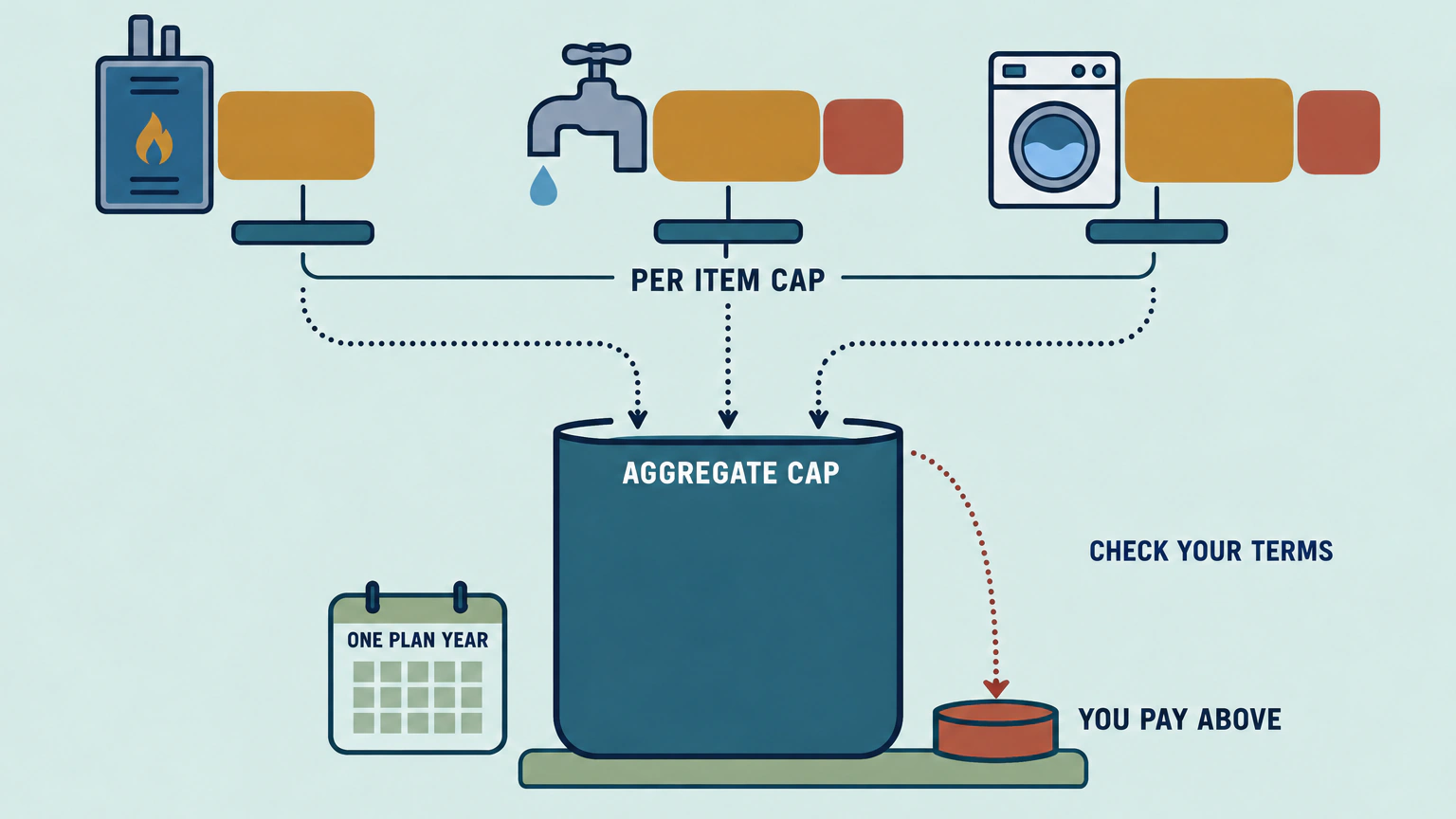
A per item cap is the most the plan will pay on any single covered system or appliance. Assurant's sample plan agreement puts it plainly: "Coverage Limit means the maximum amount We will pay per Covered Item or Service Requests under this Plan." Home Warranty of America's direct-to-consumer contract attaches numbers to the same idea, limiting its obligation to "$5,000 per Covered System and Component and $15,000 in the aggregate during the Coverage Period."
Five thousand dollars sounds generous until you price a heating and cooling job. Our own cost profiles for that work sit at $5,630 on average, in a typical range of $3,865 to $7,463, drawn from 832 profiles. Against a $5,000 per item cap, the average job leaves $630 with you. The top of that range leaves $2,463. Both figures land before the service fee.
That's the collision, and it's why the cap outranks the price. Those profiles come from our HVAC contractors near you listings, which is also where you'd go to get the job quoted.
The cap on the whole plan year
The aggregate cap is the second ceiling, and it counts all payments subject to that limit. Assurant defines it as "the maximum amount We will pay for all Service Requests under this Plan," tied on its coverage confirmation to "a twelve (12) month period beginning with your plan start date." Replacing one item doesn't reset it. A large first claim can leave very little room for a second.
Underneath sit the sub caps, and those are the ones that catch people. Home Warranty of America's contract says it "will pay no more than $1,000 in the aggregate during the Coverage Period for repair or replacement of tankless or oil water heater." Fidelity National Home Warranty's California sample limits concrete-encased or inaccessible interior plumbing lines to $1,000 for the term, and combined water heater or radiant heating systems to $1,500 each. Get a quote from local plumbers for that work and the gap stops being theoretical.
So a system can be capped far below both headline numbers. How the plan classifies your equipment decides which cap it lands under.
What happens when a repair goes over
When an approved repair costs more than its applicable cap, the plan pays no more than the cap and the rest is yours. Home Warranty of America writes it in: your "sole remedy" is the cost of the repair or replacement, and "in no event, will Our liability exceed $5,000 per covered item or $15,000 in the aggregate." That isn't a loophole. It's the deal, stated in the open.
In the HWA and Fidelity samples, the fee applies even when the request is denied.
So here's the sentence to send a seller, word for word: what is my per item limit, what is my aggregate limit, and which systems carry their own lower limit? Three answers, one email. If a brochure comes back instead of a clause, ask again.
The exclusions that can end a claim
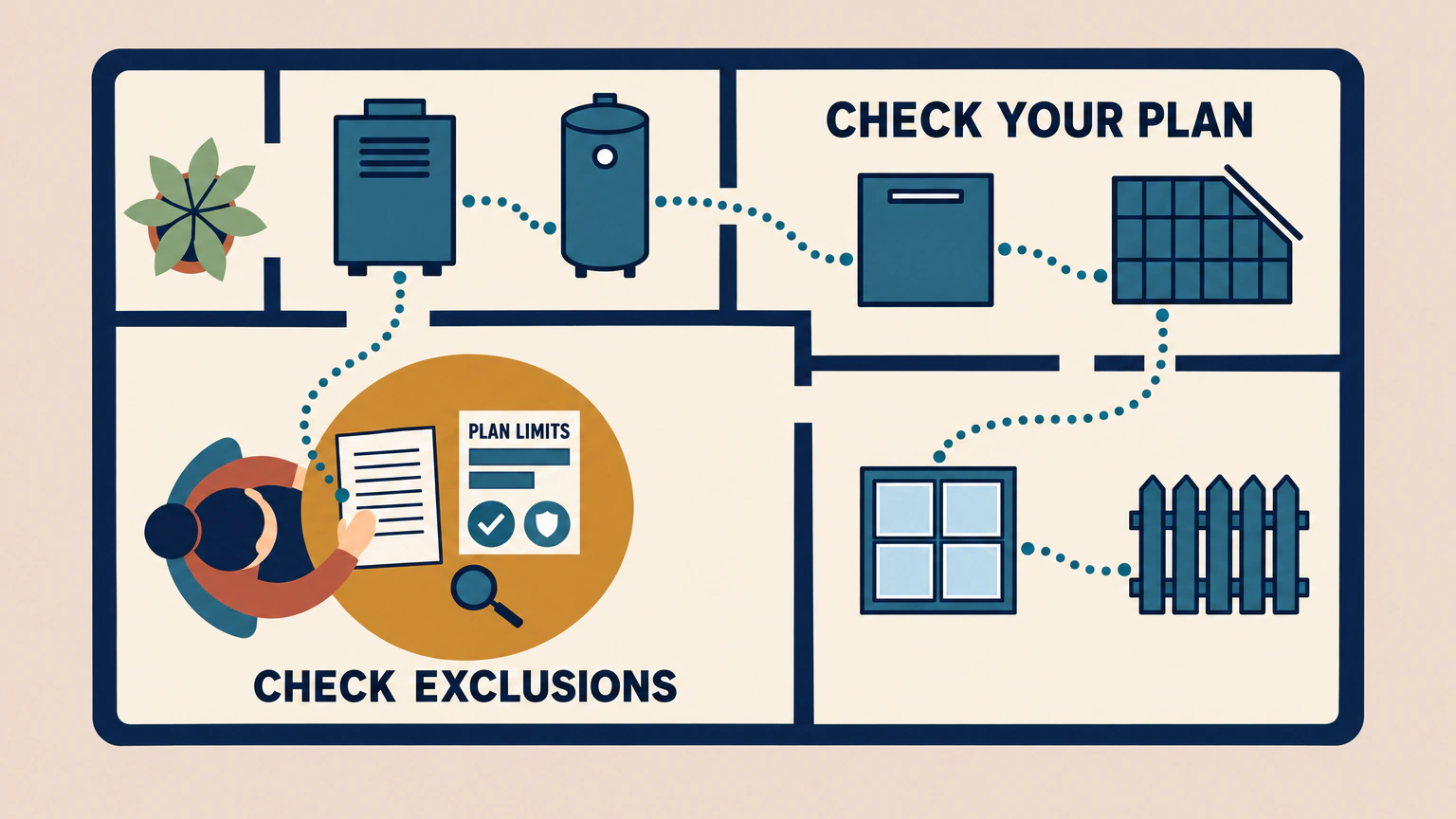
Exclusions aren't fine print. They raise questions about your claim after it is filed, and some answers turn on evidence you can gather now, while everything still works.
Pre existing conditions and the wait period
The three samples treat pre-existing conditions differently. Home Warranty of America won't pay for systems or appliances "inoperable as a result of pre-existing conditions, deficiencies, or defects." Assurant excludes "Pre-existing conditions or breakdowns known by You that occurred prior to the coverage start date."
Then there's the wait. HWA's contract starts coverage thirty days after initial payment and the contract start date, and names that gap the wait period.
An inspection report cuts both ways. Fidelity National's California sample covers unknown pre-existing conditions if, when coverage began, the defect "would not have been known to the buyer, seller, agent, or home inspector by a visual inspection and by operating the system or appliance." A report showing the furnace ran can support your claim. A report flagging a visible defect can support a denial. Either way, you want the document before you need it.
One state gets a narrower clause. HWA's Arizona wording covers pre-existing conditions unless they "were known or should reasonably have been known by Us or a person selling this Agreement on Our behalf." Same company, same contract, different answer at the state line.
Maintenance, installation and the paper trail
The second question is whether the failure was the equipment's fault or yours. Assurant won't service a breakdown resulting from "Improper installation that was known or reasonably detected by You, the use of improper cleaning methods," or from moving a fixed appliance. Defects subject to a manufacturer's warranty or recall are carved out too.
The defense is dull and it works. Dated receipts and photographs. Every service call, every filter change, every tune-up, with a date on it. Keep the technician's invoice rather than the card slip, because the invoice says what was done.
A maintenance record is the cheapest protection you'll ever buy against a denial like this. It costs you a folder.
Permits, code upgrades and getting at the thing
The third question is about everything surrounding the repair. In the samples, permits, code corrections and access are separate terms, capped or excluded.
HWA's Premier Plus or optional coverage includes "coverage of building code violations up to $250 in the aggregate per Coverage Period as well as coverage of permits up to $250 per occurrence." Assurant's coverage confirmation shows the same $250 pair, and on some plans limits it to the first plan term. Fidelity National's California sample excludes "access, code violations, or modifications made necessary for installation" from its installation labor coverage.
In an older house, required access work or code upgrades can cost more than the contract pays. The plan may cover the appliance while leaving part of the surrounding work with you.
Red flag: three sales lines that should slow you down.
"Everything in the house is covered." Only what's on the list is covered. Ask for the covered items list and read what sits under it.
"No inspection needed, so nothing counts as pre existing." Inspections aren't what create pre existing conditions. Contract wording does. Ask which sentence defines it.
"Sign today and the discount holds." Ask for the full contract instead. A seller who won't send it before payment has told you what you need to know.
Run the arithmetic on your own house
Three steps, and you end up with a number rather than a feeling. You need the premium on your own quote, the fee from the contract, and an honest guess at how many service requests or trades you may need this year.
Add up what the plan really costs in a year
Start with your quoted premium. We won't hand you a national figure for that, because we couldn't find one worth trusting, and yours is the only one that decides anything.
Add the service or trade fee, multiplied by the requests you expect. Fidelity National's California contract sets its fee at $75, payable "for each trade service request submitted to FNHW." Assurant's sample confirmation lists fees of $75, $100 or $125 depending on the plan.
Then the trap. One problem can carry two fees. Fidelity National spells it out: if a contract holder needs "both a plumber and an appliance technician, each will require a separate Service Trade Call Fee." A leaking dishwasher that turns out to be a supply line is one incident and two trades.
Price the repairs you are buying protection against
Now price the other side. Our own cost profiles cover three of the categories a plan is sold to protect.
Two things to know before you use them. They're our own aggregate, built from the profiles behind our category pages rather than from a market survey. And those pages price to a location, so treat the figures as one snapshot rather than a fixed national line. If your worry sits outside these three categories, skip the estimate and get two written quotes.
| The job | What it costs near you (our cost profiles) | What the contract does to it |
|---|---|---|
| Appliance repair | $174 average across our cost profiles, typical range $107 to $242, from 670 cost profiles | If covered, you pay the applicable service or trade fee; one published contract sets that fee at $75 |
| Plumbing repair | $318 average across our cost profiles, typical range $178 to $465, from 629 cost profiles | Sub caps bite here; one contract limits concrete encased or inaccessible interior lines to $1,000 for the whole term |
| HVAC work | $5,630 average across our cost profiles, typical range $3,865 to $7,463, from 832 cost profiles | A $5,000 per item cap leaves $630 on you at that average, and $2,463 at the top of the typical range |
| Tankless or oil water heater | Not covered by our panels; get two written quotes | One contract caps these at $1,000 in the aggregate for the entire coverage period |
The appliance figures come from the same place you'd hire from, our appliance repair pros listings. And if your real fear is a burst line at midnight rather than a dishwasher on a Tuesday, what an after hours plumber costs is the price the plan's service fee is competing against.
Find your break even, then decide
Here's the worked example. Two appliance repairs in a year cost about $348 in cash at our $174 average. The same two under a plan cost $150 in service fees, at $75 each. So the plan wins only if the premium comes in under $198.
| Line | Where you find it | Worked example |
|---|---|---|
| Annual premium | Your quote or the renewal notice | Your number |
| Service or trade call fee | The fee clause in the contract | $75 in one published contract |
| Visits you expect this year | Your own estimate | 2 |
| What those repairs cost in cash | Our cost panels, or two written quotes | 2 x $174 = $348 |
| What the plan costs for the same year | Premium plus fee times visits | Premium plus $150 |
| Your break even premium | Cash cost minus fee times visits | $348 − $150 = $198 |
The band moves with the repair price. At the low end of our appliance range, two repairs cost $214, so the break even premium is $64. At the high end, two repairs cost $484 and it's $334. Call it roughly $64 to $334 a year on small appliance work. Compare that band with the premium on your own quote.
A large covered system failure changes the arithmetic more than the small repairs in this example. That flips the question. You aren't buying a discount on dishwasher visits. You're buying a partial hedge against the furnace, and the size of that hedge is the per item cap, which is also the moment to weigh whether to repair or replace the furnace on your own money.
Who a plan fits, and who should keep the money
The honest answer here is conditional. It turns on your cash position and the age of your equipment, and not at all on how the plan is marketed.
The cases where it earns its keep
Four situations can make the plan more useful.
Equipment that's old but still working. Compare the per item cap with a current replacement quote before you use the equipment's age as a reason to buy.
Thin savings. If a $5,000 bill would land on a credit card, a capped payout and a known monthly cost beat an unknown one.
Distance. A landlord or out-of-state owner may value the dispatching as much as the coverage.
A listing incentive. A seller may include a plan to take one worry off a buyer's list.
The cases where a repair fund wins
And four where the money does more sitting in a savings account you never touch.
New construction. Check the builder and manufacturer warranties first. A service contract may duplicate coverage you already have.
Cash on hand. If you can absorb a five-figure replacement without borrowing, you're buying a cap you don't need.
Obsolete equipment. A service contract cannot make a scarce part available. Fidelity's sample warns that parts delays can happen.
One dominant worry with a low sub cap. If the thing keeping you up at night carries the lowest limit in the contract, the plan answers a different question from the one you asked.
One clause is worth hunting for either way. Assurant's sample says that if the company arranges for you to find and schedule your own licensed technician, "you will not be charged a Service Fee." If you'd rather choose who comes to your house, that's the sentence that lets you, and it's worth knowing how Industry Oversight vets the businesses it lists before you pick one off a search page.
Before you sign anything, find these eight things in the contract:
- The per item Coverage Limit, and whether HVAC carries its own lower one
- The Aggregate Claims Limit for the entire plan year
- Any sub caps by system: water heaters, sewer lines, inaccessible pipe runs
- The trade or service call fee, and whether each trade on one visit is charged separately
- The wait period before coverage starts, and what it applies to
- The pre existing condition wording, and what proof it puts on you
- Who chooses the technician, and whether you may use your own
- Whether permits and code upgrades are paid, and up to what amount
If your claim is denied
A denial isn't a verdict. Ask for a written decision that points to the clause in your own contract. Then you have something you can read, check and push back on.
Ask for the denial in writing, with the clause
Ask for three things, in one message.
The denial itself, in writing. The specific section of the contract they're relying on. And the technician's diagnostic report, the one that says what failed and why.
Keep the tone flat. You aren't arguing yet, you're collecting. If the company names a clause, check it against your own copy.
While you wait, go back to the classification question. What does the contract call the thing that failed, and does that name appear on the covered items list? A fight about a category is a different fight from one about a breakdown, and usually the easier one.
Then use your state's complaint route
If the clause doesn't hold up, start with the insurance regulator named for your state. In Florida, the Office of Insurance Regulation administers home warranty associations, but the Department of Financial Services' Division of Consumer Services handles warranty complaints. Elsewhere, check the regulator's complaint page before you file.
Your state attorney general's consumer protection office may also take a sales complaint. Before filing in small claims court, check your state's dollar limit and the contract's dispute clause.
Home Warranty of America's own contract tells Arizona customers they may still use the state complaint process, and prints the department's address for it. A fair hint about where these arguments end up.
Pro tip: ask for the sample contract, not just the brochure, before you compare prices. Find the caps, fees and exclusions in the contract and any coverage confirmation. Compare those terms beside the premium on the quote.
Frequently asked questions
Does a home warranty cover a pre existing problem?
It depends on the contract. Home Warranty of America's contract excludes items "inoperable as a result of pre-existing conditions, deficiencies, or defects," and Assurant's excludes conditions "known by You that occurred prior to the coverage start date." Fidelity's California sample covers an unknown condition only when visual inspection and normal operation would not have revealed it. A recent inspection report can help show what appeared to work or what fault was visible. Arizona customers get a narrower version of the clause in the HWA contract.
Is a home warranty the same as homeowners insurance?
No. A homeowners policy covers the home and belongings against the losses named in that policy. A service contract covers listed systems and appliances that break down from wear and tear. Some homeowners endorsements add equipment breakdown coverage, so check both contracts before assuming there is no overlap.
What does a home warranty not cover?
Start with anything missing from the covered items list. Then check the contract's rules for pre existing conditions, maintenance, installation, permits, code work and access. The Assurant sample also excludes cosmetic damage that does not affect function. The details differ by plan, which is why the exclusions page matters more than the sales summary.
Can I buy a home warranty at any time, or only when I buy the house?
You can buy a plan outside a home purchase if the provider's eligibility rules allow it. What changes with timing is the wait period and the pre existing wording. Buying at closing can give you a fresh inspection report showing what appeared to work near the start of coverage. That evidence cuts both ways, so read the report before you lean on it. HWA's contract starts coverage thirty days after initial payment and the contract start date.
Is a home warranty worth it just for the HVAC?
That depends entirely on the per item cap. Against a $5,000 cap, a heating and cooling job at our $5,630 average leaves $630 with you, and one at the top of our typical range leaves $2,463. A plan bought for HVAC alone is worth what its HVAC cap is worth, minus the premium and the fees. Check whether heating and cooling carries its own lower sub cap.
My claim was denied. Who do I complain to?
Start by getting the denial in writing with the clause it relies on. Then check the complaint route for the insurance regulator in your state. Florida sends warranty complaints to the Department of Financial Services' Division of Consumer Services, while the Office of Insurance Regulation administers home warranty associations. Keep the technician's diagnostic report through any complaint or court claim.