

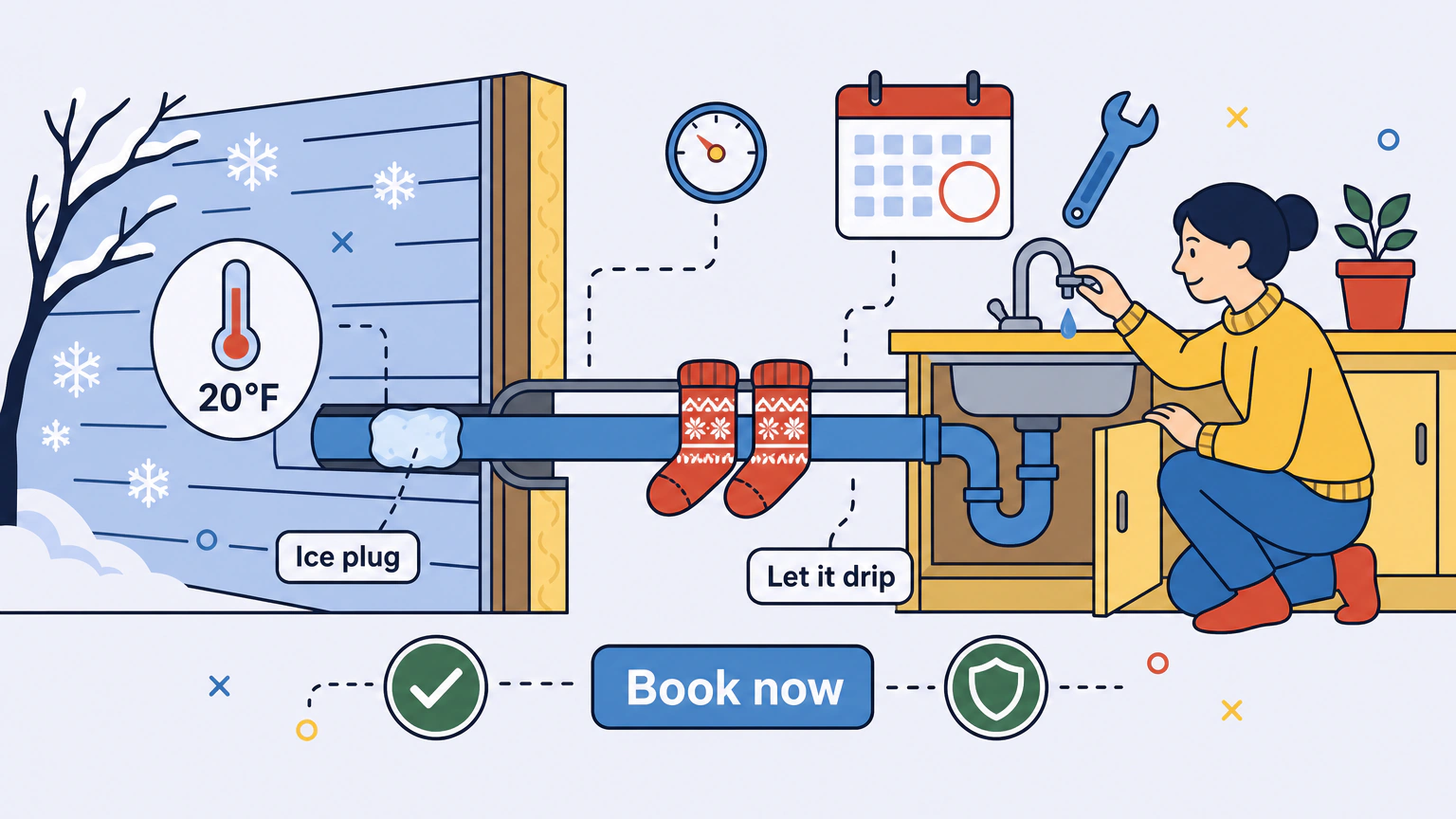
A frozen pipe doesn't burst because ice shoves it apart, either. An ice plug seals the line, the water trapped behind it has nowhere to go as freezing continues, and pressure climbs until the pipe splits where little or no ice formed, sometimes in a warm space.
Which is why you open a faucet. And why you leave it open after the water stops.
On this page
- The short answer, and the number to actually watch
- Why a frozen pipe bursts, and why almost everything you'll read gets this wrong
- What to do tonight, when the forecast drops
- The fall jobs: what you can do yourself, and what's worth paying for
- What it costs if you skip it
- If a pipe freezes or bursts anyway
- Checking the pro before you book (ninety seconds)
- Frequently asked questions
The short answer, and the number to actually watch
About 20°F, not 32°F
Water freezes at 32°F. Plumbing, mostly, doesn't fail there. When the Building Research Council at the University of Illinois put pipes in real houses and watched what happened, freezing started in uninsulated attic runs at about 20°F outdoors. Plumbers across the southern states, asked where their trouble begins, said the teens.
Time at temperature matters more than the low
A 20°F low for an hour is not the same night as 18°F for two days. Read the hours, not just the number.
| Forecast low | What is likely | Time to freeze, uninsulated pipe | What to do |
|---|---|---|---|
| 32°F to 25°F | Low risk indoors | About 12 hours or more | Disconnect the hoses |
| 24°F to 20°F | Exposed runs at risk | About 12 hours | Open cabinet doors, consider a drip |
| 20°F to 15°F | Real risk | About 6-12 hours | Drip both handles, close the garage |
| Below 15°F, wind | High risk | No universal time; wind can accelerate it | Full checklist; find your shutoff |
| Below 15°F, heat out | Very high risk | No universal time; assume urgent | Shut the main, drain the system |
The 20°F onset and the controlled blockage times come from the Building Research Council's field and laboratory work. Angi publishes broader rules of thumb, but timing swings widely with insulation, wind, pipe size and location.
Wind, insulation and location beat pipe material
Moving subfreezing air can speed up ice blockage substantially in uninsulated pipe. Insulation, pipe size and material all change the timing. PEX and CPVC are forgiving. Forgiving is not freeze-proof.
Which pipes go first
Unconditioned attics. Vented crawl spaces. Attached garages, unheated porches, windward wall cavities. Tonight, act on the supply line behind a sink on an exterior wall, where only a cabinet door stands between the pipe and your heated room.
How to read a forecast and an NWS alert
A Frost Advisory covers frost that may damage vegetation. A Freeze Watch or Freeze Warning means 32°F or below over a widespread area. On 1 October 2024 the National Weather Service folded its Hard Freeze products into those and retained the 28°F hard-freeze idea through enhanced wording. These products primarily protect vegetation, not household plumbing, so your trigger stays the forecast low and how long it sits there.
Why a frozen pipe bursts, and why almost everything you'll read gets this wrong
Myth vs. mechanism
What you'll read What the research found Ice expands and pushes the pipe apart The ice seals the pipe, and the water trapped behind it pressurizes The pipe splits where it froze It splits at the weakest point in the sealed section, often where there was no ice A running faucet protects only by stopping water freezing Flow can delay freezing, and an open faucet also relieves pressure downstream of a blockage
The story everyone tells
Water expands about 9% when it freezes, so the ice pushes outward and splits the pipe. It's tidy, it's intuitive, and it's all over page one, State Farm's own prevention article included. It's also not what happens.
What the research found
The Building Research Council spent two years on this in the laboratory and in the field. A pipe open at one end can't be pressurized and won't burst. The rest of the system absorbs the expansion.
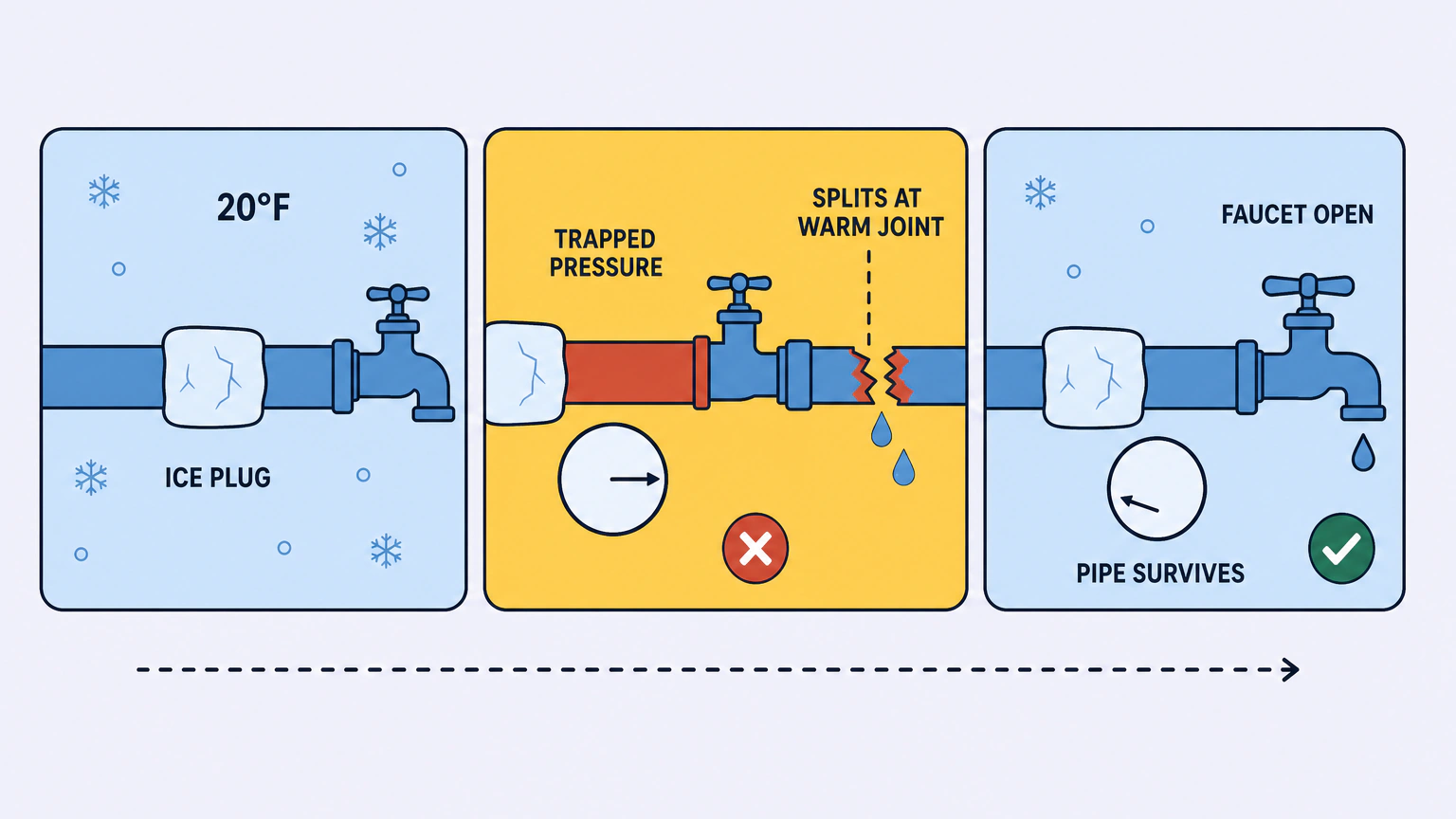
Bursting takes two steps. First an ice plug seals the bore. Then freezing continues behind it, and because water doesn't compress, pressure climbs from a normal 40-60 psi supply, past the 80 psi ceiling codes set, past a thousand psi. IBHS states the same mechanism today.
Which is why the split is usually somewhere warm
Upstream of the plug, water retreats toward the main. Nothing builds, nothing fails. Downstream, that sealed section gives out at its weakest point, which may be a joint under a sink that never saw ice. Don't only look where it was cold. The damage often surfaces as a stain on the ceiling instead of a flood.
And why the drip works
Moving water does delay freezing. But the burst protection comes from pressure relief: an open faucet lets water escape before pressure reaches the pipe's burst strength, even if the water freezes anyway. So a slight drip is enough. And if the drip stops, leave the faucet open, because a plug has formed upstream and the open path still provides pressure relief.
Can it burst days later?
Damage can surface days later. A split may leak nothing while still plugged with ice, then flood when the plug thaws. Treat a pipe you know froze as suspect until it flows normally.
What to do tonight, when the forecast drops
Open one faucet properly
Pick the fixture on the most exposed run, or the one farthest from where water enters, and open both handles where hot and cold serve it. Oklahoma City Utilities puts the target at a small, steady stream no wider than a pencil lead.
Pro tip: A small, steady stream no wider than a pencil lead is enough, and if it stops, don't close the faucet. The stopped flow means ice has already sealed the line upstream, and the open faucet still provides pressure relief.
Three free moves that actually matter
Open the cabinet doors under sinks on exterior walls so room air reaches the pipes. Move the cleaning chemicals out of children's reach first. Close the garage door. Then hold the thermostat at one temperature, day and night. No overnight setback.
If the house will be empty
Leave the heat at no lower than 55°F, the American Red Cross minimum, or drain the system for a long absence. Check whether your policy conditions coverage on maintaining heat. And settle whether that furnace will make it through the winter: a whole-house freeze can start with a heater that quit.
The cold-snap checklist
- Check the forecast low and how many hours it stays below 20°F.
- Disconnect and drain every garden hose; leave the outdoor faucet open to drain.
- Open a faucet on the most exposed run to a small, steady stream no wider than a pencil lead, both hot and cold handles.
- Open cabinet doors under sinks on exterior walls.
- Close the garage door and any crawl space vents you can safely reach.
- Set the thermostat to one temperature, day and night, no lower than 55°F.
- Find your main water shutoff, confirm it turns, and make sure everyone in the house knows where it is.
- If the heat fails during the cold snap, treat it as an emergency, not an inconvenience.
The fall jobs: what you can do yourself, and what's worth paying for
Four jobs to do yourself, this weekend
Pull the hoses off every spigot and drain them. Sleeve the exposed runs you can reach. Caulk the wall penetrations where cold air gets in. Find the main shutoff, label it, work it once.
Five jobs worth paying a pro for
- Irrigation blowout. Excess compressor pressure can damage the system, and incomplete draining leaves freeze risk.
- Frost-free sillcock replacement. A sillcock is a hose bib whose valve sits inside the heated wall, so fitting one may require access behind the wall.
- Crawl space and attic pipe insulation with air sealing. Reduces the risk rather than managing a single cold night. Quote it from insulation contractors.
- Thermostatically controlled, UL-listed heat cable where insulation can't reach. Ask what it costs to run.
- Relocating pipes out of unconditioned space. The permanent fix for a spot that freezes yearly.
If you only hire one, we'd make it the blowout: it's the one with a hard deadline. For a shortlist, start with vetted plumbing contractors near you.
| Job | What it is | Typical cost | Source | Book by |
|---|---|---|---|---|
| Irrigation blowout | Compressed air clears every zone, from irrigation specialists in your area | $50-$150; HomeAdvisor average $93, most $56-$137 | HomeAdvisor, HomeGuide, Inch Calculator, 2026 | Before your first freeze |
| Frost-free hose bib | Valve moved inside the heated wall | $250-$400 installed; anti-frost $250-$450 | HomeGuide, HomeAdvisor, 2026 | Before freezing weather |
| Crawl space insulation | Insulation plus air sealing | $500-$3,700 typical. Industry Oversight insulation: $1,657 average, $1,040-$2,392 typical, 809 profiles | HomeGuide, 2026; Industry Oversight, checked 2026-08-03 | Before freezing weather |
| Thermostatic pipe heat cable | Cable where insulation can't reach | Get a local quote | Manufacturer specifications | Before freezing weather |
| Plumber's visit | Diagnostic plus small repairs | Industry Oversight plumbing: $318 average, $178-$465 typical, 629 profiles | Industry Oversight, checked 2026-08-03 | Before the first freeze |
The Industry Oversight figures are our own cost-profile data on our own listings, sample size and check date shown, not an outside audit, and no business can pay for placement. Pull the module for your metro. The irrigation module is weighted toward installation, so the blowout prices come from external guides.
When to book
Work backward from your own median first fall freeze, not from a month on the calendar. NOAA publishes it station by station from the 1991-2020 normals, so look up the station nearest your ZIP.
| Where you live | Median first fall freeze (NOAA 1991-2020) | Finish before |
|---|---|---|
| High mountain West, far north | Late August to early September | Before late August |
| Northern and central Rockies, northern Great Basin | Early to mid-September | Before early September |
| Northern Plains, Upper Midwest near the border | Mid-September | Before mid-September |
| Much of the West and Midwest | Around 1 October | Before October |
| Four Corners, central Plains, mid-Mississippi Valley, southern Great Lakes, Ohio Valley | Mid-October | Before mid-October |
| Most of the rest of the country | October into November | Before your local freeze date |
| Gulf Coast, Deep South, low-elevation Southwest, coastal California | Late November or later, often no freeze at all | Before a forecast freeze |
These are 50% probability dates, meaning the freeze arrived on or before them in half the years on record. A cold front can beat them by weeks.
The one that catches southern homeowners
The 1996 research found the burst-pipe problem is worse in the South than in the North, because southern houses often run supply lines through unconditioned attics and protect them less consistently. If you're in Houston or Atlanta, you have more reason to do this work, not less.
What it costs if you skip it
The claim numbers
Insurance Information Institute homeowners data for 2018-2022 puts water damage and freezing at 27.6% of incurred losses in 2022, up from 23.4% in 2021, with an average claim severity of $13,954. Frequency runs 1.61 claims per 100 house-years, about one home in 60.
State Farm's 2023 experience: more than 17,200 frozen-pipe claims, more than $432.5 million paid, an average just over $23,500.
What your policy probably won't pay for
Sudden and accidental water damage is usually covered: drywall, flooring, contents, living expenses. The pipe itself often isn't.
Two traps sit in the fine print. Some policies condition coverage on maintaining heat. Most distinguish unoccupied from vacant in a way that can limit coverage once a home sits empty for 30-60 days. We'd read the declarations page tonight rather than at the claim, along with any winterization or protective-safeguards endorsement.
If a pipe freezes or bursts anyway
If the freeze arrives inside a named winter storm, with the power out and several systems down, sequence matters more than any single repair. Work through the order of calls after a storm first.
If no water comes out
Leave the faucet open. Shut the main if you suspect a break. Then thaw slowly: a hair dryer, or a space heater at a safe distance, working from the faucet end back toward the cold section.
Never an open flame, a torch or a heat gun. Never an electrical appliance in standing water. If you smell gas or see water near an electrical panel, leave and call 911. We can tell you what usually works, but none of it substitutes for a licensed plumber.
If it has already burst
Main off. Power off to any affected area. Photograph everything before you touch it and keep the failed pipe section for the adjuster. Then call in order: a plumber to stop the water, your insurer to open the claim, a restoration firm to dry the structure. The EPA says drying wet materials within 24-48 hours prevents mold growth in most cases. If you can't meet that window, call water damage restoration companies.
Who to call, and what each one costs
Our plumbing profiles run $178-$465 typical against a $318 average, across 629 profiles. Restoration runs $1,428-$6,120 typical against a $2,550 average, across 570 profiles. Both are our own listing data, not an outside audit. Demand IICRC certification from a restoration firm, and if the pipe picks 2 a.m. to fail, weigh what an after-hours call actually costs.
Red flag: the cold-snap door knock
- Someone appears unsolicited during or after a freeze, offering to check your pipes.
- A large cash deposit demanded before any work, or cash-only pricing.
- No street address you can find, just a cell number.
- Pressure to sign today, or a price that expires when they leave.
- A repipe quote from someone who hasn't located the failure.
- No permit mentioned on work that clearly needs one.
- No written scope before money changes hands.
The ninety-second check that clears all seven: license status, a street address that resolves to a real building, years in business, and the shape of the review history rather than the star average.
Checking the pro before you book (ninety seconds)
Four things, before the coffee cools. A current license number and status for the trade and state. A physical street address, not a mail drop. An "In Business Since" year. A review history with volume and spread, because a dozen five-star reviews posted in one week says less than sixty averaging 4.3. During a freeze, add 24-hour availability, and IICRC certification on a restoration firm.
Then verify the license yourself on your state board's lookup. Those signals are our own checks on our own listings, dated, not an independent audit. See how Industry Oversight vets the companies it lists.
Frequently asked questions
At what temperature do pipes freeze?
Around 20°F outdoors, held there for several hours. Water freezes at 32°F, but plumbing usually doesn't fail there. University of Illinois Building Research Council field testing found uninsulated attic pipes began freezing at about 20°F, and southern-state plumbers put burst-pipe trouble in the teens. Wind accelerates it.
How long does it take for pipes to freeze?
There's no single number. Insulation, wind, pipe size and location all matter. In one controlled study, a test pipe blocked in about 11.5 hours at 20°F, 6.5 hours at 10°F and 4.75 hours at 0°F. Those are test results, not universal household deadlines.
Do frozen pipes always burst?
No. Plenty freeze, thaw and carry on fine. A pipe bursts only when an ice plug completely seals the line and freezing continues behind it, pressurizing water that cannot compress. That's why an open faucet protects a pipe that freezes anyway.
Should I drip hot water, cold water, or both?
Both. Wherever hot and cold lines cross an exposed area, each one needs its own pressure relief, so open both handles. A small, steady stream no wider than a pencil lead is enough, per Oklahoma City Utilities. Use the fixture on the most exposed run.
What temperature should I set my thermostat to if I go away in winter?
No lower than 55°F, per the American Red Cross, held at one temperature rather than set back overnight. For a long absence, draining the system is safer. Check your policy too: some condition coverage on maintaining heat, and vacant-property clauses can limit it after 30-60 days.
Does homeowners insurance cover a burst pipe?
Usually the resulting water damage is covered when the break is sudden and accidental: drywall, flooring, contents, living expenses. The pipe itself often isn't, gradual leaks are excluded, and a claim can be denied if the heat was off. Insurance Information Institute data for 2018-2022 puts average claim severity at $13,954.
How do I know if a pipe is already frozen?
The usual sign is one faucet giving a trickle or nothing while the others run normally. Frost on an exposed pipe, a bulge in the line and a strange drain smell are the others. Leave that faucet open, find the main shutoff, and thaw from the faucet end with a hair dryer, never a flame.
Is it worth paying a plumber to winterize my house?
For the four free jobs, no. For four others, usually yes: an irrigation blowout about $50-$150, a frost-free hose bib $250-$400 installed, crawl space insulation $500-$3,700, thermostatic pipe heat cable quoted locally. Set that against State Farm's average of just over $23,500 on more than 17,200 frozen-pipe claims in 2023.
If your median first freeze is approaching, schedule the blowout and sillcock before freezing weather arrives. If it isn't, do the four free jobs this weekend and put a date on the pro work. Either way, pull a local cost band and a license-checked shortlist from the plumbing contractors directory.
Then go find that shutoff valve, before the forecast makes you.