

On this page
- The short answer, and what sets your deadline
- How a shingle seals itself, and what goes wrong when it does not
- What four shingle makers require in cold weather
- Season by season, honestly
- Is the off season really cheaper?
- Your city may already have a rule about cold installs
- What to get in writing before a cold weather roof
- When waiting is the wrong call
- Frequently asked questions
The short answer, and what sets your deadline
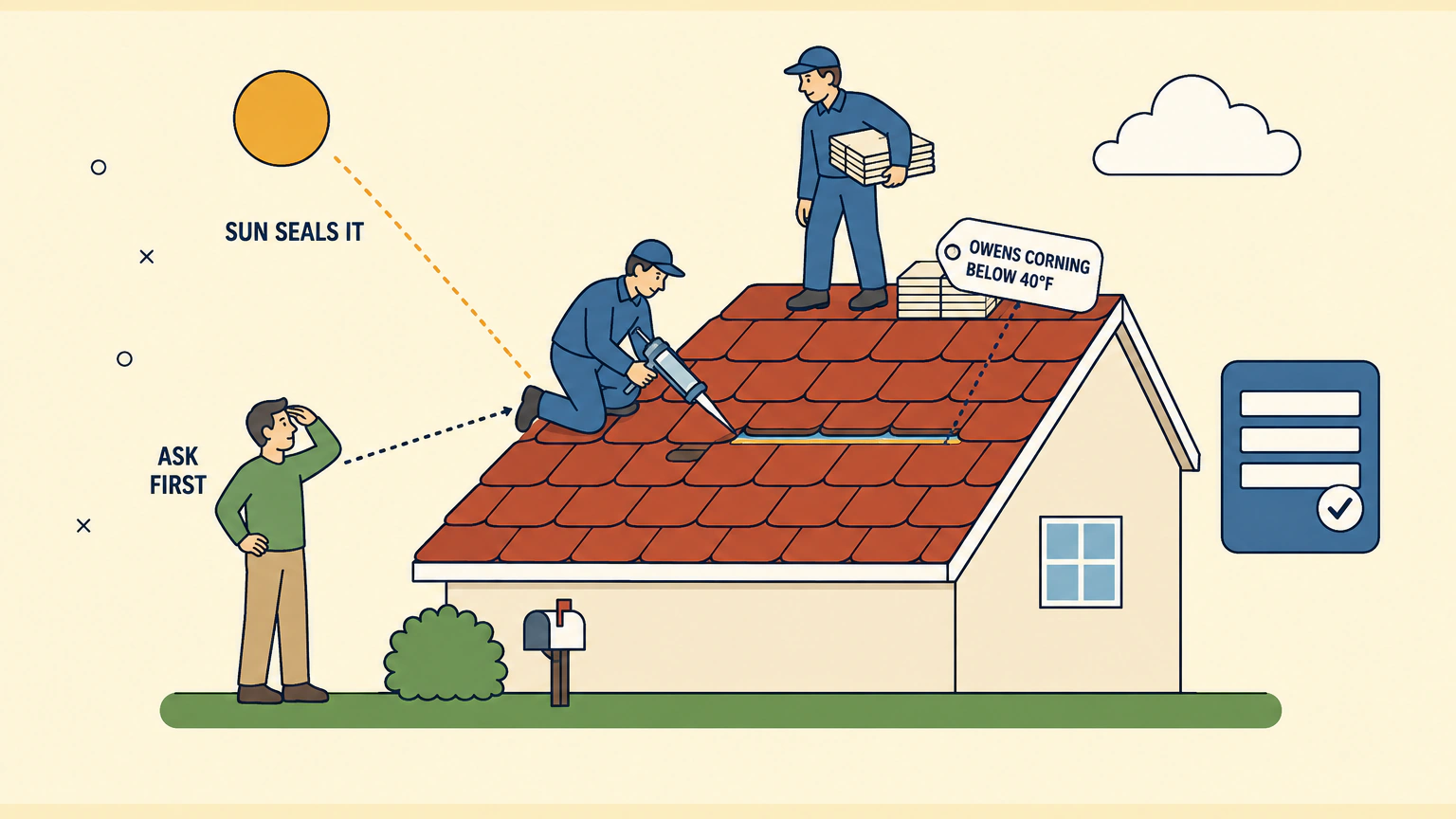
Your roof has been on borrowed time all summer. Now you're holding a quote, the contractor has offered you a date, and you want to know whether that date is a problem. Fall is the popular answer, and it isn't wrong. But the thing that really sets your deadline is your shingle brand's cold weather rule, not September. Owens Corning's current instructions switch to a below-40°F procedure that makes the crew hand seal every shingle around the edge of the roof with four dabs of cement.
In much of the country, spring, summer and fall bring the easiest installation weather. Cold weather procedures come up earlier in colder regions and less often in warmer ones. So the useful question isn't which month. It's whether your roof will bond before the first hard wind, and who hand seals it if the answer is no. One sentence on your contract settles that. It names the shingle brand, that brand's cold weather procedure, and who pays for the trip back up the ladder.
How a shingle seals itself, and what goes wrong when it does not
Ninety seconds of physics, and the whole calendar argument makes sense. Most asphalt shingles arrive with a factory-applied strip of thermally activated sealant. After installation, heat from the sun activates the strip and bonds each shingle to the course below. Until that happens, the nails hold the shingle in place, but the sealant provides extra resistance to wind lift.
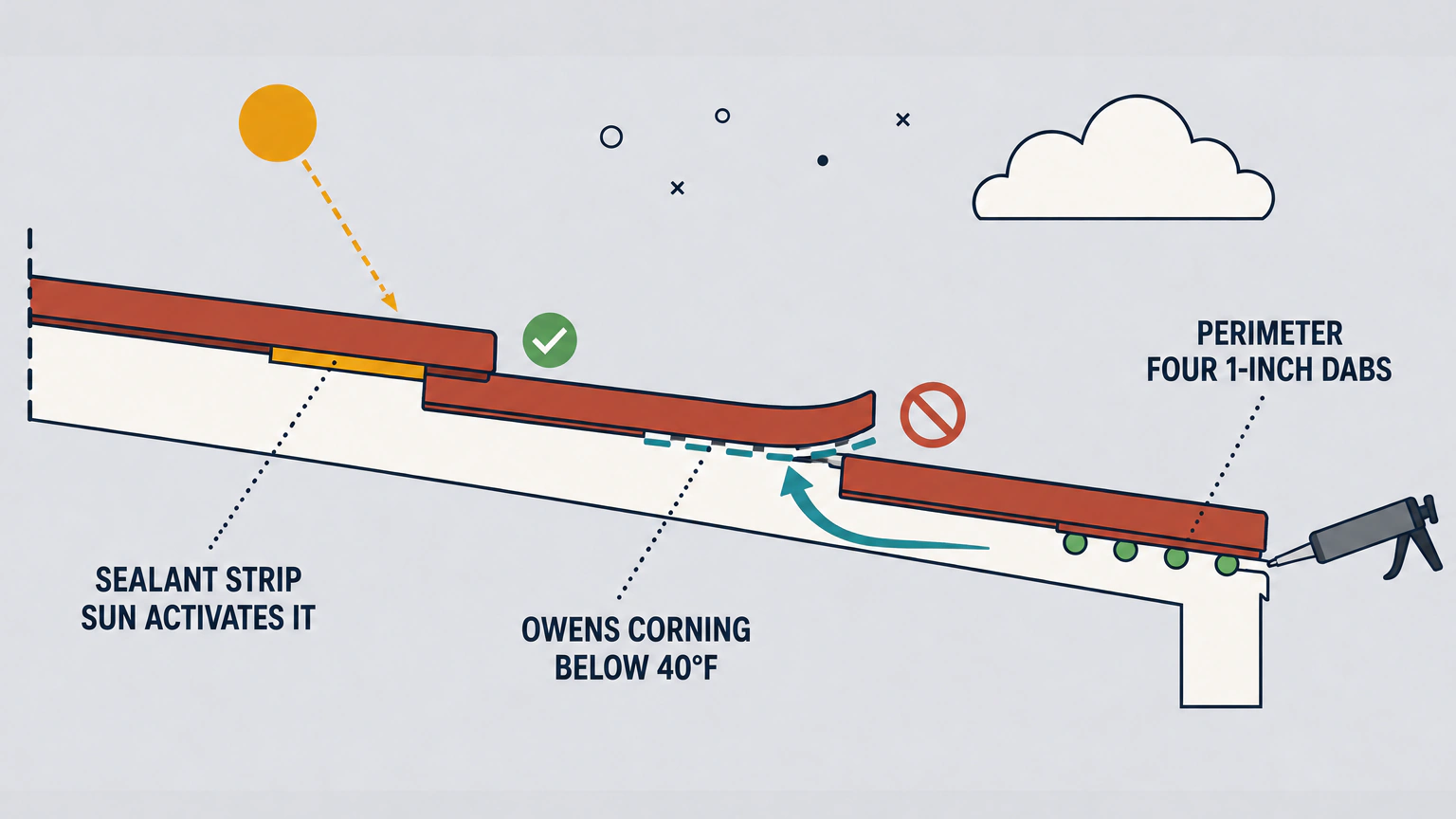
The sealant strip is warmed by the sun, not squeezed from a tube
Owens Corning puts the mechanism plainly in its cold weather bulletin: its shingles "are manufactured with a factory-applied strip of thermally activated sealant. Direct exposure to the sun's energy activates the sealant, allowing shingles to bond to the course below."
The same bulletin names four things that decide how fast that happens: where you live, how steep the roof is, which way it faces relative to the sun, and the average daily outdoor temperature during and after the install. Three of those four have nothing to do with the month. A steep north-facing slope in late October is a different job from a shallow south-facing one on the same street, in the same weather.
How long does bonding take? Longer than most people expect. IKO's cold weather bulletin says it "might take up to several weeks for shingles to seal together." The Asphalt Roofing Manufacturers Association, the trade group for these companies, agrees the wait isn't fixed: sealing time varies with the roof's slope, its direction and the sun it gets.
An unsealed shingle is a wind problem, not a leak problem
A cold-day install can look finished while the shingles remain unbonded. The immediate concern is wind lift before the sealant activates.
Owens Corning gives the reason in one sentence. Hand sealing "protects against wind uplift which may occur when the temperature is too low for the adhesive strip of the shingles to activate." GAF attaches money to the same idea. Its bulletin says the shingle warranty stays in force whatever the air temperature was on install day, and then excludes "blowoffs prior to activation of sealant" from coverage. Read those two together and the risk lands where it always lands, on you.
There's a quieter cost too. CertainTeed's instructions warn that airborne dust can delay sealing further. The roofing association adds that roof traffic can break a cold, less-flexible sealant bond, leaving shingles that may need hand sealing. Cold weather doesn't only postpone the bond. It gives other things time to interfere with it.
What four shingle makers require in cold weather
Manufacturer documents don't share one cold weather rule, and the differences matter to your bid.
Four brands publish instructions a homeowner can read, and all four answer the cold question differently. One makes hand sealing mandatory. One ties it to a wind warranty and changes the rule by state and by country. One treats it as a delay to check on later, which quietly makes it your job to notice. The fourth sets no practical temperature limit as long as the crew takes the right precautions.
Owens Corning makes hand sealing mandatory below 40 degrees
Owens Corning gives the clearest below-40 procedure, and that makes it easy to hold a crew to. Its current TruDefinition Duration instructions carry a heading that reads "Cold Weather Installation (Below 40F)," and under it two requirements. Field shingles get a gap no more than a sixteenth of an inch at every end and butt joint, so they can expand in warm weather without buckling. And "all shingles installed on the perimeter of the roof must be hand-sealed with four 1 inch dabs of ASTM D4586-compliant asphalt cement."
Must, not may. The same page opens with a precaution worth quoting to anyone who shrugs at it: "The manufacturer will not be responsible for problems resulting from any deviation from the application instructions."
The company's cold weather bulletin adds the detail a crew needs. Hand seal along the rake edges. Architectural shingles get four evenly spaced spots about an inch from the leading edge, and three-tab shingles get two spots under each tab. Keep the cement off the exposed face, because too much of it makes shingles blister.
IKO ties it to the wind warranty, and changes the rule by where you live
IKO is the one with your money in it. Its Cambridge instructions set out what the High Wind Resistance Limited Warranty needs. Starter strip shingles go at all eaves and rakes, with the extra nails. And the shingles "must have an opportunity to seal or be manually sealed as described."
Then comes the sentence no consumer page carries. "In Canada, manual sealing in addition to 6 nails is required. In Florida, manual sealing is not required." Same brand, same shingle, opposite rules. That line proves there isn't one national rule of thumb. A January date in Minnesota and a January date in Georgia are not the same purchase.
Two more IKO details belong on your bid. Shingles can get brittle at 50 degrees and below, so the crew has to handle bundles gently and may need to warm them first. And nailing is unforgiving: "HIGH NAILING ABOVE THE NAIL LINE CAN VOID IKO'S LIMITED WARRANTY."
CertainTeed calls it a delay, and puts hand sealing after the fact
CertainTeed is the loose one, and the loose one is the one to watch. Its Landmark instructions say only this: "Shingle sealing may be delayed if shingles are applied in cool weather and may be further delayed by airborne dust accumulation. If any shingles have not sealed after a reasonable time period, hand sealing may be necessary."
No temperature for field shingles, no date, no named person. Somebody has to climb back up later, check whether the courses bonded, and hand seal the ones that didn't. The instructions never say who. If your bid names a CertainTeed shingle, that somebody needs a name and a date before the crew drives away.
CertainTeed's Master Craftsman manual is firmer where wind ratings are concerned. To reach the ASTM D3161 Class F wind classification, each hip and ridge shingle has to be nailed as specified and hand sealed with two quarter-inch beads of adhesive. It also warns that shingles must be warm enough to bend for hips, ridges and valleys so they don't crack.
| Shingle brand | What the published instructions say about cold installs | The temperature the document names | How it connects to the warranty | Document read |
|---|---|---|---|---|
| Owens Corning | A gap no more than 1/16 inch at all end and butt joints, and every perimeter shingle hand sealed with four 1 inch dabs of ASTM D4586 asphalt cement | Heading reads "Cold Weather Installation (Below 40F)" | "The manufacturer will not be responsible for problems resulting from any deviation from the application instructions" | TruDefinition Duration Series Installation Instructions, July 2026 edition |
| IKO | Manual sealing with a good quality asphalt plastic cement where shingles won't get time to seal before winter: three 1 inch spots on laminates, a quarter-sized dab per tab on three-tab | Brittle at 10°C (50°F) and below; sealing can take up to several weeks | High Wind Resistance Limited Warranty requires shingles "have an opportunity to seal or be manually sealed"; manual sealing required in Canada, not required in Florida | Cambridge Shingles Application Instructions (© 01/21) and Bulletin R-52, August 2012 |
| CertainTeed | Sealing "may be delayed" in cool weather and further delayed by airborne dust; hand sealing "may be necessary" if shingles have not sealed after a reasonable time period | No field-shingle temperature stated in the document | Hip and ridge shingles must be hand sealed with two 1/4 inch beads to reach the ASTM D3161 Class F wind classification | Landmark Series, Master Craftsman Shingle Applicator's Manual, chapter 13 |
| GAF | Hand seal when installing in cold weather, in quarter-sized dabs of ASTM D4586 roofing cement; GAF also recommends placing fasteners in the common bond area to limit blow-off until the adhesive activates | "No practical lower or upper temperature limit... as long as appropriate precautions are taken"; above 40°F for easiest handling | Limited warranty stays in effect whatever the air temperature at install, but damage such as cracking and "blowoffs prior to activation of sealant" is excluded | Technical Advisory Bulletins TAB-R-133 and TAB-R-114 |
Pro tip: You can read your own brand's rules in about five minutes. Application instructions are printed on the shingle bundle wrapper and posted in each brand's online document library, and the cold weather paragraph is usually one page in. Ask the contractor to pull it up and show you before the crew starts, then ask which line of it applies to your start date. A roofer who knows the answer will enjoy the question.
One honest limit. We read the instructions these brands publish, not the warranty certificate that came with your roof, and yours is the document that governs. Ask your contractor for a copy of it in the same breath.
Season by season, honestly
Roofing advice often lands on the same answer: fall, book early. Fine as far as it goes, and it skips the part you control. Each season carries one specific risk, and each risk has one thing to pin down before you sign.
Fall is popular for a reason and crowded for the same reason. Spring buys you rising temperatures and costs you rain days. Midsummer brings strong sun and can be hard on the crew and shingles underfoot. Winter is the honest gamble, workable if the procedure is written down and a bad deal if it isn't. In warmer climates, the 40 degree question comes up less often, while heat and storms may matter more.
| Season | What is genuinely good about it | What actually bites | The one thing to nail down before you book |
|---|---|---|---|
| Fall (September to early November) | Warm decks and strong sun can help shingles bond | Schedules can fill, and a slipped date can push the job into cold weather | A written start date, and what the crew does if the job slides into the cold |
| Spring and early summer | Rising temperatures | Rain days, and a wet deck stops the work | Who tarps an open deck overnight, and who pays if water gets in |
| Midsummer | Long days and strong sun can help shingles seal | Heat makes shingles easier to scuff and tear underfoot; GAF suggests staying below 90°F for easiest handling | Who checks the finished courses for foot damage before final payment |
| Winter | Roofing employment is lowest in January | Depending on the brand and conditions, cold can delay the bond, make shingles brittle and call for hand sealing | The brand's cold weather procedure in writing, plus a date to come back and confirm the roof sealed |
Is the off season really cheaper?
The winter discount is the internet's favorite roofing claim, and every page making it leaves the number hanging without a source. So we went looking for something a homeowner could stand on.
What the employment numbers show, and what they do not
The federal jobs data is clear about the season, at least. Across ten complete years, from 2016 through 2025, employment at US roofing contractors runs about 9% below the year's average in January and about 5% above it in August, which is the peak. The busiest month of the year carries roughly 14% more roofers than the quietest one. In 2025 alone the swing was about 23,000 jobs, from 240,100 in January to 263,100 in October.
So the slow season is real, and it's measurable. Now the honest half: employment isn't price, and we couldn't find a single published dataset that tells a homeowner what the winter discount actually is. A national percentage would go beyond the data.
Ask for something better than a season. Get a written scope, the brand and product line by name, and the cold weather procedure priced into the bid rather than promised as a favor. A roofer with an empty January has a reason to give you all three, and that's worth more than a number somebody rounded off.
Your city may already have a rule about cold installs
Your building department may have taken a position on this already, and it may need your signature.
Take the City of Oak Forest, Illinois, a suburb south of Chicago. Its roofing packet includes a letter for the homeowner to sign, headed "ROOFS BEING COMPLETED BELOW 40° TEMPERATURES." Sign it and you're confirming four things. Asphalt shingles get less flexible in cold weather. Most shingle and ice-and-water-shield makers want the work done at 40 degrees or above. Shingles need enough heat from sunlight to stick, and unsealed ones are more likely to blow off.
The same packet runs a tight ship on the rest of the job. The contractor has to be registered with the city before a permit is issued, and a signed contract goes in with the application. The permit runs $135. Inspectors want to see the sheathing before underlayment goes down, and the roof again at the end. Self-adhering ice and water shield has to run from the eave edge to a point at least 24 inches inside the interior wall line.
That's one suburb, and we won't pretend it's the country. What travels is the move: spend ten minutes on your own city's rules before you book a cold weather install. Search your city name plus roofing permit requirements, or call the building department and ask for the residential roofing handout. If you're in that climate belt, our list of roofers in Rockford, Illinois shows what to look for locally. You want crews who work through the cold every winter and know what their own city asks for.
What to get in writing before a cold weather roof
This is the part to print out. None of it is exotic, and all of it is refusable, which is exactly what makes it useful: a contractor who won't put these on paper has told you something. If you're weighing two quotes that don't match, reading two roofing bids line by line is the companion job.
- The exact shingle brand and product line, written on the bid. Not "architectural shingles," the actual product name, because the cold weather rule is different for each brand.
- A line saying the crew will follow that brand's published cold weather procedure if the install runs below the temperature the brand names, and who pays for a return trip if one is needed.
- The cement they will use, by its ASTM number. Owens Corning and GAF both name asphalt cement meeting ASTM D4586.
- For IKO Cambridge, starter strip at both the eaves and the rakes, plus the extra nails the wind warranty requires, priced into the quote rather than added later.
- A commitment that nails go on the manufacturer's nail line. IKO states in its own instructions that nailing above the line can void its limited warranty.
- The ice barrier, where local code requires one, with the coverage distance written out. Oak Forest's packet, for one example, requires it from the eave edge to a point at least 24 inches inside the interior wall line.
- A written date for the contractor to come back and confirm the field shingles have sealed, and what happens if they haven't.
- Who pulls the permit, which inspections are required, and whether the city needs a homeowner sign-off for a below-40 install.
When waiting is the wrong call
None of this adds up to "wait for spring." Some roofs can't wait, and delaying an active leak can add damage.
Water coming into the house beats a perfect install window every time. So do missing shingles over living space, storm damage that has already opened the deck, and an insurance claim with a deadline on it. A tarp only buys time.
That's the point the calendar arguments miss. A cold weather install can be legitimate when it follows the shingle maker's procedure and local code. The makers write cold weather procedures so the work can happen in winter. The failure mode isn't the month. It's a crew that ignores the product instructions and a homeowner who finds out in the first strong wind.
So do the two things in order. Get the brand and its cold weather procedure onto the bid. Then hire someone who will sign it. If you're starting from scratch, our directory lists roofing contractors near you, and you can read how we screen the companies we list before you trust any of them. If your roof just failed in a storm and someone is already at the door with a clipboard, take ten minutes first on checking out a roofer who showed up after a storm.
Frequently asked questions
What temperature is too cold to install shingles?
There isn't one cutoff for every shingle. Owens Corning's instructions switch into a cold weather procedure below 40°F. GAF sets no practical lower limit at all, "as long as appropriate precautions are taken," and says shingles handle most easily above 40°F. IKO adds that shingles can turn brittle at 50°F and below, so careful handling starts earlier than sealing does.
How long does it take for new shingles to seal?
Days in warm weather. In the cold it can run much longer. IKO's cold weather bulletin says it "might take up to several weeks for shingles to seal together." Owens Corning names the four things that decide it: your location, the roof's slope, the direction it faces relative to the sun, and the average daily outdoor temperature during and after the install. Sun does the work, so a shaded north slope can take longer to seal.
Can you replace a roof in the winter?
Yes, and manufacturers write the procedures for it. GAF states there's "no practical lower or upper temperature limit" for applying asphalt shingles as long as the right precautions are taken. Owens Corning requires hand sealing of every perimeter shingle below 40°F. Winter work is legitimate when the crew follows the brand's cold weather steps and local code, and it's a gamble when they treat those rules as optional.
Is it cheaper to replace a roof in winter?
Maybe, and nobody publishes the number. Roofing employment runs about 9% below the yearly average in January and about 5% above it in August, so the trade has a measurable off season. That's an employment fact, not a price list. Instead of chasing a percentage, ask a winter contractor to price the brand's cold weather procedure into the bid and to name a return date for the seal check.
Does a cold weather install void the shingle warranty?
Not by itself, but the conditions get sharper. GAF says its limited warranty stays in effect regardless of the air temperature at install, while excluding damage like cracking and blow-offs that happen before the sealant activates. IKO's High Wind Resistance Limited Warranty requires that shingles seal or get manually sealed. Owens Corning disclaims responsibility for problems that follow any deviation from its instructions.
How long does a roof replacement take?
The crew days are the short part, and they belong on your contract in writing. The longer wait is the one that decides your risk: how long until the shingles bond. IKO says that can run up to several weeks in cold conditions. So ask for two dates, the start date and the date someone returns to confirm the roof has sealed, and treat the job as unfinished until the second one passes.
Do roofers work in the rain?
Not on an open deck, and you don't want them to. IKO's instructions require a deck that is "smooth, firm, clean, dry and securely nailed" before shingles go on. Oak Forest's roofing guide says it in permit language: the sheathing has to be clean and dry before the covering goes down. Rain delays are a sign of a crew following the rules. Ask how they tarp an open roof overnight.