

On this page
The short answer, and the thing most people get backwards
You have a quote in your hand, or an empty spot on the garage wall where an outlet should be. Behind the arithmetic sits a quieter worry: is any of this even legal? Two different offices answer that question. Most people only think about one of them.
A license and a permit are two separate gates
A license exemption and a permit requirement are separate gates, and settling one settles nothing about the other. Oregon writes that straight into the exemption. Skipping the license, it says, "does not exempt the work performed by the person from having to comply with the requirements for such work" under the state building code chapter. Washington puts the same idea in the same section. Nothing in the exemption is "intended to derogate from or dispense with the requirements of any valid electrical code enacted by a city or town." Florida makes the permit office hand you the point in writing, in a disclosure that tells owners "your construction shall be done according to building codes and zoning regulations." Same code. Different gate.
What the exemption actually exempts you from
What you're exempt from is holding the card. That is the whole of it. The work still has to meet the code. Whether your job needs a permit or inspection is a separate question, and Oregon expressly waives permits for some maintenance work. The exemption also says nothing by itself about who may work on your house for money. That's the mirror question. It often turns on the jurisdiction and the worker's status, not only on occupancy. Read what someone you hire may legally do if you're weighing doing it against hiring it.
Four questions that show where state rules split
The same four issues keep turning up in the ten statutes, but not every state uses every one. They show what to ask before you call anybody.
Do you own it, and is your own name on the deed
Ownership sounds like the easy one. It still deserves a record check. Portland's permit desk is blunt about it: the homeowner has to be "the recorded property owner by the County and not an LLC." Florida's version reaches further out and counts the owner of a mobile home on a leased lot. Iowa adds a different condition because it ties the exemption to whether the home qualifies for the homestead tax credit. Pull up the county record first. In Portland, the name on it is the name the counter cares about.
Do you live in it
Occupancy comes in three shapes. Texas asks whether you own and reside in the dwelling, and stops there. Minnesota accepts either that you occupy it now, or that you'll occupy it once construction is finished. California's principal-residence route requires 12 months of residence before the work is completed. Notice who that quietly leaves out. You closed three weeks ago, the movers come Saturday, and you'd like the wiring sorted before the furniture lands. Minnesota has room for you. California, on that route, doesn't. Same plan, two answers, and nothing on the deed tells you which one you're in.
Is it for sale, for rent, or about to be
Several of the ten care whether the property is for sale or rent, but the triggers differ. Arizona and Nevada treat a sale or rental within a year after completion as evidence of your original intent. California creates a rebuttable presumption if an owner-builder sells or offers a structure within a year after completion. Florida's rule is narrower. Its presumption appears only if you wire and then sell or lease more than one building within a year. Washington instead asks whether you offer the property for sale within 12 months after acquiring it. Oregon gives a partial answer for a home that is rented or up for sale. You may maintain and replace existing wiring, but you may not make new installations or substantial alterations. If this work is going to show up in front of a home inspector next spring, that can matter today.
Who is actually holding the tools
Here the ten genuinely disagree. California's personal-work route covers your own work or your wage-paid employees. Minnesota's clause turns on the individual who physically does the work. Arizona lets you use your own employees or licensed contractors. Virginia lets you supervise rather than swing the screwdriver. Oregon's wording can reach a member of your immediate family. A friend helping for free is a different question. Before you accept the help, confirm that your exemption covers the person holding the tool. Then look at who covers someone who gets hurt at your house.
What the statute says in the ten states we could read
The question people type is "can I do my own electrical work in Texas", or in Iowa, or in Massachusetts. So here are ten answers instead of one. These are the states whose own statutes we could open and read, weighted toward the ones people keep asking about. It isn't a map of the country and it isn't fifty.
| State | Can you do it yourself | What the statute requires | Authority |
|---|---|---|---|
| Arizona | Yes, on property you own | You do the work yourself, with your own employees, or with licensed contractors, and the structure is for occupancy solely by you and not intended for sale or rent. Selling or renting within one year of completion is prima facie evidence you built it to sell. | A.R.S. § 32-1121(A)(5) |
| California | Yes, on your own property | Under one route, you personally perform all the work or use your own wage-paid employees, and none of it is intended or offered for sale. A principal-residence route requires 12 months of residence before completion. It also says the homeowner must not have used that exemption ‘on more than two structures more than once during any three-year period.’ A sale or offer within one year after completion creates a rebuttable presumption that the work was undertaken for sale. California's separate electrician certification applies only to people who work for a licensed C-10 electrical contractor (Lab. Code § 108.2(b)(1)). | Cal. Bus. & Prof. Code § 7044(a)(1), (a)(3), (b) |
| Florida | Yes, on a single family or duplex home | You apply for the permit, supervise and do the work, and the home is for your own use and occupancy and not intended for sale. You must personally appear and sign the permit application, and the permitting agency must give you a disclosure statement whose wording is set out in the statute itself. | Fla. Stat. § 489.503(6) |
| Iowa | Yes, on your principal residence | The home must be an existing dwelling rather than new construction, must not be an apartment attached to another apartment or building, must be no larger than a single family dwelling, and must qualify for the homestead tax credit. | Iowa Code § 103.22(7) |
| Minnesota | Yes, if you physically do the work | You own the property and actually occupy it as a residence, or own it and will occupy it when construction is complete, and the dwelling has a separate electrical utility service not shared with any other dwelling. | Minn. Stat. § 326B.33, subd. 21(f) |
| Nevada | Yes, after the board grants it | The structure is for your own occupancy and not intended for sale or lease, and you must apply to the State Contractors Board for the exemption. Selling or leasing within one year of completion creates a rebuttable presumption that you built it to sell. | NRS 624.031(5) |
| Oregon | Yes, and on a close relative's home too | The property is residential or farm property owned by you or a member of your immediate family and is not intended for sale, exchange, lease or rent. On a property that is rented or for sale you may maintain and replace existing wiring but not make new installations or substantial alterations. | ORS 479.540(1) |
| Texas | Yes, unless your city regulates it | The work is in or on a dwelling you own and reside in, and it is not work that a municipal ordinance specifically regulates. | Tex. Occ. Code § 1305.003(a)(6) |
| Virginia | Yes, once in any two years | You perform or supervise work on no more than one primary residence that you own and use yourself during any 24 month period. The exemption is written for the whole chapter, and Virginia's separate tradesman license covers only work done for the general public for compensation, so neither one catches you on your own home (Va. Code §§ 54.1-1101(A), 54.1-1128). | Va. Code § 54.1-1101(A)(7) |
| Washington | Yes, on property you own | The exemption fails if the work is on a new building intended for rent, sale or lease, or on property you offer for sale within 12 months of obtaining it. For a new residential building of up to four units you can still qualify by filing an affidavit that you will occupy one unit as your principal residence, and that route is available once every 24 months. | RCW 19.28.261(1), (5)(a) |
The clocks do not all start or work the same way
Arizona, California, Nevada and Florida each use a one-year window, but the rules work differently. Arizona starts at completion or the certificate of occupancy. A sale or rental then becomes prima facie evidence that you built the structure for sale or rent. California creates a rebuttable presumption after a sale or offer within one year of completion. Nevada also uses a rebuttable presumption, starting at completion. Florida's rule appears only after more than one building is sold or leased within a year. Virginia runs a different clock, with one primary residence in any 24 months. Washington's affidavit route opens once every 24 months and expects 24 months of occupancy after completion.
The conditions almost nobody writes about
These conditions deserve more attention. Minnesota wants the dwelling to have its own electrical utility service, not one shared with another dwelling. That rules out a dwelling that shares service, including some duplexes and conversions. Iowa wants an existing home rather than new construction, no bigger than a single family dwelling, and qualifying for the homestead tax credit. Texas hands the decision back to your city because its exemption covers work that a municipal ordinance doesn't specifically regulate. The same job can be exempt in one Texas city and regulated in the next. One Texas electrician's page says flatly that homeowners there may do electrical work "of any kind." The statute says no such thing, and your city's ordinance is part of the test.
If your state is not in the table, here is how to find your own answer
That leaves forty states, so here's the route rather than a shrug. Search your state's electrical licensing statute plus the word "exemptions", then read the exemptions section itself instead of anybody's summary of it. Look for ownership, occupancy, sale or rental limits, and who may do the work. Those issues recur across the ten, but not every state uses every one. Then call the building department that would issue the permit and ask how the rule applies to your job.
Two more states are worth naming. Wisconsin exempts a residential property owner who works on premises they own and occupy. There's a proviso on the end of it: "unless a license or registration issued by the department is required by local ordinance" (Wis. Stat. § 101.862(4)(a)). Massachusetts takes a different route. Section 1A frames the license rule around the "business or occupation" of electrical work. Section 7's separate exemption list does not name homeowners. Marion's current FAQ says an owner-occupant may do residential work with the wiring inspector's prior approval. Ask your own wiring inspector rather than assuming Marion's answer travels.
And if electrical work is one trade inside a bigger remodel, ask a licensed general contractor who will hold each permit.
One caveat, said once: this is how ten statutes read, and it's general information rather than legal advice. State law and the building department that issues the permit both shape the answer for your job.
When you need a permit, it is a separate gate
That covers whether you may. What comes next depends on the job. Which jobs need a permit is a question of its own, and which permits a specific job triggers works through it job by job. Assume yes more often than you'd like, because in Portland even adding one outlet is on the list.
Portland's three inspection types, and when rough-in matters
Portland lists three inspection types, though your project may not need all three. Rough-in comes after the new circuits are run, with the boxes, wires, grounding conductors and nail plates in place. A service inspection covers the mast, meter base, service panel and grounding electrode conductors. It applies to a panel change or an added sub panel. The final closes the permit once the circuits are labeled and the cover plates are on.
Rough-in is the one with teeth. Portland's instruction is exact: don't cover the work until it's approved, and that means no insulation, no receptacles, no wall switches. Insulate on Friday and you'll be pulling it back out on Monday. Ask your own department for their sequence in the same call where you ask whether you may pull the permit.
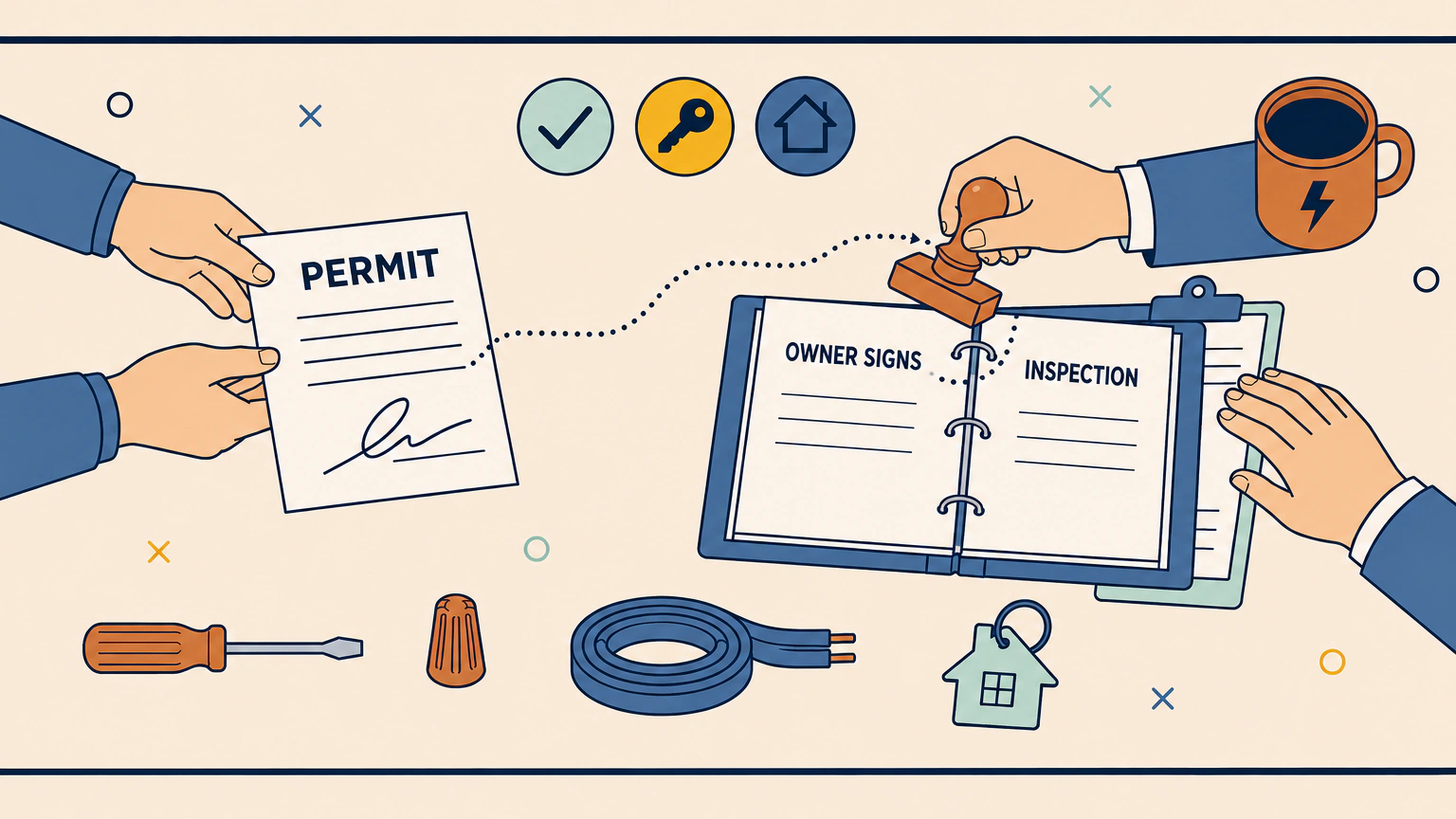
What you are signing when you take a homeowner permit
Florida is the clean example, because its legislature wrote the warning into the statute and told the permit office to hand it over. It opens by saying state law requires electrical contracting to be done by licensed contractors. You've applied under an exemption to that law. The building must be for your own use and occupancy. And "you may not hire an unlicensed person as your electrical contractor." Washington's version is an affidavit filed with the state, where you promise to do the work yourself and live in the unit. Draw the general lesson from both. Pulling the permit moves code compliance, inspection and the cost of failing one onto your name. That's the trade the exemption is actually offering.
What you are actually agreeing to when you pull the permit yourself The code standard doesn't drop. If your job needs an inspection, the local inspection rules still apply. The responsibility moves to your name. Compliance, inspection and the consequences of failing one now sit with you, not with a contractor. You still may not assume a helper shares your exemption. Florida expressly bars an unlicensed electrical contractor, while other states define who may do the work differently. If any of this reads as more than you want to own, that's a fair call and not a failure. Ask an electrical contractor to quote the job and pull the permit.
When to stop and call a licensed electrician
There's a point where handing the job over is the right answer, and it isn't a moral failure. Run this before you buy materials, not after. It takes about ninety seconds, and the first two items are the ones people get wrong.
- Pull up the property record and check how title is held. Portland, for example, requires you to be the recorded owner and rejects an LLC.
- Ask whether the place will be listed, rented or sold. Arizona, California and Nevada use one-year evidence rules. Florida's presumption applies only after more than one building is sold or leased.
- Call the building department that would issue the permit before you buy anything, and ask two things at once: does this job need a permit, and may I pull it myself.
- Ask who will be holding a tool. Some states cover employees, licensed contractors, supervised workers or immediate family, while others tie the exemption to your own work.
- Ask what inspections the permit carries and when each one has to happen, then write those points into your own plan before you open a wall.
- If your permit carries a rough-in inspection, do not insulate, hang drywall or install devices until the work has been signed off.
- If the job touches the service, the meter or the main panel, ask the department whether it is on the homeowner list at all before you plan around it.
What hiring it out actually costs
Licensed electrical contractors near you can quote the work and tell you who will handle the permit and inspection. You can read how Industry Oversight checks the pros it lists.
Common questions
Can I pull my own electrical permit as a homeowner?
Not always. State law sets the license exemption, and local rules decide whether the job needs a permit and who may pull it. Portland, for one, issues only to the recorded property owner. It excludes an LLC, a rental, and a house that's up for sale. Call the department that would issue yours and ask before you buy materials.
Do I need a permit to replace a light fixture or an outlet?
More often than people expect. Portland requires a permit to add a light fixture or an outlet, to run new wiring, or to swap a fuse box for breakers. Replacing a fuse or an existing dishwasher needs none. Every city draws that line in its own place, so ask yours whether your exact job sits on the no-permit side.
Can a homeowner replace their own electrical panel?
Sometimes. Several state license exemptions are broad enough to reach panel work, but local permit rules may still bar it. In Portland, a panel or service change triggers a service inspection. Ask your building department whether a panel swap is on its homeowner list before you price the parts.
What happens if you do electrical work without a permit?
Florida gives one concrete example. If you break its owner-builder rules, the permit agency may withhold final approval, revoke the permit, or pursue unlicensed-work remedies. Here's what it costs to legalize work that skipped the permit.
Can a friend or a relative help me with the work?
Do not assume so. California covers your own wage-paid employees, Arizona covers your own employees or licensed contractors, Virginia lets you supervise, and Oregon reaches immediate family. Minnesota and several others tie the exemption to the individual doing the work. A friend helping for free is not automatically covered, so ask the permit office before anyone else picks up a tool.
Can I do my own electrical work on a house I own but do not live in?
Not always. California's first owner-builder route and Washington's general owner exemption do not require you to live there, but both have sale-related limits. Oregon lets an owner maintain existing wiring on a rental but not add new installations or make substantial alterations. The answer turns on your state, the property's use and the exact job.
Two calls settle this. Start with the building department that would issue the permit, and ask whether your job needs one and whether you may pull it yourself. Then, if either answer is no, or if the work touches the service or the panel, get a quote from licensed electrical contractors near you. Make both calls before you buy a single wire nut.