

Falls are the leading cause of injury for adults 65 and older, the CDC reports, and more than 14 million of them fall every year. One in four.
On this page
- The short answer, and the document it comes from
- Medicare Advantage: what "your plan might cover it" is really worth in 2026
- The four routes that do pay, and who each one is for
- What it costs when nobody else pays
- Who should install it
- The standard to hold your installer to
- Red flags: the "Medicare-covered grab bar" phone call
- Frequently asked questions
- Where our numbers come from
The short answer, and the document it comes from
What CMS's own equipment list says about grab bars
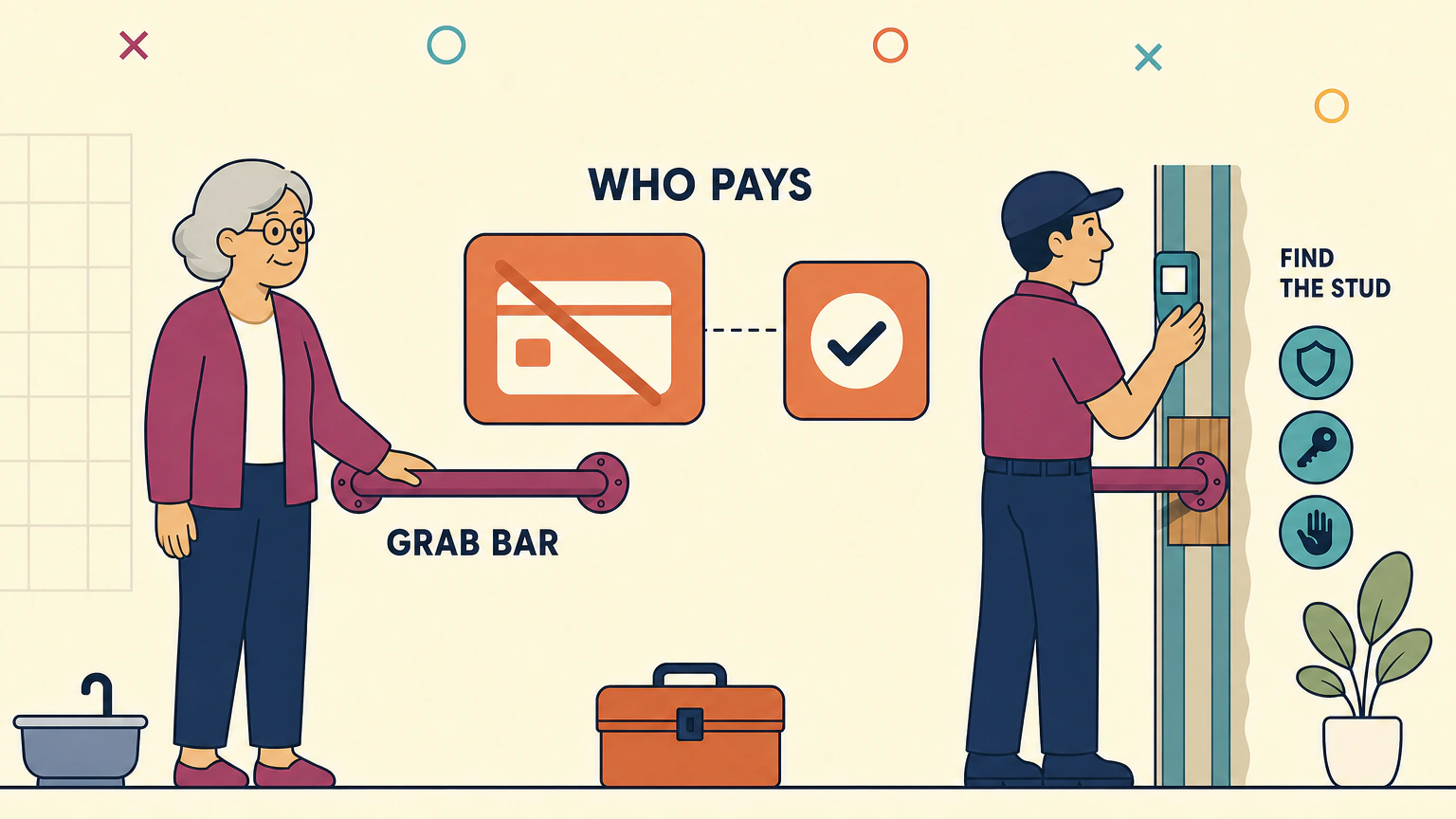
CMS keeps a Durable Medical Equipment Reference List, and grab bars sit on it by name, in the denied column: "Grab Bars — Deny - self-help device; not primarily medical in nature (§1861(n) of the Act)." That's National Coverage Determination 280.1, and a national coverage determination binds every Medicare contractor in the country. Your state doesn't change it. Neither does your doctor.
The five-part test every piece of equipment has to pass
Medicare's definition of durable medical equipment has five conditions. A grab bar clears four. It fails on the question of who else in the house could use it.
| Medicare's requirement | Does a grab bar meet it? |
|---|---|
| Durable, can withstand repeated use | Yes |
| Used for a medical reason | Arguably yes |
| Typically only useful to someone sick or injured | No; the prong it fails |
| Used in your home | Yes |
| Expected to last at least 3 years | Yes |
What Part B does cover in the bathroom
Quite a lot. A commode chair is covered under Part B as durable medical equipment, at 20% after the 2026 Part B deductible of $283. Walkers, canes and safety rollers are covered once you meet Medicare's mobility criteria. Raised toilet seats aren't: CMS calls them a convenience and hygienic item. Plain toilet seats get a shorter verdict, "not medical equipment."
Medicare Advantage: what "your plan might cover it" is really worth in 2026
How a bathroom safety benefit gets into a plan at all
A Medicare Advantage plan can offer what Original Medicare won't, but not just anything. A supplemental benefit has to diagnose, prevent or treat an illness or injury, compensate for physical impairments, ameliorate the functional or psychological impact of a condition, or reduce avoidable emergency and health care use. Grab bars get in through the impairment door. Any cap, or an assessment first, is that plan's own business.
The number that contradicts every article you will read on this
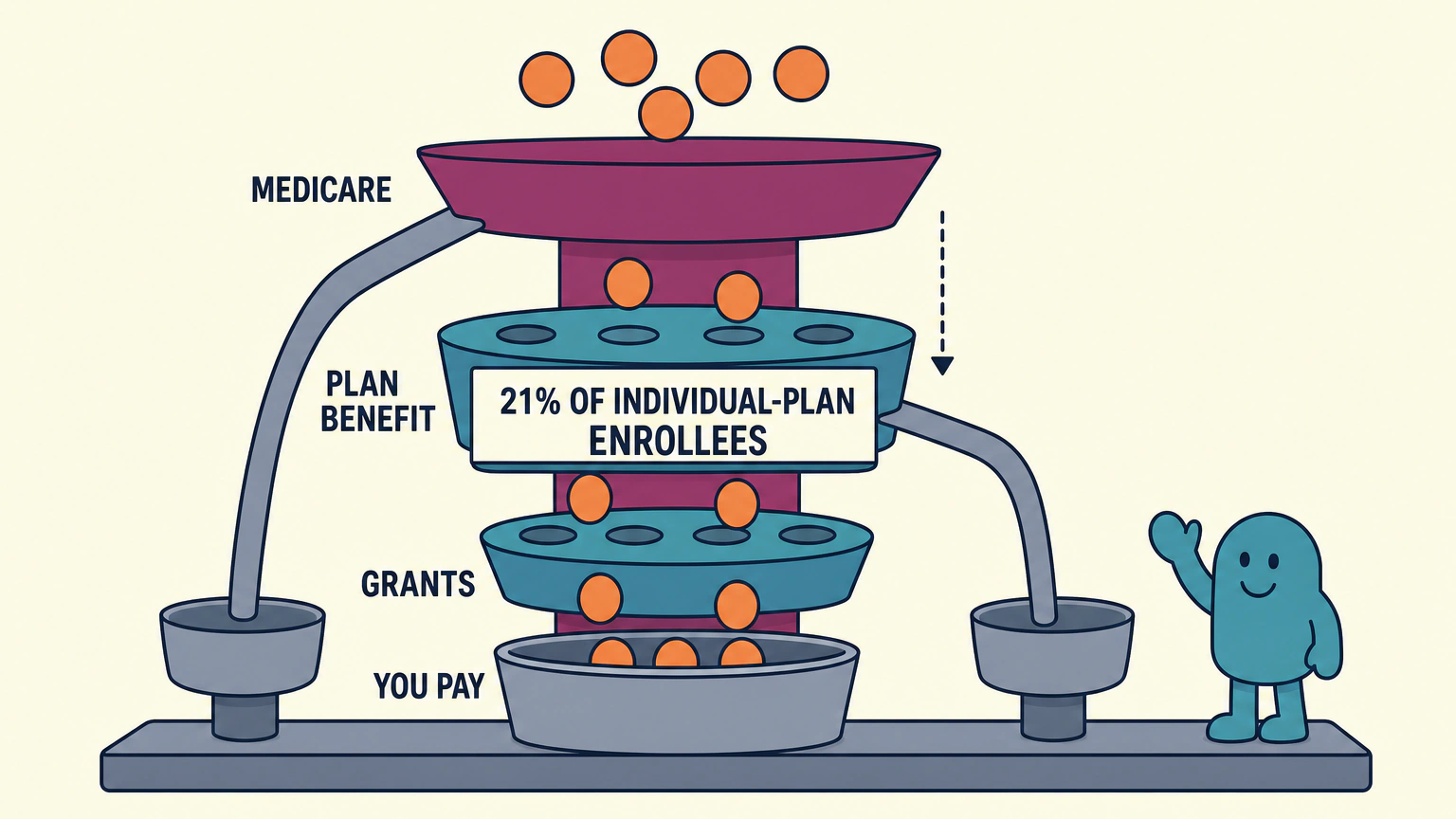
Here's the number the plan-shopping pages leave out. KFF, reading CMS's own plan files, puts 21% of individual-plan enrollees in a plan offering bathroom safety devices in 2026, down from 32% in 2025. Special Needs Plans do better, 60%, and they're falling too, from 68%. So four in five individual-plan enrollees have no such benefit at all. KFF is straight about the rest: nobody knows how many of them ever use it, because that data isn't published yet.
SSBCI: the three conditions, and why "I have a chronic condition" is not one of them
Some plans route this help through Special Supplemental Benefits for the Chronically Ill, SSBCI, and the name misleads. Having a chronic condition doesn't qualify you. The rule asks for three things at once: one or more comorbid and medically complex chronic conditions that is life threatening or significantly limits overall health or function; a high risk of hospitalization or other adverse outcomes; and a need for intensive care coordination. The conditions alone aren't sufficient either. The plan has to demonstrate all three through health risk assessments, claims data or similar means, and it's the plan's determination.
The annual fall window, and other times you may switch
The big window opens October 15 and closes December 7, and it isn't the only one. People already in a Medicare Advantage plan get their own open enrollment in the first three months of the year, and special election periods exist, so ask before you assume you've missed it. Search a plan's Evidence of Coverage for "bathroom safety devices," then find out which of three things it is: a dollar allowance, a catalog order, or an installation the plan arranges. The difference is who ends up drilling the hole.
The four routes that do pay, and who each one is for
| Route | Who it is for | What it pays toward | Where to start |
|---|---|---|---|
| Original Medicare | Anyone on Medicare | Nothing; NCD 280.1 denies them as a self-help device | n/a |
| MA supplemental benefit | Enrollees whose plan offers it (21% of individual-plan enrollees, 2026) | A plan-set allowance or catalog item | Evidence of Coverage; check applicable enrollment periods |
| MA SSBCI | Chronically ill enrollees meeting all three tests in 42 CFR 422.102(f) | Broader items, plan-determined | The plan documents eligibility |
| Medicaid HCBS waiver | Waiver participants; caps and waitlists set by state | Home modifications as an approved waiver service | State Medicaid agency |
| VA HISA grant | Eligible veterans | $6,800 lifetime service-connected (or 50%+ rating); $2,000 otherwise | VA Prosthetic and Sensory Aids Service; Form 10-0103 |
| VA SAH / SHA / TRA | Veterans with qualifying service-connected disabilities | FY 2026: $126,526 / $25,350; TRA $50,961 or $9,100 | VA housing grant application |
| USDA Section 504 grant | Homeowners 62+, very low income, eligible rural area | Up to $10,000 lifetime for health and safety hazards | USDA Rural Development office |
| Area Agency on Aging | Varies by county | Varies; sometimes free installation | Eldercare Locator, 1-800-677-1116 |
Please note: We can tell you what these programs say. Whether you qualify is settled by your plan documents and your state agency, and the dollar limits change every year.
Medicaid home and community-based services waivers
Medicaid pays for a great deal that keeps someone out of a nursing home, through home and community-based services waivers. The federal service list ends with a catch-all: "other services requested by the agency and approved by CMS as cost effective and necessary to avoid institutionalization." Home modifications live there. After that it's a state decision, so the rules, the caps and the waiting list change the moment you cross a state line. Your state Medicaid agency publishes its waiver list.
VA HISA: the grant with two amounts nobody separates
If there's a veteran in the house, start here. HISA, the VA's home improvements and structural alterations grant, is a lifetime benefit covering "use of essential lavatory and sanitary facilities" in a veteran's primary residence. The figure everyone quotes is $6,800. It isn't everyone's figure. The VA approves it for a service-connected disability, a compensable disability treated as if it were service-connected, or a non-service-connected disability where the veteran already holds a service-connected rating of at least 50%. Every other qualifying case gets $2,000. Either way: a VA physician's prescription and VA Form 10-0103.
VA SAH, SHA and TRA for a bigger conversion
When the honest fix is a roll-in shower, the VA has larger instruments. A Specially Adapted Housing grant tops out at $126,526 in fiscal year 2026, and a Special Home Adaptation grant at $25,350. For a veteran staying in a family member's home, Temporary Residence Adaptation pays $50,961 if SAH-eligible and $9,100 if SHA-eligible. These are house-adaptation grants, and a bar inside one is a rounding error.
USDA Section 504 repair grants, for rural homeowners 62 and older
USDA Rural Development publishes a repair program for very-low-income homeowners in eligible rural areas, Section 504: lifetime grants up to $10,000 to remove health and safety hazards, and loans up to $40,000 at a fixed 1% for 20 years, or $50,000 combined. The grant side carries an age test, 62 or older, and a string: sell within three years and you pay it back. Check the address on the USDA eligibility map first: "rural" here is a map, not an impression.
Your Area Agency on Aging, and the one phone number that finds it
The Eldercare Locator, 1-800-677-1116, is a public service of the Administration for Community Living, and it hands you the Area Agency on Aging for your county, or for your parent's county three states away. That office knows which local programs install bars, sometimes for free.
What it costs when nobody else pays
If none of those doors opens, this stops being an insurance problem and becomes a hiring problem.
Per-bar pricing, and what moves it
HomeGuide puts grab bar installation at $100 to $350 a bar in 2026, of which $20 to $150 is hardware and $80 to $200 is labor. Our own handyman contractors near you profiles run higher, a national average of $411 and a fair range of $187 to $681, and that's every handyman job we track averaged together, not a grab bar price. The minimum service charge is what bites on a job this small, so bundle every bar into one visit.
What the wall decides
What's behind the tile decides the price, and you can't see it. Ceramic over cement board wants the right bit and a slow hand. A fiberglass surround is hollow behind the flange, with nothing for a screw to hold. Studs sit about 16 inches apart, and the spot where a hand lands rarely lines up with one. An installer who says "I will add blocking" is quoting more work, not padding the bill.
When a bar is not the answer
If the daily risk is swinging a leg over a tub wall, more bars only soften a bad geometry. A curbless shower removes the step, which moves the job to bathroom remodeling contractors and the price from hundreds to thousands. Our remodeling profiles show a national average of $10,468 and a fair range of $6,016 to $14,994. That scope may require permits. And if a contractor asks for money up front, read how much to pay a contractor up front first, then compare the bids properly.
Who should install it
Which trade you need is decided by the wall, not by the bar.
Handyman, carpenter, or bathroom remodeler
A bar landing on existing studs is handyman work, and there's nothing second-rate about that. Ask to watch the stud finder and to see the fasteners going in. If the wall has to open for blocking, or the tile needs reinforcing behind it, hire a carpenter who'll state the blocking dimensions and how the tile gets made watertight. Changing the shower is a remodeler's job.
The CAPS credential, and how to check it is live
Certified Aging-in-Place Specialist, CAPS, is a National Association of Home Builders credential held by remodelers, builders, designers and some occupational therapists. It carries continuing education requirements and a code of ethics. It also lapses. NAHB publishes a directory of active designees, so look the name up there rather than trusting the logo on the truck door. Then the ordinary checks: license, liability insurance, workers' compensation.
What an occupational therapist adds, and how Medicare pays for that part
Original Medicare won't buy the bar, but it does cover occupational therapy, including under the home health benefit, where you pay nothing for covered services once the eligibility conditions are met. An occupational therapist marks where the bar has to go for one person in one bathroom. A bar in the wrong place is a bar nobody reaches for.
Pro tip: Book the assessment before you buy anything. Original Medicare won't pay for the bar, but it does cover occupational therapy when eligibility conditions are met.
The standard to hold your installer to
250 pounds, at any point
Read this one out loud to your installer. Section 609.8 of the 2010 ADA Standards for Accessible Design: allowable stresses must not be exceeded when a vertical or horizontal force of 250 pounds (1112 N) is applied at any point on the grab bar, fastener, mounting device or supporting structure. Read those last four words again. The bar is only as strong as its anchoring and wall, which is why a suction-cup bar is never fall protection. Where the bar goes is a separate question, and a professional's call.
Height, clearance and cross section
The height isn't a matter of taste. A bar mounts horizontally, top of the gripping surface 33 to 36 inches above the finished floor. The space between wall and bar is 1 1/2 inches. A circular bar measures 1 1/4 to 2 inches in outside diameter. Write each number into the work order; "install a grab bar" isn't a specification.
Why "ADA-compliant" means nothing in your own bathroom
The Americans with Disabilities Act governs public accommodations and commercial facilities. Your bathroom is neither, so "ADA-compliant" on a product page is a claim about the bar in the box, not a promise about your wall. The numbers are still the only published benchmark anyone has, and we'd hold an installer to them. If you're remodeling anyway, the standards allow reinforcement in the walls of residential dwelling units in place of installed bars, the cheapest accessibility decision available.
Ten things to put in the work order
- Bar and mounting withstand 250 pounds at any point, vertical or horizontal.
- Mounted horizontally, gripping surface 33 to 36 inches above finished floor.
- Clearance of 1 1/2 inches between wall and bar.
- Circular bar, 1 1/4 to 2 inches outside diameter.
- Anchored into studs or new solid blocking, no drywall-only anchors.
- Photograph the open wall, blocking visible, before closing.
- No suction-cup bars as fall protection.
- Placement confirmed with the user, standing, wet-hands position.
- Written scope, fixed price, trip charge on its own line.
- Proof of liability insurance, workers' compensation, license where required.
Red flags: the "Medicare-covered grab bar" phone call
If someone calls offering a grab bar covered by Medicare, hang up. Original Medicare doesn't cover grab bars, so anyone claiming that Original Medicare pays for them is misrepresenting the program. Medicare's own guidance is blunt: it will never call you to sell you anything or visit your home. Never give a Medicare number to a caller. Check statements against the visits that actually happened. And treat a free in-home "safety assessment" from a company that sells the product as what it is, a sales call. Your State Health Insurance Assistance Program counsels free.
Red flag: Nobody can sell you a grab bar that Original Medicare pays for, because Original Medicare doesn't cover grab bars. Medicare will never call you to sell you anything or visit your home. Report suspected fraud to 1-800-MEDICARE (1-800-633-4227).
Frequently asked questions
Are grab bars considered durable medical equipment?
No. CMS's own equipment list names grab bars and denies them as a "self-help device; not primarily medical in nature." That decision is national, so it doesn't vary by state, by contractor or by doctor, and a prescription changes nothing. Spend the energy on the programs that do pay.
Does Medicare cover walk-in tubs or shower chairs?
Not the tub. A walk-in tub is a permanent home fixture and Original Medicare doesn't cover it. A commode chair is different, covered under Part B as durable medical equipment when medically necessary, at 20% coinsurance after the deductible. A shower chair generally isn't covered by Original Medicare. CMS decides these item by item.
Does Medicaid cover grab bars?
Sometimes, through a home and community-based services waiver. Home modifications are left to the states, so whether your state's waiver funds a grab bar, how much it pays and how long the waiting list runs are all state answers. Call your state Medicaid agency and ask for its waiver list.
Who installs grab bars for seniors?
A handyman or a carpenter, usually. Surface-mounted bars on existing studs are handyman work, opening a wall for blocking is carpentry, and changing the shower is a remodeler's job. An occupational therapist recommends where the bars go. Check that the CAPS credential is active, plus license and insurance, before anyone drills.
Why doesn't Medicare cover grab bars when they prevent falls?
Because the test isn't whether it helps. Medicare's definition of durable medical equipment asks whether an item is typically only useful to someone sick or injured, and a grab bar is useful to everyone in the household. That's the prong it fails. Preventing falls isn't the question the rule asks.
How much weight should a grab bar hold?
250 pounds, applied at any point on the bar, the fastener, the mounting device or the structure behind it, pushed down or pulled out. That benchmark is section 609.8 of the 2010 ADA Standards. Notice where the load is measured: the bar is only as strong as its anchoring and the wall it's fixed to.
Will Medicare pay for toilet safety rails or a raised toilet seat?
Not the raised seat. CMS denies raised toilet seats as convenience and hygienic items that are not primarily medical in nature, so Original Medicare doesn't cover them. A commode chair is separate equipment, covered under Part B when medically necessary. Rails are their own question, so ask Medicare or your plan to confirm coverage for a specific toilet-rail product.
Where our numbers come from
Everything here comes from the primary documents: CMS's coverage database, medicare.gov, the Code of Federal Regulations, KFF's annual Medicare Advantage analysis, the VA's benefit pages, USDA Rural Development, the CDC and the 2010 ADA Standards. Two federal sites wouldn't open for us, so the USDA and CDC figures come from archived copies of those same official pages. Medicare Advantage benefits and Medicaid waiver rules get rewritten every year, so treat any dollar figure here as the number to confirm with the plan or the agency, not the number to budget around.