

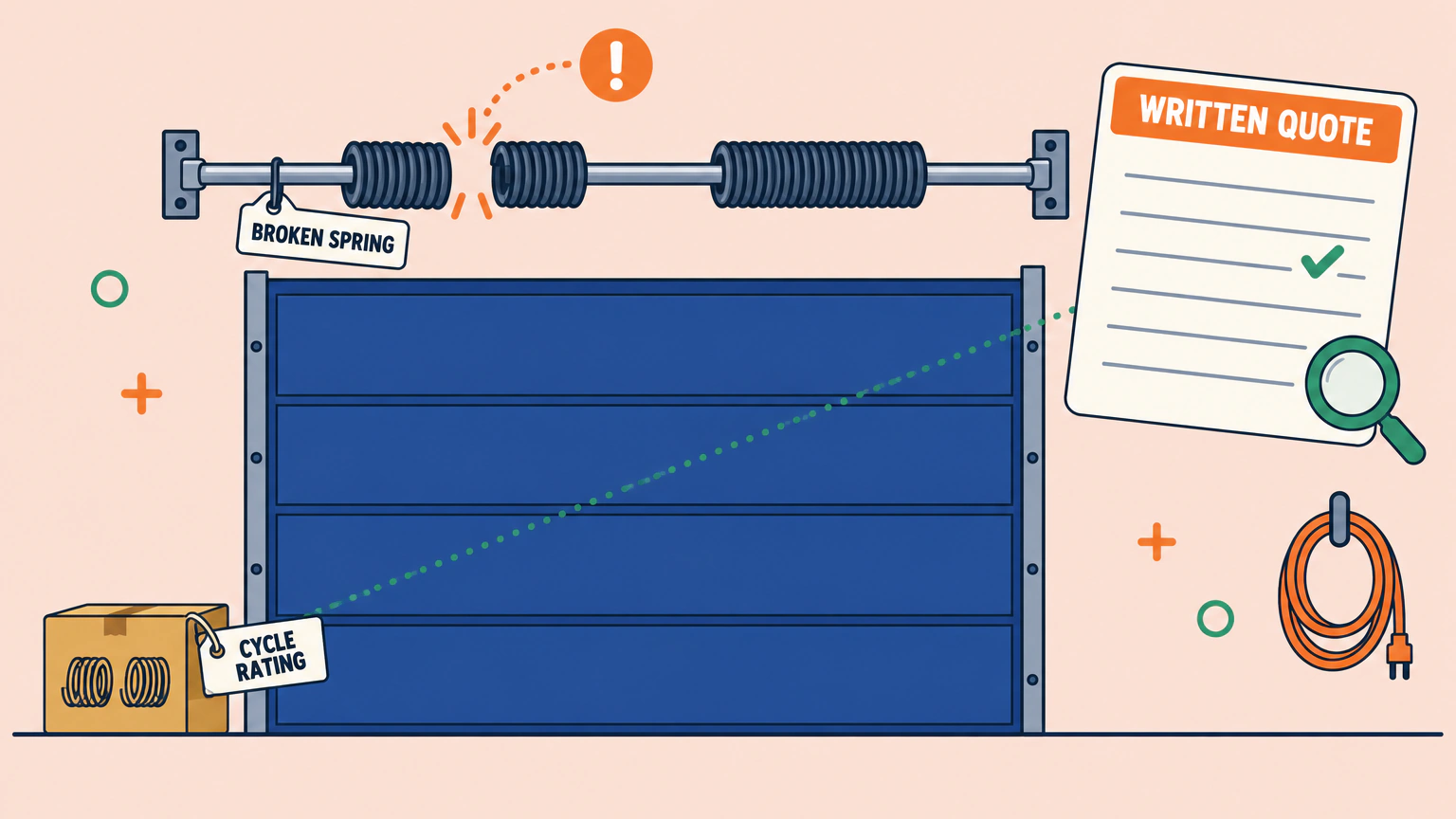
HomeAdvisor puts garage door spring replacement at $150 to $350 installed for both springs on a typical door, with a $250 average. A quote well above that should name what the extra money buys, in writing: a higher cycle rating, new cables, a longer warranty or a same-day premium.
That's the easy half. The published price guides for this one job disagree by about three times, and the whole gap is what the visit includes.
On this page
What garage door spring replacement costs
What the price guides say, and why they don't agree
Four businesses publish a price for the same broken spring, and not one of them is pricing the same visit.
| Who publishes the price | What kind of business | Both springs on one door | What else it prices |
|---|---|---|---|
| HomeAdvisor cost guide | National cost guide and quote marketplace | $150 to $350 installed, $250 on average | Springs alone $30 to $100 each; new cables $75 to $200 |
| Overhead Door Company of Denver | Local garage door dealer | $200 to $350 | Springs and cables $250 to $450; same-day spring repair $250 to $450; emergency $300 to $500 |
| A1 Garage Door Service | Multi-state garage door company | $500 to $1,200 installed | High-cycle pair $700 to $1,500 installed |
| DDM Garage Doors | Parts retailer, no installation | $56.56 for a 10,000-cycle pair | 27,000-cycle pair $83.10; 54,000-cycle pair $112.38 |
Each business is pricing a different visit. The parts prices cover one 150-pound, 16 by 7 foot door and the springs only, and the full-service company's installed price includes an inspection, balancing and a full system test by its own description.
A1's $500 low end is about three times as high as HomeAdvisor's $150, and its $1,200 top end is about three times as high as $350. Then it gets properly confusing. A1's guide calls a quote under $250 a red flag, and $250 is HomeAdvisor's stated average bill. Both can be honest, because they're selling different visits under the same three words. So the right price isn't a number you carry in your head. It's the one whose scope is written down.
What you're paying for when the springs are the cheap part
On HomeAdvisor's $250 average job, the springs alone can be a smaller share of the invoice. The same guide puts torsion springs at $30 to $100 each, and DDM sells a standard pair for one common 150-pound door at $56.56. Labor, HomeAdvisor says, runs $75 to $150 for work that takes one to two hours.
The rest is the visit. A1's list of what its price covers runs long: an inspection of the cables, drums, bearings and rollers, precise balancing, lubrication of the moving parts, a safety-system check, written documentation and a labor warranty. Some visits carry all of that, and some are the swap and the door closing behind them. You can't tell them apart from the invoice afterward, which is why you compare first.
When the spring breaks
The ten minutes after the bang decide two things. Whether this stays a spring job, and whether the company that pulls into your driveway is the one you thought you called.
How to tell it's the spring, and why the opener stays off
Lee Company's technicians list seven signs, and most people have already seen three. The door won't open at all, or it lifts a few inches and stops. It feels extremely heavy by hand. It goes up crooked, one side higher than the other. The cables along the tracks look loose, frayed or hanging. The opener runs, hums or strains while the door stays put. And the bang itself.
Then the rule, from DASMA, the trade association that writes the technical standards for this equipment: "If a spring is broken, do not operate the door until the spring is replaced. Do not try to remove, repair or adjust springs or any door parts or mounting surfaces, such as wood blocks, steel brackets, cables or other like items." Its homeowner sheet adds the physical version. If the door is too heavy or difficult to move, stop. The Denver dealer adds the unglamorous one. Running the opener against a dead spring can damage it.
Every check here is one you watch a technician run, not one you perform on a broken door. The springs and the hardware bolted to them hold enough tension to cause serious injury.
Tonight or tomorrow morning
The night premium is real, and some companies publish theirs. The Denver dealer puts a double spring job at $200 to $350, same-day spring repair at $250 to $450, and emergency spring repair at $300 to $500. A1 charges a $199 flat-rate emergency trip fee and says the work itself is no different after hours.
Our position, since somebody should take one. If the door is closed, the car is out and nothing in the garage is worth a thief's evening, we'd book the morning and keep the difference. If the door is stuck open and the house is standing wide to the street, pay the premium. That's what it's for.
One catch to the 10 p.m. search that follows. It's the easiest moment all year to hire a company that doesn't exist.
Two minutes of checking before anyone comes out
The Better Business Bureau publishes a garage door repair scam alert, and its warning signs read like a transcript of that search. Several generic business names, none registered with the state. No physical address, just a phone number. A technician with no identification and no marked vehicle. A low service-call price on the phone, then demands for more once the truck is in your driveway. And pressure to pay in full before any work is done.
BBB's fix takes about a minute of the two. When they answer, ask for their address and compare it with the ad. Then look the name up online with the words complaint, review and scam attached. The International Door Association says the same from the trade's side. Inconsistent contact information or branding is a red flag. Scammers bid low to get in the door, then raise the cost. A reputable installer verifies who's coming, so ask for a branded business card and matching gear.
It's a live problem. In May 2026 the Justice Department, acting for the FTC, and the state of Illinois sued a company they allege created thousands of online profiles for home-repair businesses that don't exist, with garage door repair among the search terms targeted. The local addresses on those profiles belonged to unrelated third parties or were invented, according to the complaint, and people who called a local number reached representatives somewhere else. Those are allegations, and the case has yet to be decided.
Licensing won't settle it for you either. BBB and the FTC both say the requirements vary by location, so the check is with your state or county government, and how licensing thresholds work covers why the line moves from place to place.
Our own card on the table. Before a company is listed with us it goes through a physical-location check, and you can read our listing checks in full. That's a first screen and not a promise, and we'd still rather you spent the two minutes. When you're ready to book, garage door companies near you is where the list starts.
Reading the quote in your driveway
The technician is in your garage and the number is on a tablet. Three questions sort a fair quote from an inflated one, and none of them needs you to know a torsion spring from a tent pole.
Both springs, and the doors where that's the wrong answer
Two shapes of spring do this job. Torsion springs sit on a steel shaft above the door opening. Extension springs run alongside the horizontal tracks near the ceiling, one down each side.
HomeAdvisor's position is the trade's. You'll almost always have two springs per door, and both should be replaced at once, because balanced tension is essential to safe operation and mismatched components compromise it. A1 prices the choice plainly: on its own numbers, doing both at once costs $150 to $300 more than doing one.
The flip side is the word almost. Plenty of single doors run on one spring, and there's no second one on those to buy. Look up and count them.
One more question decides how long the repair lasts. DASMA warns that fitting a spring without checking it meets the door's counterbalance requirement can shorten the life of the whole assembly and become a safety problem. So ask what size and rating the new spring is, and whether it matches your door. Nobody good is offended by that.
Ask for the cycle rating before you ask for a discount
A cycle, in DASMA's terms, is the door going from fully closed to fully open and back. Each trip out by car and home again is two of them, so you can count your own in a day.
Standard springs are commonly rated at 10,000 cycles. HomeAdvisor gives torsion springs 10,000 to 20,000, roughly eight to 15 years, and the Denver dealer's FAQ puts a standard spring at about 10,000. DDM's retail prices show what the upgrade costs on one 150-pound door: $56.56 for the standard pair, $83.10 for a 27,000-cycle pair, $112.38 for a 54,000-cycle pair. That's $26.54 or $55.82 more in parts.
| Times the door opens and closes a day | Cycles a year | Years to use 10,000 cycles | Years to use 27,000 cycles |
|---|---|---|---|
| 4 | 1,460 | 6.8 | 18.5 |
| 6 | 2,190 | 4.6 | 12.3 |
| 8 | 2,920 | 3.4 | 9.2 |
| 10 | 3,650 | 2.7 | 7.4 |
A cycle is one full open and close. Ratings are engineering estimates, not guarantees.
A door that moves twice a day runs 730 cycles a year, so a 10,000-cycle spring has almost 14 years in it. Use the garage as the family's front door at ten cycles a day and the same spring is finished in under three years. That's the whole high-cycle argument, and it's yours to make rather than the technician's.
One limit, in DDM's own words: cycle ratings are engineering estimates and not guarantees of actual service life. DASMA puts rust, lubrication and correct sizing beside the rating itself.
Cables, openers and the new door pitch
Three extras turn up on spring quotes. Each needs its own proof.
Cables can be a real extra. They run down each side of the door and fray with age. HomeAdvisor prices replacement at $75 to $200, and the Denver dealer's springs-plus-cables job runs $250 to $450 against $200 to $350 for the springs alone, so $50 to $100 more on that guide. Ask to be shown the fray. Frayed steel is visible from across the garage.
An opener can be a real extra. DASMA's checklist names one case for replacing it: when the entrapment protection isn't there, meaning nothing makes the door stop and reverse when something gets underneath it. IDA says it plainly. If your opener has no photo eyes, or doesn't reverse when something's in the way, it's time for an upgrade. An opener that reverses properly doesn't need replacing because a spring broke.
A new door is the third, and the one to slow down for. A broken spring is a reason to replace springs. If the conversation turns into a door, take the written quote and get a second one before you sign. BBB names the pattern: high-pressure tactics used to convince you the door needs immediate and costly repairs. Pressure to pay the whole bill up front belongs in the same family, and paying a contractor up front is worth reading on a job this size.
Red flag: Three things on a spring call deserve a pause. A price that was low on the phone and much higher once the technician is standing in your garage, the pattern both the Better Business Bureau and the International Door Association warn about. Pressure to pay the whole bill before the work is done. And a truck, uniform or business card that doesn't match the company you called. Any one of them is a good reason to ask for the quote in writing and a day to think it over.
What to watch before you pay
The job looks finished and the truck is still in the driveway. These three minutes decide whether it really is.
Ask the technician to show you the door is balanced
Balance is the whole job. DASMA puts it in one line: safe and proper operation of the door, the opener and the entrapment protection all depend on a balanced door.
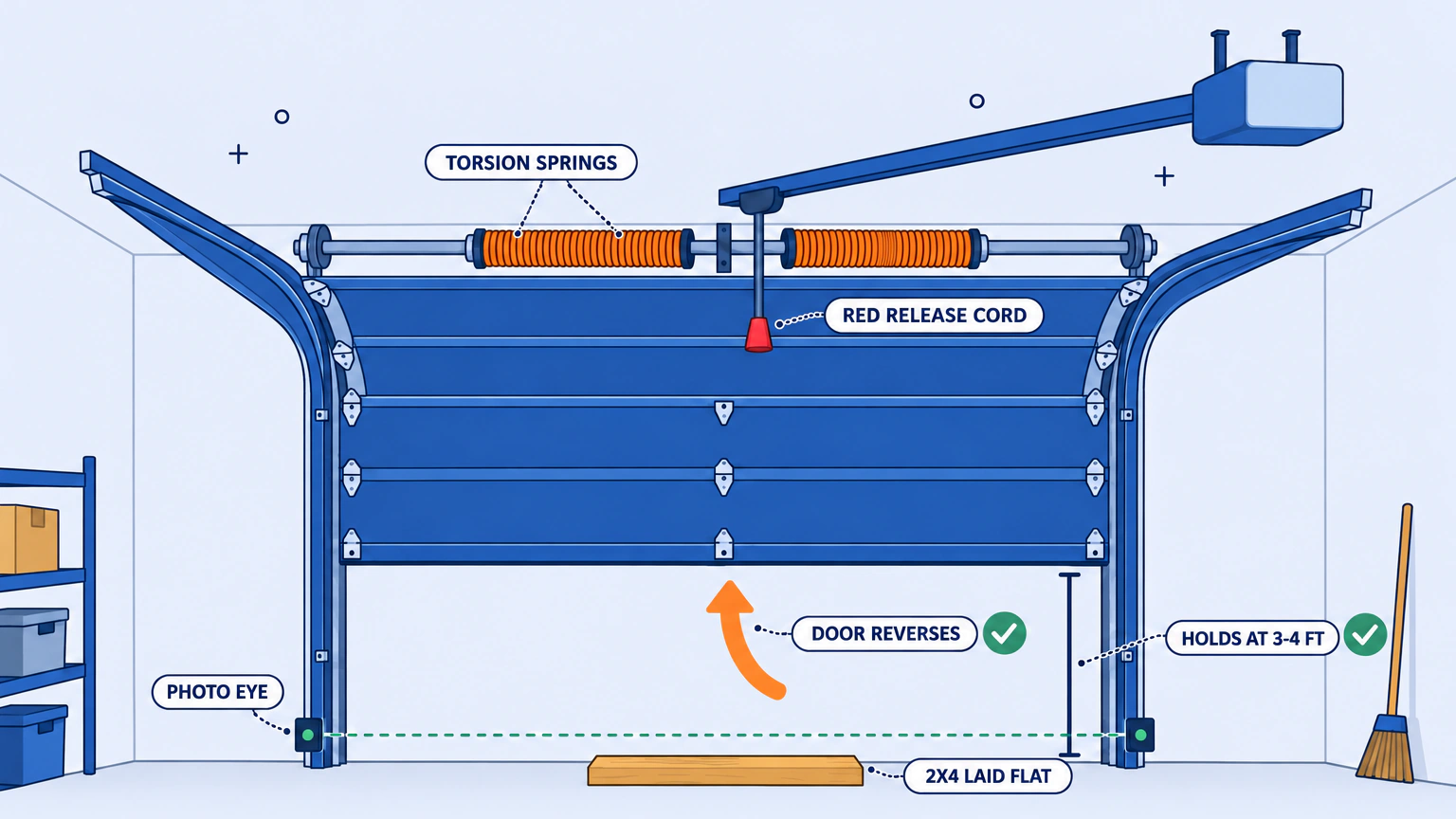
The test comes straight off its checklist. With the opener disconnected at the red release handle, the door should move freely, stay put in the fully open position, and hold where it's left 3 to 4 feet above the floor. A door that holds has passed the balance check. A door that sinks back down has too little spring torque, which is the exact symptom DASMA names.
Ask the technician to run it while you watch. DASMA warns that a door can begin to move on its own the moment the opener is disengaged.
A door can drift out of balance before a spring snaps. The same test tells you when to ask a technician about an adjustment.
Watch the door reverse, twice
Two more tests from the same checklist, both a minute's work.
The photo eyes first. The sensors sit near the floor on each side of the opening, and DASMA says the beam belongs no higher than six inches above it. Start the door closing, pass something through the beam, and the door should reverse and return to fully open. A length of two-by-four is the usual prop. Stand well clear of the door's path.
Then the contact test. Lay a 2x4 flat on the floor under the center of the door and close it. When the door touches the board it should reverse and go back to fully open. DASMA says federal law requires residential openers made after 1992 to have entrapment protection, so it isn't optional on an opener that age.
One more line on the checklist is worth a glance while you're standing there. The opener should plug into a grounded or GFCI outlet within reach of its own cord, and an extension cord isn't permitted. If yours runs on one, that's a job for an electrician rather than the door company.
What to have in writing
The FTC's advice for any home improvement job fits a spring call exactly. A written estimate should include a description of the work, the materials, the completion date and the price. And never make the final payment until the work is done and you're satisfied with it. BBB says the same thing: a detailed estimate up front, payment after the work is finished.
Warranty terms are where the paperwork earns its keep. HomeAdvisor says most extension springs come with a three- to five-year warranty, the spring line in homewyse's estimator assumes one year, and A1 says parts should carry three to five years plus labor coverage. With a spread like that, the term belongs on the invoice.
Before you pay for a spring replacement
- A written quote that names the springs, the labor, any trip or service-call fee and each extra part before work starts.
- The new springs' cycle rating and the warranty on parts and labor, written on the quote or the invoice.
- On a two-spring door, both springs replaced together.
- With the opener disconnected, the door stays put when it's let go of 3 to 4 feet off the floor.
- The door reverses when it closes onto a 2x4 laid flat under the middle of the door.
- The door reverses when something passes through the photo-eye beam as it closes.
- On a door with extension springs, a safety cable runs through the center of each spring.
- You pay after the work is done and the door passes these checks.
Then do the dull thing that saves the most money. Get a second written quote and compare two quotes line by line.
Should you replace a garage door spring yourself?
Start with the honest part. You can buy the parts: DDM sells that standard pair for a 150-pound door at $56.56 and publishes full winding instructions with them. The saving is easy to name too. On HomeAdvisor's figures it's the labor line, $75 to $150.
We'd pay it. DASMA doesn't hedge: "Because of potential dangers involved, all repairs and adjustments must be performed by a trained door systems technician using proper tools and instructions." Its homeowner sheet has the sentence that stays with you. Doors "are large, heavy objects that move with the help of springs under extreme tension, and can cause serious injury or death."
The danger everyone pictures is a winding bar kicking back. The quieter one is getting the job nearly right. DASMA's list of what shortens spring life opens with two mistakes shaped exactly like a first attempt: fitting a spring without checking it meets the door's counterbalance requirement, and applying the wrong number of turns to it. Both are safety issues in DASMA's words, and a homeowner working from a parts list is guessing at both.
Frequently asked questions
Can you open a garage door with a broken spring?
We wouldn't. DASMA says not to operate the door until the spring is replaced, and its homeowner sheet says a door too heavy or difficult to move is a reason to stop rather than push harder. HomeAdvisor calls manual opening unsafe, because a broken spring leaves the door unbalanced and it can move suddenly. If the car is trapped inside, that's the case for a same-day call.
How long do garage door springs last?
In cycles, not years. HomeAdvisor gives torsion springs 10,000 to 20,000 cycles, about eight to 15 years, and extension springs 8,000 to 15,000 cycles, about seven to 12. Those year figures assume average use, so the real answer comes from your own door. At ten openings a day, a 10,000-cycle spring is finished in under three years.
Should you replace both garage door springs if only one broke?
On a two-spring door, yes. HomeAdvisor says to replace both at the same time, because balanced tension is essential to safe operation and mismatched components compromise it. The surviving spring has carried the same load through the same number of cycles, so it's due anyway. On a single-spring door there's nothing else to replace.
How long does it take to replace garage door springs?
HomeAdvisor says a skilled technician replaces two springs on a standard door in 30 minutes to an hour. A1's guide says 45 to 90 minutes, because its version includes the inspection, the balancing and the written documentation. That gap is the difference between a swap and a service visit, and it's fair to ask which one you're buying.
Why did my garage door spring break?
Usually fatigue, after it reached the end of its rated cycles. DASMA's cycle-life sheet names the rest: rust, which reduces the strength of the spring wire, a spring applied to the wrong door, the wrong number of winding turns, a lack of lubrication, and doors left open in extreme heat or cold. Paint or added components can push a door past the weight its springs were sized for.
Does a home warranty cover garage door springs?
Sometimes. American Home Shield covers extension and torsion springs under its garage door opener coverage, and excludes the rest of the system, including the door, the tracks, the rollers and the guides. Plans differ, so read the garage door clause and budget the service fee. The same arithmetic decides whether a home warranty is worth it anywhere else in the house.
How often should garage door springs be lubricated or adjusted?
Follow the schedule in your door manufacturer's instructions. DASMA says regular lubrication on that schedule helps maximize spring cycle life, and IDA recommends spray lubricant for the hinges, rollers and tracks every six months. Adjusting spring tension is a technician's job. A door that won't hold at 3 to 4 feet needs a technician's attention.