

On this page
- What gutter cleaning costs, one story to three
- How cleaners price the job, and how to price yours first
- What the price should cover, and what costs extra
- How often to book, and when it costs less
- Where wildfires burn, a full gutter is a fire risk
- What skipping a cleaning can cost you
- Doing it yourself, or paying for the ladder work
- Gutter cleaning questions people ask
What gutter cleaning costs, one story to three
Angi and HomeAdvisor print the same gutter cleaning prices: an average of $168, with most homeowners paying $119 to $234. HomeGuide's average range is $100 to $250. Thumbtack's national range is $163 to $333, and most people pay around $233. Height is what moves your gutter cleaning cost. Every one of these guides prices a taller house higher, because the ladder work takes longer and gets riskier as the roofline climbs. Angi adds a useful detail for a house with gutters on different levels. You don't pay the premium on the whole job, "just the higher gutters."
What a gutter cleaning costs by story
| Price guide | One story | Two stories | Three stories | What the range assumes |
|---|---|---|---|---|
| Angi | $145 to $250 | $180 to $360 | $210 to $450 | Average project cost by height, from Angi's survey of its own customers |
| HomeGuide | $70 to $200 | $100 to $275 | $130 to $400 | 150 to 200 feet of gutter, three stories or more in the last column |
| Fixr | $150 to $225 | $225 to $375 | $375 to $480 | 150 linear feet of gutter |
| Thumbtack | $135 to $250 | $160 to $300 | Not published | National averages from Thumbtack's own job data |
Our own planning ranges for gutter cleaning, on our category page, put 200 feet of gutter at $200 to $400 for one story and $325 to $475 for two.
Ours are budgeting figures for one scope, 200 feet of ordinary open gutter with routine debris, not an average of anybody's invoices.
Why the published averages don't agree
The averages run from $168 to $300, and none of the guides is lying. They're pricing different houses. Fixr's $300 is for 150 linear feet of gutter "with minimal buildup on a two-story house." Angi's $168 is one average across every height, built from a survey of more than 30,000 of its own customers' project costs. Thumbtack's $233 is what most people pay in its own job data, and HomeGuide's ranges assume 150 to 200 feet of gutter.
Taskrabbit prices the hour instead. Gutter jobs are booked in its Yardwork category, which averages $37 an hour, and average Yardwork invoices in its city table run from $136 in Austin to $206 in New York City.
Each guide is right about its own imaginary house. Yours is the one nobody priced, so price it by the foot.
How cleaners price the job, and how to price yours first
Quotes arrive in three shapes. HomeGuide's price table lists them as per linear foot ($0.50 to $2.50), a flat rate ($100 to $250) or by the hour ($40 to $80). Thumbtack says companies "typically charge a fixed (not hourly) rate," and that some price by your home's square footage, at $0.09 to $0.12 a square foot. Whatever shape the quote takes, we'd ask for two numbers: the linear footage and the story it's priced at. Those are the only figures you can hold against anyone else's.
One house, three price lists
A two-story house with 160 feet of gutter, all of it on the upper story.
| Price guide | Two-story rate per foot | 160 feet of gutter | Plus clearing clogged downspouts |
|---|---|---|---|
| Angi | $1.00 to $1.85 | $160 to $296 | $210 to $396 |
| HomeGuide | $0.75 to $2.00 | $120 to $320 | $180 to $470 |
| Fixr | $1.50 to $2.50 | $240 to $400 | $290 to $500 |
The downspout column adds each guide's own figure for clearing clogs, $50 to $100 from Angi and Fixr and $60 to $150 from HomeGuide.
The same 160 feet runs $120 to $400 depending on whose per-foot rate you use, before anyone touches a downspout. That's why a quote with no footage on it can't be compared with anything.
Measure your gutters before you call anyone
A gutter cleaning cost per linear foot is useless until you know your feet. Most homes have 125 to 200 linear feet of gutter by Angi's count, or 150 to 200 by HomeGuide's. Angi says to measure along the base of your walls. A Maryland gutter cleaner quoted by Thumbtack walks it off from the ground instead: "Calibrate one step equals 3 feet of length." Fixr adds the downspouts, so measure those too and have the numbers ready when you call.
Then write down which runs sit on the second story or higher. That's where the per-foot rate climbs, and by Angi's per-level rule it's the only part that should carry the premium. Ten minutes with a tape measure turns a phone quote into a number you can hold someone to.
What the price should cover, and what costs extra
The guides don't agree on what a standard cleaning includes, and that gap is where surprise charges come from. Taskrabbit counts "Bagging or disposing of the removed debris" as included, and repairs like "reattaching loose sections" as excluded. HomeGuide lists "Collecting and disposing of waste" and "Fixing fasteners, seals, and end caps" among typical inclusions, yet says some companies charge $20 to $35 to haul the debris off. Fixr includes "repairing fasteners and seals." None of that is a scam. They're different menus, so settle the menu before the work starts.
Extras that can land on the bill
| Extra | What it usually adds | Who says so |
|---|---|---|
| Clearing clogged downspouts | $50 to $100 | Angi, Fixr |
| Flushing heavily clogged downspouts | $60 to $150 | HomeGuide |
| Taking off and refitting gutter screens | $30 to $80 | HomeGuide |
| Hauling the debris away, where it isn't included | $20 to $35 | HomeGuide |
| Clearing debris off the roof | $50 to $150 | Taskrabbit |
| Gutters left uncleaned for a long stretch | 10% to 50% more | Angi |
| A steep roof | About 15% more | Angi |
| Booking in the fall or spring rush | 10% to 50% more | Angi |
Six answers to get in writing before the ladder goes up
- The total feet of gutter in the price, and which runs are on an upper story.
- That every downspout gets flushed and drains out the bottom, and what clearing a clog costs if they find one.
- Whether the leaves get bagged and hauled away or left in a pile for you.
- Whether guards or screens come off for the cleaning, and what that adds.
- Whether small fixes like a loose hanger or a leaking seam are included or quoted separately.
- Proof of liability insurance, plus workers' comp if a crew is coming.
If the cleaner finds rusted-through runs or a section sagging off the fascia, you've left cleaning territory. That's a repair or replacement decision, and our guide to what new gutters cost, and when a repair is enough walks through it.
The downspout check before you pay
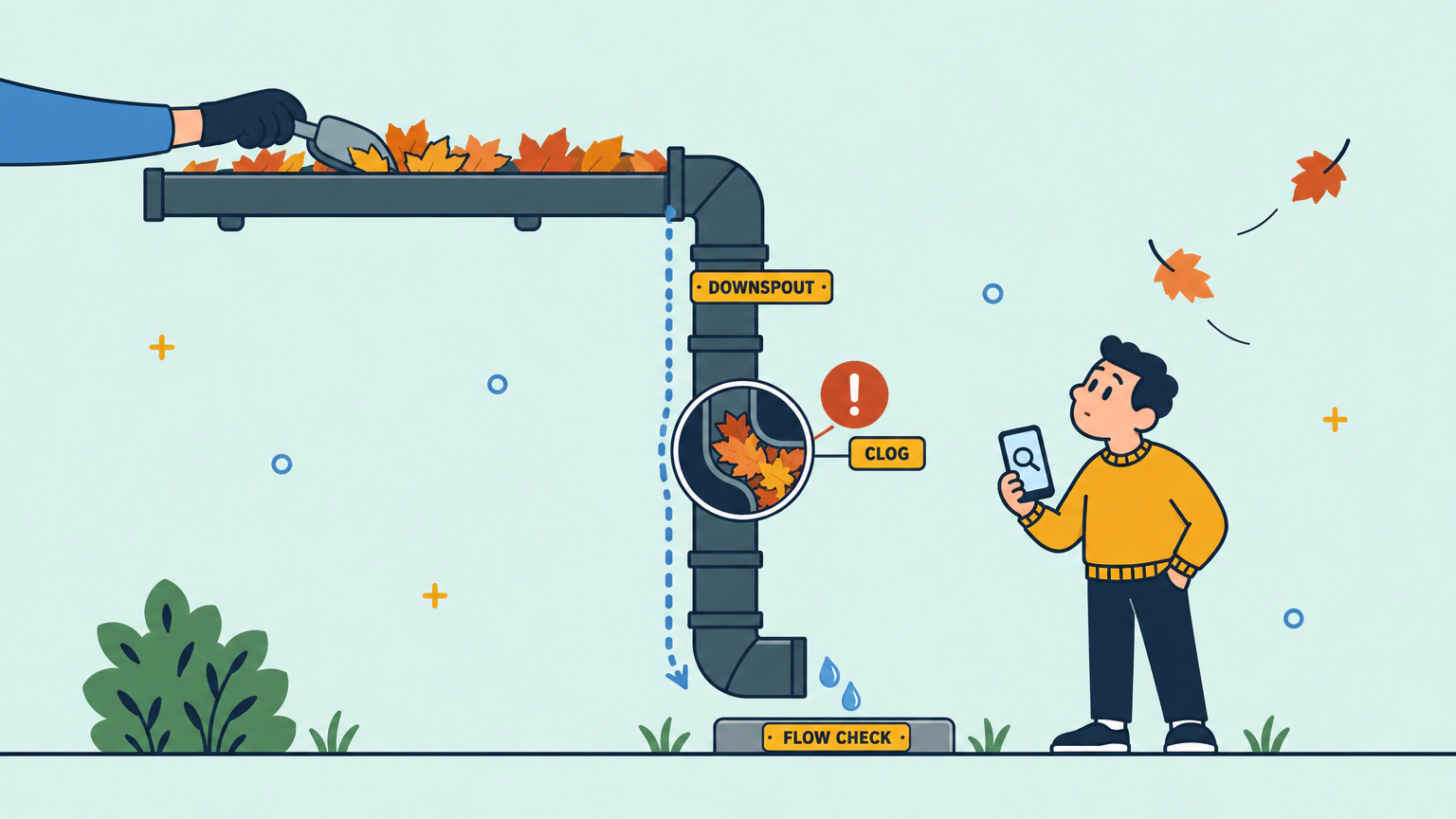
Clean troughs feeding a clogged downspout still overflow, and from the ladder you can't see a clog in the elbow. Fixr's rule is the one to hold a company to: "If your downspout is not clogged, the cleaning should be included in the standard flat-rate quote." Clogged ones, Fixr says, "frequently add" $50 to $100. HomeGuide puts heavily clogged downspouts at $60 to $150 extra, and Taskrabbit lists flushing them "to ensure they are free of clogs and draining properly" as a standard inclusion.
So the check is simple. Before you pay, ask the crew to flush each downspout while you watch the water come out the bottom at full flow. HomeGuide lists "Downspouts that don't drain during rain" as a sign the gutters need cleaning. And a whole run still holding water after the rain stops can mean a blocked downspout or a gutter slope problem.
Some downspouts empty into a pipe underground. If the water stops there, ask whether the company clears underground lines at all. If it doesn't, call a drain cleaning company, and know when a drain line needs more than a snake before you do.
How often to book, and when it costs less
Angi says once or twice a year for an average home, in spring and early fall, and more often near oaks or pines. HomeGuide says "2 to 3 times per year or before the rainiest seasons." Taskrabbit says one to three times. Timing changes the price too. Angi names autumn and spring as the two peak seasons and says booking off-peak, in early winter or summer, can save 10% to 50%.
How often gutters need cleaning
| Your situation | How often | Source |
|---|---|---|
| An average home | Once or twice a year, spring and early fall | Angi |
| Oaks near the house | Twice a year or more | Angi |
| Pines near the house | Four times a year | Angi |
| Guards or screens fitted | At least once a year, or every two years | Angi, HomeGuide |
| Gutters and downspouts in general | Two to three times a year, or before the rainiest seasons | HomeGuide |
Angi and HomeGuide disagree on guarded gutters, so the row gives both answers.
HomeGuide makes the same point from the other side. Schedule "in the spring and late fall," it says, but book "in early winter or midsummer for faster service and cheaper rates." For a fall booking, we'd wait until the trees near the house are mostly bare, or you'll pay for the visit and then watch the gutters refill.
Gutter guards cut the visits, not the job
Guards reduce what gets in. Angi says they "don't eliminate all debris," that screened gutters still need cleaning at least once a year, and that guards can cut cleaning costs "sometimes by up to 50%." HomeGuide says gutters with guards need cleaning every two years, and that removing a screen for cleaning adds $30 to $80.
That's two sources' answers, not one fact, and your trees will decide between them. Even professionally installed micro-mesh covers need an occasional cleaning, because debris can collect on top. So if a guard salesperson says you'll never clean again, that's the line to question. When you book a cleaning, ask whether the screens come off and what that adds.
Where wildfires burn, a full gutter is a fire risk
NFPA's wildfire guidance starts with the house and the first five feet around it, the zone it calls "the most vulnerable to embers." Its first instruction there: "Clean roofs and gutters of dead leaves, debris and pine needles that could catch embers." California's Board of Forestry sums up the research in one line: "debris collected in a gutter can be ignited by firebrands, potentially spreading the fire to the home at the roof-gutter intersection." A firebrand is a burning ember on the wind.
California makes it law. Its fire-safety statutes (Public Resources Code § 4291 and Government Code § 51182) cover homes in the state responsibility area, the land outside city limits and federal ownership where the state carries the main cost of fighting wildfires. They also cover very high fire hazard severity zones, the top hazard rating, that a city or county has designated. Anyone who owns or runs a home there must keep the roof "free of leaves, needles, or other vegetative materials" at all times. The Board's defensible-space regulation names "the roof or rain gutters" outright.
California is the state whose rules we checked, so if you live in fire country somewhere else, look up what your own state or county requires for defensible space. Either way, the cleaning schedule follows the dry season and the needle drop, not just the fall leaves. A gutter of dead leaves is a dry tinder bundle at the roof edge, and even an ember-resistant mesh guard needs the litter swept off its top.
What skipping a cleaning can cost you
You'll read online that skipping gutter cleanings voids your homeowners insurance. It doesn't work that way, and the truth is less dramatic and more expensive. The NAIC, the association of every state's chief insurance regulator, puts it plainly: "A homeowners policy isn't a maintenance contract." It "doesn't pay to repair items that simply wear out, like rotted porch railings." The Texas Department of Insurance says companies "won't pay for damages that happen over time, like rotted boards." It adds that an insurer might inspect when you buy or renew, then charge more or decline to sell you a policy if the house is in poor condition. California's Department of Insurance lists "Wear and tear or maintenance," "Neglect" and "Water damage cause by seepage or leaks" among the perils a homeowners policy generally doesn't cover.
Years of overflow rotting a fascia board or seeping along a foundation is exactly that kind of damage. If the cleaner spots soft fascia or lifted shingles, get a roofer to look. Keep each invoice and a photo as your record. Your policy's own exclusions are the final word, so read them or ask your agent. And if there's water already coming inside, deal with that first.
Doing it yourself, or paying for the ladder work
The case for hiring is the ladder, not the skill. A national study of emergency-room records, published in the American Journal of Preventive Medicine, counted about 136,000 ladder injuries a year on average from 1990 to 2005. Where the location was recorded, about 97% happened away from work, at homes, farms and similar places. Nearly one in ten of all those injuries ended in a hospital admission or transfer. Cal/OSHA's ladder guidance adds that "Twice as many falls occur stepping down compared to going up ladders," and that the main causes are the base sliding out and the ladder tipping sideways.
A ladder standoff holds the ladder off the gutter. Ask how the crew will set theirs.
If you hire, insist on proof of insurance before anyone climbs, and read up on what happens if a contractor gets hurt at your house so you know what that proof should show. Then find vetted gutter cleaners near you on our category page, and get those six answers in writing before you book.
Gutter cleaning questions people ask
Does gutter cleaning include the downspouts?
Checking that every downspout drains should be part of any cleaning. Fixr says an unclogged downspout belongs in the standard flat-rate quote, and Taskrabbit lists flushing downspouts among its typical inclusions. Clearing a real clog is the extra: $50 to $100 on Fixr's figures, the same as Angi's downspout cleaning price, and $60 to $150 for heavily clogged ones on HomeGuide's. Ask which one you're paying for.
How much does it cost to clean gutters on a two story house?
Angi puts a two-story cleaning at $180 to $360, Thumbtack at $160 to $300, HomeGuide at $100 to $275, and Fixr at $225 to $375 for 150 feet of gutter. The per-foot rate is what climbs with height. If only part of your gutter sits on the second story, Angi says you won't pay the premium on the whole job, just on the higher gutters.
Why is gutter cleaning so expensive?
Most of what you pay for is labor and risk, not supplies. Angi puts labor at around 70% of the cost. A taller house means a longer ladder, more time moving it and more danger, so every guide we compared prices the job higher as the stories add up. Gutters left for a long stretch take longer too, and Angi says they can run 10% to 50% more.
How long does gutter cleaning take?
HomeGuide says a crew usually takes 30 to 90 minutes, or up to 4 hours on a large house with several stories. Angi gives older seamed gutters 2 to 3 hours against 1 to 2 for seamless ones, since seams give debris more places to collect. A long gap since the last cleaning, a steep roof and screens that have to come off all add time.
Do gutter cleaners need insurance?
Reputable ones carry it, HomeGuide says, and you want proof either way, because the work happens on a ladder at your roofline. Ask for a certificate of insurance showing liability coverage, plus workers' comp if a crew is coming, and check that it's current. Our guide to what happens if a contractor gets hurt at your house explains how to read one.
Should you tip gutter cleaners?
You don't have to. Angi says a tip "isn't necessary or expected," and HomeGuide's reason is that cleaners earn hourly wages. If a crew went past the job, say a packed downspout or a bitter cold day, both suggest $10 to $20 per person. Angi adds that a good review can mean a lot to the business, too.