

Maybe the last outage ran two days. Maybe it took the well pump, and the water with it. Now you've got two quotes on the counter that don't agree, one for a 14 kW unit and one for a 22. You want to know what a fair quote should list, which of those sizes your house needs, and what a day of outage costs once the lights go out.
On this page
- What a whole home generator costs installed
- What goes into the price on a generator quote
- Why square footage can't size your generator
- Natural gas or propane: keeping it fed
- Where it can sit, and why the spot changes the price
- Permits and approvals before it can run
- What it costs to keep it ready: maintenance and warranty
- Is a whole home generator worth it?
- Frequently asked questions
What a whole home generator costs installed
Search the question and the headline numbers run from HomeAdvisor's $5,157 average all the way to HomeGuide's $24,000 top end. That spread isn't sloppiness. Each publisher is counting something different.
| Who publishes it | The figure | What it counts |
|---|---|---|
| Generac, the manufacturer | $8,000 to $16,000 | The generator, system equipment and materials, and installation |
| HomeGuide | $6,000 to $11,000 on average; $9,500 to $24,000 for long runs or units over 20 kW | The unit plus labor |
| HomeAdvisor | About $5,157; most projects $1,512 to $8,803 | Installation projects of every size it prices, starting at small portable units |
| Angi | Units of 22 to 48 kW from about $5,000; labor and installation $1,500 to $5,000 | Unit and labor priced separately |
Each figure is that publisher's own published range, not a measurement of your market.
HomeAdvisor's $5,157 isn't a whole-house price. Its own text calls it the average cost of installing "a backup generator," and its size table starts with 1 to 6 kW portable units at $500 to $1,800. That's a fine number if the generator you're pricing has wheels.
Generac's $8,000 to $16,000 is the closest thing to a real installed figure. It counts the generator, the transfer switch and other system equipment, the materials and the labor, which is what you'll write the check for. HomeGuide's average job sits in the same neighborhood.
When two quotes sit thousands of dollars apart, the difference usually lives in the line items.
What goes into the price on a generator quote
HomeGuide breaks a standby generator installation cost into parts. Here are its ranges, with the one line nobody can price for you added at the bottom:
| Line on the quote | Published range | What moves it |
|---|---|---|
| Generator, 17 to 20 kW | $4,000 to $6,000 | Brand, and whether it ships with a whole house switch |
| Generator, 22 to 25 kW | $4,500 to $12,000 | Brand, switch, and how much of the house it has to carry |
| Automatic transfer switch, installed | $600 to $2,500 | Whole house service-rated switch or a limited-circuit one |
| Electrical run | $6 to $8 per foot | Distance from your panel and trenching |
| Gas line | HomeGuide's table: $12 to $25 per foot; page prose: $15 to $50+ per linear foot | Distance from the meter and pipe sized for full load |
| Concrete pad | $150 to $400 | Poured slab or a prebuilt pad |
| Propane tank installation | $400 to $1,800 | Tank size and where it has to sit |
| Permits | $80 to $450 | Your local fee schedule, and separate gas and electrical permits |
| Load manager | $130 to $250 | How many big loads need managing |
| Gas meter upgrade | Set by your gas utility | Whether the meter can carry the generator plus your other gas appliances |
Ranges are HomeGuide's published figures. The two generator rows are unit prices before installation.
Three lines move a quote most. The first is size, and square footage won't settle it. The second is the transfer switch, the box that moves your house from utility power to the generator. A whole house switch moves your entire panel over, while a limited-circuit switch carries only the circuits you pick. Generac sells its 14 kW unit both ways, so two quotes for the same generator can hide two different switches. The third is distance, because gas pipe and wire are priced by the foot.
Then there's the gas meter. Whether yours can carry a generator on top of the furnace and water heater is your gas utility's call, and so is the price of a bigger one. The installer can ask. The installer can't decide.
Most of this job belongs to licensed electrical contractors, who set the generator, the switch and any load manager. One plain warning: this is licensed work that needs permits, and your building department's adopted code edition and its inspector have the final word on your house.
Why square footage can't size your generator
The published size charts put a 2,000 square foot house anywhere from 14 to 24 kW, from HomeAdvisor's 14 to 18 up to PowerOutage.us and its "at least 20 to 24 kW." Even Generac's own guide gives two different answers for that house.
The same guide admits why. Square footage is "a starting point, not the final answer," it says, and "Two neighbors with identical floor plans could require generators with an 8kW gap or more." Take its 1,550 square foot example. With one or two load managers carrying the AC and well pump, it suggests 10 to 14 kW. If the house relies on an electric heat pump or high-draw medical equipment, an 18 kW unit is "a safer bet."
The reason is starting surge. A motor needs a burst of power to get going, which Generac puts at "often two to three times the running figure." Your central air conditioner is usually the biggest motor in the house, and HomeGuide's wattage table lists a 4-ton unit at 8,500 watts. Before the site visit, find the rating plate on your outdoor AC unit and note its LRA, or locked rotor amps, the current it draws the instant it starts.
| Load in your house | Why it pushes the size up | What can keep the size down |
|---|---|---|
| Central air conditioner | Its compressor needs a starting surge, often two to three times its running draw | A load manager, or a soft starter fitted to the compressor |
| Heat pump or all-electric heat | Generac lists a heat pump's startup surge and all-electric homes among the loads that change the size | A load manager, or gas heat, which asks far less of the generator |
| Well pump | Another motor start, and your water depends on it | Keep it on the must-run list and size for its start |
| Electric range, oven or dryer | Big 240-volt loads that can switch on while the AC starts | A load manager pauses them while the AC starts |
| EV charger | HomeGuide lists a home charging station at 7,200 watts | Put it behind a load manager, or leave it off the generator |
| CPAP or oxygen equipment | Some medical devices are sensitive to power quality | Tell the installer at the site visit |
The code rule behind a whole house switch
None of the six cost pages we could read mentions this rule, and it's the one that decides between your two quotes. The National Electrical Code calls a home standby generator an "optional standby system." Section 702.4(A)(2) of the 2023 edition covers a switch that moves your load over by itself. The standby source "shall be capable of supplying the full load that is automatically connected." The only alternative is an energy management system that automatically keeps the load inside what the generator can carry. In a house, that usually means load managers.
In plain words, if the switch flips the whole house over on its own, the generator has to run the whole house. Otherwise a load manager has to stop it from trying.
North Carolina's Office of State Fire Marshal spelled out the consequence in a formal interpretation dated December 1, 2024: "manual load management of an optional standby system is prohibited when supplied by an automatic transfer switch." A plan that has you flipping breakers off during an outage doesn't meet the rule on an automatic setup. A manual switch, where you pick what runs, is treated differently. The 2020 edition gave the same two options, full load or automatic load management, under 702.4(B)(2). Your inspector enforces whichever edition your state has adopted.
Red flag: The one quote to walk away from is a whole house automatic switch on a generator smaller than your house's calculated load, with no load manager in the price. The code panel that writes this section put it bluntly: the code "clearly prohibits" a standby system that "will transfer automatically to more load than it can supply." If the math doesn't work on paper, it won't work during an ice storm either.
Load managers and soft starters: how a smaller unit runs a bigger house
A load manager is a small module wired in line with a big appliance. It watches how hard the generator is working, and if the AC and the dryer start at the same moment, it pauses the lower-priority one, the dryer. HomeGuide prices a smart load manager at $130 to $250. That matters for your two quotes. The smaller quote may count on managers to cap the load.
A soft starter works on the surge itself. It's fitted to the air conditioner's compressor and eases it into motion. In one test Enphase published, a soft starter cut a four-ton AC's starting current from 105.5 amps to about 38, a 64 percent drop. HVAC contractors fit them, and Generac itself suggests pairing a mid-sized generator with a load manager or a soft start kit rather than buying size for one spike.
So the choice is a bigger generator, or a smaller one plus managers. Ask each installer which one they priced, and why.
Natural gas or propane: keeping it fed
Your fuel decides three things a quote may not spell out. It sets how much power the generator really makes. It decides whether your gas meter can keep up. And it sets what a day without power costs to run.
On natural gas, the same generator makes less power
Generac's spec pages rate its 26 kW unit at 26,000 watts on propane and 22,500 on natural gas. Its 24 kW makes 24,000 and 21,000, and its 10 kW makes 10,000 and 9,000. On these Generac models, the kW number on the box is the propane rating. So a 26 kW generator on your gas line is a 22.5 kW generator. The box, like most boxes, leads with its best side.
Ask each installer which rating they sized your house against. On the 26 kW, a quote that used the propane number for a house on natural gas starts 3,500 watts short.
Will your gas meter keep up?
A running generator draws gas nonstop. Generac's 26 kW burns 333 cubic feet an hour at full load, which its spec sheet converts to about 333,000 BTU an hour, and the same sheet says the fuel pipe "must be sized for full load."
Your gas utility adds that to your furnace, water heater and range, then decides whether the meter and service line can carry it all. Installers run the same check by adding up rating plates. National Grid's New York City load form covers any BTU increase and tells applicants to allow a minimum of 14 weeks. Pinal County, Arizona, wants the gas company's approval when a generator ties into the meter. The piping itself is work for plumbers who run gas lines.
Pro tip: Before the installer's site visit, photograph the rating plates on your furnace, water heater, range and gas dryer. The utility adds their BTU inputs to the generator's when it decides whether your meter can keep up.
Propane tanks and how long they last
Generac says a propane tank feeding one of its home standby generators must be at least 250 gallons. No tank holds its full size, though. Suppliers fill to about 80 percent to leave room for the propane to expand, and AmeriGas's own example is a 120-gallon tank that holds 96. So a 500-gallon tank holds about 400 gallons, and a 250 holds about 200.
On a 250-gallon tank, Generac's 26 kW runs about 4 days at half load and 2.3 at full. That's a short storm, not a long one.
The tank belongs on the quote, not in a later conversation. Its size, its placement and the first fill all cost money. Who owns it matters too, so get that answer in writing.
What a day without power costs to run
Here's the fuel math for Generac's 26 kW unit at national average prices:
| Generac 26 kW running on | Burns per hour | Per 24 hours | Fuel cost per 24 hours | Full 500-gallon tank lasts |
|---|---|---|---|---|
| Natural gas, half load | 188 cubic feet | 4,512 cubic feet | $62.99 | Piped in, no tank |
| Natural gas, full load | 333 cubic feet | 7,992 cubic feet | $111.57 | Piped in, no tank |
| Propane, half load | 2.06 gallons | 49.44 gallons | $132.20 | 8.1 days |
| Propane, full load | 3.63 gallons | 87.12 gallons | $232.96 | 4.6 days |
Fuel burn is from Generac's spec sheet for its Guardian 26 kW. Natural gas is priced at EIA's US residential average of $13.96 per thousand cubic feet (January 2026), propane at EIA's US residential average of $2.674 a gallon before taxes (week of March 30, 2026). A full 500-gallon tank holds about 400 gallons because suppliers fill to 80 percent.
Half load is one published comparison point, not a forecast of your house. Generac says every appliance running at full power at the same second "almost never happens in a real home." Use your own load for a real estimate.
On price, your own bill is the better input. EIA's natural gas figure is an all-in average that folds taxes, delivery and other charges into every thousand cubic feet, and it swings with the season. In September 2025 it averaged $24.70, which would put the half-load day at $111.45. Multiply your own rate by the day's burn and you have your number.
Where it can sit, and why the spot changes the price
Where the generator sits settles two things at once: whether the spot is legal, and how much pipe and wire you pay for. Generac's advice is that the closer the site is to the gas line and the electric meter, "the more you will save on installation costs."
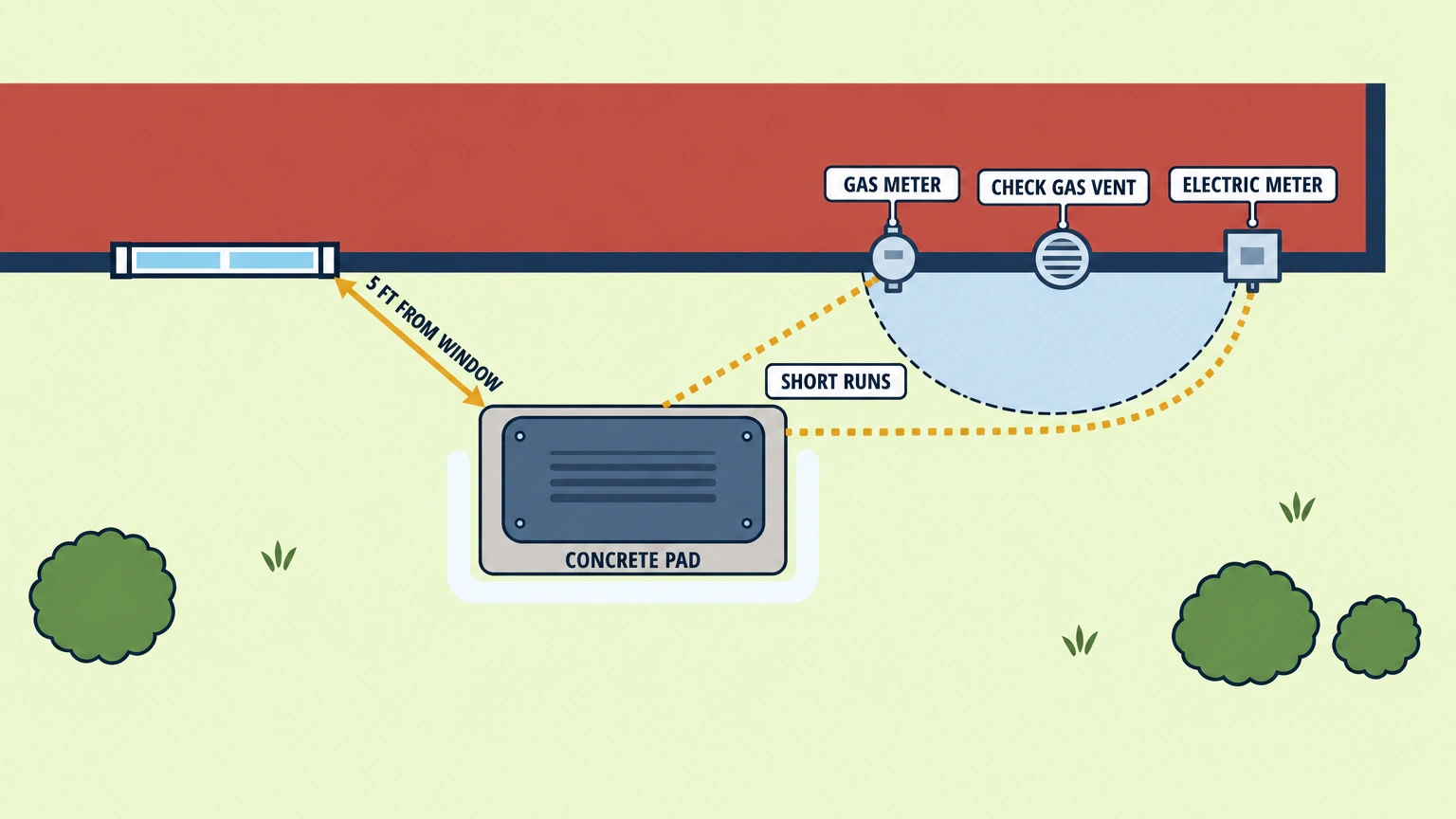
The rules come from NFPA 37, the National Fire Protection Association's standard for stationary generators, as Generac and Pinal County state it. Keep the generator at least 5 feet from windows, doors, vents and any other opening in the wall. A unit tested by the Southwest Research Institute and carrying its logo can sit with its back 18 inches from the wall. Keep 3 feet clear at the front and both ends, shrubs included, and 5 feet clear above. Never put it under a wooden deck.
The gas meter brings spacing of its own. Pinal County wants the generator 5 feet from the vent of any gas regulator, the fitting that steps gas pressure down, unless that vent is piped away. It wants 10 feet from a propane tank's fill or vent valve. Generac's help center points to its installation manuals for the distance from the gas meter.
Carbon monoxide is the part the clearances don't settle. Generac warns that a unit installed to the NFPA minimums "may still allow CO to enter the structure" through openings like a dryer vent, a basement window or cracks around pipes. It "may need to be installed farther from the structure than the NFPA requirements."
Now the money. Every extra foot from the house and meters means more pipe and wire. HomeGuide's table lists $12 to $25 a foot for gas line, but the same page's prose lists $15 to $50+ per linear foot. It lists $6 to $8 a foot for wiring. With wiring included, a unit 60 feet from the meters instead of 10 adds $900 to $1,650 on the table's gas-line range. With the prose range, it adds $1,050 to $2,900+.
Generac rates its 26 kW at 67 dB(A) at 23 feet running at normal load, and HOAs and local zoning can add setbacks of their own. If your pad is a poured slab, concrete contractors do that work.
Permits and approvals before it can run
Expect a permit, and check whether the gas line needs its own. We read the generator checklists from three building departments. Pinal County, Arizona, asks for a site plan showing the gas pipe's size, material and length, plus an electrical design and approvals from the electric and gas utilities. It puts gas lines on a separate permit when they fall outside the contractor's license. Auburn, California, wants a "Load calculation demonstrating back-up power does not exceed the capacity of the generator." Contra Costa County, California, wants a site plan showing at least 5 feet to building openings. That's three jurisdictions, not a national rule, so your own city or county checklist decides.
Plan for the calendar, too. Generac says the install itself usually takes hours, "but the process of preparing for it takes multiple weeks." If you've wondered whether you could wire it yourself, your state's licensing law answers that, and Generac notes most jurisdictions still want a permit and an inspection.
Before you sign a generator quote, make sure it shows:
- The generator's model number and its rated output on the fuel you'll actually use. On natural gas, that's the lower rating.
- The transfer switch: whole house or limited circuit, automatic or manual, and its amp rating. This is where two quotes quietly differ.
- For a whole house automatic switch, a load calculation, plus a load manager for anything the generator can't carry on its own. Ask to see the numbers.
- The gas run's pipe size and length, and who is asking your gas utility about the meter. Get a name and a date.
- For propane, the tank size in gallons, who owns the tank, and whether the first fill is included. A 500-gallon tank holds about 400.
- The pad, trenching, permit fees and inspections listed as included, not left to you. Anything missing becomes your bill.
- A site sketch with the unit's distance to windows, doors, vents and any propane tank valve. Five feet from openings is the minimum.
- Startup, warranty registration, and who handles warranty repairs and the first maintenance visit. Generac's warranty requires registration and proof of maintenance.
With each quote itemized this way, you can put two quotes side by side and see where the money differs.
What it costs to keep it ready: maintenance and warranty
A standby generator starts itself on a schedule to exercise, and it needs regular service. Generac's owner's manual for its 10 to 26 kW air-cooled line calls for an oil and filter change after the first 25 hours of running. After that come two schedules, one every two years or 200 hours and one every four years or 400 hours. Below 40°F, or running nonstop above 85°F, the oil change moves to every year or 100 hours.
Generac's standard limited warranty runs five years or 2,000 hours, whichever comes first. Years one and two cover parts, labor and limited travel. Year three covers parts only. Years four and five cover only major components, the engine's short block and the alternator.
Read the fine print. The unit has to be registered, repairs go through an independent authorized service dealer, and you must be able to show proof of all required maintenance. So set up a maintenance agreement at the manual's intervals and keep every receipt. The warranty also excludes failures from "improper installation, improper sizing," which makes the sizing fight with your installer a warranty fight, too.
Is a whole home generator worth it?
EIA's numbers are a sober place to start. The average US customer went 11 hours without power in 2024, nearly twice the average of the decade before. Ordinary outages account for only about two hours a year. Major events like Hurricanes Beryl, Helene and Milton accounted for 80 percent of 2024's hours, and South Carolina customers averaged nearly 53.
For some houses the answer is plainly yes: a house on a well, one with a sump pump, medical equipment or a home office that can't go dark, or one where a winter outage means frozen pipes. If that last one is yours, it's worth knowing how cold it has to get before pipes freeze.
A battery system is the other route, and it isn't the cheap one. Angi and HomeAdvisor both put whole-home battery backup at $10,000 to $25,000 for the unit. On taxes, there's no federal credit for a standby generator, and the federal battery credit ended after 2025.
If you're buying, get two quotes that each name the model, the switch and the load calculation. Then hold both to the checklist before you sign anything.
Frequently asked questions
How much is a generator for a 2,000 sq ft house?
Expect something inside Generac's $8,000 to $16,000 installed range, with the size deciding where you land. Generac's guide puts that house at 18 to 22 kW in one place and 20 or 22 kW in its own FAQ. HomeGuide prices 17 to 20 kW units at $4,000 to $6,000 before installation. Gas heat and one AC push you toward the low end. A heat pump, a well or an EV charger push you up.
How much does it cost to run a whole house generator per day?
For Generac's 26 kW unit at national average prices, it's $62.99 to $111.57 a day on natural gas and $132.20 to $232.96 on propane, from half load to full. Your own rate is the better input: multiply it by the day's burn, 4,512 to 7,992 cubic feet of gas or about 49 to 87 gallons of propane.
How long will a 500 gallon propane tank run a whole house generator?
About 8.1 days at half load and 4.6 days at full load for Generac's 26 kW unit. A 500-gallon tank only holds about 400 gallons, because suppliers fill to 80 percent to leave room for expansion. A smaller generator or a lighter load stretches that. A 250-gallon tank, Generac's minimum, lasts about 4 days at half load and 2.3 at full.
How close can a generator be to a house?
The back of a unit labeled for it can sit 18 inches from the wall, but it still has to be at least 5 feet from any window, door or vent, with 3 feet clear at the front and ends. Units without that label need more room. Generac warns carbon monoxide can still get in at the minimums, so yours may need to go farther out. Local code has the last word.
Do you need a permit for a whole house generator?
Yes. Check whether the gas line needs its own permit too. All three building departments we checked, Pinal County in Arizona and Auburn and Contra Costa County in California, want a permit with a site plan. Pinal County also wants approval from the electric and gas utilities. Your installer should pull the permits and list the fees on the quote.
Is there a tax credit for a whole house generator?
No federal one. Section 25D's list of qualifying equipment has no engine-driven generator on it, and that credit ended for spending after 2025 anyway. IRS Publication 502 allows special equipment installed mainly for medical care to count as a medical expense, reduced by any rise in the home's value. It does not name standby generators. Ask a tax preparer whether your installation qualifies.
How long does it take to install a whole house generator?
The install itself usually takes hours. The preparation takes "multiple weeks," Generac says, between dealer availability, gas line work and the permit. A gas meter upgrade can take longer: National Grid's New York City load form says to allow at least 14 weeks for BTU increases. Start pricing before storm season, not after the first long outage.
Can a generator be too big for a house?
Yes, in money. Generac's own sizing guide says it outright: "Oversizing a generator means overpaying at purchase and every time it runs." The right size is the number your load calculation gives, with load managers handling the peaks. Bigger isn't safer when a smaller unit plus managers will carry your house.