

On this page
- The short answer, and why one number can't give it to you
- What a year of pest control actually costs, four ways
- Cost by pest, and the one line where the big price guides disagree
- What actually moves your price
- The contract is part of the price
- Check the license before you agree on the price
- When a plan earns its money, and when it doesn't
- Frequently asked questions
The short answer, and why one number can't give it to you
One price can't answer the question unless it says what you're buying. A one-time visit is $100 to $600. An initial treatment, the larger first service that starts a plan, is $150 to $300. A year of that plan is $450 to $1,500. Three products wearing one question.
The trap is the missing unit. Many published exterminator prices are per-visit numbers, and a per-visit number can't answer a question about a year. A monthly charge and a per-visit quote can describe the same plan. One tells you when you pay. The other tells you when the company comes.
Measure the year. It's the only frame in which two quotes compare.
What a year of pest control actually costs, four ways
HomeGuide lists four price-table shapes, and each produces a different year-one total. Each has a per-visit price, and the three ongoing shapes add a bigger first service before the plan starts. Every per-visit and initial-visit figure below is HomeGuide's published band, so the arithmetic stays inside one source.
| How it's sold | Visits in year one | Price per visit | Initial visit | What year one comes to |
|---|---|---|---|---|
| One-time treatment | 1 | $100 to $600 | None | $100 to $600 |
| Monthly plan | 12, plus the initial visit | $40 to $75 | $150 to $300 | $630 to $1,200 |
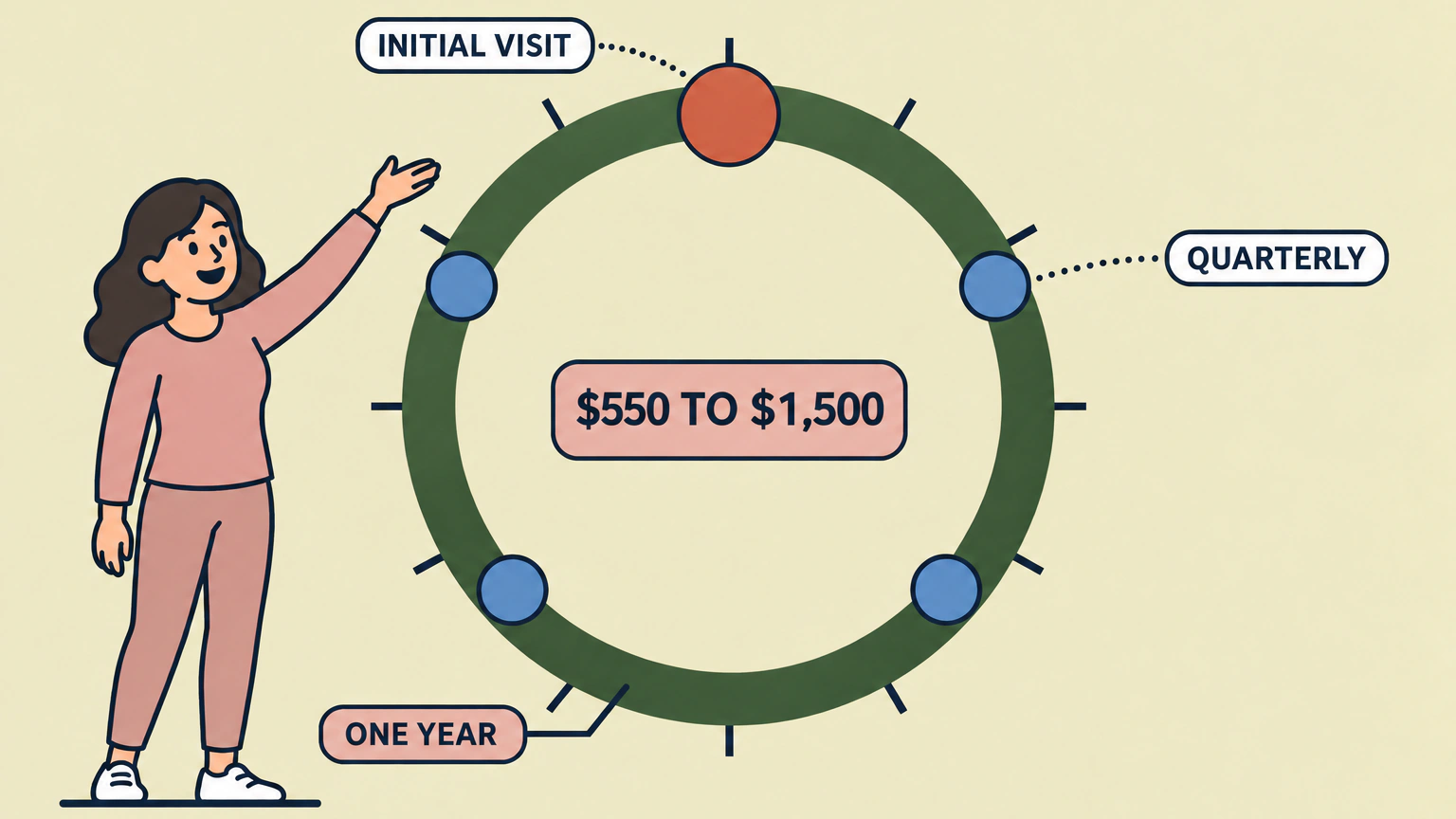
| Quarterly plan | 4, plus the initial visit | $100 to $300 | $150 to $300 | $550 to $1,500 |
| Annual plan | 1, plus the initial visit | $300 to $900 | $150 to $300 | $450 to $1,200 |
Per-visit and initial-visit figures are HomeGuide's published bands. The year-one column is those figures multiplied out.
Price a whole year and your instinct inverts. Monthly has the cheapest visit at $40 and the highest year-one floor of the three plans at $630. Annual has the dearest visit at $300 and the lowest floor at $450. Twelve cheap visits beat one expensive one only in the brochure.
The quarterly row holds the widest spread here: $550 to $1,500, a $950 range inside one product. One franchise's own page brackets the same territory, putting ongoing plans at $300 to $1,600 a year.
What "per month" usually means on a pest control plan
Monthly billing doesn't always mean monthly service. It's a payment schedule, and the visit count sits somewhere else in the agreement.
Terminix Triad, a franchise of a national brand, publishes its own terms: its plans "start at $42 per month (plus initial fees), totaling $468 for a one-year contract with three customized treatments." Read that twice. Twelve payments. Three treatments. That's $156 a visit, an ordinary quarterly price wearing a monthly label.
It isn't a trick. The company publishes its own terms. The trouble is what a shopper does with it: they set a $42 beside a $110 and think they've found a bargain.
So ask a different question. Not "what's the monthly?" but "how many treatments does the term include, and on what dates?" Get it written into the agreement. A plan that won't put a visit count in writing is selling a subscription, not a service.
Cost by pest, and the one line where the big price guides disagree
Two sources, side by side and deliberately not averaged, because the width between them is the point.
Our own numbers land in the same place from a third direction. Our cost profiles for this category put a typical pest control job at $113 to $276, averaging $177, across 886 profiles. That's our own aggregate rather than a market survey, and it prices to a location, not to the whole country. It sits inside the quarterly per-visit band below, and about three times the monthly one.
| Pest | One-time visit, HomeGuide | One-time visit, HomeAdvisor |
|---|---|---|
| Ants | $200 to $300 | $100 to $500 |
| Cockroaches | $100 to $600 | $100 to $600 |
| Mice and rats | $150 to $600 | $180 to $600 |
| Bed bugs | $300 to $500 per room | $1,000 to $4,000 whole home |
| Fleas | $200 to $400 | $100 to $400 |
| Spiders | $100 to $300 | $100 to $500 |
| Mosquitos | $350 to $1,000 per season | $350 to $500 per season |
| Whole-home termite tenting | $2,000 to $8,000 | $250 to $1,000 |
One row isn't a disagreement at all. Bed bugs read $300 to $500 per room against $1,000 to $4,000 whole home, which is two units rather than two opinions. A three-bedroom job at the per-room rate comes to $900 to $1,500, overlapping the whole-home band. The termite row is the real fight.
Whole-home termite tenting: two numbers, eight times apart
HomeGuide prices whole-home termite tenting at $2,000 to $8,000. HomeAdvisor's pest table prices the same job at $250 to $1,000. Eight times apart at the floor and eight times apart at the ceiling: $2,000 against $250, and $8,000 against $1,000. The same HomeAdvisor page separately prices fumigation, including whole-home fumigation, at $1,500 to $8,000.
Both are real published figures from real cost hubs, and we can't reconcile them. Here's what to do with a gap that size on a high-cost line.
Price the method, not the category. "Termite treatment" covers an exterior chemical barrier, a bait system and a full tent fumigation, and those aren't variations on one job. Get the scope in writing: which method, how much of the structure, how many square feet, and what happens if they find more than the inspection showed. Then get a second quote against that same scope.
On a number this large, a national average is the least useful figure anyone can hand you.
What actually moves your price
Those bands are wide. What decides where inside them your house lands is the pest, the house and where you live. Each one is a question to ask before a price gets agreed.
The pest, and how far in it has got
Method, species and infestation size all move the price. A trap-and-bait rodent job, a targeted chemical treatment for ants and a whole-home fumigation are three products with three floors. A lighter problem usually lands lower in the price band.
Ask for an inspection before relying on a firm price. The EPA says the company should inspect the site and outline the pest and proposed control program before it starts work.
One boundary before you dial. Raccoons, squirrels and bats belong elsewhere, because wildlife removal is a separate trade with its own licensing and prices. Our profiles put a typical job there at roughly double a pest control one.
Your home's size, and how much of it they treat
Home size can move the quote, and some published ranges assume a certain size. Ask which size yours assumes, and what the price does at 2,500 square feet, or 3,500.
Then ask how much of the house a visit covers. Does the quote cover the perimeter and entry points, the rooms where you've seen pests, or both?
Get the treated area written down. Square feet, perimeter, inside or outside, and which rooms.
Where you live, and when you call
Labor rates and pest pressure vary by location. Ask whether the quote changes with the season or whether the same schedule and price apply year round.
If it can't wait, it can't wait. A wasp nest by the back door in July isn't a pricing exercise.
The contract is part of the price
You aren't buying a visit. You're buying an agreement, and that's where the year-one number gets set.
Four lines in it decide what you pay. The term, meaning how long you're committed. The visit count inside that term. Whether a call-back between visits is free or billed. And the cost of leaving, which nobody reads until they want out.
We checked seven measurable price guides ranking on this question, and none explained those contract terms. They price the spray. The spray is the cheap part.
Red flag: Two things should stop the conversation at your door. First, if a salesperson asks you to hand-write, date and sign a statement describing an emergency, stop. That statement can remove your three-day right to cancel for that emergency sale. Second, if the pitch includes an ultrasonic pest repeller, treat the whole quote as sales rather than service. The FTC warned more than 60 manufacturers and retailers in 2001 that efficacy claims like those need scientific evidence behind them.
Your three business days, and the sales that don't get them
Federal law gives you three business days to cancel a sale of $25 or more made at your home. It's the FTC's Cooling-Off Rule.
It still covers you when you invited the salesperson in. A free inspection you booked, a contract signed at your own table. The FTC says so in as many words: the rule "also applies when you invite a salesperson to make a presentation in your home." If somebody knocked first, the same rules apply to anyone selling at your door.
It doesn't cover everything. A sale made after you finish negotiating at the company's permanent place of business is outside the rule. So is a sale conducted entirely by mail or telephone. An emergency is excluded only when you hand the seller a separate dated statement in your own handwriting describing the situation and giving up the three days.
Count the days properly. A business day is any calendar day except Sunday and federal holidays. Sign Friday afternoon and, if Monday and Tuesday aren't federal holidays, you have until Tuesday at midnight.
What the notice has to say, and what has to happen if you cancel
A right you can't prove is a right you don't have, so the rule tells the seller exactly what to hand you. Check your folder tonight.
Two completed copies of a cancellation notice, given to you when you sign. Not one. Both filled in with the seller's name and address and the sale date. Both carrying the deadline date, which the rule sets no earlier than the third business day after the transaction. The form's own wording is blunt: "You may CANCEL this transaction, without any Penalty or Obligation, within THREE BUSINESS DAYS from the above date."
The seller also has to tell you about the right out loud when you sign, and the rule bars the contract from waiving it.
Cancel in time and the seller has 10 business days from receiving your notice to refund everything. If those two copies weren't in your folder, say so in writing when you cancel and keep proof of what you sent.
Getting out after the three days are up
After the federal window closes, the agreement and state law govern cancellation. That's why the agreement matters more than the monthly figure.
So read three lines before you sign. The term, because a plan that renews on its own is one you have to remember to stop. The renewal clause, because it tells you how much notice you owe and in what form. And the early-termination fee, in dollars, because that's the real price of changing your mind. Ask for the cancellation procedure in writing too. A company that will email it has told you something useful.
One honest limit: state contract law sits on top of the federal rule and it varies, so nothing here is a ruling on your particular agreement. If there's real money in it, take the paperwork to your state consumer protection office rather than to a search engine. Complaints about pesticide use go to your state pesticide regulator.
Check the license before you agree on the price
Pest control licensing comes from state or local agencies, not the federal government. Many states route it through agriculture departments, while California uses a consumer-affairs board. The credential may be called an applicator, operator, technician or business license.
The EPA's own consumer sheet is plain. Most state or local agencies issue pest control licenses, and you should make sure the operator's license is current if your state requires one. It adds a sharper line: don't rely on the company salesperson.
Six states, and where each one routes it.
| State | Who licenses it, and what the credential is called | Where to look a company up |
|---|---|---|
| California | Structural Pest Control Board, part of the Department of Consumer Affairs; company registration plus operator and field representative licenses | The board's own license search |
| Florida | Department of Agriculture and Consumer Services, under the Structural Pest Control Act, Chapter 482; pest control business license plus a certified operator | The AES licensing portal's pest control business license report |
| Texas | Department of Agriculture, Structural Pest Control Service; business license, certified applicator license, apprentice registration | The department's downloadable Commercial Business Licensed Report |
| Georgia | Department of Agriculture, Structural Pest Control; company license, certified operator, registered employees | The department's structural pest control search |
| Illinois | Department of Public Health, Structural Pest Control Program; commercial business license plus certified technician | The department's Pest Control Business Search |
| North Carolina | Department of Agriculture and Consumer Services, Structural Pest Control and Pesticides Division; structural pest control license, certified applicator and registered technician | The division's credential search |
For the other 44, start with EPA's pesticide state lead agency route. Search that agency's site for "structural pest control," "license search" or "applicator." If the search is down, call the agency.
Now our own limit, plainly. Every company we list has cleared our checks, and we publish what those checks cover. It's a screen, not the state's record. Start with pest control companies we've vetted near you, then look yours up on the state's own site before anybody comes out.
Six things to settle before you sign
Have this conversation before you agree on a price, not after. Most of it comes from the EPA's own consumer guidance, the rest from the four contract lines that set your year-one number.
- The visit count, in writing. Not the monthly figure. Ask how many treatments the term includes and what the date of each one is.
- What happens between visits. Ask whether call-backs between scheduled treatments are included at no charge, and get the answer in the agreement rather than from the salesperson.
- The term and the renewal. Ask how long the agreement runs, whether it renews automatically, and what notice you have to give to stop it.
- The cost of leaving. Ask for the early-termination figure in dollars. A plan that won't quote one is a plan you can't price.
- The license, checked yourself. Look the company up on the state's own record before the visit, not after. A directory listing is a screen, not a state license.
- What's going on your property, and what the label says. Ask which product will be applied and to see the label, including its directions and precautionary warnings.
That last one has federal law behind it. Using a registered pesticide in a way its label doesn't allow is illegal. The label is the rulebook the applicator works under, and you can ask to read it.
When a plan earns its money, and when it doesn't
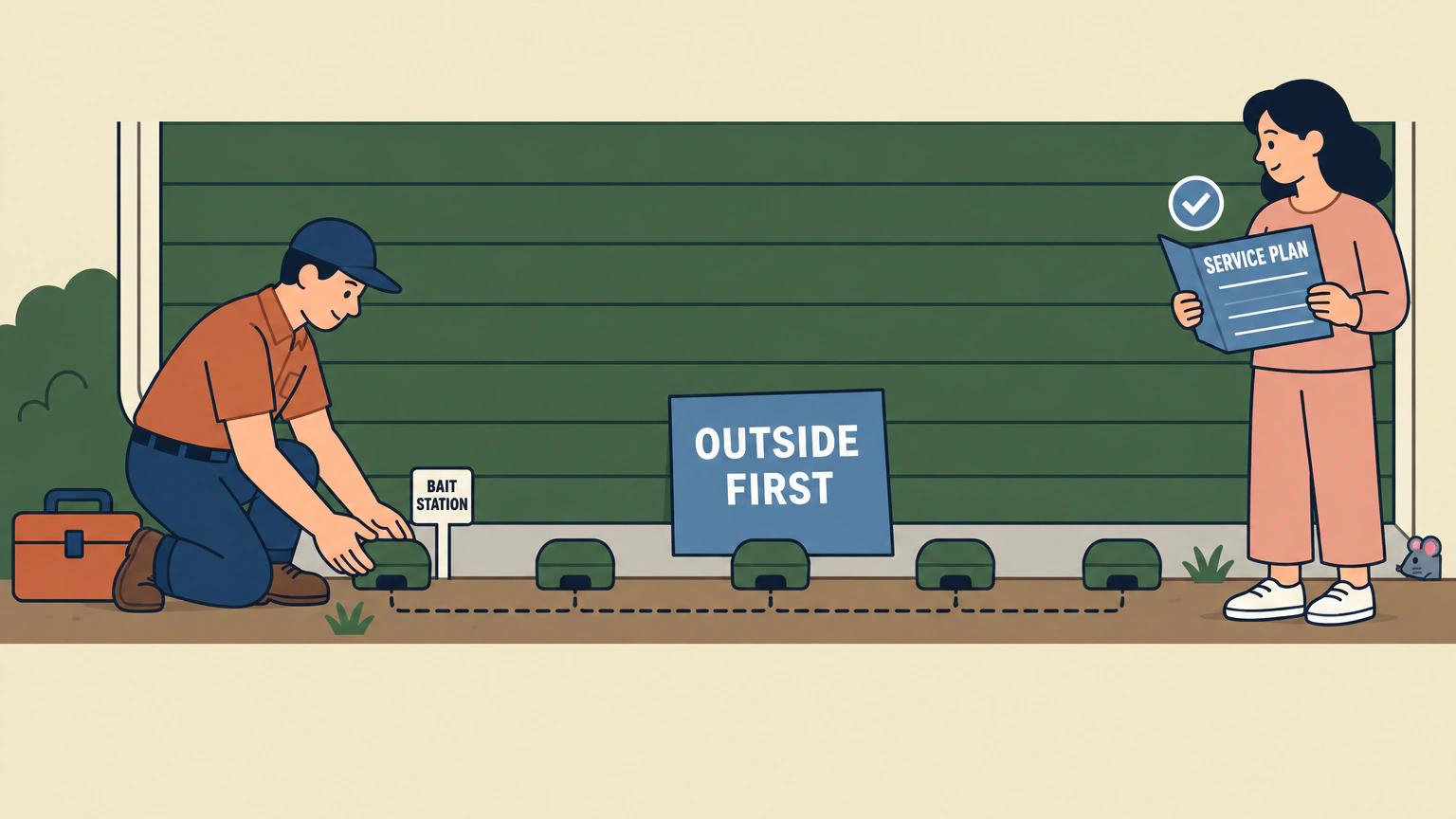
A plan earns its money under three conditions, and all three have to hold. The pressure has to be continuous: a field behind the house, a warm climate, or the same problem coming back. Someone has to actually show up. And the work has to happen outside.
Those locked boxes along your foundation are bait stations. EPA says protection varies by product: some resist tampering by young children and dogs, while others must be kept where children and pets cannot reach them. Refillable stations need new bait after the old bait is consumed or contaminated.
Here's the part the price guides leave out. The durable half of rodent control is sealing the gaps. CDC says a mouse can fit through a 1/4-inch hole, about the width of a pencil. Fill small holes with steel wool and hold it in place with caulk or spray foam. Larger holes need metal, cement or hardware cloth. If you don't want to do it yourself, a handyman can seal most of them.
So it's the same question a home warranty asks, and the answer turns on sequence. A plan on a sealed house is worth real money. A plan instead of sealing it is a standing order to come back and find the same holes.
Seal first. Then take two quotes on what's left, from companies whose license you can check or anywhere else, and hold both against the year, not the visit.
Frequently asked questions
Short answers to the questions people actually type.
Can I cancel a pest control contract after I've signed it?
Yes, if the sale falls under the rule and you signed at home for $25 or more. The FTC's Cooling-Off Rule gives you three business days, and it holds even when you invited the salesperson in. It doesn't cover a sale conducted entirely by phone or mail, or one made after you finish negotiating at the company's permanent office. After that federal window, the agreement and state law govern cancellation, so read the term, renewal clause and early-termination fee.
How much should pest control cost per month?
On a monthly plan, $40 to $75 a visit. But monthly billing doesn't always mean monthly service. One franchise page publishes plans at $42 a month that deliver three treatments a year, which works out to $156 a treatment. The number worth comparing is the year, and year one runs about $450 to $1,500 across the common plan shapes.
Do pest control prices include follow-up visits?
Sometimes, and it's the question that separates two plans quoted at the same price. Some agreements include free call-backs between scheduled treatments. Others bill for every return. Ask outright what a visit between services costs, then get the answer written into the agreement. Compare the total annual price and included return visits, not the scheduled-visit price alone.
How often should pest control come to your house?
There is no single schedule for every house. HomeAdvisor says frequency depends on the pest and location. A one-off job may need one visit, while ongoing ant or rodent problems may call for quarterly or monthly service. Ask why the proposed cadence fits your house, local pest pressure and the contract.
Is a pest inspection really free?
It can be. Ask what you'll receive in writing before you book: a finding of what they saw and where, the method they'd use, the area they'd treat, and a price. If all you get is a number and a contract to sign today, you got a pitch.
How do I check that a pest control company is licensed?
Through the state or local agency, not any directory. Start with EPA's pesticide state lead agency route, then search that agency for structural pest control licensing. Our own listing checks are a screen, not the state's record, so look the company up yourself first.