

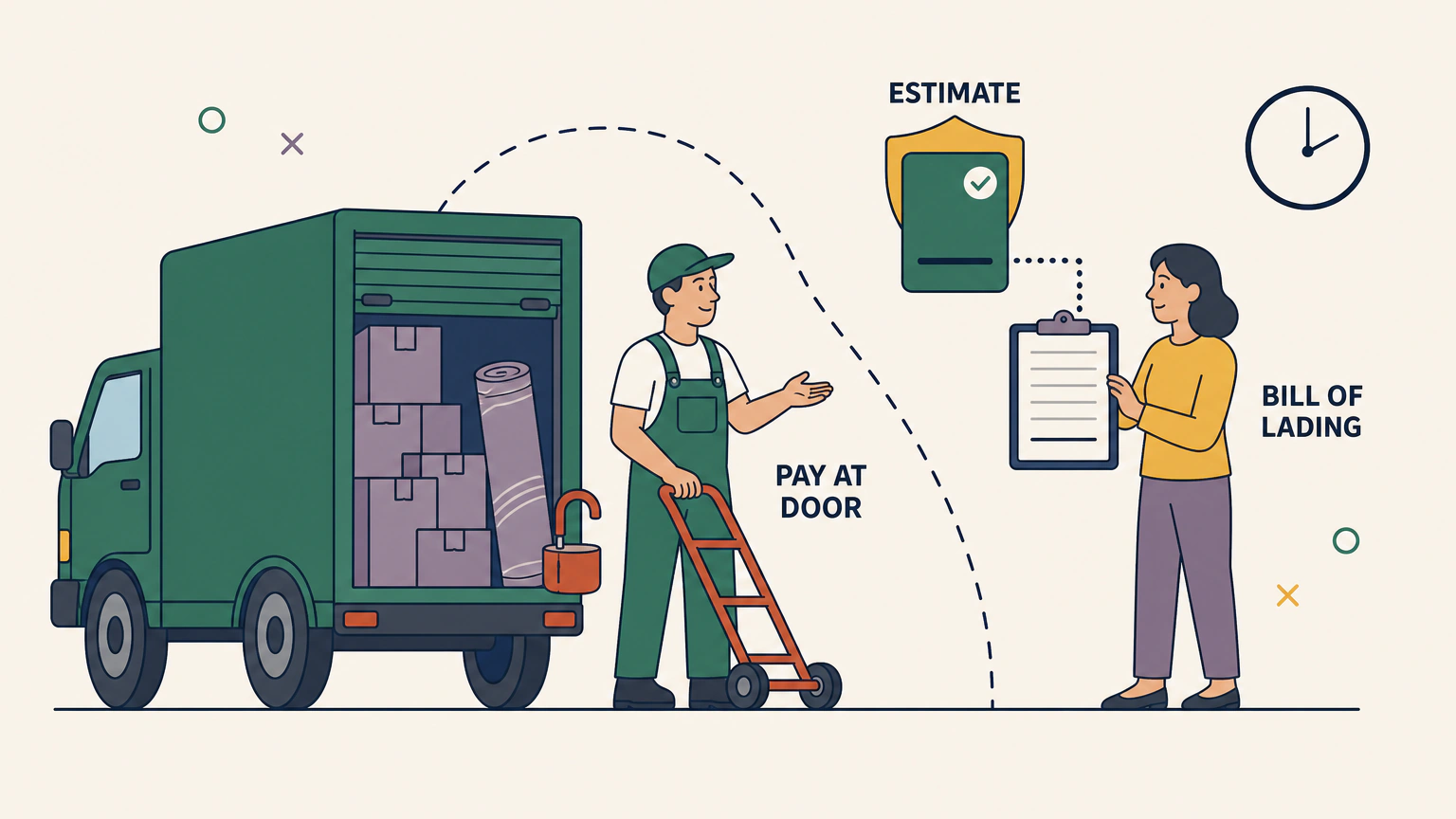
That ceiling is 49 CFR 375.703, and it isn't a courtesy. A moving company holding your stuff hostage after you've offered that amount is what 49 U.S.C. 14915 was written for. Work out your own figure below, then say it out loud.
On this page
- The most a mover can require at your door
- What happens to the rest of the bill
- Interstate or in-state? The answer changes the rule
- What to do in the next hour
- Where to complain, and in what order
- What federal law actually does to a mover who holds a load
- Booking the next move so this can't happen
- Frequently asked questions
The most a mover can require at your door
One number governs this moment, and it's built from paperwork you already have. Not from what the crew decided the job turned out to be, and not from a fuel surcharge invented in traffic. Find your estimate, because the kind you signed decides everything that follows.
What you have to pay at the door
Interstate moves. Enter what you signed and what they are asking for.
How the bill splits
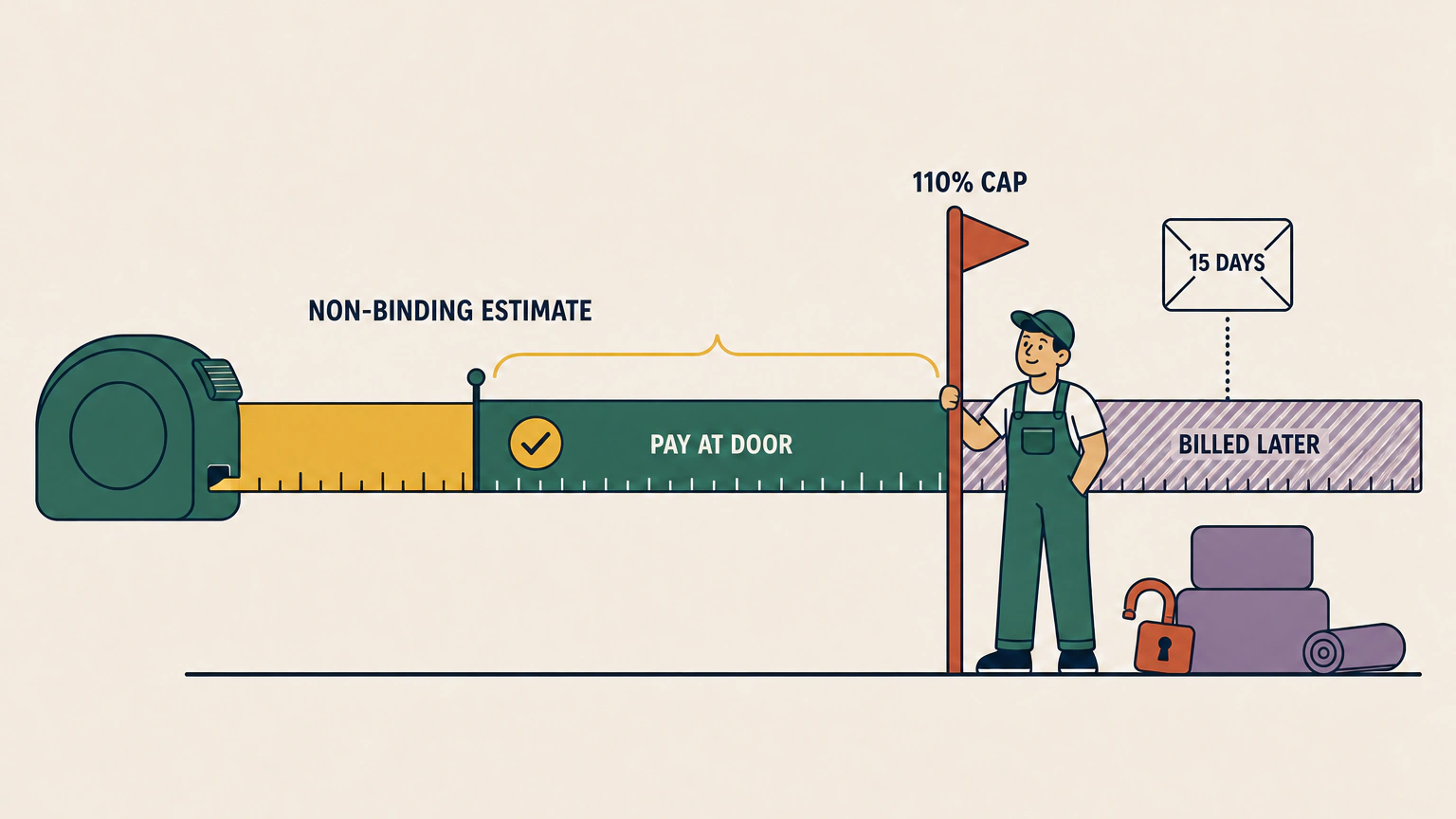
Worked example: a non-binding estimate of $3,200.
- Non-binding estimate$3,200
- 110% cap$3,520
- Pay at the door$3,520
- Billed laterAnything above $3,520
- Invoice for the balanceDue within 15 days of delivery, excluding Saturdays, Sundays and Federal holidays
Interstate moves only. If your move began and ended inside one state, your state sets the rule - see the state table below.
Enter an estimate amount to see your ceiling
The most they can require before unloading:
$3,520 for this delivery
- Estimate ceiling: $3,520 - 49 CFR 375.703
- Extra services you requested after signing: $0 - collectible in full
- Impracticable operations, capped at 15% of everything else: $0
$0 of the impracticable-operations charge cannot be collected at your door. It has to be invoiced to you within 15 days of delivery, excluding Saturdays, Sundays and Federal holidays (49 CFR 375.805, 375.807(a)).
Anything the final bill comes to above $3,520 gets invoiced later, not collected now.
If it was binding
$3,200
If it was non-binding
$3,520
The estimate itself says which it is. A binding estimate must state on its face that it is binding (49 CFR 375.403(a)(4)). A non-binding estimate must state on its face that you will not have to pay more than 110% of it at delivery (49 CFR 375.405(b)(5)).
More than one vehicle changes the calculation. Under 49 CFR 375.705, the carrier may wait for the entire shipment, collect the share of whole-shipment charges represented by this portion, or calculate this portion's charges if the whole shipment cannot yet be calculated. Ask which method the carrier is using and for its numbers in writing.
Interstate moves only. The federal rule is 49 CFR Part 375. General information, not legal advice.
If you signed a binding estimate
The maximum is the estimate. Exactly the estimate, with no drift for a job that ran long or a truck that turned out heavier than anyone guessed.
A binding estimate has to say on its face that it's binding on both of you, and that the charges cover only the services listed on it. That sentence is the whole purpose of the document. Once the shipment is loaded, a mover who never wrote up a new estimate has reaffirmed the original, and the original is the ceiling.
If you signed a non-binding estimate, and where the extra 10% comes from
A non-binding estimate is a guess, so the rule gives it a tolerance: 110% of the estimate at delivery, and not a dollar more. Final charges can legitimately land higher than the guess. They just can't be collected in your driveway.
The sentence you need is already printed on your own paperwork, and almost nobody tells a shipper that. A non-binding estimate has to state on its face that you will not be required to pay more than 110% of it at the time of delivery. Read it back to them.
The two things that can legally be added on top
Only two categories can sit on top of that ceiling, and each one comes with conditions.
The first is extra services you requested after the bill of lading was issued, after the mover told you the added charge and you agreed to it. On a binding estimate, the mover also has to prepare a new binding estimate you sign. That is different from a service the mover decides is necessary: the mover has to tell you before performing it and give you at least an hour to decide, and those carrier-initiated charges generally get billed after 30 days instead of collected at the door.
The second is impracticable operations, tariff language for the long carry, the stair carry, the shuttle truck, the elevator. This is the mechanism behind most driveway demands, and it carries a hard cap: 15% of all other charges due at delivery. Not 15% of your estimate. Fifteen percent of everything else on the bill that day, which is a far smaller number than the one being said at you.
When only part of your shipment shows up
If half your things are on a second truck somewhere, the mover can't demand the whole ceiling. On a non-binding estimate they may collect only the delivered weight's share of it, and the rule prints its own example: deliver 2,500 pounds of a 5,000-pound shipment, and 50% of not more than 110% of the estimate comes due. Binding estimates prorate by weight the same way. When a shipment genuinely travels on more than one vehicle, a separate section sets what may be collected at each stop, and it's fair to ask them to produce it in writing.
| What you signed | Maximum collectible at delivery | Billed later instead | Rule |
|---|---|---|---|
| Binding estimate | The exact estimate amount | Carrier-initiated additional services, and any impracticable-operations amount above the 15% cap | 49 CFR 375.403(a)(8)-(11), 375.703(a) |
| Non-binding estimate | Up to 110% of the estimate | The balance of final transportation charges above that base ceiling | 49 CFR 375.407(a), 375.703(b) |
| Extras requested after the bill of lading was issued | Collectible in full, on top, after the mover discloses the charge and you agree; a binding move also needs a new binding estimate you sign | Nothing from that agreed charge | 49 CFR 375.403(a)(9), 375.405(b)(10), 375.703(a)-(b) |
| Impracticable operations (long carry, stair carry, shuttle) | 15% of all other charges due at delivery | Any excess above that cap | 49 CFR 375.407(d), 375.703 |
| Partial delivery | The delivered weight's share of the binding estimate, or of up to 110% of a non-binding estimate | The rest, when the rest arrives | 49 CFR 375.403(a)(11), 375.407(c) |
What happens to the rest of the bill
The sentence that ends most standoffs is one hardly anyone says out loud: the mover doesn't lose the disputed money by unloading. They have to bill for it instead, on a clock, in writing. Unloading isn't a concession to you. It's the order of operations federal law already set for them.
The 15-day invoice clock
A carrier that hands over a collect-on-delivery shipment before being paid in full doesn't get to sit on the balance. Its invoice for all transportation charges has to be presented within 15 days of delivery, excluding Saturdays, Sundays and Federal holidays, and the uncollected part of an impracticable-operations charge travels the same route.
Roughly three weeks on a calendar, then. Not "sometime". If no invoice arrives, that silence is worth documenting too.
Seven days to pay, automatically extended to 30
The credit period is seven days, and this one counts weekends and holidays. Don't panic at that. Miss the seven days and you get an automatic extension to a total of 30 calendar days, which the carrier's tariff has to provide. The extension costs a service charge of 1% of the invoice, with a $20 minimum, for each 30-day stretch the charges go unpaid.
So the widely repeated "you have 30 days to pay" is two different rules mashed into one wrong one.
Interstate or in-state? The answer changes the rule
All of that comes from federal law, which reaches exactly one kind of move. Get this fork wrong and you'll lose an afternoon to an agency with no authority over your shipment.
How to tell which move you had
Crossing a state line at any point makes the move interstate, which puts it under the Federal Motor Carrier Safety Administration and 49 CFR Part 375. The Surface Transportation Board, which handles the tariff side of interstate moving, says plainly that hostage situations are FMCSA's territory.
A move that starts and ends inside one state belongs to that state instead, and the 110% rule doesn't apply to it. Some states are tougher than the federal rule, some are looser, and none are identical.
Three states, three different rules
We looked at three states closely, and the answers weren't variations on a theme. They were three different machines.
| Where the move happens | Who regulates it | The ceiling on your final bill | Where to complain |
|---|---|---|---|
| Across a state line | FMCSA, under 49 CFR Part 375 | The binding estimate exactly, or 110% of a non-binding estimate | FMCSA's National Consumer Complaint Database, through the protectyourmove.gov portal |
| Within California | Bureau of Household Goods and Services, Dept. of Consumer Affairs | A written "Not to Exceed" price is required on every household move; verbal and internet estimates are unlawful; a written estimate may follow only a visual inspection. The ceiling can rise for added services you request in a written Change Order, but not just because the mover underestimated the job | BHGS complaint form, online or by mail; loss or damage claims in writing within nine months of delivery |
| Within Washington | Utilities and Transportation Commission | The final cost may not exceed 125% of the written non-binding estimate, plus any supplemental estimates | UTC consumer help, or its illegal-mover line at 360-664-1121 |
| Within Florida | Dept. of Agriculture and Consumer Services, under Ch. 507, Fla. Stat. | Written estimate and contract signed or electronically acknowledged and dated by the shipper, mover and any broker; refusing an officer's release order is a third-degree felony after the officer finds the written amount plus any shipper-signed price amendments was tendered, or the mover cannot produce those signed documents on demand (Fla. Stat. 507.11(1)) | FDACS at 1-800-HELP-FLA (435-7352), or its online form |
Moved inside one of the other 47 states? Your authority is that state's public utilities or transportation commission, consumer affairs office, or attorney general. Search for the state's own household goods mover page rather than a third-party roundup, because those lists rot fast.
What to do in the next hour
You can work through all of it on a phone, outside, with people watching.
Document the demand before you argue it
Ten minutes with your phone now beats an hour of arguing.
- Photograph the truck, its license plate and its USDOT number.
- Photograph or screenshot the written estimate, front and back, including the sentence on its face saying whether it is binding.
- Photograph the bill of lading and write down its number. FMCSA asks you to upload the estimate, bill of lading and inventory with a complaint.
- Get the new demand in writing: a text message, an email, or a photo of the handwritten total.
- Note the date, the time, the address and the names of everyone present.
- Record the weight tickets if the move was priced by weight.
- Keep every deposit receipt and payment confirmation in one place.
- Write down what you offered to pay and when you offered it. The offer is what triggers the carrier's duty to relinquish.
Offer the lawful amount out loud, and in writing
Say the figure. Then text it, so there's a timestamp on it.
Something close to this works: "I'm offering $X right now. That's 110% of the non-binding estimate I signed, plus the agreed charges for services I asked for after the bill of lading and the allowed impracticable-operations amount. My estimate says on its face I won't be asked for more than 110% of the estimate at delivery. Anything above the lawful delivery amount, invoice me."
Two details make the offer stick. On a collect-on-delivery move your bill of lading is required to state the maximum the carrier will demand at delivery to get possession. And the carrier has to accept the form of payment agreed at the time of the estimate unless you agree in writing to change it. If a card was fine six weeks ago, a sudden cash-only rule is not a rule.
Pay in a form you can trace and dispute
A demand for cash, a money order, or an app transfer at the truck is a warning in itself. A credit-card payment can give you a federal billing-error route those payment methods do not, but a dispute is not automatic.
If you can pay by card under the payment terms you already agreed to, keep the receipt and contact the issuer quickly if the charge exceeded the written amount or the service was not delivered as agreed. To preserve the federal process, send the issuer a written billing-error notice within 60 days after the charge first appears on your statement, using its billing-inquiries address, and keep paying the part you do not dispute. The same discipline governs money that changes hands before loading day, which is the argument in how much to pay up front.
Where to complain, and in what order
Order matters here, and it isn't the satisfying order. For the federal route, start with the plain facts: a moving company is holding my stuff hostage on an interstate move. Have the estimate, bill of lading and inventory ready to upload.
FMCSA's National Consumer Complaint Database
FMCSA runs the federal complaint database for household goods moves, reachable through its protectyourmove.gov consumer portal. That portal also carries the agency's booklet "Your Rights and Responsibilities When You Move", which your mover had to give you with the estimate.
FMCSA uses complaints with other data to decide which companies to investigate; filing one is not a promise that the truck will turn around this afternoon. File anyway, with the estimate, bill of lading and inventory.
Your state's regulator
For an in-state move this is the only route there is. For an interstate move it runs in parallel and is still worth using, because a state consumer protection office can pursue a business practice that a federal safety agency handles differently.
Arbitration, and your card issuer
Every interstate household goods carrier has to run a neutral arbitration program and tell you it exists before the bill of lading is executed. It can't make you agree to arbitrate before there is a dispute. Arbitration is binding for claims of $10,000 or less if you request it, and the arbitrator has 60 days to decide. The carrier can't charge you more than half the cost of starting the proceeding. It covers loss and damage, and it covers disputes about charges beyond what was collected at delivery. People miss that second half.
Then your card issuer. Report the charge quickly and lead with the written estimate, the amount charged and the bill of lading. Federal billing-error rights generally require written notice within 60 days after the charge first appears on your statement, and the issuer still decides the dispute after investigating it.
What federal law actually does to a mover who holds a load
The law here is short, and it's widely repeated backwards.
The penalty is a floor, not a ceiling
A carrier that knowingly and willfully fails to deliver a household goods shipment after the shipper has tendered payment is liable to the United States for a civil penalty of not less than $10,000 for each violation, and each day the goods are withheld may count as its own violation. Inflation adjustment has since raised that minimum to $20,537 per violation. The government may assign all or part of it to the shipper it was taken from. The Secretary of Transportation may order the goods returned and may suspend the carrier's or broker's registration for 12 to 36 months, reaching any other company under the same ownership. A conviction carries a fine or up to two years in prison.
Two things people usually get wrong. First, the $10,000 figure is a statutory minimum per violation, not a daily maximum, and the adjusted figure is now more than double it. Anyone telling you a mover can be fined "up to $10,000 a day" has inverted both the number and your leverage. Second, the 15% ceiling is 15% of all other charges due at delivery, and it applies to impracticable operations specifically. It is not 15% of your estimate, and not a general allowance for whatever the mover left out of it.
Booking the next move so this can't happen
If you're reading this the night before loading day rather than at the curb, you're in the best position anyone gets. Almost every hostage situation traces back to a booking decision.
Check the USDOT number and the type of authority before you book
Look up the USDOT number and confirm two separate things: that the registration is active, and that the company holds household goods authority for the kind of move you're making. An active registration only means the paperwork is current. Complaint history is a separate check.
Insist on an in-home or video survey before anyone quotes you, too. A price given without seeing your basement is a price that will change. The habits that catch a fake mover are the ones that catch a fake roofer, so how to tell a real contractor from a storm chaser transfers directly.
Broker or carrier, and the four documents you should already have
A broker arranges your move. A carrier performs it. Brokers are legal and some are good, but money paid to a broker is not money the carrier has, and the truck that shows up may know nothing about the price you were quoted. A broker's estimate binds the carrier only where a written agreement adopts it as the carrier's own, and once it does, that carrier must still relinquish possession at 110% of a non-binding estimate.
Before a carrier executes a bill of lading it owes you four documents: a clear estimate of charges, notice that its tariff sections are available to read, a summary of its arbitration program, and a summary of how it handles complaints, including a phone number. Two DOT publications come with the estimate as well. Anything missing there is something you learned before your sofa was on a truck, which is the point of comparing estimates that don't match instead of picking the lowest number.
Signs you hired a broker, not a carrier. The estimate arrived without anyone seeing your belongings, so insist on a survey and a new written estimate. The name on the truck differs from the name on your paperwork, so get that carrier's USDOT number and check it before loading starts. The deposit went to a company that owns no trucks, so pay by card and keep the receipt. No bill of lading was issued before loading, so stop the load, because that document is required before the truck takes your shipment.
Weight and volume drive the price, so the cheapest way to stay inside an estimate is to ship less: junk removal companies and storage facilities both beat hauling things across the country twice. When you're ready, start with vetted movers in your area.
Frequently asked questions
Can movers legally hold your stuff hostage?
Not after you tender the lawful delivery amount. On an interstate move, that is the binding estimate amount, or its delivered-weight share for a partial delivery, or up to 110% of a non-binding estimate, plus agreed charges for extras you requested after the bill of lading and the allowed impracticable-operations charge. A knowing and willful refusal after that tender can carry a civil penalty of not less than $20,537 per violation, and each continuing day can count separately.
How long can movers hold your stuff?
Not past your lawful payment. The moment you tender the amount the rules allow, the duty to hand the shipment over attaches, and every further day of refusal can count as its own violation. A mover can lawfully put goods into storage when payment hasn't been tendered, and that is a different situation with its own notice rules.
How long does a moving company have to deliver, legally?
Federal rules require "reasonable dispatch" rather than a fixed number of days, unless you bought guaranteed pickup and delivery dates. Your bill of lading has to carry the agreed date or period for both. If those dates pass without your goods, that's a delay claim, separate from any argument about charges.
What if the moving company won't deliver at all?
Treat non-delivery as its own emergency. Document the last known location of your goods, file with FMCSA using your bill of lading number, and file with your state's consumer agency too. A carrier holding goods in storage in transit has to notify you in writing before that storage converts to permanent, and the notice trail is evidence.
Should I call the police?
Call, but expect most departments to treat it as a civil dispute. Two of the states we checked give officers a real role: in Florida, refusing an officer's release order is a third-degree felony after the officer finds you tendered the written estimate or contract amount plus any signed price amendments, or the mover cannot produce those signed documents on demand; in California, a peace officer may take custody of goods held by an unpermitted mover and release them to you.
How do I file a complaint against a moving company?
For an interstate move, file with FMCSA through the National Consumer Complaint Database, with your written estimate, bill of lading and inventory. For a move inside one state, file with that state's regulator instead. File both if you aren't sure which you had, and keep a copy of everything you send.
Can I dispute the charge on my credit card?
Possibly. A credit-card charge for the wrong amount or for services not accepted or delivered as agreed can qualify for the federal billing-error process. Contact the issuer quickly and send a written notice to its billing-inquiries address within 60 days after the charge first appears on your statement. Include the estimate, bill of lading and charged amount, and keep paying the part you do not dispute.
This is general information about federal and state moving rules, not legal advice. If your goods are being withheld right now, file with FMCSA and your state agency, and talk to a lawyer about anything you're being asked to sign.