

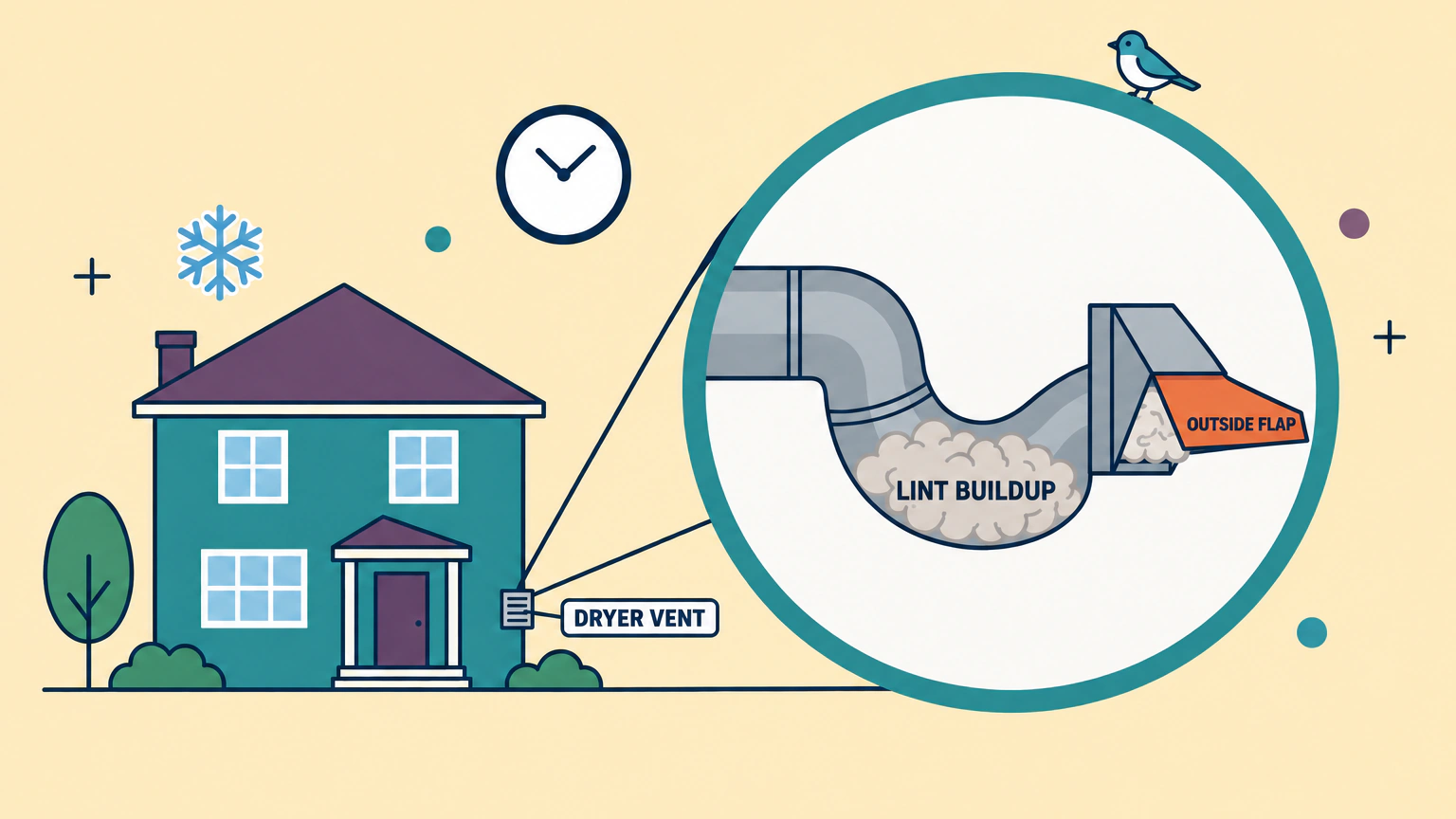
Maybe the towels need two cycles now, or a mailer is offering a cheap special on a vent nobody has looked at since the house was built, which is the usual arrangement. Either way, you want three things before you book: a fair price, a list of what the visit should cover, and a way to tell whether the vent itself is the problem.
On this page
What dryer vent cleaning costs
The $80 to $185 covers one vent leaving the house on the first or second floor. Five publishers print a price, and they aren't all counting the same thing.
| Who publishes it | The figure | What it counts |
|---|---|---|
| HomeGuide | $80 to $185 for a standard vent; $150 to $250 for a roof vent. Members' jobs average $130 | A standard cleaning; the average comes from 1,184 project costs its members reported, from $60 to $250 |
| Angi | $145 on average; $75 to $340 | A standard cleaning; where the vent exits moves the total |
| HomeAdvisor | $104 to $188 for most jobs; $145 on average | The same national figures as its sister site Angi |
| Homewyse | $171 to $392 per vent | An estimator's model for September 2026: basic labor and equipment, with a minimum labor charge built in |
| Brown Chimney, one company's price list | $249 standard; $449 premium | Standard: ground-floor wall exit, short straight run, cleaned recently. Premium: roof exit, a run over 25 feet, several bends, or three or more years since the last cleaning |
Angi and HomeAdvisor are one company, and HomeGuide's location bands match theirs. HomeGuide's member average is the only figure here with its own count of dryer vent jobs.
Three big names agreeing looks like corroboration, and it's a little less. The two sister sites print the same $145 average, and HomeGuide's prices by exit location match theirs to the dollar. Count two sources, not three.
Homewyse isn't a survey at all. It's an estimator's model with a minimum labor charge built in. Brown Chimney's two flat prices show the shape of real pricing better than any average: its $449 tier applies when any one of four things is true, and those triggers are the line items on your quote. It's one company's list, though, not a market rate.
What pushes the price up
A quote grows one line at a time. These are the lines the big dryer vent cleaning cost guides print.
| What's on the quote | Typical price | What to know |
|---|---|---|
| Basement or first-floor exit | $80 to $150 | The easiest access |
| Second-floor exit | $110 to $185 | Ladder work outside |
| Roof exit | $150 to $250 | Roof work; the cap must have no screen |
| Nest or packed clog removal | $120 to $250 with the cleaning | Angi prints $195 to $550 for the same bundle |
| Inspection only | $30 to $60 | Some companies waive it when you book a cleaning |
| New bird guard | $30 to $100 | A hood with a flap is fine; a mesh screen over the opening is not allowed |
| Reroute or new vent run | $200 to $500 | New work has to meet the length rules |
| Lint alarm | $170 to $250 | Warns you of a clog; it doesn't clear one |
| Booster fan | $150 to $400 | Only a power ventilator listed to UL 705 is allowed |
| Air ducts cleaned too | $340 to $800 for both | A separate system from the dryer vent |
Location bands, inspection, reroute and lint alarm: HomeGuide, Angi and HomeAdvisor print the same figures. Bird guard: HomeGuide and Angi. Nest removal: HomeGuide. Booster fan: Angi. Bundle: Angi and HomeGuide.
Three lines move a quote most. The exit comes first, and roof dryer vent cleaning cost sits highest because someone has to work up there. Next is what's inside: a nest or packed clog turns a cleaning into an extraction, and anything still living in the duct is a job for wildlife removal pros first. Third is a reroute, which is new work and has to meet the code's length limit.
Then come the add-ons, which is how a $145 job acquires a lint alarm, a fogging and a fan by the time the quote is printed. A "bird guard" can turn out to be a mesh screen over the hood, and the code is blunt: "Screens shall not be installed at the duct termination." A booster fan is legal only as a power ventilator listed to UL 705, meaning a testing organization lists it as meeting that standard. An air duct bundle cleans a different system.
What a proper cleaning should cover
Whirlpool's venting specification lays out the job. Disconnect the duct at the dryer and at the hood outside, clear the lint from the whole run, and clean the hood until its flap moves freely. Then reassemble it, run the dryer, and confirm the air comes out with no leaks.
A cleaning that only vacuums the connector behind the dryer hasn't cleaned the vent. It has cleaned the easy part. HomeGuide puts a real visit at 30 to 60 minutes for a short ground-floor vent, and up to two hours for heavy lint, a big blockage or a roof exit.
The inside of the dryer cabinet is a separate job. CPSC advises having "a qualified service person clean the interior of the dryer chassis periodically," so ask whether your cleaner does it. If not, call appliance repair pros.
The vent belongs to the trade that also cleans air ducts and sweeps chimneys, and you can compare vetted dryer vent cleaners near you on our list. Whoever you hire, check the work yourself. One term first: UL 2158A is the standard the code names for the connector behind the dryer.
Before the cleaner leaves, check these.
- They cleaned the whole run, from the back of the dryer to the hood outside, not just the connector.
- With the dryer running, the flap outside opens and you can feel air pushing out. With it off, the flap closes.
- Nothing covers the outside opening. No screen, no mesh guard.
- The connector behind the dryer is one piece, no longer than 8 feet, out in the open, and labeled UL 2158A. If it's white plastic or foil accordion, ask for metal.
- Where you can see the duct, no screw tip pokes more than 1/8 inch into it.
- They showed you the airflow before and after, or at least had you feel the difference at the hood.
- They told you how long the vent runs and how many turns it makes, so you can check it against 35 feet.
- If they recommend a booster fan, the box says UL 705.
Is your dryer vent too long?
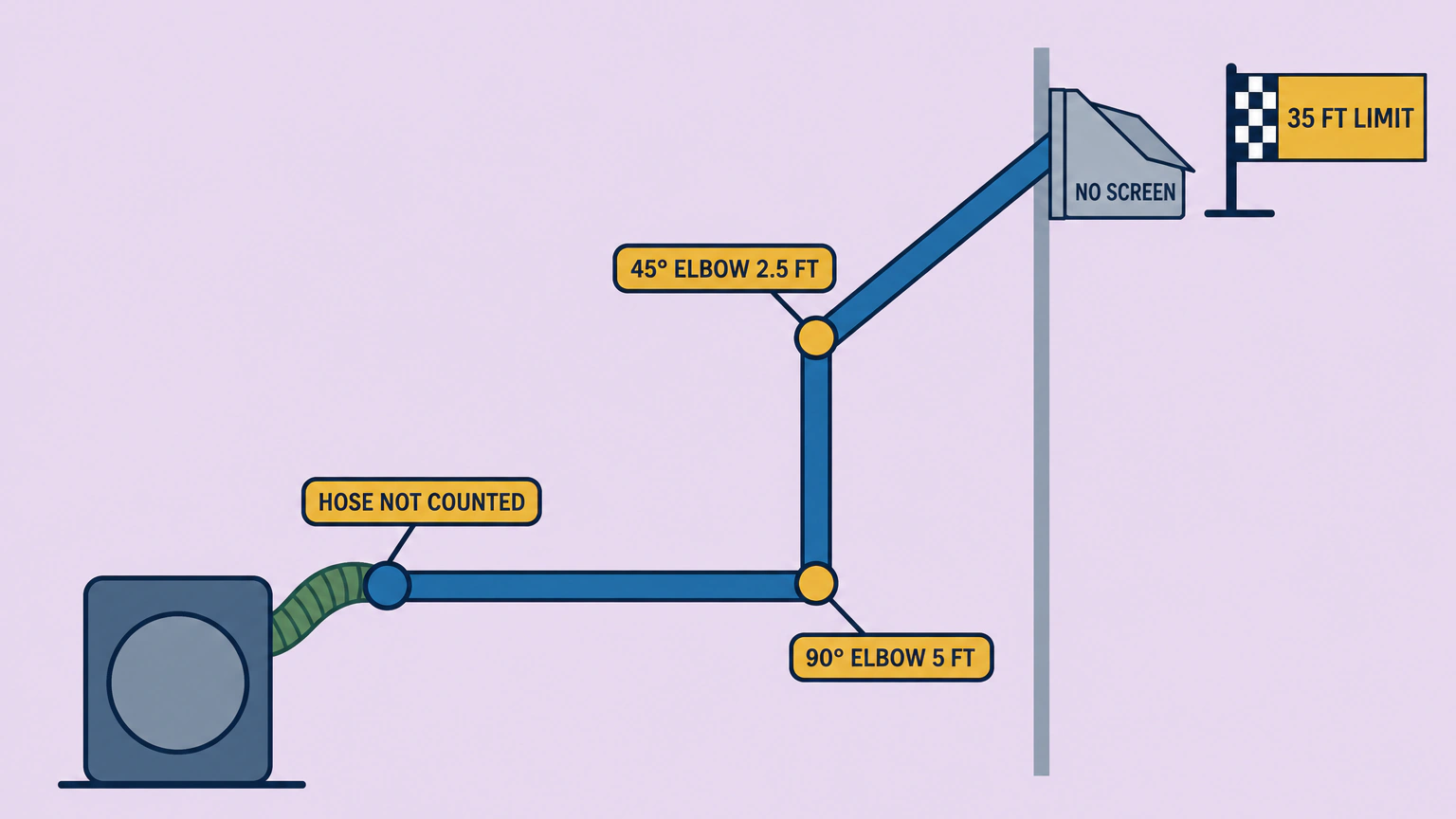
Stand at your dryer and picture the pipe behind the wall. The building code has an opinion about how long it can be: 35 feet, under the International Residential Code, which the International Code Council says is in use or adopted in 49 states. The count runs from where the connector behind the dryer joins the duct to the hood outside, and the connector itself isn't counted.
The code's own words: "The maximum length of the exhaust duct shall be 35 feet." You rarely get all 35, because every turn uses up some of that length.
| Elbow type | A 45-degree turn counts as | A 90-degree turn counts as |
|---|---|---|
| Mitered (sectioned) elbow, 4-inch radius | 2 ft 6 in | 5 ft |
| Smooth sweep, 6-inch radius | 1 ft | 1 ft 9 in |
| Smooth sweep, 8-inch radius | 1 ft | 1 ft 7 in |
| Smooth sweep, 10-inch radius | 9 in | 1 ft 6 in |
Start from 35 feet and subtract each turn. Two 4-inch-radius mitered 90s leave 25 feet of straight duct. The connector behind the dryer isn't counted.
Mitered is the code's word for the sectioned elbow, built from short angled rings, and it costs the most: 5 feet for every 90-degree turn. A smooth sweep with a 10-inch radius costs 1 foot 6 inches for the same turn, less than a third as much.
Add up your own vent here.
Dryer Vent Length Check
Start from 35 feet and subtract each turn. Two 4-inch-radius mitered 90s leave 25 feet of straight duct. The connector behind the dryer isn't counted.
The numbers filled in are an example: 22 feet of straight duct, two 90-degree turns and one 45-degree turn, all mitered.
Measure from where the connector behind the dryer meets the wall duct to the hood outside, and round up to the next foot. Don't count the connector. If part of the run is hidden, estimate it room by room, or ask your cleaner to measure it.
Count every right-angle bend, including one where the duct turns up through a roof.
Count the shallow half-turns separately.
Sectioned elbows have visible rings where the pieces join. If your turns are a mix, pick the type most of them are, or choose Not sure.
Your vent counts as 34 ft 6 in.
That's 6 in under the code's 35-foot default. Clean sooner if drying starts taking longer.
Each mitered 90-degree turn counts as 5 ft and each 45-degree turn as 2 ft 6 in. The connector behind the dryer isn't counted.
This follows the default method in the International Residential Code. Your dryer's manual, or your local code, can set a different limit.
The limit isn't only paperwork. Long runs and tight turns slow the air, and Whirlpool's venting specification calls for at least 1,200 feet per minute of air speed "to keep lint moving through the vent." So a vent near or over 35 feet tends to clog sooner, and the cost guides already charge more to clean long runs with many turns. You pay for the extra feet twice.
When your dryer's manual allows a longer run
The code offers a second route: the dryer maker's installation instructions can set the length and number of turns instead, and for new work the code official gets a copy. Whirlpool's 2011 engineering guide shows how far that goes. Its models' maximum rated vent lengths run from 36 or 37 feet to 130 feet with no 90-degree elbows. Whirlpool says every dryer covered still moves at least 105 cubic feet of air a minute at that length.
The manual's arithmetic isn't the code's, though. Where a model's chart doesn't cover your number of elbows, Whirlpool takes off 10 feet for each extra 90 and 6 for each extra 45. So find the installation instructions for your exact model.
Past 35 feet of counted length, the code also wants a permanent label or tag within 6 feet of the duct connection, stating that length. A long vent with no label is worth asking about.
Booster fans, and the only kind the code allows
A fan in the duct sounds like the easy fix for a long run, and the code allows exactly one kind. Its 2021 and 2024 editions permit a "dryer exhaust duct power ventilator" that conforms to UL 705 and is installed to its maker's instructions, which then set the duct's length. They add a flat sentence: "Domestic booster fans shall not be installed in dryer exhaust systems." The 2015 edition already held power ventilators to UL 705. Angi prices a booster fan at $150 to $400, so ask to see the listing on the box before anyone mounts one.
Red flag: Two add-ons to question on any quote: a booster fan that doesn't name UL 705 on the box, and a bird guard that's really a wire screen over the hood. The code bans both. Ask for the listing, or skip the add-on.
If your vent is over the limit
A long vent in an existing house isn't automatically a violation: the 2024 code lets a building's legal occupancy "continue without change" unless the codes or the building official say otherwise. But additions, alterations and repairs have to meet the rules for new work.
Try the fixes in order. Check the dryer's manual. Shorten or straighten the duct: the three big cost guides put a reroute at $200 to $500 in their tables, and HomeGuide's text goes up to $800 for a new run. Swap tight elbows for smooth sweeps. Or fit a UL 705 power ventilator. A vent that packs up again within months of a cleaning may need the reroute, not another cleaning.
For a short run, look at handymen who take on small reroutes, and at what a handyman can legally take on in your state. Moving or rebuilding a dryer vent is building work. Your city or county's adopted code, and its inspector, have the final word.
A listed and labeled condensing (ductless) dryer is exempt from the code's independent-exhaust requirement.
How often your dryer vent needs cleaning
NFPA's tip sheet sets the schedule: "Once a year, or more often if you notice that it is taking longer than normal for your clothes to dry, clean lint out of the vent pipe or have a dryer lint removal service do it for you." Whirlpool's venting specification agrees: "For single-family usage, an annual inspection is recommended."
Some signs can't wait for the calendar. CPSC's list starts with clothes still damp after a normal cycle, or drying that takes longer than it used to, and Whirlpool adds a hot dryer top. CPSC says to check that air is escaping outside while the dryer runs, NFPA that the flap opens and, in winter, that snow isn't covering it.
The reason is on the record. In its 2008 to 2010 analysis, the U.S. Fire Administration estimated about 2,900 clothes dryer fires a year in residential buildings, along with 5 deaths, 100 injuries and $35 million in property loss. "Failure to clean" was the leading factor, at 34 percent then and 31 percent in the agency's 2018 to 2020 figures. Dust, fiber and lint were the first thing to ignite in 28 percent, and the fires peak in January.
Pro tip: A quick check: start a load, walk outside, and find the hood. You should see the flap open and feel a steady push of air. A weak push, a flap that barely moves, or lint around the hood means it's time, whatever the calendar says.
Dryer vent cleaning isn't air duct cleaning
Dryer duct cleaning, dryer air duct cleaning and dryer vent cleaning all mean the same 4-inch pipe. Air duct cleaning means your heating and cooling ducts, and the code keeps the two apart: dryer exhaust systems "shall be independent of all other systems and shall convey the moisture to the outdoors." So cleaning your air ducts does nothing for the dryer vent unless the company cleans that as its own line, and a dryer vent problem never calls for an air duct cleaning.
Air ducts alone run $270 to $490 on Angi's and HomeAdvisor's pages, a bundle of dryer vent and air duct cleaning $340 to $800, and the dryer vent alone $80 to $250. HomeGuide prices air ducts alone at $450 to $1,000, more than the bundle it prints, so read these as loose ranges. If you only need the dryer vent, book only that.
The companies that clean dryer vents often sweep chimneys too, which is why our category lists them together. If you have a fireplace, one fall visit can cover both, once you know which chimney inspection you actually need.
The parts you can clean yourself
Three parts of this are yours: the lint screen, the connector behind the dryer and the hood outside. Clean the screen before or after every load. CPSC and NFPA both put that on their lists. HomeGuide puts a brush kit at $15 to $50.
HomeAdvisor says a leaf blower "often pushes lint deeper into the vent or causes it to become more compacted, creating a worse clog." And if your connector is the plastic or foil accordion kind, CPSC's advice is to replace "plastic or foil, accordion-type ducting material with rigid or corrugated semi-rigid metal duct." That flexible kind kinks and crushes easily, so if the dryer was just moved, look behind it first.
Hire out the rest: a roof exit, a long run hidden in walls or ceilings, a clog you can't reach, anything with a nest. Dryer fires peak in January, so book before then, and ask the cleaner for two numbers while they're there: how long the vent runs and how many turns it makes.
Frequently asked questions
How often should dryer vents be cleaned?
Once a year is the standard answer. NFPA gives that schedule and says to go sooner if clothes are taking longer than normal to dry. Whirlpool recommends an annual inspection for a single-family home. We'd check a long run, or one with several turns, more often.
How do I know if my dryer vent is clogged?
Clothes come out damp after a normal cycle, or drying takes longer than it used to, which CPSC lists as a sign of a blocked duct. Whirlpool adds a hot dryer top. Outside, the flap stays shut while the dryer runs, or lint collects around the hood.
Can a clogged dryer vent cause a fire?
Yes. The U.S. Fire Administration estimated about 2,900 clothes dryer fires a year in residential buildings in its 2008 to 2010 analysis. "Failure to clean" was the leading factor at 34 percent (31 percent in its 2018 to 2020 figures), and dust, fiber and lint were the first thing to ignite in 28 percent.
How long does dryer vent cleaning take?
Plan on 30 to 60 minutes for a short ground-floor vent with easy access, by HomeGuide's figures. Heavy lint, a large blockage or a hard-to-reach vent can stretch the job to two hours, and roof exits sit at that longer end.
Does air duct cleaning include the dryer vent?
Not unless the company cleans it as a separate line. The building code requires dryer exhaust to be "independent of all other systems," so the dryer vent isn't part of your heating and cooling ductwork. Angi and HomeGuide price a bundle of both at $340 to $800. Make sure the dryer vent is on the quote by name.
Can you clean a dryer vent yourself?
Partly. The lint screen every load, the connector behind the dryer and the hood outside are homeowner jobs, and HomeGuide prices a brush kit at $15 to $50. Skip the leaf blower, which HomeAdvisor says often compacts the lint into a worse clog. Hire a pro for a roof exit, a long run hidden in walls, or a nest.
Should a dryer vent have a screen on it?
No. The International Residential Code says "Screens shall not be installed at the duct termination." It requires a backdraft damper instead, the flap that closes when the dryer stops, and its 2021 and 2024 editions want an opening of at least 12.5 square inches. A screen catches lint until the vent is blocked.
What happens if a dryer vent is longer than 35 feet?
It's allowed only two ways under the code: the dryer's installation manual permits that length and number of turns, or a power ventilator listed to UL 705 is fitted. The code also wants a permanent label within 6 feet of the connection stating the length. The code can allow an existing building's legal occupancy to continue, but additions, alterations and repairs have to comply.