

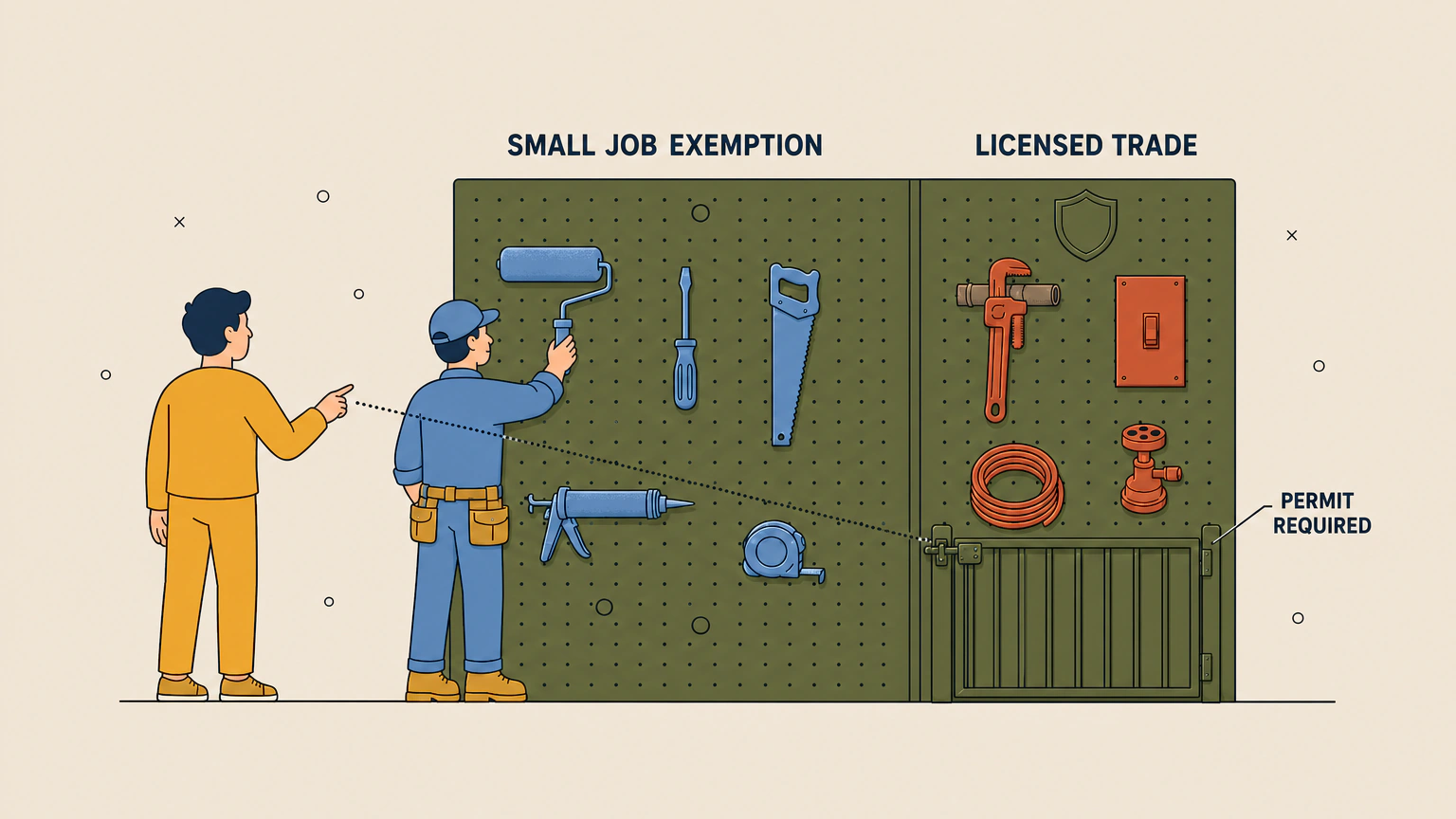
In eight of the ten places we checked, small work can fall under a contractor-license exemption, and in California, Arizona, Nevada and Oregon the line sits at $1,000, labor and materials together. But the dollar figure is only one part of the rule. A $400 job can still need a licensed contractor. California, Arizona and Nevada switch the exemption off when the work requires a building permit. California switches it off when the person employs someone to perform or help with the work. Nevada carves out plumbing, electrical, refrigeration, heating and air conditioning work, along with classifications that significantly affect health, safety or welfare.
On this page
- The short answer, and the part that trips people up
- The four questions that decide whether your handyman can take the job
- Where the line sits in the ten places we checked
- Why the dollar line is only a first pass
- What it costs you when the line gets crossed
- Ninety seconds of checking, before anyone starts
- Common questions
The short answer, and the part that trips people up
There's a number, and it's the thing everybody quotes. Then there's a short list of conditions underneath it that can switch the number off completely, whatever the price.
Most of the places we checked draw the line with a dollar figure
The number isn't a permission slip. It's a ceiling on an exemption.
There's no handyman chapter in any of these laws. In California the rule sits in the contractor law, in the article that lists who is exempt. It says the licensing chapter doesn't cover a job priced under $1,000, counting labor, materials and everything else. Arizona, Oregon, Washington and Florida build the sentence the same way, with their own number in the slot.
So what gets measured is the whole job, materials in. Not the labor line on the estimate, and not one person's share of a bigger project.
And every one of them hangs at least one more condition on it
Under each of those dollar figures sit a few more requirements, and any one of them ends the exemption on its own. Price, permit, helpers, trade. Four questions, in that order.
Which produces the result that surprises people: a $400 bathroom repair in California can require a licensed contractor, while a $2,400 fence in Florida can fall under the exemption if the work is casual, minor or inconsequential and is not part of a larger job.
None of the ten places we checked has a handyman license. "Handyman" is a job description, not a credential, so there's no register of handymen to search. What exists is a contractor license, plus exemptions that let some small work happen without one.
The four questions that decide whether your handyman can take the job
Ask these out loud, in this order, before anyone starts. They're the same four conditions that turn up statute after statute, phrased the way you'd say them at your own kitchen table.
What is the whole job worth, materials included
Add up everything: labor, materials, disposal, the trip to the supply house. That total is what the statute measures, and it's usually bigger than the number you were quoted.
Then there's the split, and every one of the seven dollar-figure rules we read closes that door. California, Arizona, Washington, Florida and New York City say it outright: the exemption goes if the work is part of a larger operation, or if the job was divided into contracts under the number to evade the rule. Oregon does it by arithmetic instead, adding up all of one person's contracts on the same structure or project. Nevada goes furthest and drops the exemption when the work is part of a project worth $500 or more.
So two invoices of $700 for one bathroom aren't two jobs. That's one $1,400 job, and in every one of those seven jurisdictions except Florida it's over the line.
Does the work need a building permit
This gate has nothing to do with price. California's exemption applies only where "the work or operation does not require a building permit." Arizona's falls away "in any case in which the performance of the work requires a local building permit." Nevada's does the same. A $300 job that needs a permit needs a licensed contractor in all three.
The building department decides that, not the contractor and not whoever tells you it's a simple swap. It's one phone call. If you're not sure, settle whether your job needs a permit at all before you compare estimates.
Is anybody helping them
California is the outlier among the dollar-limit rules here. Section 7048 says the exemption doesn't apply to a person who "employs another person to perform, or assist in performing, the work." One employed helper. That's the whole rule, and a $200 price doesn't save it.
The state's own contractor board puts it to consumers directly: "Before entering into any contract with an unlicensed individual for minor work, consumers should ensure the individual will not be using any workers and the project will not require any building permits."
So if two people pull up for a sub-$1,000 job in California and one is working for the other, the exemption is gone before anybody opens a toolbox.
Is it plumbing, electrical, gas or cooling work
Arizona and Nevada both write trade limits into their exemptions. Arizona excludes specified fire-safety mechanical, electrical and plumbing work, along with work that connects to natural gas, propane or another petroleum or gaseous fuel. Nevada's small-job rule falls away where the work "is of a type performed by a plumbing, electrical, refrigeration, heating or air-conditioning contractor," at any price.
A separate trade license can also sit on top of the contractor rule. Virginia requires a master tradesman license as a condition of licensing electrical, plumbing and HVAC contractors. Texas has no statewide license for general home repair: its licensing department's own list of regulated industries names electricians and air conditioning and refrigeration contractors, with no contractor entry beside them. The one dwelling exemption in the Texas electrician chapter runs to "a person who owns and resides in the dwelling," which covers you and not anyone you hire.
Check the separate trade-license rule before hiring licensed electrical contractors or licensed plumbing contractors.
Where the line sits in the ten places we checked
Ten jurisdictions, every cell read from the statute itself or from the regulator that runs it. Utah, Tennessee and New Jersey aren't in the table.
| Jurisdiction | The line for unlicensed work | What else has to be true | Authority |
|---|---|---|---|
| California | Under $1,000 total, labor and materials | Work must not require a building permit; may not employ anyone to perform or assist; may not advertise as licensed; no splitting a bigger job into sub-$1,000 contracts | Cal. Bus. & Prof. Code § 7048; CSLB bulletin #24-07 |
| Arizona | Under $1,000 total | Must be casual or minor; no local building permit; no larger operation or splitting; ads must say “not a licensed contractor”; excludes specified fire-safety mechanical, electrical and plumbing work and fuel-gas connections | A.R.S. § 32-1121(A)(14), (D) |
| Nevada | Under $1,000 including labor and materials | No permit; excludes five named trades and other Board classifications that significantly affect health, safety or welfare; not part of a project worth $500 or more | NRS 624.031(6) |
| Oregon | Under $1,000 total | Must be casual, minor or inconsequential; does not apply to anyone who advertises as a contractor | ORS 701.010(4) |
| Washington | Under $500 total | Must be casual, minor or inconsequential; no splitting a larger job; not for anyone who advertises as a contractor. Washington registers contractors rather than examining them | RCW 18.27.090(9) |
| Florida | Under $2,500 total | Must be casual, minor or inconsequential; no splitting; does not apply to anyone who advertises as a contractor | Fla. Stat. § 489.103(9) |
| Virginia | No general dollar exemption for contracting work | Anyone doing or offering contracting work must be licensed; the class depends on project value and 12-month totals. Electrical, plumbing and HVAC contractors also need a master tradesman license | Va. Code §§ 54.1-1100, 54.1-1103 |
| North Carolina | $40,000 or more needs a general contractor license | Below that there is no state general-contractor requirement; trade licensing is separate | N.C. Gen. Stat. § 87-1; NC Licensing Board for General Contractors |
| Maryland | No dollar line | A contractor license is required to perform or offer home improvement work at any price; selling requires a contractor or salesperson license. Counties and cities may not run their own licensing scheme, though they still run permits and inspections | Md. Code, Bus. Reg. §§ 8-101, 8-102, 8-601 |
| New York City | Under $200 total for covered home improvement | No larger operation or splitting; above the line, a DCWP Home Improvement Contractor license is required. New York State has no statewide home-improvement-contractor license | NYC Admin. Code §§ 20-386, 20-397(5); NYC DCWP consumer guidance |
The thousand dollar cluster, and why it is not one rule
Four states land on $1,000 and mean four different things by it.
California requires no permit and no employed helpers; the helper rule is unique among these four. Arizona adds the permit and anti-splitting conditions, an advertising disclosure and exclusions for specified fire-safety and fuel-gas work. Nevada adds the permit condition, five named trades, other safety-sensitive classifications and the $500 larger-project trigger. Oregon requires casual, minor or inconsequential work and denies the exemption to anyone advertising as a contractor.
California's number is also the one that moved. It was $500 until the start of 2025, when AB 2622 raised it to $1,000 and added the permit and employee conditions. The current rule makes those conditions as important as the new number: a permit or an employed helper still ends the exemption below $1,000.
If your job sits over the line, that's a call to a licensed general contractor instead.
Washington and Florida use very different lines
Washington's $500 is the lowest state-level figure in the table, so ordinary repair work can sit above it. Washington also registers contractors rather than examining them, so a registration tells you a bond and an insurance policy are on file, not that anyone tested this person's skill. Check for it anyway.
Florida's $2,500 is the highest small-job figure here. A second number sits in the same section, $5,000, and it isn't a handyman rule. That one belongs to a licensed real estate agent acting for an owner, and only where a licensed contractor does any work that needs one. If someone in Florida quotes you $5,000 as their limit, they've read the wrong subsection.
Four places that take different paths
Maryland has no threshold. A contractor license is required to act, or to offer to act, as a contractor on home improvement work at any price. Its counties and municipalities may not require their own business authorization or set their own qualifications for the work. They still run permits and inspections. They just don't run a competing license.
New York flips it. There's no statewide home-improvement-contractor license, so the rule is local, and in New York City it belongs to the Department of Consumer and Worker Protection: covered home improvement under $200 is exempt, while work at $200 or more needs a Home Improvement Contractor license unless another exception applies.
Virginia and North Carolina take different paths. Virginia requires a license for contracting work at any price; $1,000 is the lower edge of the Class C single-project band, not an exemption. North Carolina's general-contractor requirement starts at $40,000.
If your state is not in the table, find your own answer in about five minutes
Search the applicable licensing agency's name plus the word "exemptions." Then open the statute rather than a summary and read the licensing requirement, definitions and adjacent exemptions together.
Look for the aggregate price, anti-splitting language, advertising limits, permit and employee conditions, and any trade exclusions. Then read adjacent definitions and exceptions, because a dollar figure can sit beside conditions that change the result.
Then check your city, because a state rule tells you nothing about what your building department wants before it issues a permit.
Why the dollar line is only a first pass
Price is only a first pass.
What that means for the job you are actually hiring for
Ask handyman services near you for a written quote, including materials, then compare the whole job price with the applicable licensing rule.
Price alone does not settle the license question. Permit, helper and trade conditions can still end an exemption, and Virginia and Maryland do not provide a general dollar exemption for covered work. Check the permit first, then ask whether the person will employ anyone on site.
How we vet the pros we list describes our own checking and rating, not an independent third-party review.
What it costs you when the line gets crossed
Say it happened anyway, or you're weighing what you'd be risking. This is what happens if you hire an unlicensed contractor and it goes wrong.
In California you can ask for every dollar back
This is the part almost nobody tells homeowners.
California's Business and Professions Code section 7031 does three things at once. An unlicensed contractor may not "bring or maintain any action" in a California court to collect what you owe, so the unpaid invoice isn't enforceable against you. That settles whether an unlicensed contractor can sue you. It runs the other way too: you can sue to get back every dollar you already paid, regardless of the merits and regardless of how good the work was. Any security they took to cover that payment, including a lien on your house, can't be enforced.
There's a narrow escape hatch. A contractor who held a proper license before the work, acted in good faith to keep it and moved promptly to fix a lapse can ask a court to find substantial compliance. Someone never licensed in California at all cannot.
Florida lands somewhere similar: a contract signed by an unlicensed contractor is one that contractor can't enforce, by any route. Washington won't let an unregistered contractor sue for payment unless it can show it was registered when it signed.
None of it is automatic. Each one is something you or your lawyer raises when the bill or the lien turns up.
The quieter costs, your permit, your insurer and your closing
The money case is the loud one. Other costs can follow the property or the injury.
Work that needed a permit and never got one can leave the owner facing an inspection, a retroactive permit, corrective work or a resale disclosure, depending on local law. If that has already happened at your house, what it costs to legalize work that skipped the permit is the next thing to read.
Then there's the person on the ladder. When someone working at your house is hurt, who pays depends on workers' compensation, the insurance policies and state law.
Licensing rules change and a city can be stricter than its state. When real money or an insurance claim is riding on the answer, call the board and your building department before anyone signs.
Ninety seconds of checking, before anyone starts
Start with the documents and questions below.
- Ask for the price of the whole job, materials included, and write it down. That total, not the labor quote, is what the statute measures.
- Ask whether any part of the work needs a building permit, then confirm it with your city or county building department rather than with the person who wants the job.
- Ask whether the person will employ anyone to help on site. In California one employed helper ends the exemption on its own, whatever the price.
- Ask whether the job touches plumbing, electrical, gas, heating or cooling, because a separate trade license may apply.
- Look the name up in the applicable licensing agency's own search, using the legal business name printed on the estimate.
- If they advertise as licensed, ask for the license number and check it. Where the small-job rule restricts contractor advertising, a false licensing claim can also end the exemption.
- Ask for the certificate of insurance and read it before anyone climbs a ladder.
Red flag: four things that should slow you down, and what to do about each
"We can start today, no permit needed." The building department decides that, not the person holding the estimate. Call and ask.
An estimate that arrives as two or three contracts, each just under your state's number. Every dollar-figure statute we read closes that door. Ask for one contract for one job.
"Licensed and insured" on the truck, with no license number on the paperwork. Ask for the number and look it up before you agree to anything.
Cash only, or a deposit bigger than a tenth of the price. California's contractor board tells consumers a down payment should not exceed 10 percent of the contract price. Here's how much to pay up front.
What to ask when there is nothing to look up
When a person relies on a small-job exemption, there may be no license record for that work. Three things still exist.
The legal business name on the estimate, which is what you search a license database with. A written scope naming who does the work, so "my guy" doesn't quietly become three people on the day. And the certificate of insurance, which identifies policies but does not decide whether a specific injury is covered. Here's what to read on the certificate of insurance.
Then there's advertising. Five of the seven dollar-limit rules we read regulate it. Oregon, Washington and Florida deny the exemption to someone advertising as a contractor. California and Arizona let an unlicensed person advertise only with a disclosure that they are not licensed. So if the truck says licensed and the paperwork carries no number, one of those two is wrong.
Common questions
Can a handyman legally do electrical work?
Not on the strength of a small-job exemption alone. Arizona excludes specified fire-safety electrical work, and Nevada excludes work of the type an electrical contractor performs. A separate electrician law may also apply. Texas is the clean illustration: its electrician chapter exempts the owner who lives in the dwelling, not anyone that owner hires.
Can a handyman do plumbing work?
A low price does not settle it. Nevada writes plumbing into the list of trades that end its small-job exemption. Virginia requires a master tradesman license as a condition of licensing plumbing contractors. A separate plumbing law may still apply when a general small-job exemption does.
How do I check whether a handyman is licensed?
Take the legal business name printed on the estimate, not the name painted on the truck, and run it through the applicable licensing agency's own search. If the person relies on a small-job exemption, there may be no license record for that work, so also check the business name, a written scope naming who does the work, and the certificate of insurance.
Is it illegal to hire an unlicensed contractor?
That depends on the jurisdiction and the job. The ten contractor laws we checked focus their licensing penalties on the person doing the work, but that does not resolve every rule that may apply to the owner. California's contractor board lists administrative fines up to $15,000, jail up to six months and criminal fines up to $5,000 for unlicensed contracting. Separate permit and insurance questions remain for the owner.
Can a handyman pull a permit for my job?
In California, Arizona and Nevada the question answers itself. If the job needs a permit the small-job exemption is gone, so the work goes to a licensed contractor no matter who files the paperwork. Everywhere else, your building department decides who may file, not the state. Call them before you accept an estimate that assumes no permit.
What does it mean when a handyman says they are bonded?
Less than most people assume. In Washington, the bond is a limited sum available for certain claims against a registered contractor. It isn't liability insurance and it isn't a license. Washington's registration statute treats the bond and the insurance policy as separate requirements that both have to be in force. Bonded, insured and licensed are three different things.
If the job falls outside a small-job exemption or needs a separate trade license, that's a different phone call, not the end of your list. Get quotes from handyman services near you for exempt work, and a licensed trade for the rest.