

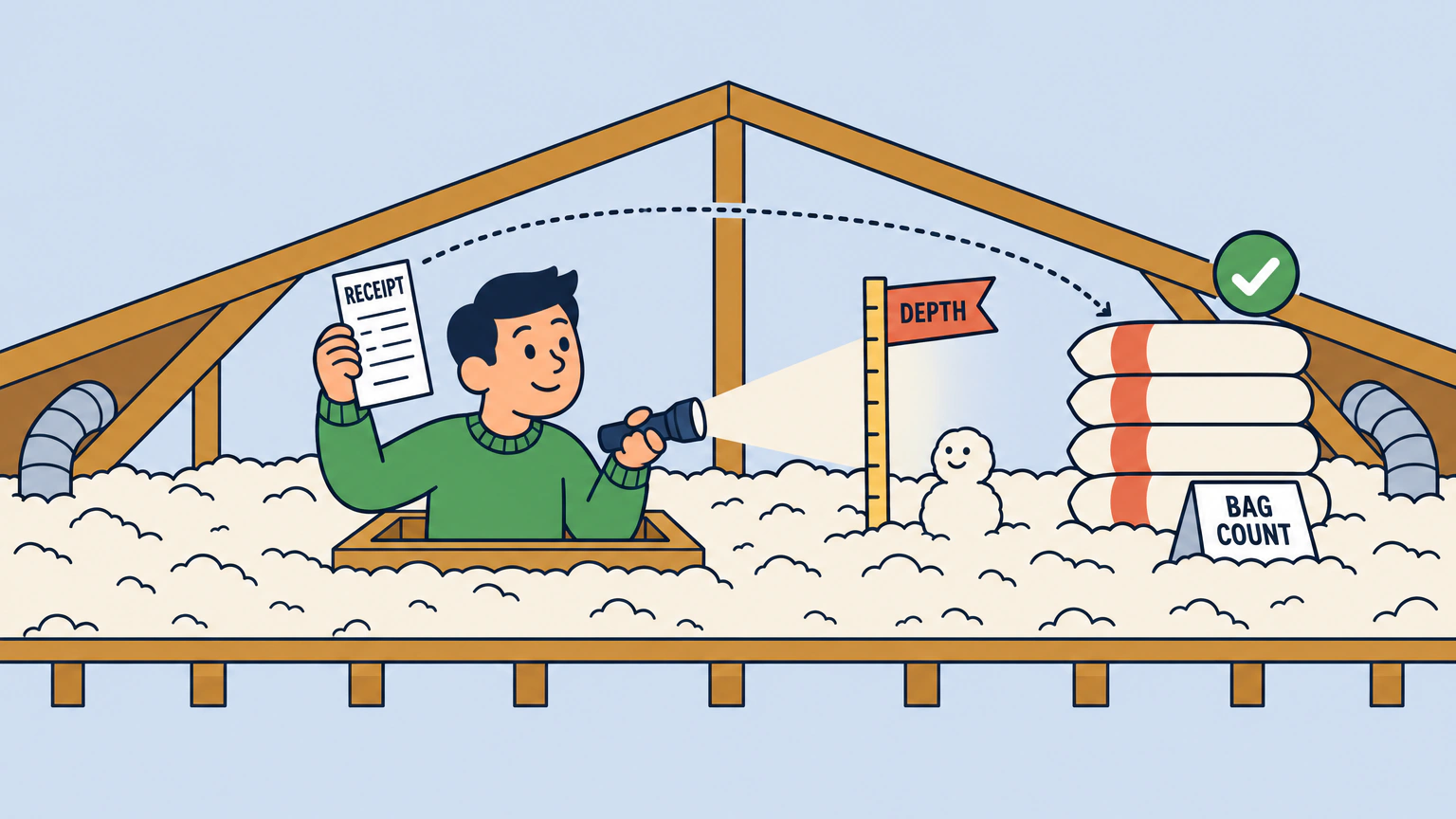
Most blown-in insulation jobs cost about $1,000 to $2,400, or roughly $1.00 to $2.80 per square foot installed, and the price climbs with the R-value you're adding. Before you pay, check the one thing the price guides skip. A federal rule requires your installer to hand you a signed, dated receipt showing the area covered, the installed and settled thickness, the R-value and the number of bags used, and that bag count should meet or exceed the minimum from the coverage chart printed on the bag.
On this page
- What blown-in insulation costs right now
- How much R-value your attic needs
- The receipt federal law says you get
- How to count the bags
- When the count comes up short
- What a fair quote covers besides the insulation
- Who helps pay now that the tax credit is gone
- Should you blow it in yourself?
- Questions people ask about blown-in insulation
What blown-in insulation costs right now
Two big price guides land in the same neighborhood for an attic, and the one source that doesn't is pricing a different job.
What most attic jobs come to
HomeAdvisor says most homeowners spend $987 to $2,335 on blown-in insulation, with an average of $1,661. HomeGuide prices blown-in on an attic floor at $900 to $3,600.
| Source | Typical range | What that range covers |
|---|---|---|
| HomeAdvisor | $987 to $2,335 | A blown-in job, average $1,661 |
| HomeGuide | $900 to $3,600 | Blown-in on an attic floor |
| Fixr | $3,000 to $7,000 | Walls and attic of a 2,000 sq ft house |
Fixr's number looks like an outlier until you read what it prices. Fixr says most people pay around $5,000 "to fill wall cavities and the attic with cellulose insulation in a 2,000 sq.ft. home with a 2-car garage." It's a fair number for that job and a useless one for yours.
The low end has a floor, too. HomeGuide notes that some companies have "a $1,500 to $2,000 minimum project requirement," which is why a small attic rarely costs half of what a big one does. The crew, the truck and the blower show up either way.
Why two big guides disagree on the price per square foot
HomeGuide puts blown-in insulation at $1.00 to $2.80 per square foot installed. Angi's page says $1.75 to $7.50. You'd guess the gap is wall work, and walls do cost more: HomeGuide prices exterior walls at $1,900 to $7,800. But Angi puts existing walls at the cheap end of its range and the attic at $3 to $7.50 a square foot.
Then Angi's figures stop agreeing with each other. Its average job is "about $1,657," yet its area table puts 1,000 square feet at $1,750 to $7,500. When a page can't square its own numbers, we go with the ones that match everybody's job totals. HomeGuide's do.
Run them on a typical attic. At $1.00 to $2.80, 1,200 square feet comes to $1,200 to $3,360. HomeGuide puts the labor at $0.70 to $1.70 a square foot of that, and a bag of fiberglass at $30 to $40.
How the R-value moves the price
The price follows the material. More R-value means more bags and more time on the hose, and HomeGuide's attic table shows the climb for every 1,000 square feet.
| R-value of the layer blown in | Installed price per 1,000 sq ft of attic |
|---|---|
| R-30 | $660 to $1,200 |
| R-38 | $840 to $1,500 |
| R-49 | $1,100 to $1,900 |
| R-60 | $1,400 to $2,400 |
One oddity. The bottom of HomeGuide's R-30 row works out to 66 cents a square foot, under its own $1.00 floor, so we'd read that low end as optimistic. The rest of the ladder is steady. Each step up adds $180 to $500 per 1,000 square feet.
That makes the R-value written on your quote the number that sets your price. It's worth knowing which one your attic needs.
How much R-value your attic needs
ENERGY STAR answers that by climate zone. Its numbers cover what to add, which is the part you're paying for.
The ENERGY STAR number for your climate zone
ENERGY STAR publishes what it calls "Recommended insulation levels for retrofitting existing wood-framed buildings," based on the 2021 International Energy Conservation Code. Find your zone on ENERGY STAR's climate map, then read across.
| Climate zone | If your attic is uninsulated | If you already have 3 to 4 inches |
|---|---|---|
| 1 | R30 | R25 |
| 2 and 3 | R49 | R38 |
| 4 through 8 | R60 | R49 |
ENERGY STAR heads those columns "Add Insulation to Attic," so the figures are what to put on top. A bare attic in zones 4 through 8 calls for R60. Zones 2 and 3 call for R49, and zone 1 for R30. Already have 3 or 4 inches up there? Each zone's figure drops a step, so R60 becomes R49.
They're recommendations for comfort and cost, not a legal minimum for topping up an attic you already own.
You pay for what gets added, not the total
Manufacturers print the arithmetic for you. Greenfiber's do-it-yourself guide says to take the R-value you want and subtract the R-value you have. Want R-38 with R-19 already down? You're buying R-19. Owens Corning's attic card even has separate lines for the existing, installed and total R-value.
The federal rule calls it a receipt "for the insulation you install," and that added layer is what the bags and the labor are priced on. A quote that names only the final total hides the number your price is built on. Ask for the added R-value in writing.
You don't have to clear out the old stuff first. ENERGY STAR says "you can add loose fill on top of fiberglass batts or blankets." And more isn't always better. The boxed notice on every fact sheet says so: "If you buy too much insulation, it will cost you more than what you'll save on fuel."
The receipt federal law says you get
The Federal Trade Commission's R-value Rule has covered home insulation since 1979, and it's written in plain "you must" language a homeowner can hold an installer to.
Five numbers, signed and dated
Every installer owes you a contract or receipt for the insulation they put in. For blown-in work, the FTC's rule spells out what goes on it: "For loose-fill, the receipt must show the coverage area, initial installed thickness, minimum settled thickness, R-value, and the number of bags used." The installer dates and signs it, and if they did more than one part of the house, each part gets its own figures.
The rule also covers manufacturers, distributors, retailers and anyone who sells new homes, so the bag, the fact sheet and the receipt all answer to it.
Here's what to find on yours:
- The coverage area, in square feet. The floor you're paying to cover, not the whole house.
- The initial installed thickness. The depth on the day the crew leaves.
- The minimum settled thickness. The depth the chart says it holds after settling.
- The R-value of what was installed. The layer they added.
- The number of bags used. Check it against the chart on the bag.
- The date and the installer's signature. An unsigned receipt proves very little.
The fact sheet comes before you sign
The receipt comes after the job. The fact sheet comes first: "Before customers agree to buy insulation from you, you must show them the fact sheet(s) for the type(s) of insulation they want."
That sheet repeats the coverage chart from the bag and carries a boxed notice headed "READ THIS BEFORE YOU BUY." For blown-in products, the chart covers six R-values from R-13 to R-49. For each it lists the minimum settled and initial installed thickness, the maximum coverage, the bags per 1,000 square feet and the minimum weight per square foot. Makers can add rows, which is how R-60 shows up.
An installer can show it to you as a printed copy or in a binder. Either way, ask for the fact sheet with the quote and photograph the chart. That picture is your yardstick for everything after.
What the rule won't do for you
Know its limits. The rule sets no prices and promises no savings. Breaking it can cost a company up to $53,088 each time, but that's a federal fine for the FTC to pursue, not a refund to you.
What it does is make three sales lines checkable. An ad that names a price has to give the type of insulation, the R-value at a stated thickness and the coverage area (a per-square-foot price can skip the area). A promise to cut your fuel bills has to carry the words "Savings vary." And a seller may not "say or imply that your product qualifies for a tax benefit unless it is true."
The rule also says the FTC's three-day cooling-off rule "stays in force," so if you signed at the kitchen table, read up on the three days you have to cancel.
Three sales lines worth stopping on. A flyer price with no R-value and no coverage area beside it. A promise to cut your heating bill by a set amount with no "Savings vary" anywhere in sight. Any mention of a 30 percent federal tax credit for work done in 2026. The FTC's insulation rule speaks to all three, and the third one is simply no longer true.
How to count the bags
Every coverage chart sets two minimums for each R-value, a bag count and a depth, and the job has to meet both of them.
Read the coverage chart, not just the depth
Each row gives a minimum number of bags per 1,000 square feet and a minimum thickness. Owens Corning's install card says why both matter: "Failure by the installer to provide both the required bags and at least the minimum thickness will result in lower insulation R-value." Greenfiber's card says the same in capital letters.
Depth alone can fool you. Blown with too much air, loose fill stands tall on day one while holding less material than the chart calls for. HomeGuide warns that too much airflow gives "an inaccurate R-value appearance due to overly fluffy insulation." The FTC's rule makes the point from the other side: "Do not multiply the R-value for one inch by the number of inches you installed." Depth is half the test. The bag count is the half you can't eyeball.
| R-value | Fiberglass example, bags per 1,000 sq ft | Fiberglass, minimum thickness | Cellulose example, bags per 1,000 sq ft | Cellulose, blown then settled |
|---|---|---|---|---|
| R-30 | 14.6 | 10.75 in | 38.6 | 8.9 in, then 8.3 in |
| R-38 | 19 | 13.5 in | 52.6 | 11.2 in, then 10.4 in |
| R-49 | 25 | 17 in | 70.8 | 14.3 in, then 13.3 in |
| R-60 | 31.5 | 20.5 in | 86.0 | 17.3 in, then 16.1 in |
Fiberglass: Owens Corning AttiCat, 27.5 lb bag. Cellulose: Greenfiber SANCTUARY, 25 lb bag. Your installer's product has its own chart, and that one is the one that counts.
Do the math for your attic
The check is one line of arithmetic. Take the attic's square footage, divide by 1,000, multiply by the chart's bags per 1,000 for the R-value you're adding, and round up to a whole bag.
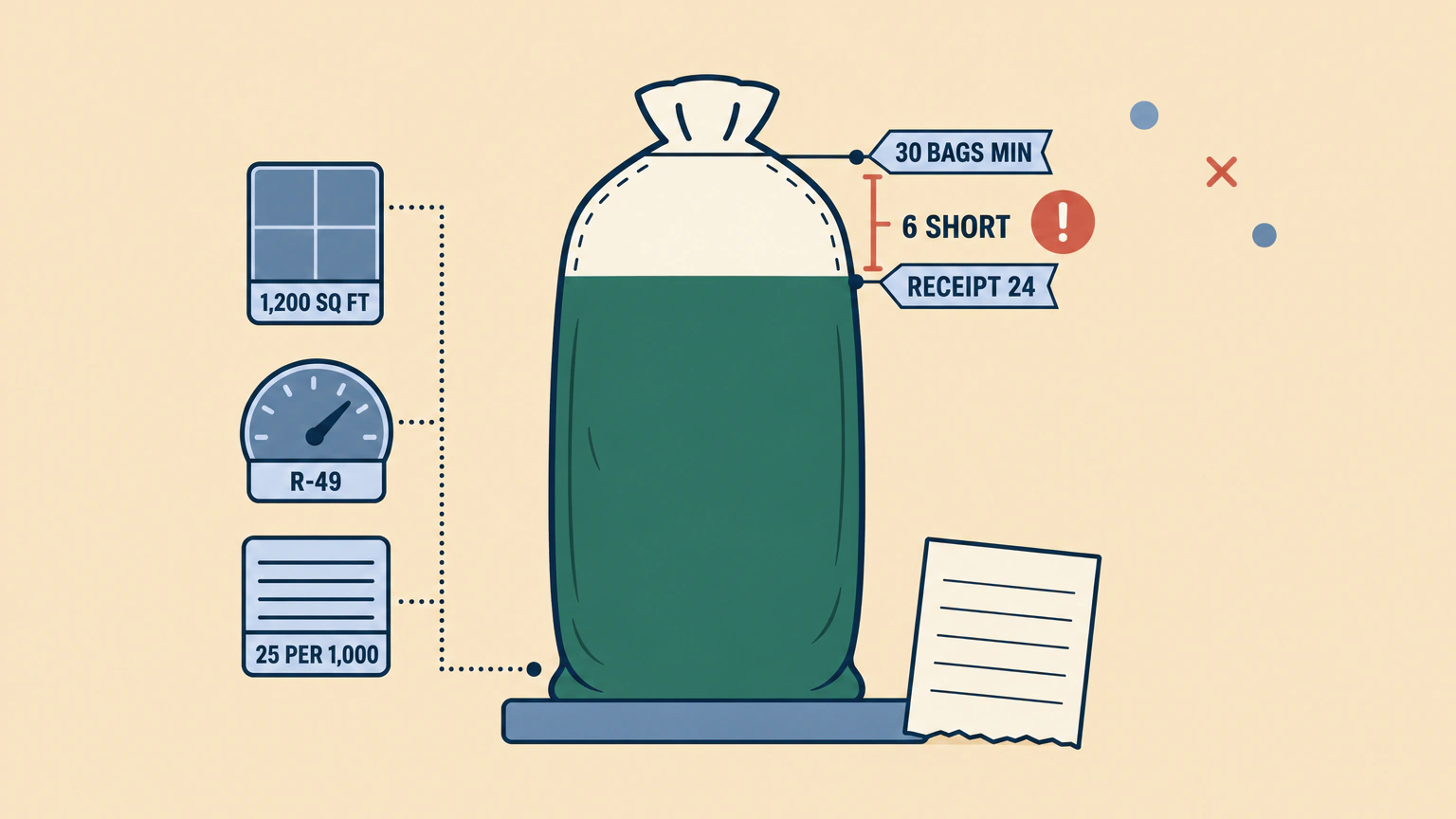
On the fiberglass chart at R-49, a 1,200 square foot attic works out to 1,200 × 25 ÷ 1,000 = 30 bags. A quote or receipt that shows 24 is six bags short. Use the R-value being added, not the total you'll end up with, or you'll be reading the wrong row. The charts count net attic area, so leave out any part that isn't being covered.
Plug in your own attic, and your product's figure if you have its fact sheet.
Bag Count Check
The chart on the bag sets a minimum number of bags for your attic. Here's yours.
For a 1,200 square foot attic at R-49, one fiberglass chart calls for at least 30 bags. A receipt showing 24 is 6 short. Multiply your own attic's square footage by the bags per 1,000 on your product's chart, divide by 1,000, and round up.
Length times width of the attic floor is close enough. Leave out any part that isn't being insulated.
The two examples are real manufacturer charts. Your installer's product has its own, and they have to show you its fact sheet before you agree to buy.
Use what the quote says they're adding, not the total you'll end up with. Going from R-19 to R-49 means adding R-30.
That's the example chart's figure, so it's locked. Pick "I have the fact sheet" to type your own.
Find the row for your R-value on the bag or the fact sheet, and copy the bags per 1,000 square feet figure.
Leave it blank if nobody's given you a number yet. That blank is worth asking about.
At least 30 bags
1,200 sq ft at 25.0 bags per 1,000, rounded up to a whole bag. That's the fiberglass example chart at R-49.
The same chart row calls for at least 17 inches of depth.
Your paperwork shows 24. That's 6 bags short of what the chart calls for. Ask which chart they used, and ask before the truck leaves.
Example charts: Owens Corning AttiCat data sheet and Greenfiber SANCTUARY attic card. Bag counts are for net attic area. Your product's own chart is the one that counts.
Why a cellulose job takes far more bags
Same attic, same R-49, cellulose chart: 70.8 bags per 1,000 square feet, or 85 bags for 1,200 square feet. That's nearly three times the fiberglass count, and neither number is padding.
The bags hold different stuff. A fiberglass bag on the example chart weighs 27.5 pounds and a cellulose bag 25, but cellulose packs far denser. At R-49 its chart calls for more than two and a half times the weight per square foot. It also reaches R-49 in a thinner layer, going in at 14.3 inches and settling to a minimum of 13.3, where the fiberglass chart asks for 17 inches and calls settling "negligible."
That's where readers get tripped up. The bag tables on the big cost guides track a fiberglass chart: HomeGuide's R-49 row says 24 to 26 bags, and HomeAdvisor's assumes a 28 1/2 pound bag. Hold a cellulose quote up to those and 85 looks like padding. Check the product name before you check the count.
When the count comes up short
A short count on paper isn't proof of a short job, so look first and ask second.
Look in the attic before you pay the balance
A careful installer leaves evidence behind: depth rulers fixed to the framing and a signed card near the hatch. Owens Corning prints one, with lines for the attic area, the R-value, the thickness and a signature.
Where the energy code governs the work, it asks for this outright. The model code, in the version Texas adopted, wants depth markers at "not less than one for every 300 square feet," each facing the attic opening. It also wants a signed, dated certificate posted on the job, listing the installed and settled thickness, the settled R-value, the coverage area and the number of bags. Whether that reaches a simple top-up depends on your local code, so ask for rulers either way.
Then take a flashlight to the hatch and sweep the far corners and the eaves, where nobody crawls and thin spots hide. A storage platform laid flat on the joists can hide one too.
Count the empties. Ask the crew to stack the empty bags by the driveway until you've counted them, or photograph the pallet before they start. It takes a minute, nobody honest minds, and it's the same number that has to appear on your receipt.
Who to tell if the installer won't fix it
Go in this order. First, show the installer the chart and the receipt and ask for the missing bags. Second, hold the final payment if your contract ties it to completion, which only works with a payment schedule that holds something back. Third, if you can't agree on what's up there, get an independent depth reading from a home inspector, someone with nothing to sell you.
An installer who won't give you a receipt at all is breaking the rule. Report it to the FTC at ReportFraud.ftc.gov and to your state attorney general's consumer office.
Keep the receipt, the fact sheet and your photos together. For a second opinion or a redo, you can find insulation contractors near you on our lists, where no business can pay its way in.
What a fair quote covers besides the insulation
Two honest quotes for the same attic can sit far apart, because one includes the work that goes under the insulation and the other doesn't.
Air sealing comes first
ENERGY STAR is blunt about the order: "EPA recommends air sealing the attic before adding attic insulation." The price is less settled. Angi puts sealing at $300 to $1,500 and HomeGuide at $350 to $3,000, noting that some contractors fold it into the estimate.
Timing matters more than price. Once a foot of loose fill is down, the leaks under it are much harder to reach, and old batts hide gaps a crew has to lift them to seal. A quote that skips sealing is cheaper for a reason.
Before you sign, the quote should say:
- The product name, and whether it's fiberglass or cellulose
- The R-value being added, not only the total you'll end up with
- The square footage being covered
- The bag count the product's chart calls for at that R-value
- Whether air sealing is included, and which leaks
- Baffles at the eaves and an insulated hatch
- What happens to the price if they find vermiculite, old wiring or wet insulation
If two quotes are still far apart after that, here's how to line up two quotes that don't match.
Baffles, the hatch and the lights
Three small details separate a careful job from a fast one. First, the vents. ENERGY STAR says never to lay insulation over soffit vents. A good crew blows it all the way out to the top of the outside wall, with baffles at the eaves to keep an air path open above it.
Second, the lights. Insulation stays "at least 3 inches away from recessed 'can' lights, unless they are rated IC," meaning rated for insulation contact.
Third, the hatch. ENERGY STAR lists it among the usual attic air leaks, and the model energy code wants attic access doors "weatherstripped and insulated to a level equivalent to the insulation on the surrounding surfaces." A bare lid in a foot of fluff is a hole in the blanket you just paid for.
Three things that stop the job
Vermiculite comes first. It's a pebble-like, pour-in fill, usually gray-brown or silver-gold. A mine near Libby, Montana, supplied over 70 percent of the vermiculite sold in the United States from 1919 to 1990, and that mine's vermiculite was contaminated with asbestos. EPA's advice leaves no room: "YOU SHOULD ASSUME THE VERMICULITE CONTAINS ASBESTOS AND DO NOT DISTURB IT!" Nobody should blow new insulation over it or drag a hose across it. If it has to come out, that's work for a trained professional.
Knob-and-tube wiring, found in houses from before about 1930, is the second. ENERGY STAR flags it as a fire hazard in contact with insulation, so an electrician needs to see it before any insulation goes down, along with any recessed lights that aren't rated IC.
The third is water. Wet or moldy insulation, rotted joists, or a bath or dryer vent dumping moist air into the attic all mean a moisture problem. ENERGY STAR treats wet insulation as a sign of a leaky roof, so get a roofer or the right trade to fix the cause first. If the old insulation has to come out, HomeGuide puts removal and disposal at $1 to $2 a square foot.
Who helps pay now that the tax credit is gone
The federal money that used to soften an insulation bill is gone for 2026 work, but a few programs still pay, and they're worth a call before the crew is booked.
The 30 percent credit ended with 2025
The IRS puts it plainly: "You can claim the credit for improvements made through December 31, 2025." The Energy Efficient Home Improvement Credit paid 30 percent, under a $1,200 yearly cap that covered insulation, and it never counted the labor.
A job done in 2026 earns no federal credit, and the FTC's rule bars a seller from implying it does. Work finished in 2025 goes on your 2025 return. We've written up what ended and what still pays in more detail.
Rebates and weatherization help that still exist
The Department of Energy's Home Energy Rebates come as two programs. HOMES pays up to $8,000 for whole-home upgrades that reach at least 20 percent modeled energy savings, and states may raise that for lower-income households. HEEHR pays up to $14,000 and can cover insulation, air sealing and ventilation. The catch is where you live. DOE says the rebates "are now available in select states," and your state energy office knows whether yours is one.
If money is tight, look at the Weatherization Assistance Program. DOE opens it to households at or below 200 percent of the poverty income guidelines or on Supplemental Security Income, renters included. It starts with an energy audit, blower-door test and all, and eligible homes join a waitlist. Those crews insulate old houses all day and tend to know the moisture and air-sealing details a new-construction crew skips.
Last, your utility. ENERGY STAR says many local utilities offer rebates on air sealing and insulation, so call yours before you start.
Should you blow it in yourself?
You can, and the savings are real. HomeGuide puts do-it-yourself blown-in at $0.35 to $1.50 a square foot, or $500 to $1,200 on average. The blower rents for $100 to $200 a day, and some stores lend it free when you buy 10 to 20 or more bags. It's a two-person job, one feeding the machine and one on the hose. ENERGY STAR rates attic insulation a moderately difficult project and says that with loose fill "it may be wise to hire a professional."
The trade-off is paperwork. You get the bag label and the fact sheet, which stores have to make available, but nobody writes you an installer's receipt, and the air sealing is yours.
For everyone else, the next move is two quotes that each state the R-value being added and the bag count. You can start with insulation contractors near you.
Questions people ask about blown-in insulation
How much does blown-in insulation cost per square foot?
HomeGuide puts it at $1.00 to $2.80 per square foot installed, and labor is $0.70 to $1.70 of that. Angi prints a higher $1.75 to $7.50, but its own average job of about $1,657 doesn't fit that range, so we'd lean on HomeGuide. At HomeGuide's rates, a 1,200 square foot attic comes to $1,200 to $3,360 before extras like air sealing.
How many bags of blown-in insulation do I need?
Divide the attic's square footage by 1,000, multiply by the bags per 1,000 on your product's coverage chart for the R-value being added, and round up. On the example charts from Owens Corning and Greenfiber, R-49 over 1,200 square feet takes 30 bags of fiberglass or 85 of cellulose. Your product's own chart is the one that counts.
Does blown-in insulation settle?
Cellulose does, and its chart tells you by how much. On the Greenfiber example, R-49 goes in at 14.3 inches and settles to a minimum of 13.3. Owens Corning calls settling on its fiberglass "negligible." The FTC's test rules make cellulose R-values reflect settled material, and your receipt has to list the minimum settled thickness.
Can you blow insulation over old insulation?
Yes. ENERGY STAR says loose fill can go on top of existing batts or blankets, and the new layer doesn't have to match the old type. There are two exceptions: never over vermiculite, and never over wet or moldy material. Seal the attic's air leaks first, because once the new layer is down they're much harder to reach.
Is cellulose or fiberglass better for an attic?
Neither one wins outright. Cellulose reaches a given R-value in a thinner layer and takes far more bags, while fiberglass weighs much less per square foot. HomeGuide's installed prices overlap, at $1.00 to $2.80 for fiberglass against $1.20 to $2.80 for cellulose. We'd pick the quote that states the R-value, the bag count and the air sealing, whichever material it uses.
Is there a tax credit for insulation in 2026?
No federal one. The IRS says the Energy Efficient Home Improvement Credit covers improvements made through December 31, 2025, so 2026 work doesn't qualify. Home Energy Rebates are live in select states, and some utilities pay rebates on insulation and air sealing. ENERGY STAR's advice is to call your utility before the job starts.
Does blown-in insulation have asbestos?
The one to watch for is vermiculite, an older pebble-like fill that's usually gray-brown or silver-gold. EPA says to assume vermiculite contains asbestos and not to disturb it. The fiberglass and cellulose that crews blow in today are glass fiber and recycled paper. If you spot vermiculite, stop the job and call a trained professional before anyone blows anything in.